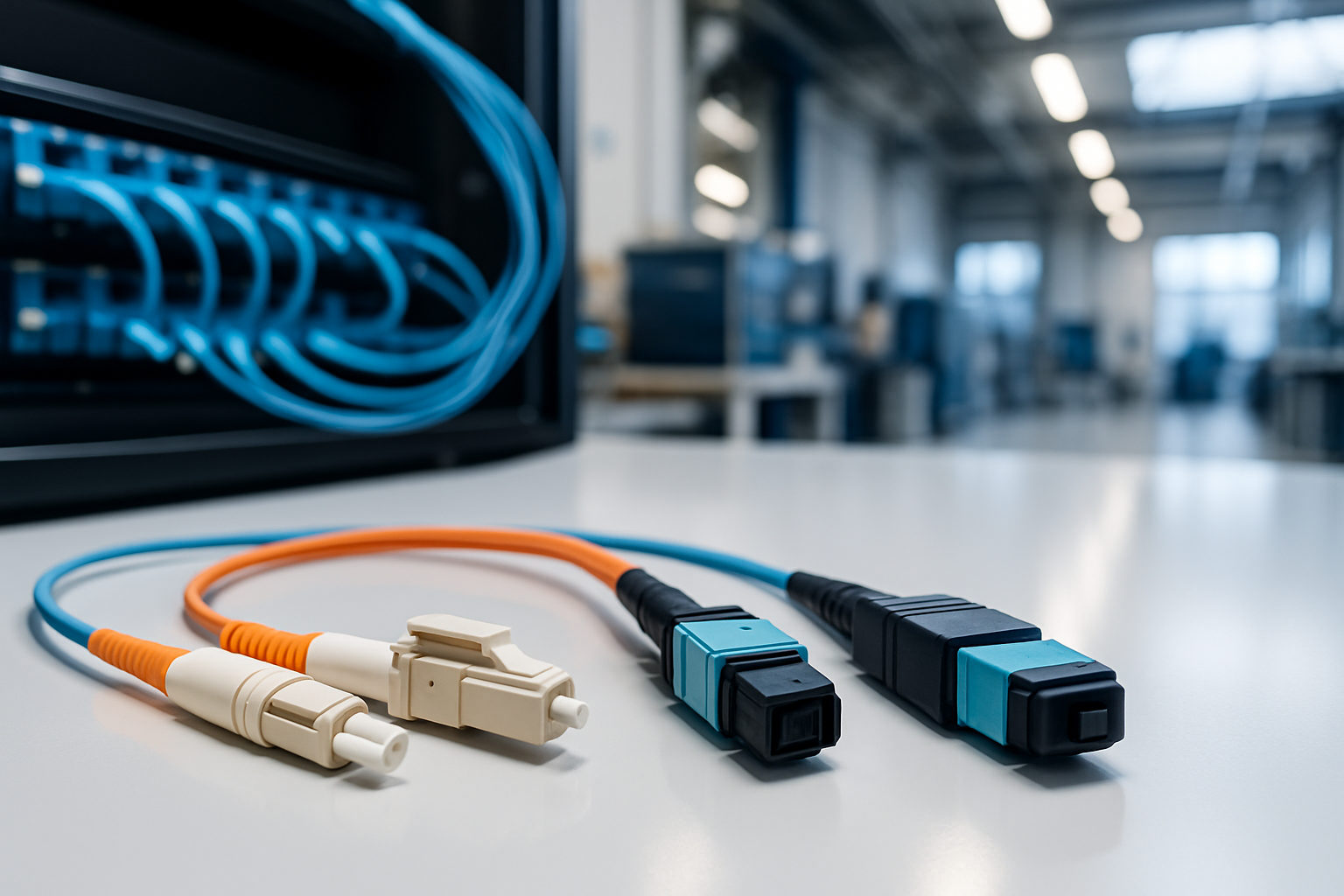
Fibre Optic Patch Cables LC SC MPO: The Right Cable for Every Application
Fibre Optic Patch Cables LC SC MPO: Technical Selection for Professional Network Connections
Fibre optic patch cables, LC SC cables, MPO trunk cables and connection cables form the backbone of modern fibre optic networks – the correct selection determines the performance, port density and future-proofing of your entire network infrastructure. When choosing between LC duplex with 1.25mm ferrule, SC simplex with 2.5mm ferrule and MPO/MTP with up to 144 fibres, technical parameters such as insertion loss, return loss and operating environment must be evaluated precisely.
In the German B2B market, three main applications dominate: FTTH networks with LC connectors for high port density, industrial environments with robust SC connections, and data centres with MPO trunk cables 40/100G links. Compliance with standards IEC 61754-7 for MPO and IEC 61754-20 for LC/SC is a fundamental requirement for professional installations.
Technical Fundamentals: LC SC MPO Connectors in Direct Comparison
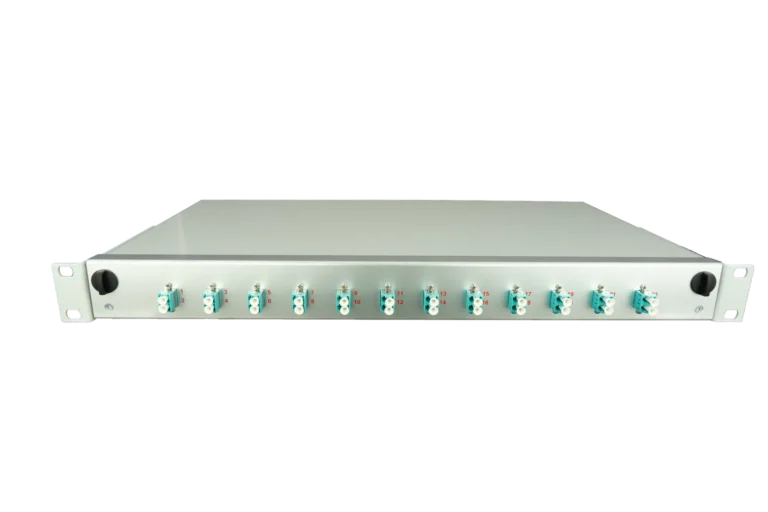
Selecting the right fibre optic patch cable begins with understanding the technical differences. LC connectors use a 1.25mm ceramic ferrule and enable double the port density compared to SC connections through their compact design. With typical insertion loss of < 0.3 dB for singlemode and < 0.5 dB for multimode, they are ideal for high-density distribution frames.
| Connector Type | Ferrule Diameter | Insertion Loss (SM) | Return Loss | Port Density |
|---|---|---|---|---|
| LC | 1.25 mm | < 0.3 dB | UPC: -50 dB / APC: -60 dB | High (48 ports/1RU) |
| SC | 2.5 mm | < 0.3 dB | UPC: -50 dB / APC: -60 dB | Medium (24 ports/1RU) |
| MPO/MTP | Multifibre | < 0.35 dB | -60 dB (APC-8°) | Very high (up to 144 fibres) |
SC connectors with their 2.5mm ferrule offer robust push-pull locking and proven reliability in industrial environments. The larger form factor simplifies handling during installations in harsh conditions where gloves are required.
MPO Trunk Cables: High-Performance Solution for Data Centres and Backbone Links
MPO connection cables revolutionise cabling density in modern data centres. A single MPO connector can combine 12, 24 or even 72 fibres in a compact form factor. This technology reduces installation time compared to individual fibre connections.
- Pre-terminated MPO-to-LC breakout cables for rapid deployment
- Polarity methods A, B and C per TIA-568 for error-free connections
- Support for 40GBASE-SR4 and 100GBASE-SR10 applications
- Reduced cable routing through bundled fibre management
- Factory termination guarantees consistent quality
Polarity management in MPO cables requires careful attention. Method A uses straight-through connections, while Method B uses crossed cables. For modern data centre applications, Method B has become the standard because it provides the most flexible handling with parallel optics transceivers.
LC SC Cables for FTTH and Municipal Utilities: Application-Specific Selection
In German FTTH rollouts, LC connections dominate due to their high packing density. Municipal utilities deploying community fibre networks rely on LC-APC connectors with green identification, which achieve -60 dB return loss through their 8° angled polished ferrule.
This high return loss is essential for PON networks (Passive Optical Networks), where reflections would degrade signal quality. SC connectors are used in industrial environments and legacy networks where robustness and simple handling take priority.
Fiber Products Quality Promise: As an official Diamond Partner and manufacturer, we produce modular splice systems in Europe. Benefit from Swiss precision and in-house manufacturing.
Fibre Types and Transmission Distances: OM3, OM4, OM5 and Singlemode
The choice of the right fibre optic patch cable depends largely on the fibre type used. Multimode fibres in the OM3 and OM4 categories support 10 Gigabit Ethernet over distances of 300 to 550 metres. The latest generation OM5 extends the spectrum for wavelength multiplexing techniques.
| Fibre Type | Core Diameter | 10 GbE Range | 40/100 GbE Range | Typical Application |
|---|---|---|---|---|
| OM3 | 50 µm | 300 m | 100 m | Data Centre |
| OM4 | 50 µm | 550 m | 150 m | Campus Backbone |
| OM5 | 50 µm | 550 m | 150 m (400G: 100m) | Future-Proof DC |
| OS2 (9/125) | 9 µm | 10 km | 40 km | FTTH/Long-haul |
Singlemode fibres of type G.652.D or G.657.A2 enable transmission over several kilometres and form the backbone for FTTH networks and long-distance links.
Quality Criteria for Professional Connection Cables
Professional LC SC cables and MPO trunk systems must meet strict quality standards. Insertion loss in high-quality cables should be below 0.25 dB, while ultra-low-loss variants achieve values as low as 0.12 dB.
- End-face quality per IEC 61300-3-35 with automated inspection
- Strain relief per IEC 61753-1 with minimum 100 N tensile strength
- Temperature cycling from -40°C to +85°C for outdoor applications
- LSZH sheathing (Low Smoke Zero Halogen) for building installations
- Bend-radius protection through reinforced strain relief boots
- Colour coding per TIA-598-C for unique fibre identification
Mating cycle durability is another important criterion. High-quality LC and SC connectors withstand at least 500 mating cycles without degradation of optical parameters. MPO connectors typically achieve 200 to 250 cycles due to their more complex mechanics.
Cable Constructions for Various Environments
The construction of fibre optic patch cables must be adapted to the operating environment. For indoor installations, tight-buffer cables with 900µm buffer coating are suitable, providing direct fibre protection and simple termination.
In harsh industrial environments, reinforced cables with aramid yarn strain relief and PUR outer jacket are used. These cables resist mechanical stress, oils and chemicals. Protection class IP65 ensures dust-tightness and protection against water jets.
In data centres, uniboot LC cables have become established, guiding both fibres in a single cable jacket. This configuration reduces cable volume and improves air circulation in densely-packed cable trays.
Installation and Handling: Best Practices for LC SC MPO Cabling
Proper installation of connection cables determines long-term network stability. Before installation, all connector end-faces must be inspected with a fibre microscope per IEC 61300-3-35. Contamination is the most common cause of elevated loss.
- Cleaning with specialised fibre wipes and isopropyl alcohol (99%)
- Use of dust caps on unused ports
- Maintaining minimum bend radius (20× cable diameter)
- Documentation of all connections in cable management system
- Measurement with OTDR or light source/power meter after installation
Correct polarity is critical in MPO installations. An MPO polarity checker verifies the Pin-1 position and ensures that transmit and receive fibres are correctly assigned. Modern splice modules offer integrated polarity switching for maximum flexibility.
Measurement Technology and Quality Assurance for Fibre Connections
Quality control of LC SC cables and MPO trunk systems requires precise measurement equipment. Loss measurement follows IEC 61280-4-1 using calibrated light sources and power metres. For singlemode connections, measurement at 1310 nm and 1550 nm is standard.
OTDR measurements (Optical Time Domain Reflectometry) visualise the entire route and identify fault sources such as poor splices or macro-bends. The backscatter curve shows attenuation and reflections along the fibre with metre-scale spatial resolution.
Future-Proof Cabling Strategies with Modular Systems
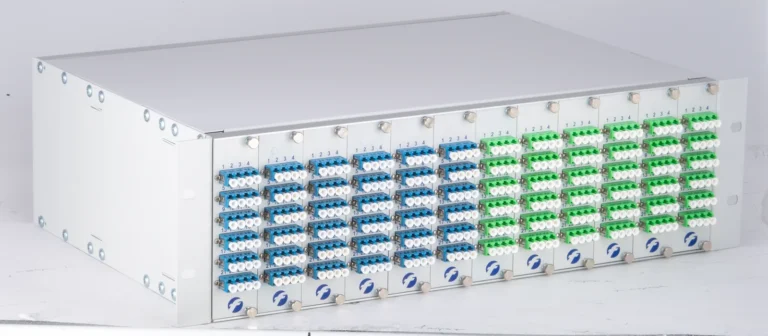
Investment in high-quality fibre optic patch cables pays off through future-proofing. Modular systems such as SlimConnect enable up to 96 fibres in one rack unit and offer double the packing density compared to conventional solutions.
Migration from 10G to 40G/100G with MPO pre-cabled systems is accomplished by simply swapping transceivers and breakout modules. This flexibility reduces operating costs and minimises downtime during network upgrades.
- VarioConnect systems scale to up to 288 fibres in 3RU
- Tool-free module exchange enables reconfiguration during operation
- Colour-coded cassettes simplify troubleshooting and maintenance
- 5-year manufacturer warranty on modular systems made in Europe
- Integration of E2000 connectors for highest precision requirements
Standards Compliance and Certifications in the German Market
The DACH region enforces strict requirements for fibre optic components. CE marking confirms compliance with European directives. Many tenders also require evidence of ISO 9001 for quality management and ISO 14001 for environmental management.
The German Federal Network Agency requires compliance with the DigiNetzG Ordinance for public networks. Connection cables must be installable without feedback and must not interfere with existing services. Documentation per DIN EN 50174 is mandatory for professional installations.
Economic Analysis: TCO Assessment for LC SC MPO Systems
Total Cost of Ownership for fibre optic patch cables extends beyond the initial purchase price. High-quality cables with guaranteed loss below 0.25 dB enable longer transmission distances and reduce the number of amplifiers required.
| Cost Item | Standard Quality | Premium Quality | Savings |
|---|---|---|---|
| Procurement (100 cables) | €3,000 | €4,500 | -€1,500 |
| Failure Rate (5 years) | 8% | 1% | +€2,100 |
| Maintenance Costs | €2,000/year | €500/year | +€7,500 |
| TCO (5 years) | €15,000 | €7,000 | +€8,100 |
Investment in premium connection cables typically pays for itself within 18 to 24 months through reduced downtime and lower maintenance costs.
Specialised Applications: E2000 and Precision Connectors
Beyond standard LC, SC and MPO connectors, specialised solutions exist for demanding requirements. The E2000 connector with integrated protective shutter offers maximum safety against laser radiation and contamination. With guaranteed return loss of -65 dB in APC configuration, it is ideal for test and measurement applications.
As an official Diamond Partner, Fiber Products offers the complete E2000 portfolio with Swiss precision quality. Integration into modular splice boxes enables flexible configurations for broadcast and telecommunications applications.
FAQ: Common Technical Questions on Fibre Optic Patch Cables
What loss values are acceptable for LC SC cables?
High-quality LC and SC connection cables should exhibit insertion loss of no more than 0.3 dB for singlemode and 0.5 dB for multimode. Ultra-low-loss variants achieve below 0.15 dB. Return loss should be at least -50 dB for UPC connectors and -60 dB for APC connectors.
How many fibres do I need for 100 Gigabit Ethernet?
For 100GBASE-SR4, 8 fibres (4 transmit, 4 receive) are required, typically implemented via a 12-fibre MPO connector. Alternatively, 100GBASE-SR10 uses 20 fibres (10 per direction). With singlemode and CWDM technology, 2-fibre solutions for 100G are also possible.
Which polarity method should I choose for MPO cabling?
For modern data centres, Method B per TIA-568 is recommended because it offers the greatest flexibility. It uses key-up to key-down connections with transposed fibre pairs. This allows the use of identical patch cables at both ends of the connection.
Can I mix singlemode and multimode components?
No, singlemode (9/125 µm) and multimode (50/125 or 62.5/125 µm) are incompatible. Attempting to connect them results in severe loss due to core diameter mismatch. Always verify fibre type before installation.
Request a Quote
Have questions about our fibre optic solutions? Our expert team is happy to advise you – free and without obligation.