Modular splice modules: flexibility for Industry 4.0
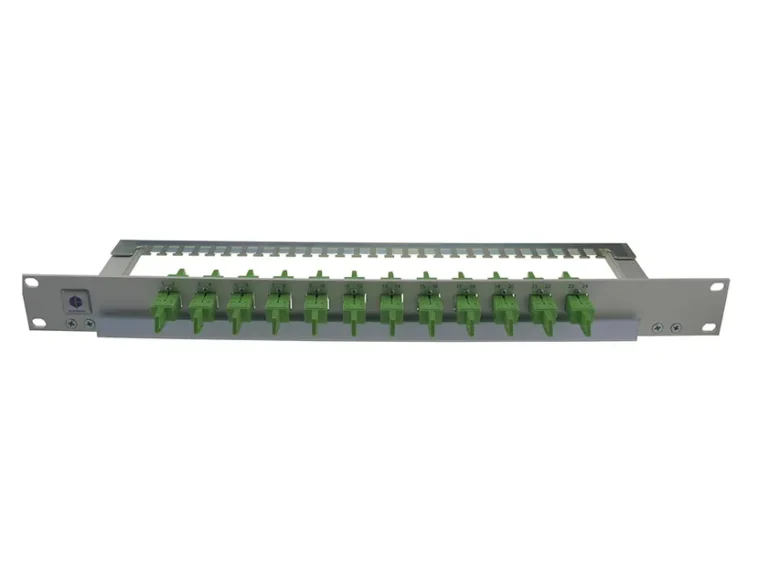
Industry 4.0 splice modules, modular fibre optic and OEM solutions form the backbone of modern manufacturing infrastructures that rely on real-time communication and decentralised intelligence. The requirements for fibre optic cabling in networked production environments differ fundamentally from conventional office installations – while standard systems operate with rigid configurations, modular splice systems such as SlimConnect 1U with up to 96 fibres or VarioConnect 3U with up to 288 fibres enable flexible, demand-driven scaling.
Industrial equipment manufacturers face the challenge of integrating heterogeneous automation components, sensor networks and control systems into a unified communication infrastructure. The solution lies in standardised, modular fibre optic systems that function both in DIN rail environments and in central distribution points whilst guaranteeing latencies below 1 millisecond and complete EMC immunity.
Technical requirements for networked production environments
The digital transformation of German industry places the highest demands on network infrastructure. Unlike office environments where occasional latency spikes are tolerable, real-time control systems require deterministic data transmission with guaranteed response times. Modern production facilities operate with cycle times in the millisecond range – any delay in data transmission can lead to production downtime.
- Latency requirements: < 1 ms for critical control processes
- Availability: 99.999% (maximum 5 minutes downtime per year)
- Bandwidth: 10 Gbit/s to 100 Gbit/s for backbone connections
- EMC immunity: Complete resistance to electromagnetic interference
- Temperature ranges: -40°C to +85°C for industrial environments
Industry 4.0 splice modules must not only meet these requirements but also enable integration into existing automation environments. This means compatibility with common industrial standards such as PROFINET, EtherCAT and OPC UA.
Modular fibre optic architectures for flexible production concepts
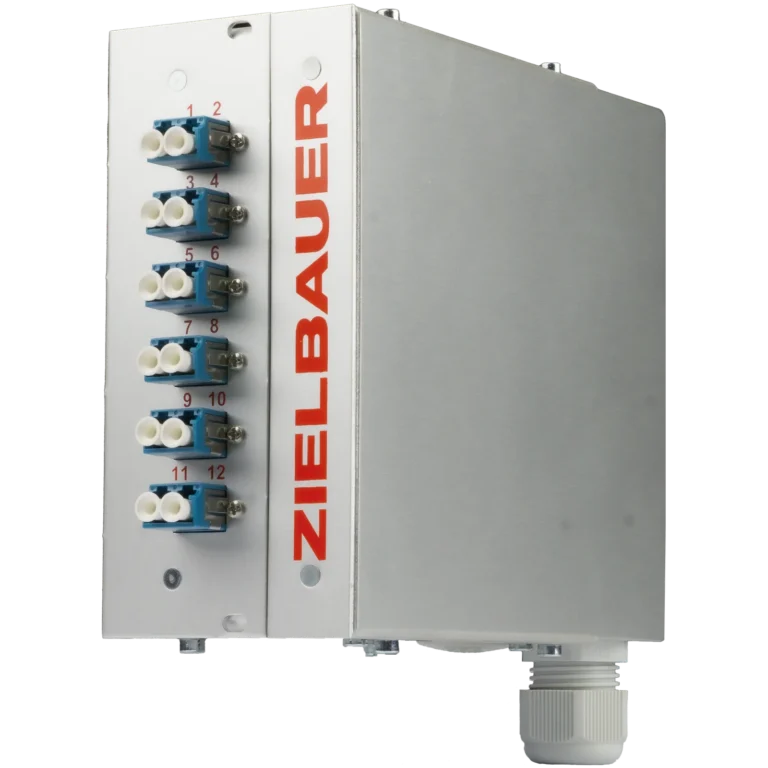
The modular fibre optic architecture is based on the European 7TE standard (35 mm width), which defines a uniform form factor for different capacity requirements. This standardisation allows industrial equipment manufacturers to work with a unified modular system that can be flexibly adapted to changing production requirements.
| System type | Height units | Max. fibre count | Port density per U | Typical application |
|---|---|---|---|---|
| SlimConnect | 1U | 96 fibres | 96 ports | Decentralised distribution points |
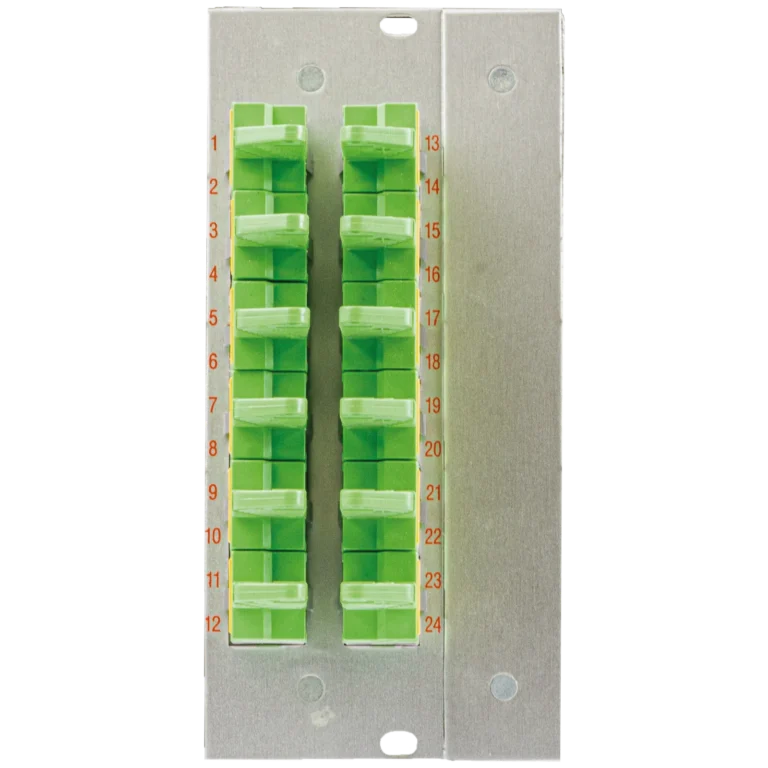
| VarioConnect | 3U | 216 fibres | 72 ports | Area distribution |
| VarioConnect | 3U | 288 fibres | 72 ports | Central main distribution |
| RailConnect | DIN rail | 48 fibres | – | Control enclosures |
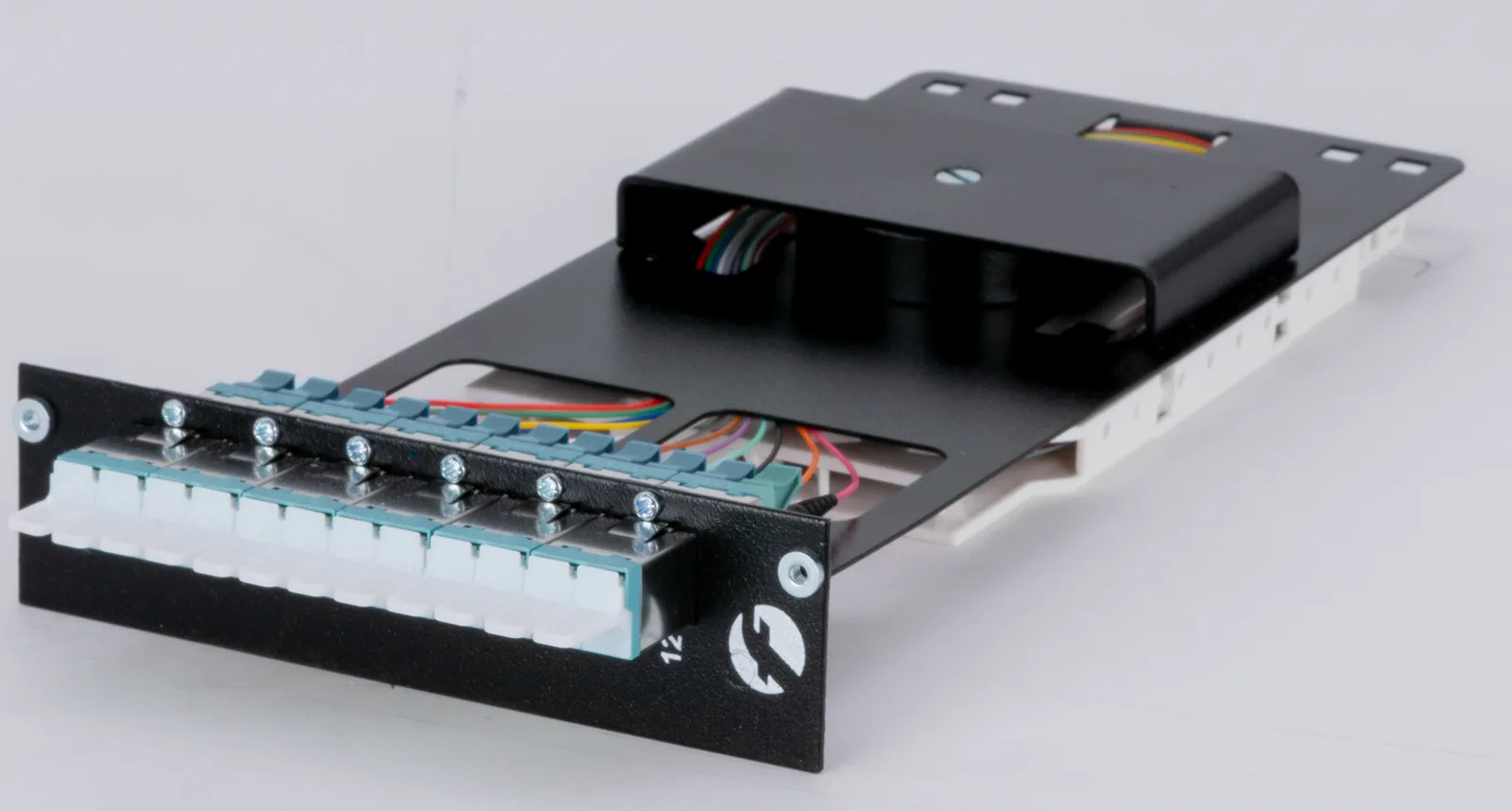
A key advantage of modular systems lies in factory pre-configuration. OEM solutions are delivered ex-works with the desired connector configuration – whether LC, SC, E2000 or MPO/MTP. This reduces on-site installation time and simultaneously minimises assembly errors.
Integration into existing automation environments
Integrating Industry 4.0 splice modules into existing automation environments requires a well-planned migration strategy. Many production facilities still operate with copper-based fieldbus systems that must be gradually replaced with fibre optic solutions.
The transition typically occurs in three phases: first, critical backbone connections are switched to fibre optic, then connections between production areas, and finally individual machine and sensor connections. Modular fibre optic systems support this migration through their flexible expandability – beginning with a small number of fibres, capacity can be expanded as needed.
Fiber Products Quality Promise: As an official Diamond partner and manufacturer, we produce modular splice systems in Europe. Benefit from Swiss precision and in-house manufacturing.
The use of E2000 connectors to IEC 61754-15 ensures the highest reliability. With a return loss of > 65 dB and insertion loss of < 0.25 dB, these connectors meet even the most demanding industrial requirements.
DIN rail solutions for decentralised automation
In modern production facilities, control components are increasingly found not just in central control rooms but decentralised in enclosures directly at the machines. DIN rail-mounted fibre optic modules enable the integration of high-speed data connections directly alongside PLC controls and frequency inverters.
- Compact design: 6 TE to 12 TE width
- Protection rating: IP20 for enclosure mounting
- Temperature range: -20°C to +70°C
- Fibre capacity: 12 to 48 fibres per module
- Connector types: LC, SC, E2000 in APC and PC versions
The DIN rail enclosures from Fiber Products offer a particularly robust solution for industrial environments. Through complete encapsulation of splice points, they are insensitive to vibration and temperature fluctuations.
OEM solutions for machinery manufacturers
Machinery manufacturers are increasingly integrating fibre optic technology directly into their equipment. OEM solutions enable perfect adaptation to the specific requirements of each machine. The modular fibre optic architecture supports this approach through standardised interfaces and flexible configuration options.
A practical example: A printing machine manufacturer requires 24 optical fibres per machine for connecting high-speed quality control cameras. Through pre-configured modules with E2000 connectors, fibre cabling can be installed and tested at the factory. At the customer site, only the connection to the customer’s network needs to be made.
| Industry | Typical requirement | Recommended solution | Connector type |
|---|---|---|---|
| Machinery manufacturing | 24–48 fibres | VarioConnect 1U | E2000 APC |
| Robotics | 12–24 fibres | RailConnect | LC Duplex |
| Process automation | 48–96 fibres | SlimConnect 1U | SC APC |
| Logistics | 96–288 fibres | VarioConnect 3U | MPO/MTP |
Standards compliance and certifications for Industry 4.0
Industry 4.0 splice modules must comply with numerous standards and regulations. The most important international standards are ISO/IEC 11801 for structured cabling and the IEC 61754 series for fibre optic connectors. Additionally, industry-specific requirements apply.
For the German market, compliance with VDE guidelines is particularly relevant. The VDE 0888 series defines requirements for optical fibre cables and their installation. Modular fibre optic systems must also meet the requirements of the Machinery Directive 2006/42/EC when integrated as components in machinery.
- CE marking according to European directives
- RoHS compliance for environmentally responsible production
- UL certification for North American export
- ATEX approval for explosive atmospheres
- Railway approval EN 50155 for railway vehicles
Economic considerations for modular systems
Investment in modular fibre optic infrastructure typically pays for itself within 24 to 36 months. Cost savings result from several factors: reduced installation time, lower maintenance costs and the ability to expand capacity as needed without complete replacement.
A concrete example: a production facility with 10 decentralised distribution points requires a total of 480 fibre optic connections. With conventional systems, 10 separate 48-port distributors would be installed. With modular systems, demand-adjusted units of 24 to 96 ports can be used instead. Material savings are achieved, installation time savings are achieved.
The modular splice systems from Fiber Products additionally offer the advantage of a 5-year warranty – unique in the industry. This reduces investment risk and significantly lowers total cost of ownership.
Future-proofing through scalability
Data rates in production environments double approximately every two years. While 10 Gbit/s is sufficient for most applications today, 25 Gbit/s will become standard in the medium term and 100 Gbit/s long-term. Modular fibre optic systems are prepared for this development.
Through the use of OM5 multimode fibres or OS2 singlemode fibres, the physical prerequisites for future transmission rates are already in place. The modular architecture also enables gradual component replacement – for example, LC modules can be replaced with MPO modules for higher port densities without renewing the entire installation.
Practical implementation in the smart factory
Implementation of Industry 4.0 splice modules follows an ideal structured project workflow. First, an inventory of existing infrastructure is conducted and future bandwidth requirements determined. Based on this, the modular fibre optic solution is dimensioned.
- Needs analysis: recording all data points and bandwidth requirements
- Network design: creating a hierarchical topology
- Component selection: defining modules and connector types
- Installation: mounting and commissioning by certified technicians
- Documentation: comprehensive recording of all connections
- Maintenance plan: definition of test intervals and spare parts provisioning
As manufacturer and official Diamond partner, Fiber Products supports customers through all project phases – from planning through delivery of pre-configured OEM solutions to technical documentation. The modular fibre optic architecture with SlimConnect and VarioConnect systems offers maximum flexibility for individual requirements.
Integration into existing IT infrastructures
Industry 4.0 splice modules must integrate seamlessly into existing IT infrastructures. This affects both the physical layer and network management. Modern systems therefore support SNMP monitoring and offer interfaces to common DCIM systems (Data Centre Infrastructure Management).
Fibre optic infrastructure documentation is ideally managed in a central system that records all connections, attenuation values and maintenance intervals. Modular systems simplify this documentation through their standardised structure – each module has a unique designation and defined connection parameters.
For industrial fibre optic cabling, Fiber Products offers comprehensive documentation templates. Technical datasheets contain all relevant parameters according to IEC 61300-3-35 for attenuation measurement and IEC 61300-3-6 for return loss.
FAQ on modular fibre optic solutions in Industry 4.0
Which connector types are suitable for industrial environments?
For industrial environments, E2000 connectors with APC polishing are recommended as they provide optimal protection against contamination and excellent optical properties through their shutter and 8-degree angled polish. Alternatively, LC connectors are suitable for high port densities.
How many fibres are typically required per machine?
Fibre requirements vary by complexity: simple sensors require 2–4 fibres, complex robotic systems 12–24 fibres, and networked production lines can require 48–96 fibres. Modular systems enable demand-driven scaling.
What temperature ranges must industrial splice modules cover?
Standard industrial modules operate in the range -20°C to +70°C. For extreme conditions, special versions are available for -40°C to +85°C. Fiber Products DIN rail solutions are designed for the extended temperature range.
How is migration from copper to fibre optic conducted?
Migration occurs gradually: first, critical backbone connections are switched, then area distributors, and finally end devices. Media converters enable temporary coexistence of both technologies during the transition phase.
Which standards apply to Industry 4.0 fibre optic installations?
Relevant standards include ISO/IEC 11801 for structured cabling, IEC 61754 for connectors, EN 50173 for building cabling and industry-specific standards such as PROFINET specifications. All Fiber Products systems comply with these standards.
What does conversion to modular fibre optic systems cost?
Investment costs depend on scope. Per workstation, expect €200–500 for passive infrastructure. Through modular design and 5 years warranty, investment typically pays for itself within 24–36 months.
Summary and outlook
Industry 4.0 splice modules, modular fibre optic and OEM solutions are essential components for the digital transformation of German industry. The combination of standardised form factors, flexible scalability and industrial-grade robustness makes modular systems the ideal choice for industrial equipment manufacturers.
With ongoing digitalisation and the expansion of 5G campus networks, the importance of high-performance fibre optic infrastructure will continue to grow. Modular systems provide the necessary flexibility to respond to future requirements – whether through higher bandwidth, new connector types or changed network topologies.
Investment in high-quality, modular
Interested in modular fibre optic solutions?
Fiber Products GmbH – official DIAMOND partner. Made in EU, 5 years warranty.
Order directly from our shop: fiber-products.com