Open access fiber optics: Legal obligations and wholesale strategies for municipal utilities

The new open access fibre optic regulations are revolutionizing business for municipal utilities and municipal network operators. With the amended Telecommunications Act and stricter EU state aid directives, municipal companies are faced with the challenge of opening up their networks without discrimination and operating them economically at the same time. This guide explains the legal obligations, shows practical implementation strategies and analyzes the opportunities and risks for fiber optic solutions for municipal utilities in the wholesale business.
What is open access fiber optics and why does it affect municipal utilities?
Definition and legal framework
In telecommunications, open access fiber optics refers to a horizontal network architecture or a business model that guarantees open and non-discriminatory access to the infrastructures that have been set up. This includes, in particular, access to empty ducts and cable distributors or collocation areas to be provided, access to dark fiber, bitstream access and fully physically unbundled access to the local loop.
Legal basis for municipal utilities: Section 155 (1) TKG obliges operators or owners of public telecommunications networks to grant other operators “non-discriminatory, open network access to publicly funded telecommunications lines or telecommunications networks on fair and reasonable terms”.
When are municipal utilities affected by open access fiber optics?
Subsidized networks: Infrastructure operators that make use of subsidies from public funds are obliged to make the connections available to other telco companies upon request. This is intended to counteract overbuilding and thus the waste of public funds.
Special municipal features: As many fiber optic solutions for network operators build their fiber optic networks with the help of Gigabit funding and public programs, they are automatically subject to the open access fiber obligations. This also applies to networks that were partially self-financed but co-financed with public funds.
The new open access fiber optic obligations in detail
Basic forms of access
Physical unbundled access (physically unbundled access): In the case of physically unbundled access, third-party service providers are permitted unrestricted access to the through-connected fiber-optic subscriber line (Gf-TAL) by using their own transmission technology. On the part of the third party, this includes a parallel installation of technology at the network operator’s site.
Virtual Unbundled Local Access (VULA): Virtual unbundled access enables third-party providers to use the fiber optic infrastructure without their own hardware on site. This is often the more practical solution for fiber optic solutions for system integrators, as they can continue to use their existing technology infrastructure.
Layer 2 bitstream access (L2-BSA): Most agreements are based on layer 2 bitstream access, i.e. an active upstream product. This enables other providers to offer their services via the municipal utility network without having to set up their own physical infrastructure.
Specific requirements for municipal utilities
Non-discrimination: Municipal utilities must offer the same conditions to all interested providers. Preferential treatment of own retail divisions or certain partners is not permitted.
Fair and appropriate conditions: Pricing must be transparent and comprehensible. Excessive wholesale prices that hinder competition are not permitted.
Timely provision: Access requests must be processed within a reasonable period of time. Delaying tactics are not permitted.
Effects of the Federal Network Agency ruling
North Hesse as a precedent
For the first time, the Federal Network Agency has obliged a telecommunications company to grant open network access to unconnected optical fibers of a publicly funded telecommunications network in northern Hesse. This case shows that the authority takes its enforcement powers for open access fiber optics seriously.
Relevance for municipal utilities: The case concerned Netcom Kassel Gesellschaft für Telekommunikation GmbH – a typical example of municipal telecommunications companies. The decision makes it clear that smaller, regional providers are also subject to the open access fiber obligations.
Telekom vs. Deutsche Glasfaser: Landmark decision
In a decision dated March 20, 2024, the Federal Network Agency (BNetzA) ruled that Telekom could not rely on a lack of capacity. The Cologne Administrative Court confirmed this decision in summary proceedings and clarified that the interpretation of the open access fiber obligations is to be understood broadly.
Key messages for municipal utilities:
- Technical excuses (“empty conduits too thin”) are not accepted
- No separate fees permitted for submitting offers
- Broad understanding of subsidized infrastructure
Business models for open access fiber optics: OpCo, NetCo and ServCo
Distribution of roles in open access fiber optics
Operating Company (OpCo) & Network Company (NetCo): The infrastructure operator (e.g. a municipal utility company) is the owner of the fiber optic network and ensures the network operation, construction and maintenance of the physical fiber optic lines. It leases the active fiber optic infrastructure to telecommunications companies (wholesale).
Service Company (ServCo): The telco company, which makes use of OpCo&NetCo’s active fiber optic infrastructure, acts as a service provider to end customers by offering a variety of different products for end customers (Internet, TV, cloud storage).
Strategic options for open access fiber optics
Wholesale-only model: Pure leasing of own network infrastructure (fiber optic network, ducts) to other telco companies. Advantages: Lower operational complexity, stable wholesale revenues, focus on infrastructure operation.
Hybrid model: Rental of passive infrastructure while simultaneously offering end customer products. Enables multiple revenue streams, but requires clear organizational separation.
Full-service provider: Offering end customer products (Internet, TV) by using third-party infrastructure in addition to the company’s own network. Maximizes market opportunities, but increases operational complexity.
Practical implementation of open access fiber optics
Organizational requirements
Separation under company law: At an organizational level, this concerns, for example, the initialization or connection to strategic cooperations of other municipal utilities (expansion initiatives) and possibly a division of the grid operator into different and independent companies (separation between ServCo & OpCo).
IT system integration: At a technical level, the IT systems previously used within the organizational units, which have to perform both ServCo and OpCo/NetCo tasks, must be able to send, receive and process data from other organizational units via interfaces and data hubs.
Technical implementation for open access fiber optics
Standardized interfaces: Standardization of the interfaces and processes and – to a certain extent – also of the contractual basis is important for the success of open access fibre optics, as the Federal Network Agency emphasized at its Gigabit Forum.
Automated processes: The exact scope and success of open access fibre optics in Germany cannot be verified on the basis of published figures, but positive examples of best practice can be seen where, for example, standardized and automated processes are used to create workflows that reduce transaction costs between infrastructure owners and service providers.
Pricing and conditions models
Cost-oriented pricing: Wholesale prices for open access fiber must be based on the actual costs of infrastructure provision. Excessive profit margins that hinder competition are problematic.
Transparent calculation: Fiber optic solutions for data centers should document their pricing transparently and comprehensibly in order to be able to stand up to any disputes before the Federal Network Agency.
Reference offers: The creation of standardized reference offers facilitates negotiations with interested wholesale customers and reduces administrative effort.
Challenges and risks with open access fiber optics
Economic challenges
Complexity and initial costs: High complexity and initialization costs for the provision of wholesale and wholesale alike pose considerable challenges for installers, especially for smaller fiber optic solutions.
Cannibalization of own services: Wholesale partners can put pressure on the municipal utilities’ own retail services with more attractive end customer offers.
Investment uncertainty: The obligation to open up the grid can make it more difficult to amortize own infrastructure investments, especially if wholesale prices have to be set too low.
Technical complexities of open access fiber optics
Technology compatibility: Open access fiber optics also means that the network technology is specified by the infrastructure operator and the provider must also use it. For example, if an operator has set up a GPON-based network and a competitor markets its products via an active direct point-to-point connection, a feed-in is not technically feasible.
Service Level Agreements: In its General Terms and Conditions, Telekom undertakes to provide its customers with a 24/7 service. This means that anyone who wants to get Telekom fiber optics on their network via Open Access must be able to provide a service team even on a Saturday evening at 10 pm.
Regulatory compliance
Documentation obligations: In order to enable the Ruling Chamber to make swift and market-oriented decisions, there is an obligation to submit concluded contracts on open network access to subsidized telecommunications infrastructures to the Federal Network Agency.
Monitoring and reporting: The Federal Network Agency actively monitors compliance with open access fiber obligations. Fiber optic solutions for educational institutions must establish appropriate monitoring systems.
Success factors and best practices for open access fiber optics
BREKO standards as orientation
BREKO believes that the voluntary nature of the offer is constitutive for open access fiber optics. The more than 240 telecommunications companies organized in BREKO have “agreed for the first time on a common understanding of open access fiber optics” and would like to make this the industry standard.
Core principles:
- Non-discriminatory access for all interested parties
- Transparent and comprehensible pricing
- Standardized processes and interfaces
- Appropriate service level agreements
Successful practical examples
Deutsche Telekom wholesale contracts: Telekom has concluded long-term wholesale contracts with EWE Tel, NetCologne, Westenergie Breitband, Thüringer Netkom, Netcom Kassel, Entega, VSE, R-Kom, SÜC // dacor, SWU Telnet, Stadtnetz Bamberg, Telepark Passau and M-net, for example.
Standardization is the secret to success: These partnerships work because they are based on standardized processes, clear SLAs and fair pricing.
Regional cooperation
Special-purpose associations and municipal utility alliances: Another current topic in the industry is the marketing of smaller quantities due to the fact that expansion in Germany is often carried out by regional and local players (special-purpose associations, municipal utilities).
Shared wholesale platforms: Multiple fiber solutions for system houses can develop common wholesale platforms to realize economies of scale and reduce complexity.
Opportunities for municipal utilities with open access fiber optics
New revenue streams
Wholesale as a business segment: open access fiber optics opens up new business opportunities for municipal utilities. Instead of only serving local end customers, they can market their infrastructure nationwide.
Improved network utilization: Wholesale partners increase the utilization of the fibre optic networks and thus improve the profitability of infrastructure investments.
Scaling effects: Thanks to higher volumes, fibre optic solutions for clinics can achieve better conditions with suppliers and optimize operating costs.
Strategic advantages
Market positioning: Municipal utilities can position themselves as neutral infrastructure providers and thus build trust with wholesale partners and end customers.
Risk diversification: Multiple revenue streams from wholesale and retail reduce dependence on individual business areas.
Innovation partners: Wholesale partners often bring innovative services and technologies with them, from which their own end customers can also benefit.
Future prospects: open access fiber optics as the standard
Market development
Consolidation through cooperation: Instead of takeovers, the fiber optic market could consolidate through increased open access fiber optic cooperation. Smaller providers remain independent but use shared infrastructures.
European harmonization: The EU is working on uniform standards that could also open up new markets for German fibre optic solutions for transport companies.
Technological trends
Software-Defined Networks (SDN): Modern network technologies facilitate the technical implementation of open access fiber optics through flexible, software-controlled resource distribution.
API-based integration: Standardized APIs simplify the integration of wholesale partners and reduce implementation costs.
Edge computing integration: Open access fiber optic networks can serve as a platform for edge computing services and open up additional revenue streams.
Recommendations for municipal utilities
Immediate measures for open access fiber optics
- Legal assessment: Checking your own obligations through specialized legal advice
- Inventory: analysis of the existing network infrastructure and technical requirements
- Organizational structure: evaluation of the necessity of separations under company law
- Cost calculation: development of transparent wholesale price models
Medium-term strategy development
Define wholesale strategy: Decide between wholesale-only, hybrid or full-service model based on local market conditions and business objectives.
Expand technical infrastructure: Investment in standardized interfaces, monitoring systems and automated provisioning processes for open access fiber optics.
Develop partnerships: Build relationships with potential wholesale customers and other smart city fiber projects for joint initiatives.
Long-term positioning
Helping to shape industry standards: Active participation in BREKO working groups and other standardization initiatives to help shape industry development.
Innovation leadership: development of innovative wholesale services and positioning as a technology leader in the municipal segment.
Supra-regional expansion: Use of open access fiber optics as a springboard for supra-regional business development and market expansion.
Compliance and risk management
Legal protection
Contract design: Wholesale contracts must be designed in a non-discriminatory and regulatory-compliant manner. Standardized model contracts reduce legal risks.
Documentation: Complete documentation of all Open Access fiber optic activities for possible audits by the Federal Network Agency.
Training courses: Employee training on obligations and compliance requirements.
Minimize operational risks
Service level monitoring: Continuous monitoring of service quality for all wholesale partners to avoid accusations of discrimination.
Capacity planning: Proactive network capacity planning to avoid bottlenecks that could be interpreted as a refusal of access.
Incident management: Establishment of professional incident handling for wholesale services with transparent communication.
Economic evaluation: TCO and ROI
Total cost of ownership for open access fiber optics
Initial costs:
- IT-System-Anpassungen: 50.000-200.000€
- Organizational restructuring: 30.000-100.000€
- Legal advice: €20,000-50,000
- Mitarbeiterschulungen: 10.000-30.000€
Operating costs:
- Additional staff: 60,000-120,000€/year
- System-Wartung: 15.000-40.000€/Jahr
- Compliance-Kosten: 10.000-25.000€/Jahr
Return on investment
Revenue potentials:
- Wholesale revenues: 5-15€/connection/month
- Improved network utilization: +20-40% utilization
- Cross-selling opportunities: Variable additional revenue
Break-even analysis: With a base of 10,000 connections and average wholesale revenues of €10/connection/month, the initial costs for open access fiber optics can be amortized within 12-18 months.
Conclusion: Open access fibre optics as an opportunity for municipal digitalization
Open access fiber obligations initially present municipal utilities with complex challenges, but at the same time open up considerable business opportunities. Municipal utilities and local authorities that have laid their own fiber optic networks face a variety of challenges when setting up open access fiber optics, but can also open up new markets.
The most important success factors:
- Strategic clarity: Clear decision for a business model (wholesale-only vs. hybrid) based on local market conditions and company resources
- Technical excellence: investment in standardized, automated systems that meet the requirements of modern wholesale partners
- Regulatory compliance: proactive implementation of all obligations to avoid legal risks and sanctions
- Cooperative approaches: Cooperation with other municipal utilities and industry associations to develop joint standards and solutions
Special opportunities for municipal utilities:
Local roots and the trust of citizens give municipal utilities a competitive edge in the open access fiber optic business. As neutral, municipal infrastructure operators, they can differentiate themselves from profit-oriented private providers and build long-term partnerships.
The way forward:
Open access fiber optics is not only a regulatory obligation, but can also become a strategic competitive advantage. Municipal utilities that invest in professional wholesale structures now are positioning themselves as indispensable partners in the German fiber optic ecosystem.
Germany’s digital transformation needs strong, trustworthy infrastructure partners. Municipal utilities have the opportunity to take on this role – open access fiber optics is the key. Those who set the right course today will be among the winners of the gigabit future.
Quality infrastructure for open access fiber optics
In the technical implementation of open access fiber optics, the quality of the passive infrastructure is decisive for the satisfaction of wholesale partners and long-term success. Fault-prone components lead to dissatisfied wholesale customers and jeopardize the reputation as a reliable infrastructure provider.
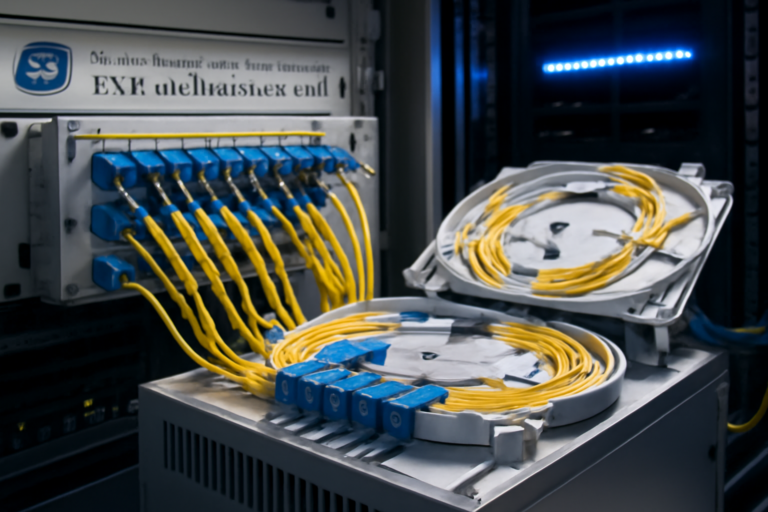
At Fiber Products, we develop modular fiber optic solutions specifically for the requirements of open access fiber optic networks. Our splice boxes and 3U ODF system VarioConnect are designed for technical rooms and air-conditioned rooms and offer the reliability that is crucial for professional wholesale services.
With a 5-year guarantee and European production to German quality standards, we offer optimum value for money for professional FTTH infrastructures. Discover our complete product range on Fiber Products or visit our online store for all products.
Talk to us – together we will develop the optimal solution for your open access fiber optic project. Contact us for an individual consultation or find out about other specialist topics on professional project management in our fiber optic knowledge blog.
Request a Consultation
Our experts will advise you on modular fiber optic solutions for your specific application — fast, personal and non-binding.