Grey-Spot Programme 2026: BMDV Fibre Subsidy for Underserved Areas FTTH – Tenders and Opportunities for Network Operators
The Grey-Spot Programme of the BMDV fibre subsidy for underserved FTTH areas enables network operators and municipal utilities in 2026 to roll out subsidised fibre-optic networks in regions with download rates below 100 Mbit/s. With funding rates of up to 75 per cent of construction costs and a total budget of €1.2 billion for 2025/2026, concrete tender opportunities are emerging for FTTH infrastructure deployment in previously underserved municipalities.
The current funding period is already showing impressive results: Münster received €12.2 million for 1,300 addresses, while Märkischer Kreis secured €49.4 million to serve 2,620 addresses plus 58 schools and 8 hospitals. The new project administrator aconium GmbH takes over nationwide management of all subsidy recipients from January 2026.
Current funding programmes and tender deadlines 2026
The Federal Ministry for Digital Affairs and Transport structures the Grey-Spot funding for 2026 through several parallel programme lines. The Infrastructure Call 2025 runs until 15 September 2025 and is specifically targeted at municipal network operators with completed deployment plans.
- Gap-closure pilot programme: €40 million for small areas under 100 addresses
- Fast-track procedure: Accelerated approval within 8 weeks for complete applications
- Standard funding call: Regular process with industry dialogue and market consultation
- Special funding for schools/hospitals: Enhanced funding rate of up to 90 per cent
The new tariff regulation for dark fibre and access lines, which came into effect in December 2024, creates additional planning certainty for network operators. Municipal utilities particularly benefit from standardised open-access terms.
Technical requirements for subsidised FTTH projects
The BMDV funding guidelines define clear technical minimum standards for grey-spot areas. Only gigabit-capable networks based on fibre-optic technology to the building (FTTB) or to the premises (FTTH) are eligible for funding.
| Criterion | Minimum requirement | Recommended standard |
|---|---|---|
| Download transmission rate | 1 Gbit/s symmetric | 10 Gbit/s ready |
| Fibre type | Singlemode OS2 | Singlemode OS2 with headroom |
| Connector types | LC/APC or SC/APC | LC/APC, E2000/APC for industrial |
| Attenuation budget | < 0.35 dB/km | < 0.25 dB/km |
| Splice loss | < 0.1 dB | < 0.05 dB |
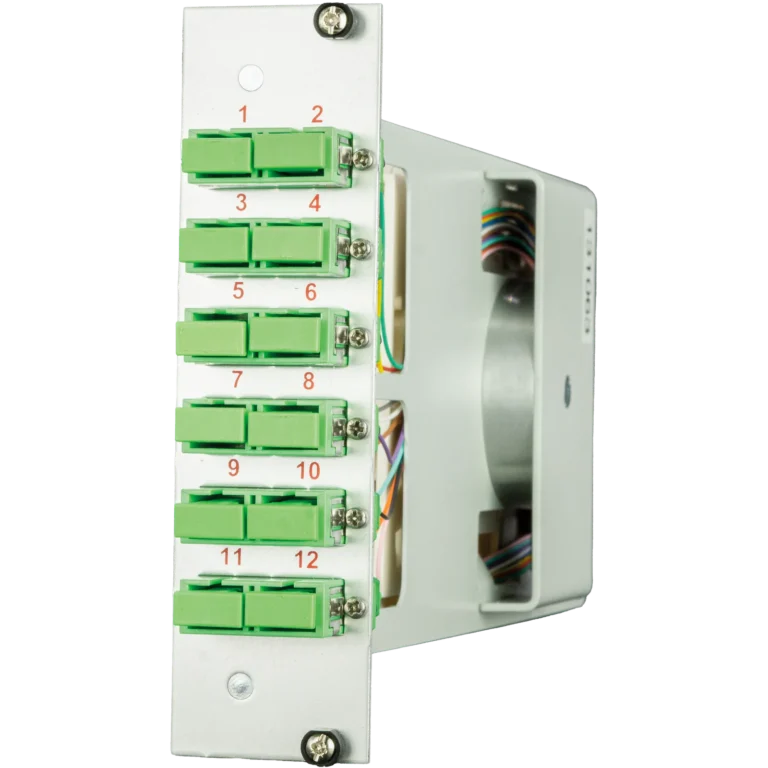
Modular splice technology is of particular importance: systems with up to 96 fibres in 1U enable efficient use of limited equipment space in municipal buildings.
Successful tender examples from 2025
Procurement practice shows clear trends in the evaluation of FTTH tenders. Wolfsburg awarded the contract for €45.3 million in construction costs to Wobcom GmbH, which impressed with modular splice systems and pre-connectorised solutions.
In Münster, epcan GmbH prevailed with an innovative concept that reduced installation times by 30 per cent. The key: high-density splice modules with factory pre-connectorisation and IEC 61754-compliant connectors.
- Tengen: naturenergie netze GmbH, 1,131 addresses, co-routing with power networks
- Märkischer Kreis: Telekom Deutschland, 2,620 addresses plus critical infrastructure
- Bad Säckingen: municipal utility consortium, focus on industrial areas
Fiber Products Quality Promise: As an official Diamond Partner and European manufacturer, we produce modular splice systems in-house. Benefit from Swiss precision and in-house manufacturing.
Modular splice technology as competitive advantage
The Grey-Spot programmes impose specific demands on splice technology. Network operators must terminate large numbers of fibres in minimal space and time. Modular systems such as SlimConnect offer decisive advantages with up to 96 fibres in just 1U.
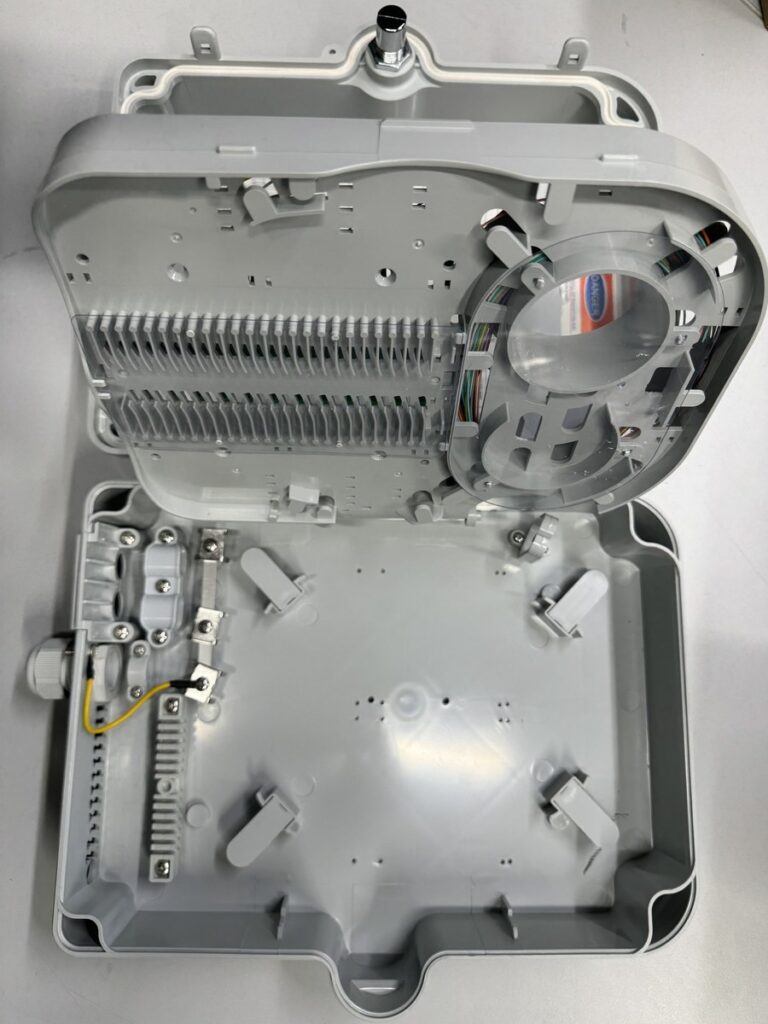
Pre-connectorisation not only reduces installation times but also minimises sources of error. For a typical grey-spot project with 500 households, this represents a time saving of up to 120 labour hours compared to traditional splice boxes.
| System type | Fibre density | Installation time | Space requirement |
|---|---|---|---|
| Traditional splice box | 48 fibres/1U | moderate | Standard |
| SlimConnect modular | 96 fibres/1U | low | noticeably reduced |
| VarioConnect 3U | 288 fibres/3U | high | Optimised |
Industry dialogues and market consultation: best practice
The mandatory industry dialogue before each tender provides network operators with an opportunity to influence technical standards early. The Federal Network Agency recommends adopting standards-compliant components per IEC 61754 and IEC 61755 at this stage.
- Early involvement of technical experts in the dialogue
- Documentation of reference projects with comparable requirements
- Evidence of conformity with TKG Amendment Act 2026
- Demonstration of scaling options for future extensions
- Integration of open-access interfaces in the planning phase
Particularly authorities focus on compliance with new procurement rules, which from March 2026 will include mandatory sustainability assessment.
E2000 connectors for robust industrial connections
Grey-spot areas frequently cover industrial zones with challenging environmental conditions. E2000 connectors excel here with their high vibration resistance and IP65 rating. As Diamond Partner, Fiber Products offers the complete E2000 product range in Swiss precision quality.
The mechanical locking and integrated protective shutter make E2000 the first choice for municipal utilities serving industrial customers. Attenuation values below 0.2 dB guarantee stable transmission rates even in harsh conditions.
Financing models and business case calculation
The viability of grey-spot projects depends significantly on the chosen system technology. Modular solutions achieve payback through reduced installation times and lower operating costs in an average of 3.5 years.
- Capital expenditure: 50% federal subsidy, 20–25% regional co-funding possible
- Operator contribution: Only 25–30% of total costs
- Operating costs: Reduction through modular systems
- Maintenance intervals: Extended through high-quality components
- Warranty periods: 5 years on Fiber Products systems reduce risk
Timeline for 2026 tenders
The tight timeline of the BMDV fibre subsidy for underserved FTTH areas requires precise project planning. After contract award, network operators have only 24 months to complete the project.
| Phase | Timeframe | Critical factors |
|---|---|---|
| Application | 3–4 months | Complete documentation |
| Approval | 2–8 weeks | Fast-track option available |
| Tender | 3 months | EU procurement law compliance |
| Construction phase | 12–18 months | Modular systems save time |
| Commissioning | 1–2 months | Complete documentation |
Quality assurance and acceptance procedures
The Federal Network Agency is tightening acceptance criteria for subsidised projects in 2026. All splice connections must be documented with OTDR test reports. Maximum attenuation per connector must not exceed 0.5 dB.
Modular splice systems with factory quality control already meet these requirements from the box. IEC 61300-3-34 defines the test procedures for connectors, while IEC 61280-4-2 standardises OTDR measurement.
- Factory test certificates for all components
- Return loss > 60 dB for APC connectors
- Documentation of all splice values with GPS coordinates
- Handover protocol with complete fibre documentation
Sustainability as procurement criterion
From March 2026, the CO₂ footprint will account for 15 per cent of tender evaluation. Products from European manufacturing score highly here due to short transport distances and documented environmental standards.
The modular design further reduces material consumption by up to 30 per cent compared to traditional installations. Replaceable components extend infrastructure lifespan to over 25 years.
Frequently asked questions on the Grey-Spot Programme 2026
Which areas count as grey-spot zones in 2026?
The BMDV defines grey spots as all addresses with available download rates below 100 Mbit/s. Additionally, no own-account deployment must be planned for the next three years. The Federal Network Agency maintains a central register of all eligible addresses.
What is the maximum funding rate for municipal utilities?
Municipal utilities regularly receive 50 per cent federal subsidy plus 20–40 per cent co-funding from states and municipalities. When connecting critical infrastructure such as schools or hospitals, funding up to 90 per cent is possible.
Which splice technology suits small equipment rooms?
For confined spaces, 1U systems with up to 96 fibres are recommended. The SlimConnect series offers this density with full modularity. Pre-connectorisation also eliminates the need for on-site splicing space.
Are MPO/MTP connectors eligible for funding?
Yes, MPO/MTP connectors are explicitly eligible if they meet the requirements of IEC 61754-7. They are particularly suitable for backbone connections between distributors with high fibre counts.
How long does approval take in the fast-track process?
With complete documentation and fulfilment of all criteria, approval is granted within 8 weeks. A successful market consultation must have been conducted beforehand.
What warranty periods are typical for subsidised projects?
The BMDV requires a minimum of 2 years’ warranty. Premium systems such as Fiber Products solutions offer 5 years’ warranty, which significantly reduces total cost of ownership and is positively evaluated in tenders.
Outlook: Grey-Spot funding beyond 2026
The EU Gigabit Strategy envisages complete fibre coverage by 2030. The Grey-Spot Programme will therefore likely continue through at least 2028. Network operators should now invest in scalable, modular systems that enable future extensions without complete replacement.
With the right splice technology and thoughtful project planning, grey spots become shining examples of successful digitalisation. The combination of BMDV funding and innovative fibre-optic technology makes 2026 a key year for nationwide FTTH rollout in Germany.
Request a quote
Do you have questions about our fibre-optic solutions? Our expert team will be happy to advise you – free and without obligation.