Laser Safety in Fibre Optic Networks: Why E2000 Connectors Are Mandatory
Laser Safety in Fibre Optic Networks: Why E2000 Connectors Are Mandatory for Government Agencies and Public Tenders
Laser safety for fibre optics, E2000 laser safety, and fibre optic safety are non-negotiable in public procurement — the E2000 connector with integrated laser safety shutter is mandated in Germany for government networks, universities, and critical infrastructure. The automatic safety shutter of the E2000 system prevents eye damage from laser radiation of classes 3R through 4 and meets the strict requirements of IEC 60825-2 as well as German workplace safety regulations on artificial optical radiation (OStrV).
While E2000 vs. LC connectors comparison dominate private networks, fibre optic procurement for public contracts mandate E2000 for good reason: at power levels above 10 mW, permanent retinal damage can occur within milliseconds. The spring-loaded safety mechanism of the E2000 closes automatically when disconnected and opens only upon full insertion — a safety level no other connector system offers.
Technical Fundamentals: Why Laser Safety in Fibre Optic Networks Is Essential
Modern fibre optic networks operate with invisible infrared radiation at 1310 nm, 1490 nm, and 1550 nm wavelengths. This radiation penetrates the cornea and focuses directly on the retina — without the natural blink reflex providing protection. With single-mode fibres of 9/125 μm core diameter, an extreme energy density develops that causes irreversible damage even with brief exposure.
- Laser Class 1M: Safe under normal use (< 0.5 mW)
- Laser Class 3R: Hazardous upon direct viewing (0.5–5 mW)
- Laser Class 3B: Eye damage possible (5–500 mW)
- Laser Class 4: Skin and eye damage, fire risk (> 500 mW)
In FTTH networks with GPON or XGS-PON, optical power levels quickly reach critical values. An OLT transmitter at +7 dBm already corresponds to 5 mW — Laser Class 3R. In DWDM systems used in government networks, transmission power often reaches +20 dBm (100 mW), which represents Laser Class 3B.
E2000 Connector: The Safety Standard for Professional Networks
The E2000 connector was specifically engineered for safety-critical applications. Its design is based on a spring-loaded shutter mechanism that completely covers the ferrule. When the connection is disconnected, the shutter closes within < 50 ms — faster than any human reaction.
| Feature | E2000 | LC/SC Standard |
|---|---|---|
| Laser Safety Shutter | Integrated | Not Available |
| Insertion Loss APC | < 0.2 dB | < 0.3 dB |
| Return Loss APC | > 65 dB | > 55 dB |
| Standards Compliance | IEC 61754-15 | IEC 61754-20/-4 |
| Mating Cycles | > 1000 | > 500 |
The superior precision of the E2000 system is evident in its optical performance: with typical insertion loss of 0.1 dB and return loss exceeding 65 dB with APC polish, it significantly outperforms LC and SC connectors. This precision stems from Swiss manufacturing tradition — as an official Diamond partner, Fiber Products maintains these quality standards in our own production.
Regulatory Requirements for Public Procurers in the DACH Region
The Workplace Safety Regulation on Artificial Optical Radiation (OStrV) requires employers to conduct hazard assessments and implement technical safeguards. For fibre optic work, this concretely means: once Laser Class 1M is exceeded, protective measures are mandatory. The E2000 connector fulfils this requirement as a technical safeguard under § 7 OStrV.
- Federal Government: E2000 mandated in all backbone network tenders
- Universities: Required in research networks with high optical power
- Hospitals: Specified for medical device networking
- Critical Infrastructure: BSI recommendation for KRITIS operators
- Armed Forces: E2000 exclusively in tactical fibre networks
Fiber Products Quality Promise: As an official Diamond partner and manufacturer, we produce modular splice systems in Europe. Benefit from Swiss precision and in-house manufacturing.
Practical Implementation: E2000 in Modular Splice Systems
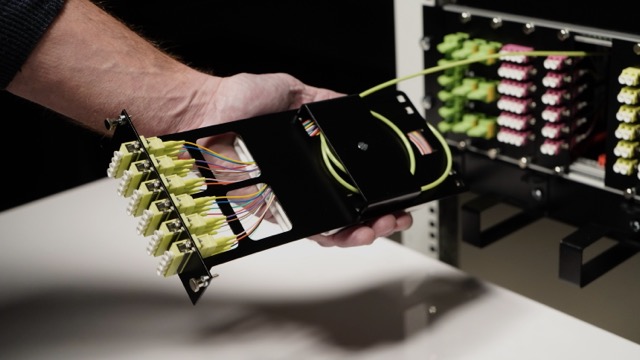
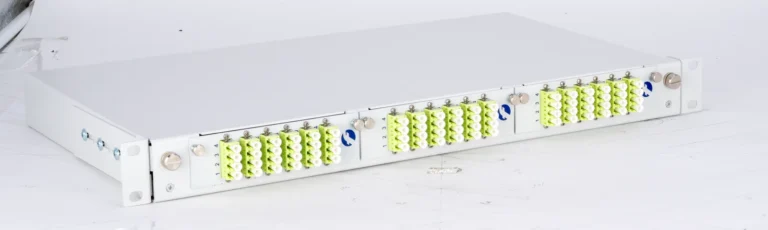
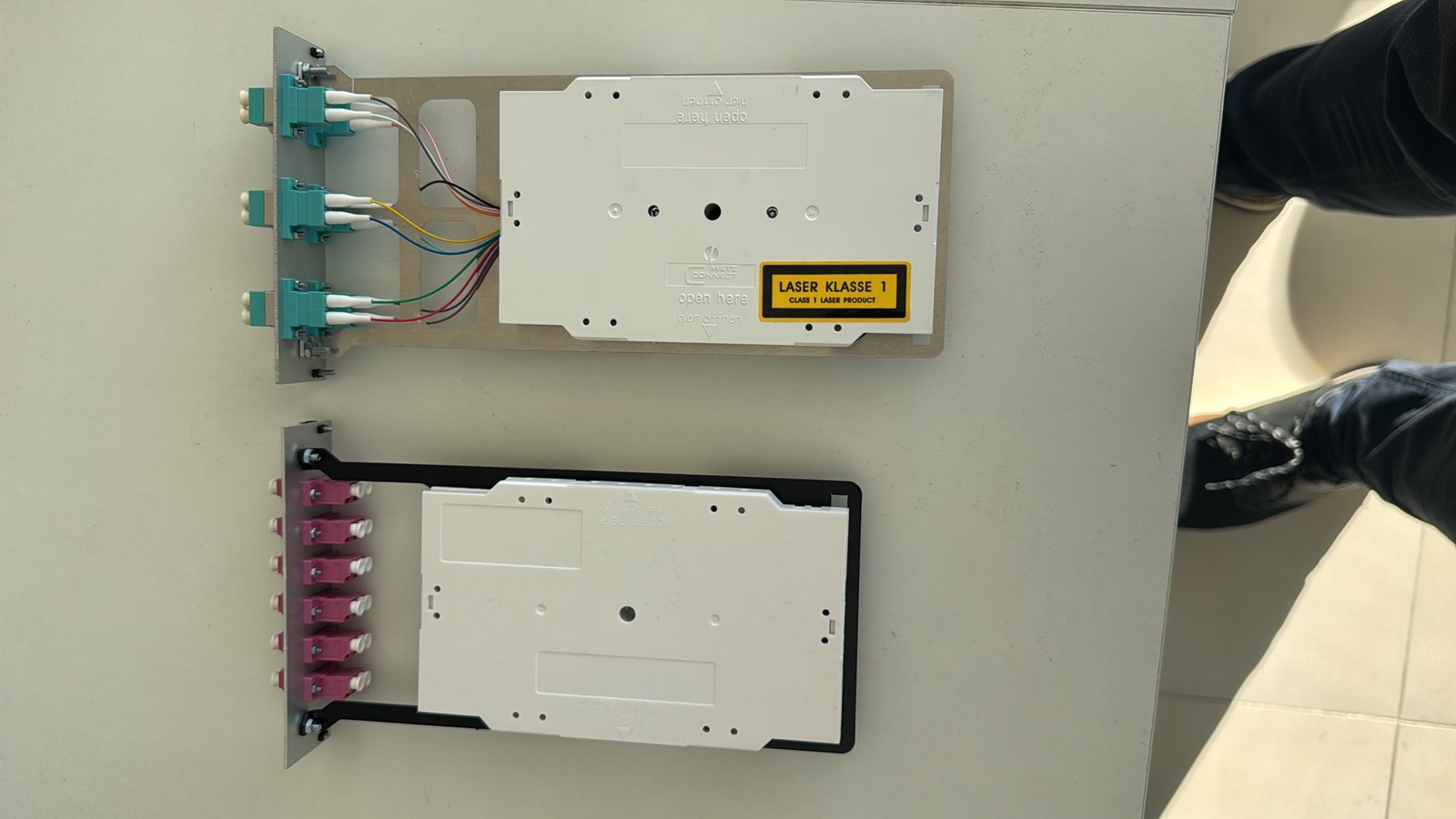
Integrating E2000 connectors into existing 19-inch infrastructure requires well-designed splice systems. Modern solutions such as the SlimConnect 1RU system provide space for up to 96 fibres with E2000 connectors in a single rack unit — double the capacity of conventional systems.
When planning, government agencies must consider the following aspects:
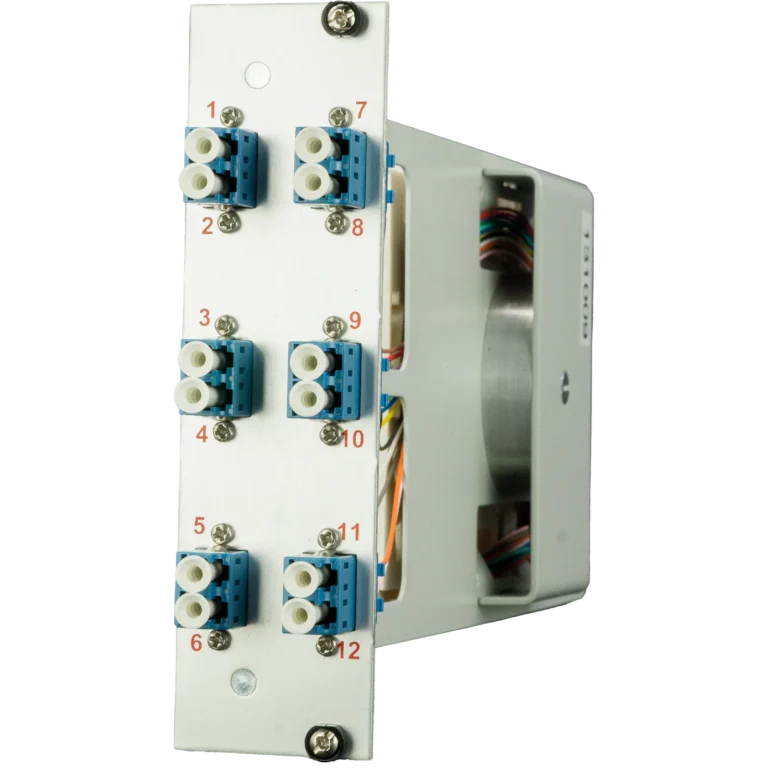
- Front modules with E2000 couplers in simplex or duplex configuration
- Colour coding per IEC 61754-15 (green for APC, blue for PC)
- Adequate bend radius for pre-terminated E2000 pigtails (min. 30 mm)
- Splice trays with E2000 connector retention
- Documentation of laser classifications for each link
Cost Analysis: E2000 Versus LC/SC in Public Networks
The higher acquisition cost of E2000 components is offset by total cost of ownership. A workplace accident resulting in eye damage can cost hundreds of thousands of euros — from lost productivity to medical treatment and potential liability claims.
| Cost Item | E2000 System | LC/SC + Protective Measures |
|---|---|---|
| Connectors | 15–20 € | 8–12 € + safety caps |
| Safety Protection | Integrated | Laser safety glasses (200 €/unit) |
| Maintenance | Standard | Regular training required |
| Liability Risk | Minimised | Elevated |
| Regulatory Compliance | Established | Additional measures required |
Technical Specifications for Public Tenders
Public procurers should specify the following E2000 requirements in their technical schedules to ensure laser safety for fibre optics and E2000 laser safety compliance:
- Conformance with IEC 61754-15 (mechanical interface)
- Automatic laser safety shutter per IEC 60825-2
- 8° APC polish for return loss > 60 dB
- Insertion loss < 0.25 dB (Grade B per IEC 61753-1)
- Repeatability < 0.1 dB over 500 mating cycles
- Temperature range −40°C to +85°C for outdoor installations
Precise definition of these parameters prevents contract renegotiation and ensures only high-quality components are deployed. As a European manufacturer with in-house production, Fiber Products guarantees compliance with all applicable standards backed by 5 years warranty.
Migration Strategy: Transitioning Existing Networks to E2000
Retrofitting existing LC/SC networks to E2000 requires a structured approach. Critical links with high optical power take priority, while non-critical areas with Laser Class 1 can remain unchanged initially.
A proven approach for fibre optic safety includes:
- Phase 1: Inventory and classification of all links by laser class
- Phase 2: Replacement of splice modules in main distribution frames (up to 288 fibres in 3RU possible)
- Phase 3: Progressive retrofit of secondary distribution points
- Phase 4: Adaptation of test equipment to E2000 reference cables
- Phase 5: Training of maintenance personnel
Maintenance and Cleaning of E2000 Connectors
The laser safety shutter of the E2000 requires special attention during cleaning. Contamination on the shutter can cause elevated insertion loss, even when the ferrule itself is clean. Standard cleaning tools for LC/SC are not compatible — specialised E2000 cleaning tools are required.
Correct cleaning procedures ensure optimal transmission performance:
- Clear the safety shutter of particles using compressed air
- Clean the ferrule with an E2000-specific cleaning tool
- Inspect with video microscope (400× magnification)
- Measure insertion loss for quality verification
- Document in maintenance record
Frequently Asked Questions on Laser Safety and E2000 in Government Networks
Is E2000 required even at low power levels below 1 mW?
No, at Laser Class 1 (< 0.39 mW at 1550 nm) there is no legal requirement. However, public procurers often mandate E2000 as a precaution, since network expansion and power increases are anticipated.
Can existing LC patch cords be retrofitted to E2000 using adapters?
Technically possible via LC-E2000 hybrid adapters, but not recommended. Laser safety protection only works on one side, and the additional loss of 0.3–0.5 dB degrades the link budget.
What alternatives to E2000 meet safety requirements?
The LSH connector (Laser Safety Housing) offers comparable protection but has not become established. SC and LC connectors with add-on safety caps only partially meet requirements, as protection depends on user compliance.
What are the additional costs for E2000 in a typical government network?
For a network with 500 ports, incremental costs are approximately €3,000–5,000 for connectors. Splice systems themselves differ little in price — modern modular systems offer universal front modules for all connector types.
Must MPO/MTP connectors also be replaced with E2000?
MPO/MTP multi-fibre connectors in data centres typically fall under Laser Class 1. However, when used in high-power DWDM systems, migration to individual E2000 fibres should be considered, as MPO lacks integrated laser safety protection.
Conclusion: E2000 as an Indispensable Safety Standard
Laser safety for fibre optics and fibre optic safety are not optional extras but legal requirements for professional networks. The E2000 connector with its proven safety mechanism meets all regulatory requirements and minimises operator liability. Public procurers who specify E2000 demonstrate responsibility and foresight.
Higher acquisition costs are offset through accident prevention and reduced training overhead. With modular splice systems that deliver up to 96 E2000 ports in 1RU, space requirements are minimised. As a European manufacturer and Diamond partner, Fiber Products provides the complete system solution — from splice boxes through pre-terminated pigtails to E2000 connectors backed by 5 years warranty.
For more information on E2000 splice systems for government agencies, visit fiber-products.com/public-sector or contact our specialists for personalised advice on your fibre optic project.
All modular fibre optic components are available directly in the Fiber Products Shop — with 5 years manufacturer warranty.
Request Expert Advice
Our specialists will advise you on modular fibre optic solutions tailored to your specific application — fast, personal, and without obligation.