Digital Radio BOS and Fibre-Optic Backbone – Technical Foundations
Digital Radio BOS and Fibre-Optic Backbone – Technical Foundations for Secure Government Communications
Digital Radio BOS, TETRA fibre optic and BOS backbone form the technical backbone of German government communications, ensuring nearly 100 per cent availability for emergency services through redundant fibre-optic infrastructures. The integration of TETRA base stations into modern fibre-optic backbones enables not only proven voice communication, but also lays the foundation for future broadband services with data rates up to 10 Gbit/s.
As the world’s largest TETRA network with complete area coverage, Germany faces the challenge of connecting existing Digital Radio infrastructure with modern fibre-optic technologies. Modernisation plans through 2030 and beyond focus on hybrid solutions that combine TETRA stability with 5G speed.
Technical Architecture: How the BOS Fibre-Optic Backbone Works
The backbone architecture of the German BOS network is based on a multi-layer fibre-optic network with redundant ring structures and geographically distributed switching centres. Each TETRA base station is connected via dedicated fibre-optic links with at least two independent paths to ensure fault tolerance.
- Primary fibre-optic connections with singlemode OS2 fibres for distances up to 40 km
- Secondary backup routes via alternative cable ducts
- Emergency power supply with 72-hour autonomous operation in case of network failure
- Encrypted IP transmission to BSI standards
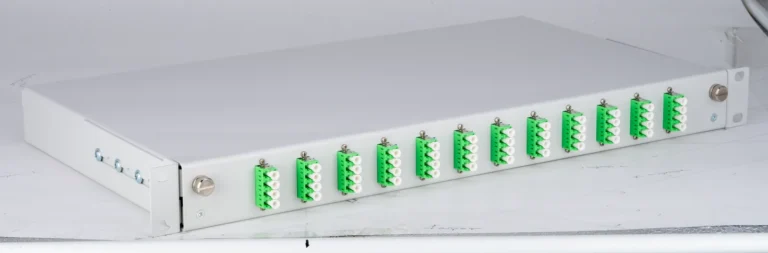
- Modular splice distribution in 19-inch rack format for central hubs
The physical layer predominantly uses Dense Wavelength Division Multiplexing (DWDM) for efficient use of fibre-optic capacity. Up to 96 channels can be transmitted per fibre simultaneously, which optimally utilises existing infrastructure, particularly in urban conurbations.
TETRA Integration into Modern Fibre-Optic Networks
The connection of TETRA base stations to the fibre-optic backbone takes place via special network interfaces that convert the proprietary TETRA protocol into IP-based data streams. This conversion enables seamless integration into existing carrier Ethernet networks with bandwidths of 1 to 10 Gbit/s.
| Component | Technical Specification | Redundancy Level |
|---|---|---|
| Base Station Connection | 2x 1 Gbit/s Ethernet | Active/Passive |
| Backbone Capacity | 10–100 Gbit/s DWDM | N+1 Redundancy |
| Switching Centres | 400 Gbit/s Switching | Geographically Distributed |
| End-to-End Latency | < 10 ms national | Multiple Routing |
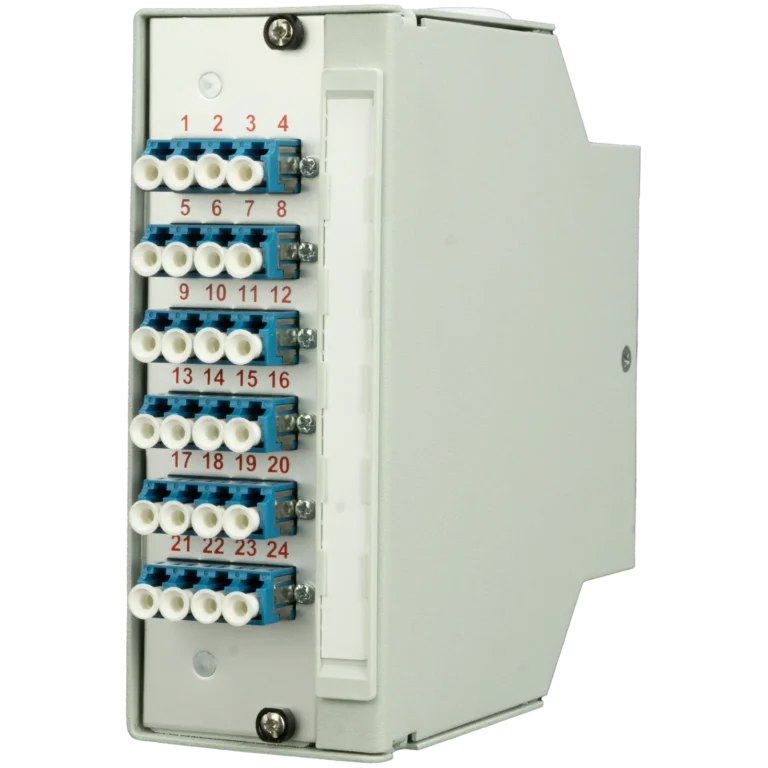
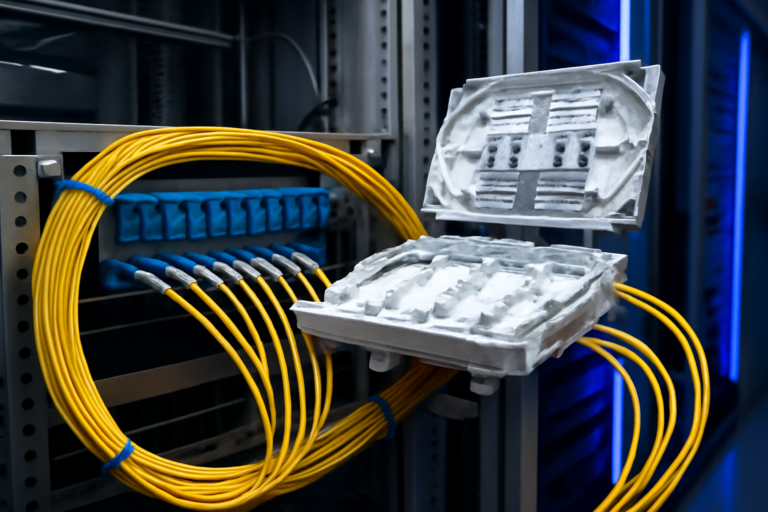
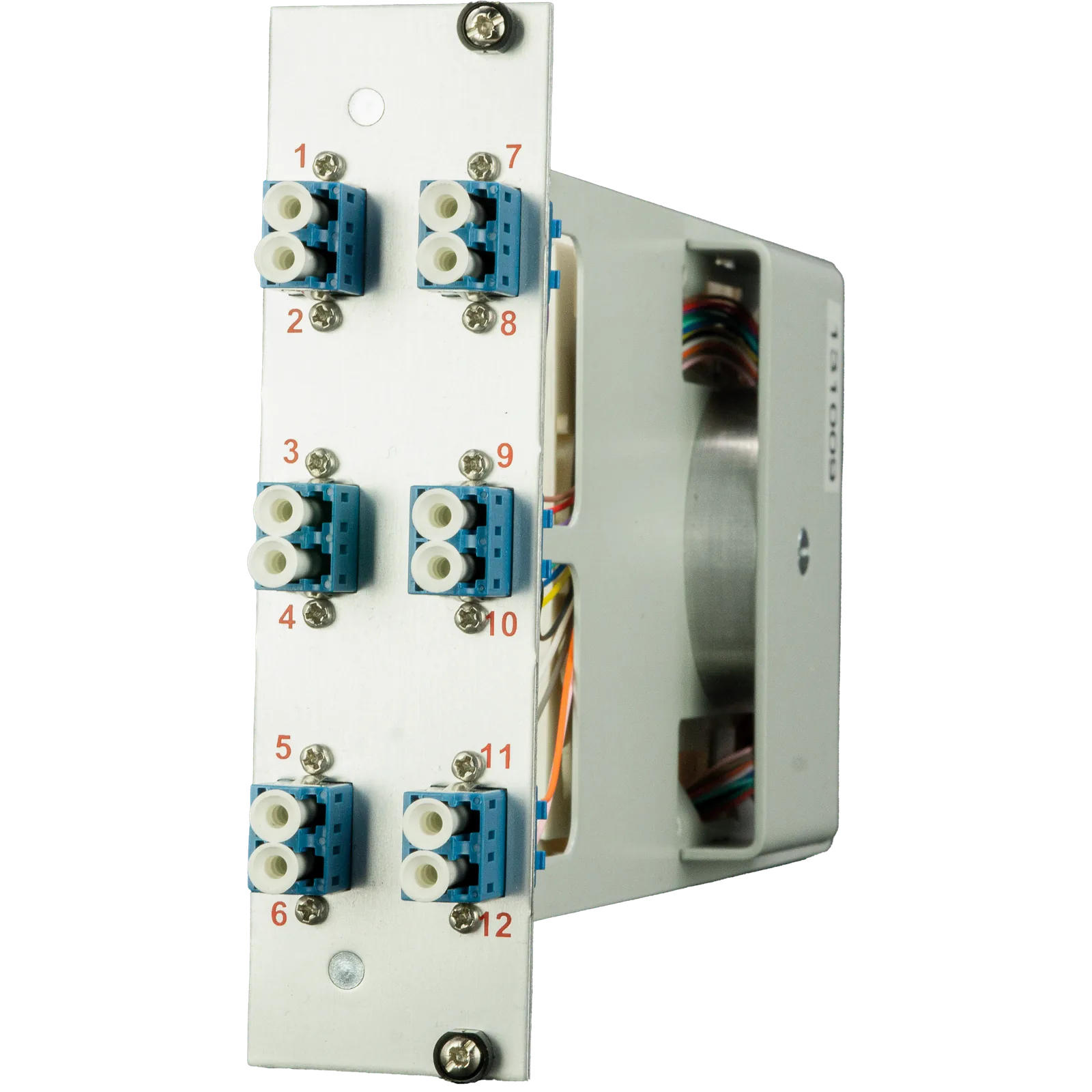
Modern splice modules at distribution points ensure the necessary flexibility for expansion. With a packing density of up to 96 fibres per rack unit, future-proof installations can be realised even in confined equipment rooms.
Standards and Regulations for BOS Fibre-Optic Infrastructures
The technical implementation of fibre-optic backbones for Digital Radio BOS is subject to strict standards. Central importance is given to IEC 61754 standards for connectors and DIN EN 50173-1 for structured cabling systems.
- IEC 61754-15: Specification for LC connectors with APC polish
- IEC 61754-4: SC connectors for outdoor installations
- IEC 61754-15: E2000 connectors for enhanced vibration resistance
- DIN EN 50173-1: Requirements for structured cabling
- ISO/IEC 11801: International cabling standards
Fiber Products Quality Promise: As an official Diamond Partner and manufacturer, we produce modular splice systems in Europe. Benefit from Swiss precision and in-house manufacturing.
Redundancy Concepts and Fault Tolerance in the BOS Backbone
Availability requirements for BOS networks are 99.98 per cent annually. This is achieved through multiple redundancy at all network levels. Fibre-optic links are generally configured as rings or meshed topologies, never as pure star structures.
Critical network nodes have dual fibre-optic connections via physically separate cable routes. Switchover times in case of fibre damage are less than 50 milliseconds thanks to Automatic Protection Switching (APS). Additionally, all active components are protected by uninterruptible power supplies and diesel generators.
| Redundancy Level | Technical Implementation | Downtime per Year |
|---|---|---|
| Fibre Level | Dual Cable Routes | < 5 Minutes |
| System Level | 1+1 Hot Standby | < 1 Minute |
| Network Level | Meshed Topology | < 30 Seconds |
| Power Supply | UPS + Diesel, 72h | 0 Minutes |
Migration to Hybrid TETRA/5G Architectures
The gradual transition from pure TETRA networks to hybrid solutions requires powerful fibre-optic backbones. Integration of 5G network slices for government services requires transmission capacities of at least 10 Gbit/s per base station.
- TETRA remains the basis for voice communication until at least 2030
- Parallel operation of TETRA and 5G over shared fibre-optic infrastructure
- Gateway solutions for seamless communication between both standards
- Stepwise migration without operational interruption
- Investment protection through modular expansion concepts
Municipal utilities and local network operators are already modernising their TETRA access networks today with government-certified fibre-optic solutions. The modular design enables demand-based scaling without complete infrastructure replacement.
Fibre-Optic Splicing Technique for BOS Applications
The quality of fibre-optic connections is decisive for transmission security in BOS networks. Splice joints must exhibit attenuation below 0.05 dB and be protected against environmental influences. Modern splice modules provide optimal conditions for this.
Central distribution points use high-density splice systems that can accommodate up to 96 fibres on one rack unit (1U). This packing density – twice as high as standard systems – is a decisive advantage, particularly in confined equipment rooms of government facilities.
- Pre-configured splice cassettes for 12 or 24 fibres
- Colour coding to DIN VDE 0888
- Integrated slack management
- Dust protection to IP54 for equipment rooms
- Label fields for complete documentation
Measurement Technology and Quality Assurance in the BOS Backbone
Acceptance and regular testing of fibre-optic links is carried out with calibrated OTDR instruments to IEC 61280-4-1. Each fibre is measured bidirectionally at 1310 nm and 1550 nm and documented.
Critical parameters such as attenuation, return loss and chromatic dispersion are continuously monitored. When defined threshold values are exceeded, the network monitoring system is automatically alerted. The measured values are incorporated into preventive maintenance to proactively prevent outages.
Practical Implementation: Fibre-Optic Backbone for Control Centres
Control centres as critical nodes of BOS communications require particularly fault-tolerant fibre-optic connections. A typical scenario comprises four independent fibre feeds from different directions, which are bundled in a central splice distributor.
| Control Centre Requirement | Technical Solution | Fiber Products System |
|---|---|---|
| Fibre Capacity | 144–288 Fibres | VarioConnect 3U |
| Connector Type | LC/APC, E2000/APC | Diamond Quality |
| Packing Density | Max. Fibres/U | 96 Fibres/1U |
| Documentation | Complete | Digital Fibre Documentation |
The modular design of splice systems allows for subsequent expansion without operational interruption. The use of pre-configured modules reduces installation time by up to 60 per cent compared to conventional solutions.
Future Perspective: Quantum-Safe Communications over Fibre Optic
The next evolutionary stage of BOS communications will include quantum-safe encryption over dedicated fibres. Initial pilot projects already use Quantum Key Distribution (QKD) for particularly sensitive connections between government agencies.
This technology requires extremely low-loss fibre-optic links with attenuation values below 0.2 dB/km and absolutely clean connectors. The use of high-quality connectors with APC polish and return loss over 60 dB is mandatory for this application.
Economic Considerations for Network Operators
Investment in modern fibre-optic backbones for BOS applications pays for itself through reduced operating costs and increased fault tolerance. Modular systems with 5 years warranty provide planning certainty and minimised maintenance effort.
- Reduced downtime through redundant architectures
- Lower operating costs through passive infrastructure
- Future-proofing through scalable bandwidths
- Investment protection through standardised components
- Simplified maintenance through modular design
As a manufacturer of modular fibre-optic solutions and official Diamond Partner, Fiber Products supports network operators in implementing future-proof BOS infrastructures with systems in proven Swiss precision quality.
FAQ: Frequently Asked Questions about Digital Radio BOS and Fibre-Optic Backbones
How long will TETRA remain as the standard for Digital Radio BOS?
TETRA will remain active as the baseline standard for mission-critical government voice communications until at least 2030 and likely beyond. The proven technology with nearly 100 per cent availability will be gradually supplemented by broadband services, not replaced.
Which fibre-optic types are suitable for BOS backbone connections?
BOS backbones exclusively use singlemode fibres to OS2 standard. These enable transmission distances up to 40 km without intermediate amplification and support wavelength multiplexing for maximum bandwidth utilisation.
How is 72-hour autonomous operation guaranteed in case of power failure?
Emergency power supply operates in two stages: uninterruptible power supplies (UPS) bridge the first hours, while diesel generators ensure long-term supply. Critical fibre-optic amplifier points have their own battery systems with at least 8 hours bridging time.
Which connector types are certified for BOS applications?
Primarily LC/APC and SC/APC connectors are used. For particularly vibration-critical environments, E2000 connectors with integrated protective shutter are employed, providing return loss over 60 dB.
Can existing TETRA sites be used for 5G integration?
Yes, the existing fibre-optic infrastructure of TETRA sites provides the ideal foundation for 5G expansion. The existing backbone connections only need to be upgraded to 10 Gbit/s or higher, which is possible by replacing active components while retaining the fibre.
What funding is available for fibre-optic rollout in the BOS sector?
In addition to general federal broadband funding, special programmes exist for safety-critical infrastructures. The EU Gigabit Regulation explicitly supports expansion for government communications. Additionally, individual federal states promote modernisation of their BOS networks with their own programmes.
Request a Quote
Do you have questions about our fibre-optic solutions? Our expert team will be happy to advise you – free and without obligation.