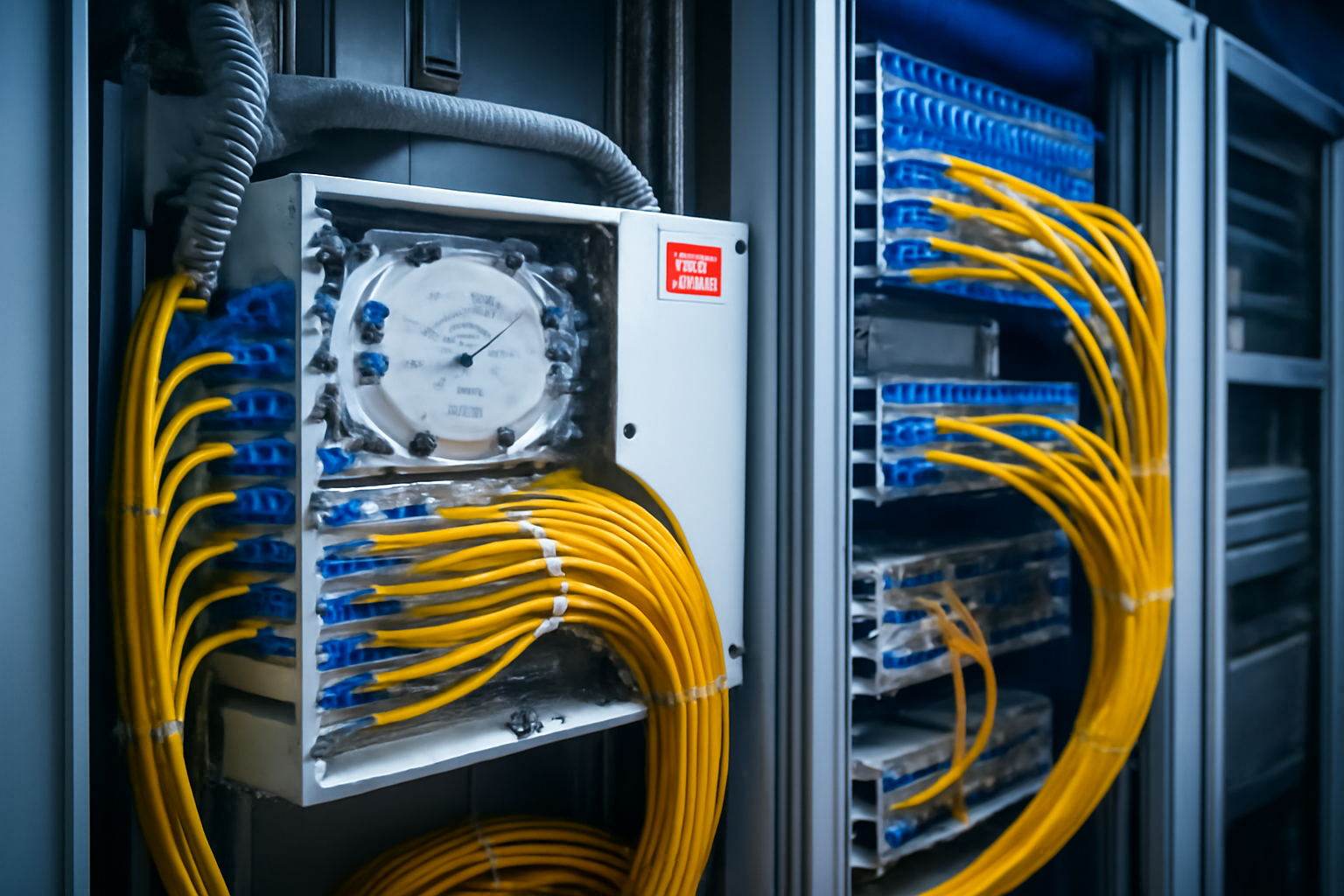
Fibre Optic Railway Stations – Network Infrastructure for Deutsche Bahn
Fibre Optic Railway Stations – Network Infrastructure for Deutsche Bahn
Fibre optic systems for Deutsche Bahn, railway station networks, and optical fibre infrastructure form the backbone of digital transformation in German rail transport – with 18,500 km of fibre optic cable deployed along routes and an expansion target of 33,400 km by 2027, state-of-the-art communication networks are being created for ETCS, digital signalling and station networks. Deutsche Bahn is thus driving not only its own digitalisation but also marketing spare capacity through DB broadband to telecommunications providers, opening up rural regions across Germany, Austria and Switzerland.
For installers and infrastructure service providers, this massive rollout creates concrete requirements: vibration-resistant splice connections, space-saving 1RU systems supporting up to 96 fibres, and modular solutions for rapid station installations are in demand. The remaining 8,200 km of fibre routes are now being deployed in-house – a multi-billion euro market for specialised system providers.
Technical Requirements for Deutsche Bahn Fibre Optic Infrastructure
Railway fibre optic infrastructure differs fundamentally from standard office installations. Stations and line sections face particular stresses from vibrations caused by passing trains, electromagnetic fields from overhead lines, and extreme temperature fluctuations ranging from -25°C to +70°C in equipment rooms.
Modern railway station networks therefore require specialised technical solutions:
- Vibration-resistant connectors to IEC 61754-15
- Protection class IP65 for outdoor installations
- EMC-shielded enclosures to EN 50121
- Temperature-resistant splice protection tubes
- Modular systems for flexible expansion
- Redundant fibre routing for fault resilience
Deutsche Bahn relies on pre-configured systems that can be installed quickly during overnight service closures. A typical station network connects signalling systems, signal equipment, video surveillance and passenger information systems via a central fibre optic network.
Splice Modules for Railway Station Networks – Space-Saving High-Density Solutions
In railway stations, space in equipment rooms is extremely limited. Deutsche Bahn fibre optic infrastructure therefore requires compact splice modules with maximum fibre density. Modern 1RU systems provide space for up to 96 fibres – double the capacity of conventional solutions.
| System Type | Height | Max. Fibres | Port Density | Application |
|---|---|---|---|---|
| Standard Splice Box | 1RU | 48 | Standard | Small Stations |
| SlimConnect | 1RU | 96 | Double | Major Stations |
| VarioConnect | 3RU | 288 | Maximum | Hub Points |
| DIN Rail Box | Modular | 24 | Compact | Signal Boxes |
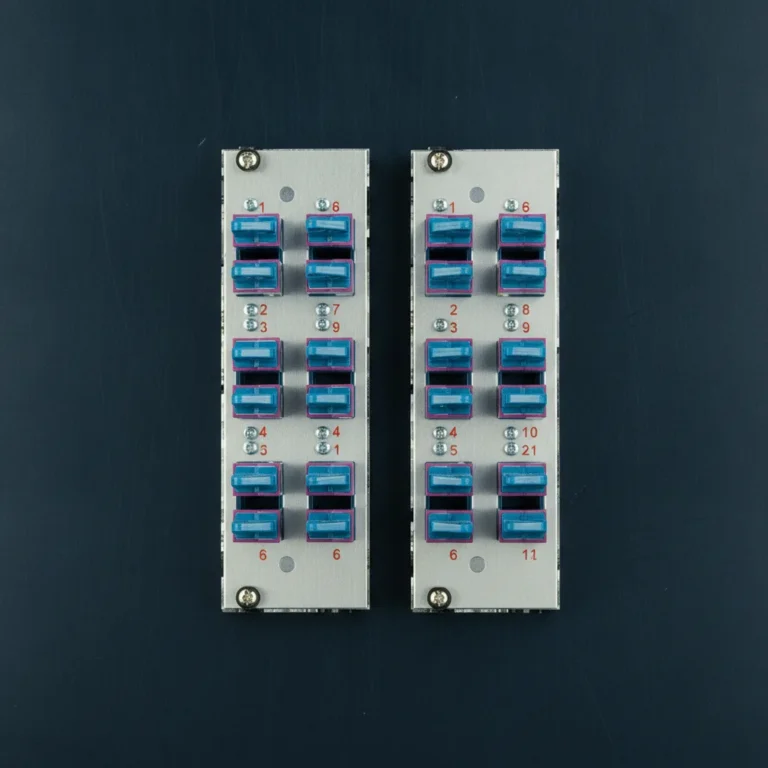
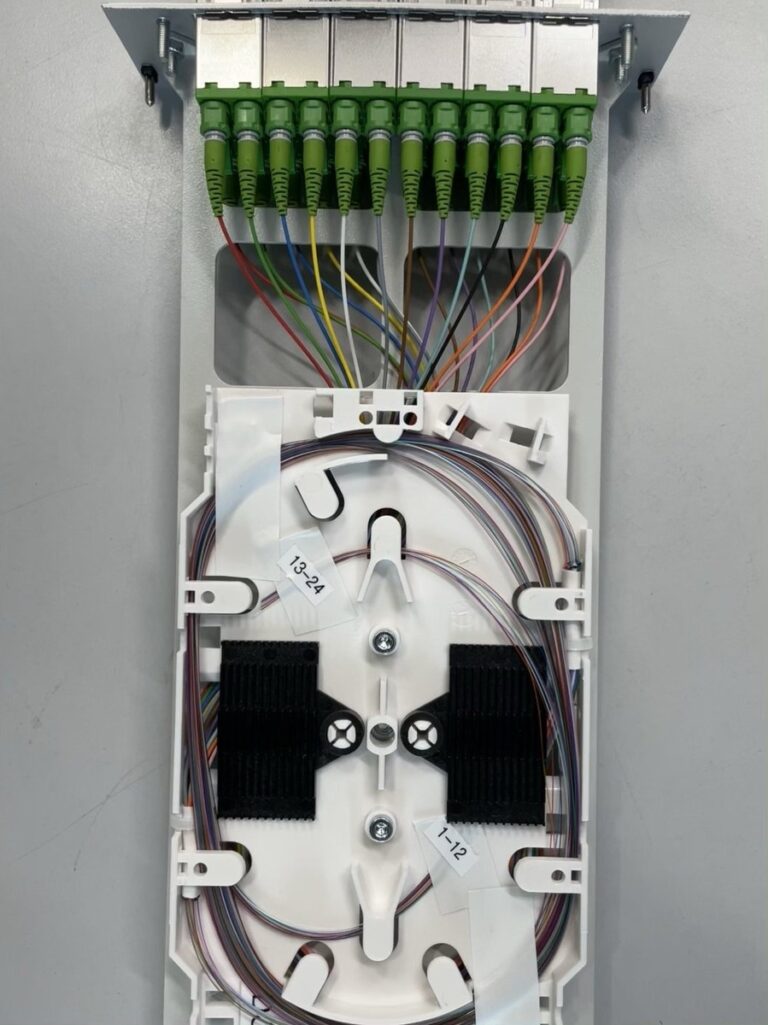
The modular design enables subsequent expansion without operational interruption. Front modules with LC, SC or E2000 adapters can be swapped without tools – ideal for gradual copper-to-fibre migration.
E2000 Connectors – The Standard for Railway Fibre Infrastructure
While LC connectors dominate office environments, Deutsche Bahn increasingly relies on E2000 connectors. These offer optimal protection against contamination through a spring-loaded shutter – essential in the dust-laden railway environment.
- Attenuation: < 0.25 dB with APC finish
- Return loss: > 60 dB
- Mating cycles: 1,000 guaranteed
- Colour coding to IEC 61754-15
- Temperature range: -40°C to +85°C
Fiber Products Quality Promise: As an official Diamond Partner and manufacturer, we produce modular splice systems in Europe. Benefit from Swiss precision and in-house manufacturing.
DB Broadband – Fibre Network as Business Model
Deutsche Bahn markets spare capacity in its public transport fibre optic networks to 18 telecommunications customers. These use the infrastructure for broadband expansion in rural regions. A current example is the 925 km fibre ring in Baden-Württemberg, realised jointly by Tele Columbus and DB broadband.
This creates new project opportunities for installers: connecting mobile masts, municipal networks and industrial areas to the rail network requires professional splicing work and modular distribution systems.
Installation of Deutsche Bahn Fibre Systems – Practical Guidance
Installation of railway fibre infrastructure typically occurs during overnight closures between 23:00 and 05:00. Pre-configured systems offer clear advantages here.
| Installation Step | Standard Time | Modular Time | Time Savings |
|---|---|---|---|
| Splice Box Installation | 45 min | 15 min | Reduced |
| Fibre Splicing (24F) | 120 min | 120 min | 0% |
| Patch Panel Configuration | 60 min | 20 min | Reduced |
| Documentation | 30 min | 10 min | Reduced |
| Total | 255 min | 165 min | Reduced |
Modular splice modules with pre-labelled cassettes and colour-coded adapters significantly reduce installation time. The saved time equates to direct cost savings on station installations – each additional closure window costs several thousand euros.
ETCS and Digital Signalling – Drivers for Railway Station Fibre Networks
The European Train Control System (ETCS) and digital signalling systems are primary drivers for Deutsche Bahn’s fibre expansion. By 2030, 2,800 signal boxes are to be digitalised – each requiring redundant fibre connections with minimum 24 fibres.
- ETCS Level 2: Continuous data transmission between train and control centre
- Digital signal boxes: 10 Gbit/s bandwidth per box
- Redundancy: Geographically separated route design
- Latency: < 5 ms for real-time control
- Availability: 99.999% required
Technical requirements far exceed standard office cabling. Splice modules must therefore be selected with particular care – professional fibre systems with 5 years warranty minimise failure risk.
Partnerships and Expansion Strategies in DACH Region
Deutsche Bahn’s fibre strategy encompasses numerous partnerships with regional network operators. In Switzerland, DB broadband works with Litecom; in Austria with ÖBB Infrastructure. These cross-border projects require standards-compliant systems to EN 50173 and ISO/IEC 11801.
Current expansion projects demonstrate demand for modular solutions:
- Frankfurt–Berlin: 96 km dark fibre for data centres
- Munich–Salzburg: Cross-border redundancy route
- Rhine-Ruhr: Consolidation to 288 fibres per route
- Hamburg–Copenhagen: Preparation for Fehmarn Belt crossing
Maintenance and Operation of Railway Fibre Infrastructure
Maintenance of railway station fibre networks is subject to strict safety regulations. Work in track areas requires safety planning to VDV 751 and trained personnel with rail earthing certification.
Typical maintenance intervals for railway station fibre systems include monthly visual inspections, bi-annual attenuation measurements with OTDR equipment to IEC 61280-4, and annual cleaning of all connectors. Modular systems simplify these tasks through tool-free access to all components.
Future Perspectives for Deutsche Bahn Fibre Projects
With planned expansion to 33,400 km by 2027 and investments in the mid-hundreds of millions, railway fibre infrastructure offers significant market opportunities. OneFiber additionally plans 28,000 km fibre deployment with direct station connections.
- 5G mobile coverage along routes
- Autonomous trains from 2035
- Predictive maintenance via fibre optic sensors
- Real-time infrastructure monitoring
- Renewable energy integration
For system providers, this means: those investing today in modular, scalable solutions will benefit long-term from the growing railway infrastructure market. Industrial-grade fibre solutions must meet the highest quality standards.
Quality Criteria for Railway Station Fibre Network Components
Selection of components for railway fibre infrastructure is subject to strict quality criteria. Deutsche Bahn requires evidence of temperature cycling tests to IEC 61300-2-22, vibration testing to IEC 61300-2-1, and EMC testing to EN 50121.
Critically important is system origin: Made in Europe guarantees short delivery times and rapid technical support. With 5 years warranty on modular splice systems, European manufacturers offer significantly longer guarantees than Asian suppliers.
FAQ – Frequently Asked Questions on Deutsche Bahn Fibre Installations
Which connector types suit vibration-resistant railway fibre?
For railway station fibre networks, E-2000 connectors with their push-pull latch and screw-coupled FC connectors are both suitable, as each locks the ferrule mechanically. Vibration behaviour is verified with the test procedure IEC 61300-2-1 (Tests – Vibration, sinusoidal); the performance requirements themselves are defined in the IEC 61753 series. An APC endface improves return loss – DIAMOND specifies >=70 dB for E-2000 SM APC versus >=50 dB for SM PC – but it does not affect vibration resistance.
How is ROI calculated for 96-fibre modules versus standard boxes?
With typical station installations, 96-fibre/1RU modules pay for themselves within 2–3 years through space savings. Reduced equipment room rental costs and lower installation times offset higher acquisition costs.
Which standards apply to Deutsche Bahn fibre infrastructure?
EN 50173-1 covers generic cabling systems and the EN 50121 series the electromagnetic compatibility requirements for railway applications. Beyond that, Deutsche Bahn applies its own company guidelines (Konzernrichtlinien); which of them apply to a given project has to be taken from the client’s tender documents rather than assumed.
How is redundancy planned for railway fibre infrastructure?
Deutsche Bahn requires geographically separated route design with minimum 50 m separation. Critical connections use ring topology with automatic switchover in < 50 ms.
What bandwidth do modern station networks require?
A medium-sized station needs 10–40 Gbit/s for all systems. Major stations reach 100 Gbit/s with video surveillance, Wi-Fi and passenger information.
How does DB broadband market dark-fibre capacity?
DB broadband offers framework agreements for fibre pair rental from 12 months upwards. Pricing varies by route between €8–25 per fibre-km monthly.
Conclusion: Fibre as the Backbone of Modern Railway Infrastructure
Deutsche Bahn fibre optic systems, railway station networks and fibre infrastructure are becoming the digital nervous system of rail transport. With the ambitious expansion target of 33,400 km by 2027, not only high-performance networks for ETCS and digital signalling are being created, but also opportunities for broadband deployment in rural areas.
For installers and system integrators, this means: only modular, future-proof solutions master the technical challenges ahead. Vibration-resistant connectors, space-saving 1RU systems and proper standards compliance are essential for successful railway projects. As a manufacturer with 5 years warranty and European production, specialised providers offer the planning certainty needed for this critical infrastructure.
Request a Quote
Questions about our fibre optic solutions? Our expert team is happy to advise you – free and without obligation.