Fibre Optic Procurement: Technical Requirements for Public Contracts
Fibre Optic Procurement, DTVP, EVB-IT and Technical Specification: The Complete Guide for Public Contracts
For every fibre optic procurement tender, DTVP, EVB-IT and technical specification, public authorities and municipalities have been required to consider the new VDE guidelines 0800-730 and the EU Gigabit Infrastructure Regulation (GIA) since February 2026 – these define binding requirements for material quality, installation methods and documentation obligations in public fibre projects. Technical requirements include IEC 61754-compliant connectors, attenuation values below 0.35 dB, and modular splice systems with minimum 96 fibres per 1HE.
The German fibre optic market is currently undergoing a regulatory transformation phase that has direct implications for public procurement tenders. Whilst fibre optic lines have already been laid to the property boundary for 24 million German households, only 13 million have active connections – a key starting point for municipal procurement projects.
Legal Framework for Fibre Optic Procurement, DTVP and EVB-IT Procedures
The legal basis for public fibre optic procurement tenders is formed by procurement law in conjunction with the German Telekom Procurement Principles (DTVP) and the Supplementary Terms and Conditions for the Procurement of IT Services (EVB-IT). Since 12 February 2026, these must also take into account the EU Gigabit Infrastructure Regulation.
- Procurement thresholds: €215,000 for supply and service contracts
- Application of VOL/A for national procedures below the threshold
- EU-wide procurement requirement above the threshold under VgV
- Mandatory use of electronic procurement platforms
- Minimum timeframes: 30 days for open procedures, 15 days for accelerated procedures
The DTVP procedure places special requirements on technical specification. Municipalities must advertise in a technology-neutral manner and may not favour particular manufacturers – except where documented technical compatibility requirements exist.
Technical Specifications according to VDE 0800-730
The new VDE guideline 0800-730 defines uniform technical standards for in-building fibre optic installations for the first time. This standard was developed by over 30 experts from network operators, planners and installers and forms the technical basis for procurement specifications.
| Component | Technical Requirement | Standard |
|---|---|---|
| Connector | < 0.35 dB attenuation | IEC 61754-15 (LC), IEC 61754-4 (SC) |
| Splice modules | Min. 96 fibres per 1HE | DIN EN 50173-1 |
| Fibre type | OS2 Singlemode 9/125 µm | ITU-T G.652.D |
| Building entry | Empty duct DN 50–100 | VDE 0800-730 |
| Bend radius | Max. 45° in empty ducts | ENTFERNT statt ERSETZT: alt: “DIN VDE 0800-720” -> neu: “Cable manufacturer specification” (Tabellenzelle bleibt gefuellt, kein Normverweis, Bezug “Biegeradius” fachlich korrekt). Achtung Folgefund: der anschliessende Satz “The guideline classifies fibre optic cable for the first time as non-intrinsically flammable” verliert damit seinen Bezug — dort “The guideline” separat zu “Current cable specifications” o. ae. umformulieren. |
Particularly important for procurement: The guideline classifies fibre optic cable for the first time as non-intrinsically flammable. This enables cost-effective installation options without expensive fire-protection conduits.
Mandatory Specifications in the Bill of Quantities for Fibre Optic Procurement
A legally compliant bill of quantities for fibre optic procurement, DTVP and technical specification must contain the following core elements. The structure follows the Standard Performance Book Construction (StLB-Bau) with appropriate adaptations for fibre optic technology.
- Project scope: Number of fibres, route length, building connections
- Quality requirements: Attenuation values, return loss, OTDR measurement protocol
- Material specifications: Fibre type, connector standard, protection classes
- Documentation: As-built plans, measurement protocols, acceptance documentation
- Warranty: Minimum 5 years on passive components
- Training services: Briefing for operations personnel
Fiber Products Quality Promise: As an official Diamond Partner and manufacturer, we produce modular splice systems in Europe. Benefit from Swiss precision and in-house manufacturing.
EVB-IT Specifics for Fibre Optic Projects
The Supplementary Terms and Conditions for IT Services (EVB-IT) regulate specific aspects of fibre optic infrastructure as part of IT infrastructure. Special requirements apply to availability and documentation.
The EVB-IT system contract is particularly suitable for complex fibre optic projects with active components. It regulates availability of 99.9%, defines response times and specifies documentation obligations. For passive fibre optic components, the EVB-IT purchase contract is frequently applied.
- Acceptance criteria according to DIN EN 50173-1
- OTDR measurements for all routes over 500 metres
- Bidirectional attenuation measurements at 1310 nm and 1550 nm
- Documentation in GIS format for municipal network management
Modular Splice Systems in Public Procurement
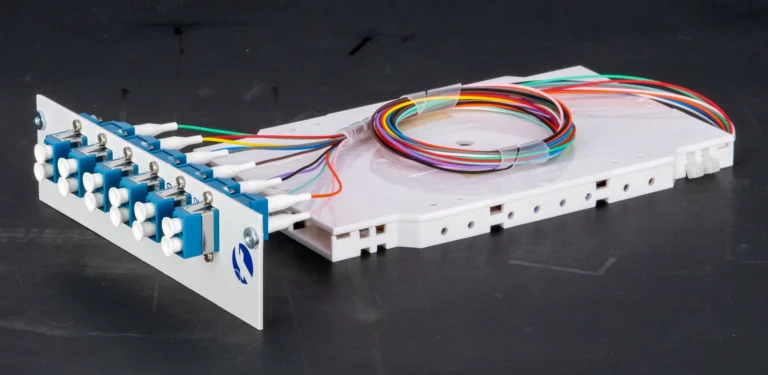
Modern fibre optic procurement tenders increasingly require modular splice systems that allow flexible adaptation to growing requirements. The technical specification should provide for packing densities of at least 96 fibres per 1HE – double that of conventional systems.
| System Type | Fibre Density | Application | Benefits |
|---|---|---|---|
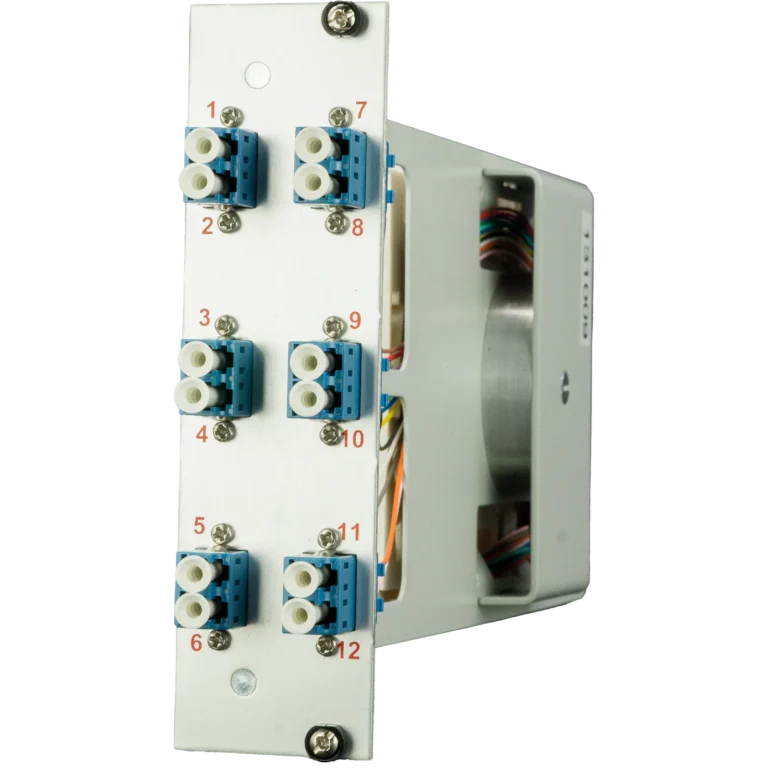
| 1HE SlimConnect | Up to 96 fibres | Distribution racks | Space-saving, modular expandable |
| 3HE VarioConnect | Up to 288 fibres | Main distribution frame | High packing density, tool-free |
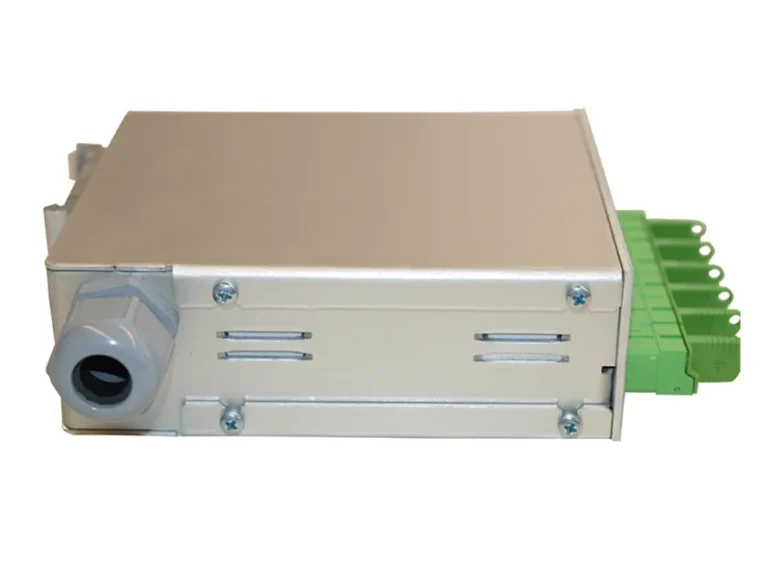
| DIN rail splice box | Up to 24 fibres | Industrial installations | IP65, vibration-resistant |
As a manufacturer and Diamond Partner, Fiber Products offers system solutions specifically developed for public authorities that meet all VDE 0800-730 requirements. The modular design enables subsequent expansion without operational disruption.
Standards-Compliant Connectors and Termination
Selecting the correct connectors is crucial for long-term stability of the fibre optic network. In public procurement, LC connectors to IEC 61754-20 dominate for high packing density and E2000 connectors to IEC 61754-15 for highest reliability.
- APC polishing (8°): Return loss > 60 dB, ideal for video transmission
- UPC polishing: Return loss > 50 dB, standard for data networks
- Attenuation: Maximum 0.25 dB for factory-terminated connectors
- Mating cycles: Minimum 1000 without performance loss
- Temperature range: −40°C to +85°C for outdoor applications
The E2000 technology with integrated protective shutter deserves particular attention, as it is becoming standard in security-critical areas such as government networks. The automatic protective cap prevents eye damage from laser radiation and reduces contamination.
Quality Assurance and Acceptance Criteria
Quality assurance in fibre optic procurement, DTVP and EVB-IT follows a multi-stage testing procedure. Every fibre must be individually documented and measured – sample inspection is not sufficient.
The acceptance protocol includes OTDR measurements in both directions, attenuation measurements at multiple wavelengths and visual end-face inspection with 400× magnification. The measurement results must comply with the limit values of DIN EN 50173-1.
- Total attenuation: Max. 0.4 dB/km at 1310 nm
- Splice attenuation: Max. 0.15 dB per splice
- Connector attenuation: Max. 0.35 dB per connection
- Macrobends: No visible attenuation spikes in OTDR
Funding Guidelines and Financing Models
Public fibre optic projects benefit from various funding programmes at federal and state level. The technical specification must take into account the respective funding guidelines, in particular requirements for open access and technology neutrality.
The federal broadband funding programme, for example, requires a minimum bandwidth of 1 Gbit/s symmetrical and the use of future-proof technologies. The 5 years warranty on Fiber Products systems significantly exceeds the required minimum standards.
| Funding Programme | Subsidy Rate | Technical Requirement |
|---|---|---|
| Federal funding | Up to 50% | Min. 1 Gbit/s symmetrical |
| State funding | Up to 40% | Fibre into building |
| EU funding | Up to 75% | Open access obligation |
Documentation Requirements under DTVP
The German Telekom Procurement Principles impose special requirements on technical documentation. This must be complete, verifiable and audit-proof. Modern fibre optic projects use digital documentation systems with GIS integration for this purpose.
- Route documentation: Georeferenced installation plans in shapefile format
- Splice diagrams: Detailed occupancy plans for all splice enclosures and distribution frames
- Measurement protocol: OTDR curves and tabular attenuation values
- Material list: Complete listing with manufacturer certifications
- Operations manual: Maintenance intervals and troubleshooting
- Training record: Documentation of personnel briefing
Documentation must be available in digital form no later than two weeks after acceptance. Fiber Products, as a German manufacturer, supports public authorities with pre-configured documentation templates specifically for public procurement.
Sustainability and Environmental Criteria in Procurement
Sustainability criteria are increasingly important in public fibre optic procurement tenders. The technical specification should define requirements for recyclable materials, energy-efficient production and short transport distances.
Modern splice systems from European production significantly reduce the carbon footprint. The modular design also enables repairs rather than complete replacement – an important contribution to resource conservation.
Public contracting authorities typically require these criteria in the specification:
- Use of halogen-free cable materials (LSZH)
- Recycling rate of at least 80% for packaging
- Demonstrable reduction in energy consumption during manufacture
- Repairability and spare parts availability for minimum 10 years
Practical Examples of Successful Municipal Fibre Optic Procurement
Successful fibre optic projects are characterised by precise technical specifications and realistic timelines. A municipal utility in Bavaria, for example, realised the connection of 15,000 households through modular splice systems with 96 fibres per 1HE – with half the space requirement in distribution racks.
The procurement explicitly required tool-free assembly systems and pre-terminated modules. This reduced installation time by 40 per cent whilst simultaneously improving documentation quality through standardised labelling systems.
Avoiding Common Mistakes in Fibre Optic Procurement
Many procurement tenders fail due to insufficient technical specifications or unrealistic requirements. The most common sources of error can be avoided through careful preparation.
- Missing reserve fibres: Plan minimum 30% reserve for future expansion
- Unclear interfaces: Define exact transition points between trades
- Forgotten ancillary services: Explicitly specify documentation, training and maintenance
- Incompatible standards: Define uniform connector types across all network levels
- Unrealistic timelines: Include buffer time for approvals and weather
FAQ: Technical Questions on Fibre Optic Procurement
What attenuation values should be specified for DTVP-compliant fibre optic procurement?
The maximum attenuation is 0.4 dB/km at 1310 nm and 0.3 dB/km at 1550 nm for singlemode fibres to ITU-T G.652.D. Connectors may have maximum 0.35 dB, splices maximum 0.15 dB attenuation.
Must EVB-IT contracts guarantee a specific availability level?
For passive fibre optic infrastructure, no availability guarantee is required. For active components, EVB-IT system contracts typically require 99.9% annual availability with defined response and recovery times.
Which splice modules meet public authority requirements?
Splice modules must be compliant with IEC 60297-3 and accommodate minimum 96 fibres per 1HE. Tool-free assembly and modular expandability are further important criteria for future-proof installations.
Are specific connector types mandatory for government networks?
There is no statutory requirement, but LC duplex APC has become the standard. For security-critical areas, the BSI recommends E2000 connectors with automatic protective cap against laser radiation.
What documentation is required under VDE 0800-730?
The standard requires complete as-built documentation with route plans, splice enclosure and distribution frame occupancy, OTDR measurement protocols for every fibre, and declarations of conformity for all components used.
How are warranty periods regulated for fibre optic projects?
VOB/B provides 4 years warranty, with EVB-IT contracts typically 2 years standard. High-quality
Order directly from our shop: fiber-products.com
Request a Quote Today
Free consultation – personalised quote within 24 hours