Patch Cables and Adapters: Perfect Accessories for Splice Modules
Patch cable adapters, splice module accessories and fibre optic accessories and adapterss form the essential foundation of every professional fibre optic installation – without optimally coordinated components, even high-quality splice modules cannot reach their maximum performance. The right combination of precision-engineered patch cables, standards-compliant adapters and modular splice systems determines attenuation values, packing density and long-term network stability.
For IT system integrators equipping their customers with future-proof fibre optic solutions, selecting the right accessories represents a central challenge. Modern splice modules require precisely matched patch cables and adapters to reliably guarantee required transmission rates of 10 to 400 Gbit/s.
Technical Fundamentals: Why Perfectly Matched Accessories Are Critical
The performance of a fibre optic connection depends substantially on the quality of all components. A high-quality patch cable adapter system minimises attenuation losses to less than 0.3 dB per connection and ensures return losses of over 50 dB with APC connectors.
- Precision-engineered ferrules with tolerances under 1 μm
- Standards-compliant connector geometry per IEC 61754
- Optimised fibre core centring for minimal insertion loss
- Long-term stable connections at over 1000 mating cycles
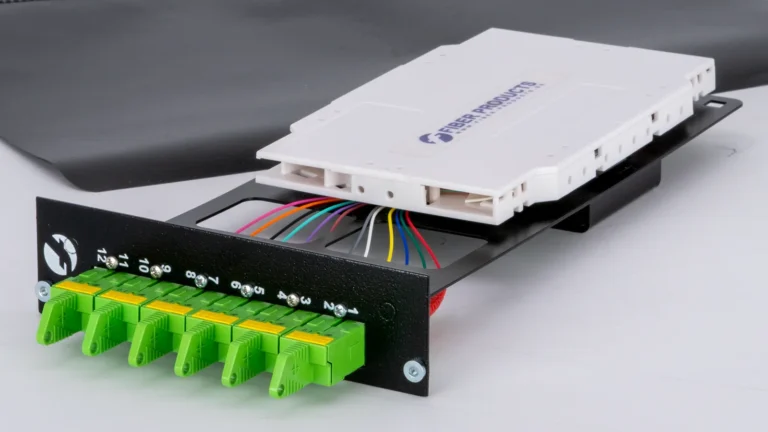
When integrating into splice modules, mechanical compatibility plays a central role. Adapters must fit exactly into the designated recesses whilst simultaneously enabling the required packing density – modern systems achieve up to 96 fibres on 1U.
Connector Types and Their Optimal Application in Splice Module Accessories
The choice of the right connector type substantially determines the possible applications and performance of the entire fibre optic complete system. Each connector type was developed for specific requirements and offers different advantages.
| Connector Type | Attenuation | Packing Density | Primary Application |
|---|---|---|---|
| LC Duplex | < 0.25 dB | Very high | Data centres, high port density |
| SC Simplex | < 0.30 dB | Medium | Distribution frames, robust environments |
| E2000 APC | < 0.20 dB | Medium | Industrial installations, dusty environments |
| MPO/MTP | < 0.35 dB | Extremely high | Backbone, parallel transmission |
The E2000 connector with integrated dust cap is particularly suitable for industrial applications, whilst LC connectors enable the highest port density through their compact design. IT system integrators increasingly rely on pre-terminated MPO trunk cables for fast backbone installations.
Patch Cable Specifications for Professional Installations
The quality of patch cables determines signal integrity across the entire network. High-quality fibre optic patch cables LC SC MPO meet strict technical requirements and guarantee long-term stable transmission characteristics.
- Fibre type: OS2 Singlemode (9/125 μm) for long distances up to 40 km
- Multimode: OM4/OM5 (50/125 μm) for data centres up to 550 m
- Jacket type: LSZH (halogen-free) per IEC 60332-1
- Bend radius: Minimum 15 mm with bend-insensitive fibres
- Tensile strength: 100 N for permanent installation
Fiber Products Quality Promise: As an official Diamond partner and manufacturer, we produce modular splice systems in Europe. Benefit from Swiss precision and in-house manufacturing.
Adapters and Couplings: The Underestimated Component in Fibre Optic Complete Systems
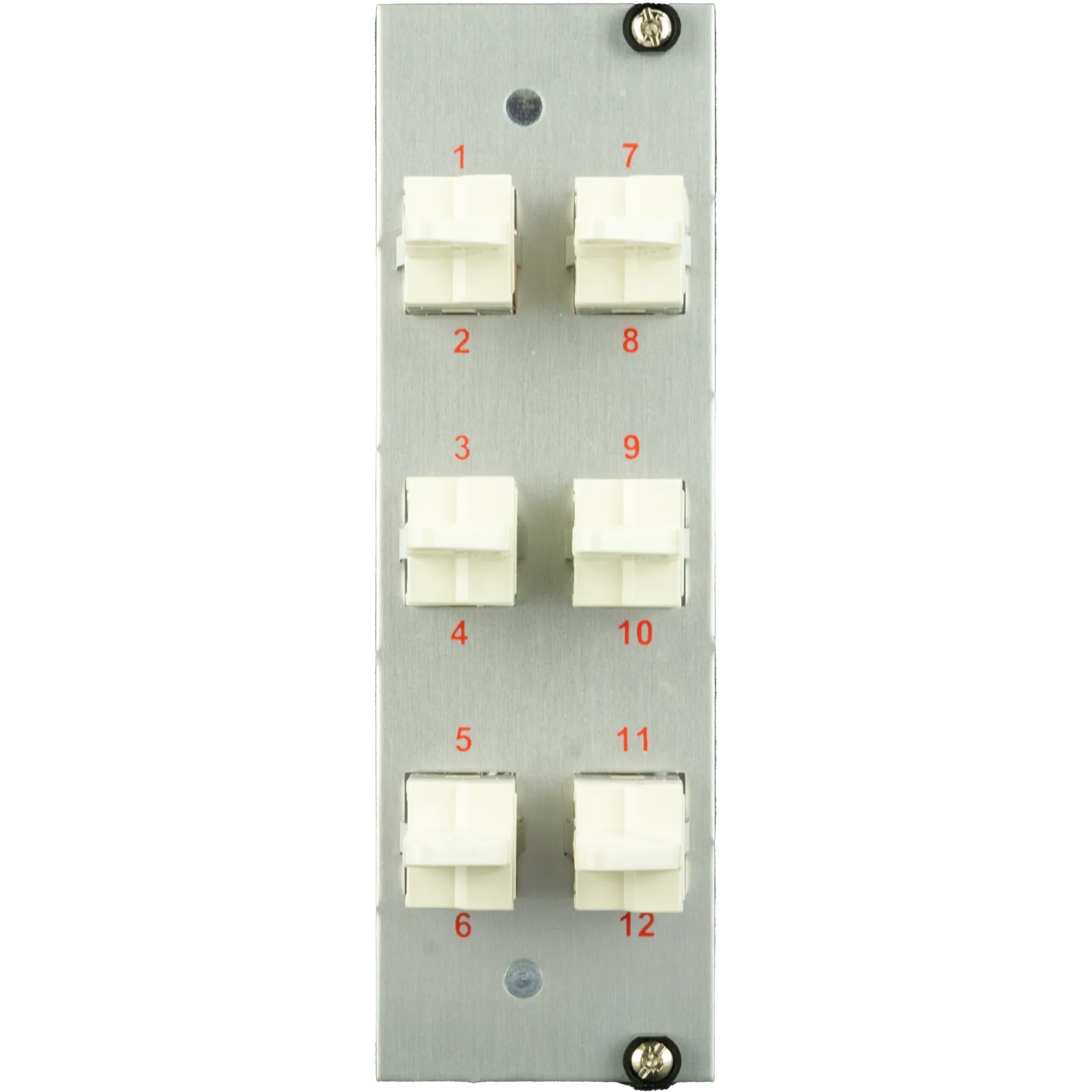
Adapters do more than just connect patch cables to splice modules – they also determine the optical performance of the entire route. Precision-engineered adapters with ceramic sleeves guarantee exact fibre alignment and minimal attenuation values.
Modern adapter variants offer special functions for different application scenarios. Hybrid adapters enable connection of different connector types, whilst shuttered adapters with automatic laser safety increase security in active networks.
| Adapter Type | Special Feature | Attenuation | Price Level |
|---|---|---|---|
| Standard Simplex | Basic design | < 0.2 dB | € |
| Duplex Adapter | Double capacity | < 0.2 dB | €€ |
| Hybrid Adapter | Different connectors | < 0.3 dB | €€€ |
| Shuttered | Laser safety integrated | < 0.25 dB | €€€€ |
Integration into Modular Splice Systems: Best Practices
Successful integration of patch cable adapter combinations into modern splice modules requires systematic planning. Modular systems such as SlimConnect (1U, up to 96 fibres) or VarioConnect (3U, up to 288 fibres) offer predefined slots for different adapter configurations.
- Colour coding per TIA-598-C for unambiguous identification
- Label fields for structured documentation
- Cable strain relief via integrated cable routing
- Dust protection caps for unused ports
- Tool-free replacement of defective modules
IT system integrators benefit from pre-configured modules that already come equipped with adapters and pigtails. This reduces installation time by up to 70 per cent and minimises assembly errors.
Quality Criteria for Professional Splice Module Accessories
The selection of high-quality components for the fibre optic complete system is based on objective quality criteria. Professional users focus on standards-compliant specifications and proven performance data.
Critical quality characteristics include insertion loss below 0.3 dB, return loss above 45 dB with PC polish and above 60 dB with APC polish. Mechanical durability must guarantee at least 500 mating cycles without performance degradation.
- Certification per ISO 9001:2015 for quality management
- Compliance with RoHS and REACH regulations
- Climate resistance: −40°C to +85°C storage temperature
- Moisture resistance: 95% relative humidity
Economic Aspects: TCO Considerations for IT System Integrators
The total cost of ownership of a patch cable adapter system extends far beyond the purchase price. IT system integrators increasingly calculate long-term maintenance and downtime costs.
High-quality components with 5 years manufacturer warranty pay for themselves through lower failure rates and reduced maintenance intervals. Standardisation on uniform connector systems also simplifies inventory management and reduces capital tied-up costs.
Modular systems enable demand-driven expansion without complete replacement. A splice module initially equipped with 24 fibres can be expanded to 96 fibres as needed – the underlying infrastructure remains intact.
Standards Compliance and Certifications in the European Market
The European market places particular demands on fibre optic complete systems. Beyond international standards such as IEC 61754 for connectors, national requirements and industry-specific specifications apply.
- DIN EN 50173-1: Application-neutral communication cabling systems
- VDE 0888: Optical fibres for telecommunications
- CPR Regulation: Fire performance of cables
- TAB Guidelines: Technical connection conditions of network operators
IT system integrators must often provide specific certificates for tender processes. Manufacturers with European production and established quality assurance systems offer decisive advantages here.
Future-Proofing: 400G and Beyond
The evolution towards 400 Gigabit Ethernet and prospectively 800G/1.6T creates new demands on patch cable adapters and splice module accessories. Modern fibre optic complete systems must already be designed for these transmission rates today.
Singlemode fibres of the OS2 type already support all current and foreseeable transmission standards. For multimode installations, OM5 fibres are recommended, which enable wavelength division multiplexing (WDM) in the short-distance range.
Investment in high-quality, future-proof components protects against costly retrofits. IT system integrators who today opt for modular systems with high-quality adapters and patch cables secure long-term investment protection for their customers.
FAQ: Frequently Asked Questions About Patch Cables, Adapters and Splice Module Accessories
What attenuation values are acceptable for professional patch cables?
Professional singlemode patch cables should exhibit attenuation of no more than 0.3 dB per connection. With high-quality components and APC polish, values below 0.2 dB are achievable.
How many mating cycles must adapters withstand at minimum?
Quality adapters guarantee at least 500 mating cycles without performance degradation. Premium components achieve over 1000 cycles with consistent optical performance.
Are pre-terminated or field-terminated patch cables better?
Pre-terminated patch cables offer consistent quality and factory-tested attenuation values. Time savings during installation amount to up to 80 per cent compared to on-site termination.
What colour coding applies to fibre optic patch cables?
Per TIA-598-C: yellow for singlemode OS2, orange for multimode OM1/OM2, aqua for OM3/OM4 and lime green for OM5. APC connectors are fundamentally marked green.
How do PC and APC polish differ in adapters?
PC polish (Physical Contact) provides return loss > 45 dB, whilst APC (Angled Physical Contact) with 8° angled finish achieves over 60 dB and minimises back-reflections.
What packing density is achievable with modern adapter systems?
Modern LC adapters enable up to 96 fibres on 1U in 19-inch systems. With MPO adapters, even 288 fibres on 1U are realisable.
Find all modular fibre optic components directly in the Fiber Products shop – with 5 years manufacturer warranty.
Request Expert Advice Now
Our experts advise you on modular fibre optic solutions tailored to your specific application – quickly, personally and with no obligation.