Fibre Optic Fire Service Networks – High-Availability Systems for Emergency Response
Fibre Optic Fire Service Networks – High-Availability Systems for Emergency Response with Modular Optical Fibre Solutions
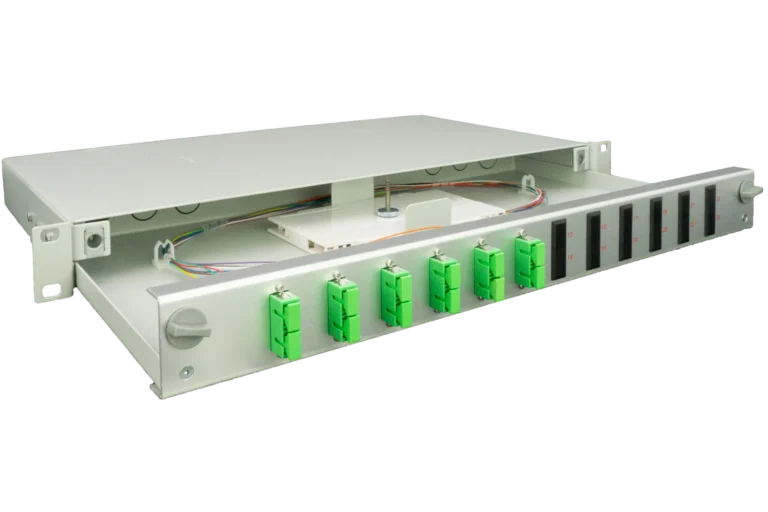
Fibre optic fire service and emergency response network solutions must deliver maximum availability with simultaneous failover protection – modern emergency control centres therefore rely on modular fibre optic systems with up to 96 fibres per 1U and redundant connections to IEC 61754-15. The critical infrastructure of fire and rescue services requires not only vibration-resistant connectors such as E2000 with IP65 protection, but also flexible splice modules that can be expanded within minutes.
The DACH market is accelerating fibre rollout for public safety facilities significantly in 2026 – the Grey Spot Programme alone provides €74 million for municipal FTTH projects, while the new VDE Guideline 0800-730 simplifies fire-compliant installations in fire station buildings.
Technical Requirements for Fibre Optic Fire Service Networks
Emergency response optical fibre infrastructure differs fundamentally from conventional office networks. Emergency control centres < 0.25 dB loss per connector and must remain operational even during partial failures. Modern fire service networks therefore use redundant ring structures with automatic switching within 50 milliseconds.
- Singlemode OS2 fibres for distances up to 40 kilometres between control centre and remote stations
- Multimode OM4/OM5 for local high-speed connections with 100 Gbit/s
- Mechanically locked connectors (E2000, LC-Push-Pull) against accidental disconnection
- Temperature range -40°C to +85°C for external installations
- Flame-retardant cables to IEC 60332-3 for building installations
The modular design enables subsequent expansion without operational interruption. Splice modules with interchangeable cassettes allow adding additional fibres or replacing faulty components during live operation.
Standards-Compliant Installation per VDE 0800-730 for Fire Station Buildings
Since February 2026, the new VDE Guideline 0800-730 applies, developed specifically for fibre optic installations in safety-critical buildings. This standard defines uniform requirements for the first time for fire-compliant optical fibre installation in fire stations and emergency response centres.
| Standards Area | Requirement | Fire Service Implementation |
|---|---|---|
| Fire Classification | B2ca-s1a,d1,a1 | Halogen-free cables throughout |
| Functional Retention | E30 to E90 | 30–90 min operation during fire |
| Bend Radius | Min. 15× cable diameter | Structured cable routing |
| Strain Relief | Max. 1000 N | Reinforced splice boxes |
The standard also requires all fibre optic fire service installations to be redundant. Critical connections must use two physically separate cable routes, with at least one fire-resistant sheathed.
Modular Splice Systems for Maximum Availability
The availability requirement of 99.999% (5 minutes downtime per year) demands well-designed system architectures. Modern fibre optic fire service networks deploy modular splice systems that expand without tools.
Fiber Products Quality Promise: As an official Diamond Partner and manufacturer, we produce modular splice systems in Europe. Benefit from Swiss precision and in-house manufacturing.
A typical fire service network consists of multiple components that work seamlessly together. Main distribution frames in the control centre use 3U splice systems with up to 288 fibres, while decentralised distribution points are equipped with compact 1U modules.
- Front panels with various connector types (LC, SC, E2000, ST)
- Splice cassettes for 24 or 48 splice connections
- Colour-coded identification per DIN EN 50173-1
- Integrated cable management with strain relief
- Documentation pockets for network plans
Emergency Response Optical Fibre: Specialised Connectors for Extreme Conditions
The selection of appropriate connectors determines the reliability of the entire fire service network. While office environments typically use LC connectors, emergency vehicles and remote stations require more robust solutions.
| Connector Type | Application Area | Special Feature | Loss |
|---|---|---|---|
| E2000 APC | Vehicles, outdoor | IP65, spring closure | < 0.15 dB |
| LC-Duplex | Control centre | High packing density | < 0.25 dB |
| MPO/MTP | Backbone | 12–72 fibres | < 0.35 dB |
| SC-Simplex | Legacy networks | Compatibility | < 0.30 dB |
The E2000 connector has proven particularly effective in emergency response optical fibre technology. Its spring-loaded protective cap automatically shields the ferrule from contamination, while the bayonet locking mechanism ensures secure retention even under severe vibration.
Redundancy Concepts for Critical Infrastructure
Fibre optic fire service systems must continue operating even during cable breaks or equipment failure. Implementation occurs across multiple layers with different protection mechanisms.
- Physical Redundancy: Dual cable routing via separate routes
- Logical Redundancy: Automatic switching to backup fibres
- Geographic Redundancy: Distributed control centre locations
- Temporal Redundancy: Buffered data transmission during interruption
Modern splice modules support these concepts through pre-installed switchover units. When a fibre breaks, switching to the backup fibre occurs automatically within 50 milliseconds – fast enough to avoid interrupting active emergency calls.
Integration into Existing Fire Service Network Structures
Most fire services migrate from copper to fibre incrementally. New optical fibre systems must integrate seamlessly with existing technology. Media converters bridge the technologies and enable smooth transition.
A typical migration project divides into three phases: First, the backbone transitions to fibre, then critical control centre connections follow, and finally end-device connections. This strategy minimises downtime and permits testing during live operation.
- Phase 1: Backbone connections between locations (6–12 weeks)
- Phase 2: Vertical cabling in buildings (4–8 weeks)
- Phase 3: Horizontal cabling to workstations (8–16 weeks)
- Parallel operation: Copper and fibre for 3–6 months
Maintenance and Documentation of Emergency Response Optical Fibre Infrastructure
The availability of fibre optic fire service networks depends heavily on regular maintenance. DIN EN 50346 defines test intervals and measurement protocols for safety-critical applications. Each fibre must be checked every six months with an OTDR instrument.
Modern splice systems simplify maintenance through labelled front panels and integrated test points. QR codes on modules link directly to digital documentation, giving technicians immediate access to history data and measurement records.
| Maintenance Interval | Task | Standard/Guideline |
|---|---|---|
| Weekly | Visual inspection | Operator guidelines |
| Monthly | Loss measurement on critical routes | IEC 61280-4 |
| Semi-annual | Full OTDR measurement | DIN EN 50346 |
| Annual | Connector cleaning and inspection | IEC 61300-3 |
Future-Proofing Through Scalable Fire Service Network Architectures
Data volumes in emergency response are increasing continuously. Body cameras, drones and IoT sensors generate data streams in the terabit range. Fibre optic fire service infrastructure must plan for this development today.
Modular systems offer decisive advantages here. By using interchangeable cassettes, capacity can be doubled without interrupting existing connections. Switching from multimode to singlemode or changing from LC to MPO connectors occurs via simple cassette replacement.
- Scaling from 1 Gbit/s to 400 Gbit/s without cable replacement
- Migration from OM3 to OM5 via cassette swap
- Expansion from 48 to 96 ports per rack unit
- Integration of new connector types without system redesign
Funding and Financing for Municipal Fibre Projects
Municipalities can utilise various funding programmes for expanding their fibre optic fire service networks. The Federal Grey Spot Programme provides €74 million for municipal projects in 2026 alone. Additionally, states support with their own programmes.
Funding rates reach up to 90% of eligible costs. This includes not only trenching and cable, but also splice systems and active components. Compliance with technical minimum requirements per Gigabit Guidelines 2.0 is required.
Practical Implementation: From Planning to Operational Emergency Response Optical Fibre
A typical fibre optic fire service project passes through several phases. Asset audit captures existing infrastructure and defines requirements. Detailed planning specifies cable routes and components. After tendering and award, installation follows.
- Asset Audit: Capture all locations and connections (2–4 weeks)
- Requirements Analysis: Define bandwidth and redundancy needs (1–2 weeks)
- High-Level Design: Cable routing and system architecture (3–4 weeks)
- Detailed Design: Component selection and bills of materials (2–3 weeks)
- Tendering: Preparation of performance specifications (4–6 weeks)
- Installation: Assembly and commissioning (8–12 weeks)
Selection of appropriate components determines project success and sustainability. Modular splice systems for government agencies with 5 years warranty significantly reduce lifecycle costs. Investment in high-quality systems pays dividends through lower maintenance costs and higher availability.
Frequently Asked Questions About Fibre Optic Fire Service Networks
What bandwidth does a modern emergency control centre require?
An emergency control centre with 50 workstations requires at least 10 Gbit/s symmetrical bandwidth. For video streaming from emergency vehicles and drones, plan an additional 40 Gbit/s reserve. Connections should ideally be redundant 100 Gbit/s links.
How long does copper-to-fibre migration take?
Complete fire service network migration takes 3–6 months depending on size. Critical connections can convert within 4–6 weeks. Dual-technology operation ensures uninterrupted service during transition.
Which standards apply to fibre in fire station buildings?
Key standards are VDE 0800-730 for building installations, DIN EN 50173-1 for structured cabling and IEC 60332-3 for fire safety requirements. Additionally, regional building codes for special buildings apply.
Can existing conduits be used for fibre?
Yes, existing conduits with minimum 20 mm internal diameter suit fibre cables up to 144 fibres. In tight spaces, microcables at only 6 mm diameter help. Blowing technique enables installation over 2000 metres distance.
How is failover protection ensured during power loss?
Fibre transmits signals purely optically without power in the cable. Active components are protected via UPS systems with 8–24 hours bridging time. Critical systems receive additional backup generators for 72 hours autonomy.
What funding options exist for municipal projects?
Federal funding covers up to 90% of costs. States like Bavaria or North Rhine-Westphalia supplement with their own programmes. Fibre solutions for municipal utilities meet all funding criteria. KfW additionally supports with low-interest loans.
Conclusion: Future-Proof Emergency Response Through Modular Fibre Systems
Fibre optic fire service networks form the backbone of modern rescue services. Investment in modular splice systems with 5 years warranty secures long-term availability and scalability. By adhering to current standards such as VDE 0800-730 and deploying high-quality components, fire service networks achieve the required 99.999% availability.
The combination of robust E2000 connectors for outdoor areas and high-density LC connections in control centres enables flexible system architectures. With proper planning and professional-grade components, emergency response optical fibre becomes the reliable lifeline in crisis. Learn more about the 5-year warranty on modular fibre systems for maximum availability in critical infrastructure.
Request a Quote
Do you have questions about our fibre optic solutions? Our expert team is happy to advise you – free and without obligation.