Fibre Rollout Frankfurt 2026: Data Centre Hub and FTTH Infrastructure
The Frankfurt fibre rollout reaches a critical turning point in 2026: while Mainova Glasfaser and the Frankfurt fibre network transform the digital infrastructure of Europe’s banking metropolis, the city positions itself as a leading European data centre ecosystem with 20 Internet hubs and port capacity of 200 terabits. The Gigabit Region Frankfurt-Rhine-Main coordinates the expansion of 25,000 kilometres of fibre optic lines to serve 1.5 million households and 640 commercial zones by 2030.
Frankfurt boasts the world’s most densely networked data centre landscape with 2,500 uniquely identified networks. This concentration makes high-density fibre-optic infrastructure indispensable – particularly for AI workloads requiring 1.6-terabit speeds and latencies below 1 millisecond.
Frankfurt Fibre Rollout: Status and Investment 2026
The Frankfurt fibre rollout received federal funding of €10.45 million in 2025 to connect the last 2,300 underserved addresses. Of 93,453 planned fibre connections across the city, over 91,000 will be implemented commercially by private operators.
- Deutsche Telekom: 8,300 new households in Frankfurt-Oberrad from spring 2026
- Speeds up to 1,000 Mbit/s symmetrical
- Free household connection with service contract
- Use of existing conduit for accelerated deployment
- First connections available in 2026
Deutsche Telekom has increased its fibre-optic investment by a further €800 million and connected 2.7 million new locations across Germany in 2025. In January 2026 alone, 120,000 new connections were provisioned – a 40 per cent increase over the previous year’s record.
Data Centres as Drivers of Frankfurt Fibre Network
Frankfurt’s status as the “Digital Capital of the World” rests on unique data centre density. The Frankfurt fibre network must meet extreme requirements: AI inference servers need a tenfold increase in connectivity from switch to GPU NIC.
| Technology | 2024 | 2026 | 2028 (Forecast) |
|---|---|---|---|
| Standard Speed | 400 Gbit/s | 1.6 Tbit/s | 3.2 Tbit/s |
| Latency Requirement | < 5 ms | < 1 ms | < 0.5 ms |
| Fibre Density per 1U | 48 Fibres | 96 Fibres | 144 Fibres |
| MPO Connectors | MPO-12 | MPO-24 | MPO-32 |
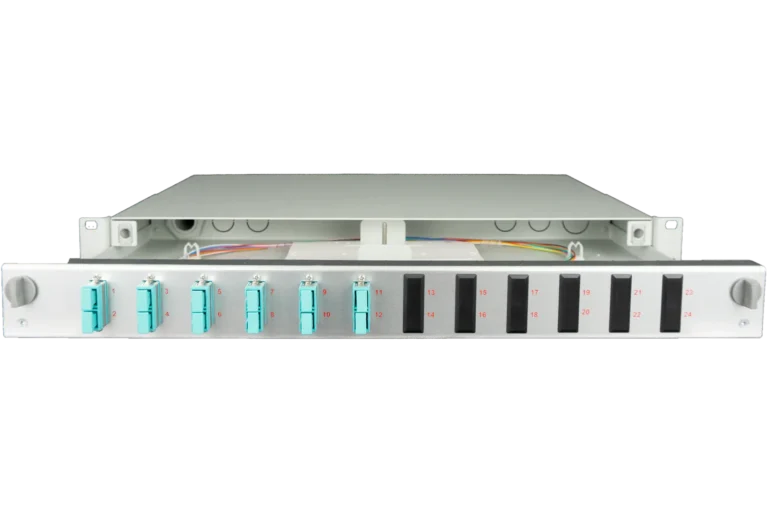
This development requires high-density splice systems with maximum port density. Modular 19-inch systems must accommodate up to 96 fibres in 1U whilst offering tool-free modularity for rapid adjustments.
Mainova Glasfaser: Synergies Between Energy and Data Infrastructure
Mainova Glasfaser benefits from unique synergies as part of Mainova AG: the company supplies over one million people with energy and leverages existing infrastructure corridors for fibre deployment. With 3,000 employees and responsibility for critical infrastructure, Mainova brings ideal conditions for parallel fibre-optic expansion.
- Use of existing energy infrastructure for fibre deployment
- Combined civil works reduce costs by 30–40 per cent
- Integration into Smart Grid projects
- Fibre-connected charging station provisioning
- 24/7 on-call service for critical infrastructure
Gigabit Region Frankfurt-Rhine-Main: Coordinated Deployment
Gigabit Region Frankfurt-Rhine-Main GmbH has coordinated regional Frankfurt fibre rollout and surrounding areas since 2025. Through framework agreements with Deutsche GigaNetz, Deutsche Glasfaser Wholesale and Telekom Deutschland, deployment is systematically advanced.
The success model rests on standardised processes: uniform permitting, digital applications and coordinated civil works accelerate deployment by up to 50 per cent. Municipalities benefit from pooled expertise without resource commitment.
Fiber Products Quality Commitment: As an official Diamond Partner and manufacturer, we produce modular splice systems in Europe. Benefit from Swiss precision and in-house manufacturing for data centres.
Technical Requirements for Modern Fibre Infrastructure
The Frankfurt fibre network must meet the highest technical standards. Data centres require not only high bandwidth but also maximum availability and scalability.
| Requirement | Standard 2024 | Data Centre 2026 | Standard/Norm |
|---|---|---|---|
| Attenuation Singlemode | < 0.35 dB/km | < 0.25 dB/km | IEC 60793-2-50 |
| Connector Loss | < 0.5 dB | < 0.25 dB | IEC 61753-1 |
| Return Loss APC | > 55 dB | > 60 dB | IEC 61754-15 |
| Bend Radius | 30 mm | 15 mm | ITU-T G.657.A2 |
Modern splice systems must meet these requirements whilst achieving high packing density. The VarioConnect 3U systems, for example, enable up to 288 fibres in 3U with full modularity.
Deployment Status Germany: Frankfurt in National Comparison
With fibre-optic availability of 42.9 per cent of all German households (June 2025), Germany sits at the European average. Frankfurt substantially exceeds this average through its function as a data hub.
- Schleswig-Holstein leads with 82 per cent fibre coverage
- Hesse achieves 38 per cent (state average)
- Frankfurt city centre: over 65 per cent availability
- Brandenburg doubled its connections within a year
- Baden-Württemberg remains last with 23 per cent
AI and Hyperscale: New Dimensions for Fibre Networks
Artificial intelligence fundamentally transforms requirements for the Frankfurt fibre network. Whilst 400-gigabit connections were standard in 2024, hyperscalers are implementing 1.6-terabit technologies in 2026 using combined 2×800-gigabit transceivers.
GPU cluster networking demands not just bandwidth but consistently low latency. Every microsecond of delay can extend AI model training time by hours. That’s why providers like Eunetworks are investing in “Super Highway” systems that reduce Frankfurt-to-Paris latency by 20 per cent.
Practical Implementation: From Planning to Installation
Successful Frankfurt fibre rollout requires systematic planning and professional components. Data centres must particularly focus on scalability and ease of maintenance.
- Demand Analysis: Current and forecast bandwidth requirements
- Route Planning: Redundant paths with separate entry points
- Component Selection: Splice boxes to IEC 61756-1
- Documentation: Complete fibre documentation per TIA-606-B
- Test Equipment: OTDR measurements per IEC 61280-4-2
Modular systems reduce installation times by up to 60 per cent. Pre-terminated modules enable plug-and-play installation without on-site splicing.
Funding and Financing Fibre Expansion
The Frankfurt fibre rollout benefits from various support programmes. Beyond the €10.45 million federal funding, state resources from Hesse and municipal contributions are available.
| Funding Source | Frankfurt Amount | Use | 2026 Status |
|---|---|---|---|
| Federal Funding | €10.45 million | Unserved Areas | Approved |
| State of Hesse | €3.5 million | Co-funding | Disbursing |
| City of Frankfurt | €1.4 million | Local Share 10% | Provisioned |
| Private Investors | >€200 million | Commercial | Ongoing |
Future Outlook: Frankfurt as a Digital Ecosystem
Mainova Glasfaser and the Frankfurt fibre network become critical infrastructure for digital transformation by 2030. The combination of data centre density, financial sector and research institutions creates unique synergies.
The planned 25,000 kilometres of fibre lines across the Gigabit Region will serve not just households but especially the 640 commercial zones with highest bandwidth. For data centres, this means access to one of Europe’s most powerful fibre-optic networks.
FAQ: Common Questions on Frankfurt Fibre Rollout for Data Centres
What fibre-optic speeds are standard in Frankfurt data centres in 2026?
Frankfurt data centres standardly implement 1.6-terabit connections via combined 2×800-gigabit transceivers in 2026. For AI workloads, initial 3.2-terabit technologies are already undergoing testing, whilst backbone connections between data centres are rated at 400 gigabits per wavelength.
What is the fibre-optic availability for commercial zones in Frankfurt?
Over 65 per cent of commercial zones in Frankfurt are already fibre-connected. By 2030, Gigabit Region Frankfurt-Rhine-Main plans to connect all 640 regional commercial zones with direct fibre connections up to 100 gigabits symmetrical.
Which technical standards apply to data centre fibre networks?
Data centres must comply with ISO/IEC 11801-5 for structured cabling and TIA-942-B for data centre infrastructure. Splice connections follow IEC 61300-3-35 with maximum attenuation of 0.1 dB, whilst MPO connectors must be certified to IEC 61754-7.
How do Mainova Glasfaser and other Frankfurt providers differ?
Mainova Glasfaser leverages existing energy infrastructure corridors for cost-effective deployment and provides integrated solutions for Smart City applications. Deutsche Telekom focuses on comprehensive FTTH deployment, whilst specialised carriers like Colt or Eunetworks provide dedicated data centre connections with guaranteed SLAs.
Which splice systems suit high fibre density in data centres?
For maximum port density, modular 19-inch systems with 1U height supporting up to 96 fibres are recommended. Systems should support both LC-duplex and MPO cassettes and offer tool-free modularity for rapid MAC operations (Move, Add, Change). Return loss on APC connectors should be at least 60 dB.
How long does fibre connection take for a data centre in Frankfurt?
With available infrastructure corridors, physical data centre connection typically takes 8 to 12 weeks. This includes permitting, civil works, fibre deployment and commissioning. Using existing conduit reduces time to 4 to 6 weeks. Redundant connections via separate routes extend timelines accordingly.
Conclusion: Frankfurt as Fibre-Optic Leader for Europe
The Frankfurt fibre rollout demonstrates how combining private investment, public funding and coordinated planning creates world-class infrastructure. With Mainova Glasfaser as local partner and the expanding Frankfurt fibre network, the city positions itself optimally for AI, hyperscale computing and digital transformation demands.
For data centres, this means access to one of Europe’s most powerful fibre-optic infrastructures. Planned investment exceeding €200 million within the city alone, coupled with Gigabit Region coordination, ensures Frankfurt strengthens its position as the digital capital. Professional fibre solutions and modular splice systems enable efficient and future-proof use of this infrastructure.
Looking for modular fibre-optic solutions?
Fiber Products GmbH – official DIAMOND SA Partner. Made in EU, 5-year warranty.