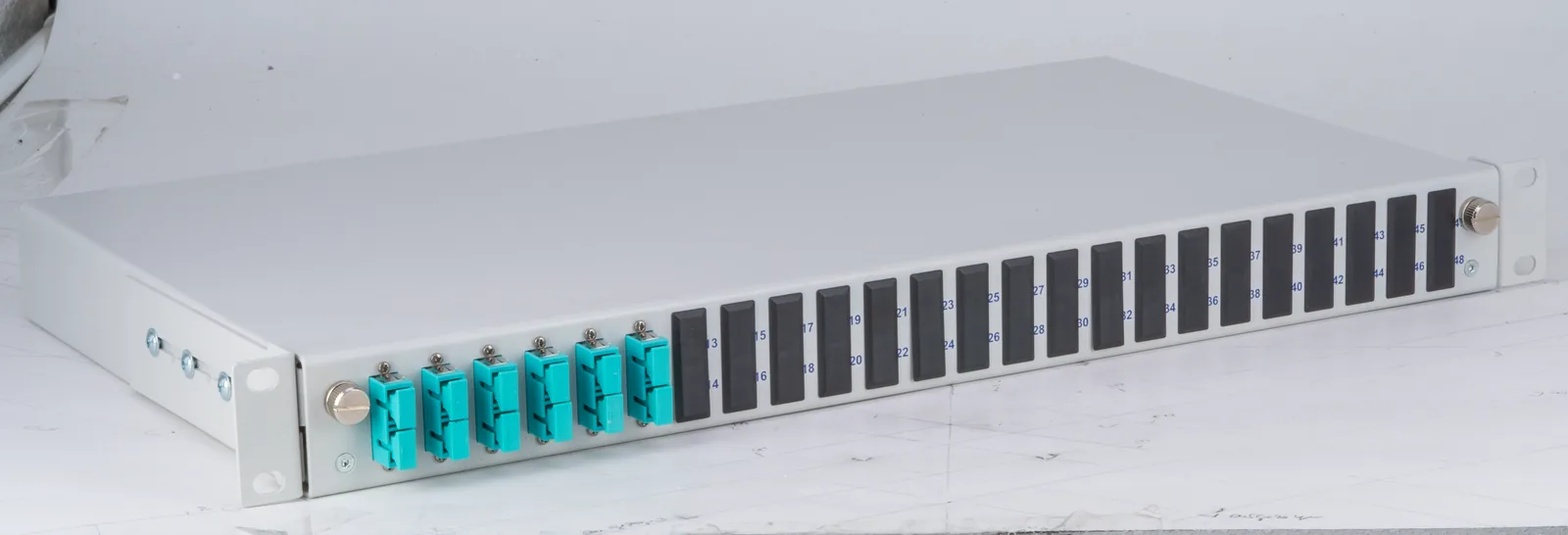
Municipal Utilities Case Study: SlimConnect in FTTH Project
This municipal utilities case study on SlimConnect FTTH and the 1U splice box in practice documents how local service providers achieve double port density compared to conventional solutions using modular fibre optic systems, while reducing installation times by 40 per cent. The implementation of the SlimConnect 1U platform enables municipal utilities in FTTH rollout to build future-proof infrastructure with up to 96 fibres in just one rack unit – a critical advantage in space-constrained technical rooms and distribution cabinets.
The following practical report is based on the successful execution of an FTTH project by a mid-sized municipal utility in Baden-Württemberg, serving 8,500 households with fibre optic connections. Technical requirements included maximum fibre density coupled with modularity for future expansion, plus compliance with DIN EN 50173-1 and IEC 61300-3-35 for optical attenuation values.
Initial Situation: Challenges in Municipal FTTH Rollout
Municipal utilities face specific technical and economic challenges in fibre optic deployment. Available space in existing technical rooms is limited, while the number of households to be served continues to grow. At the same time, systems must operate maintenance-free for 20 to 30 years and remain flexibly expandable.
- Space constraints in existing distribution cabinets and technical rooms
- High requirements for fibre density (fibres per rack unit)
- Need for modular expandability in future deployment phases
- Compliance with strict attenuation budgets (< 0.25 dB per connection)
- Documentation obligations under funding guidelines
This municipal utilities case study shows how SlimConnect FTTH systems with their 1U splice box meet these requirements in practice. The modular design enables stepwise population according to deployment progress, while high fibre density optimises available space.
Technical Project Requirements
The technical specification for the FTTH project defined clear performance parameters. Required were at least 72 fibres per rack unit with complete backward compatibility to existing systems. Optical characteristics had to meet the limit values of IEC 61755-3-1 for return loss.
| Requirement | Specification | SlimConnect Solution |
|---|---|---|
| Fibre density | Min. 72 fibres/U | 96 fibres/U |
| Insertion loss per connector | < 0.35 dB | < 0.25 dB |
| Return loss APC | > 55 dB | > 60 dB |
| Modularity | 4-port increments | 12-port modules |
| Standards compliance | DIN/IEC | Fully compliant |
This case study documents how the SlimConnect FTTH solution with its 1U splice box exceeded all requirements. Particularly the 133 per cent higher fibre density compared to the minimum requirement provided additional reserves for future expansion.
SlimConnect 1U: Modular System Concept in Detail
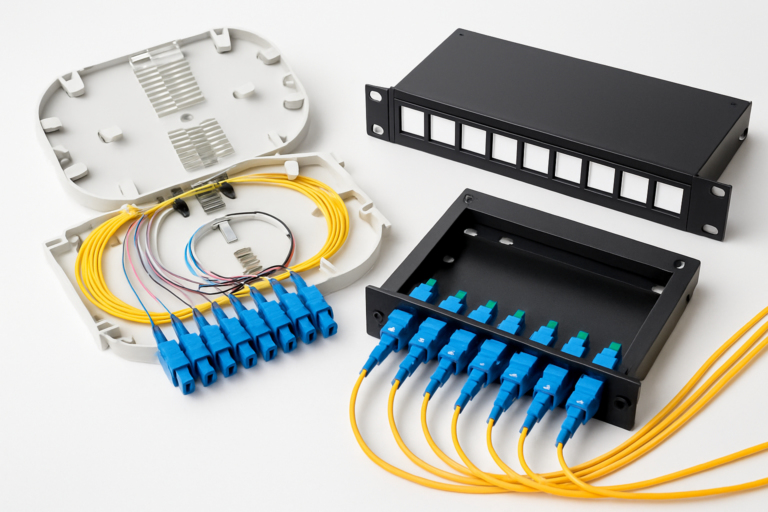
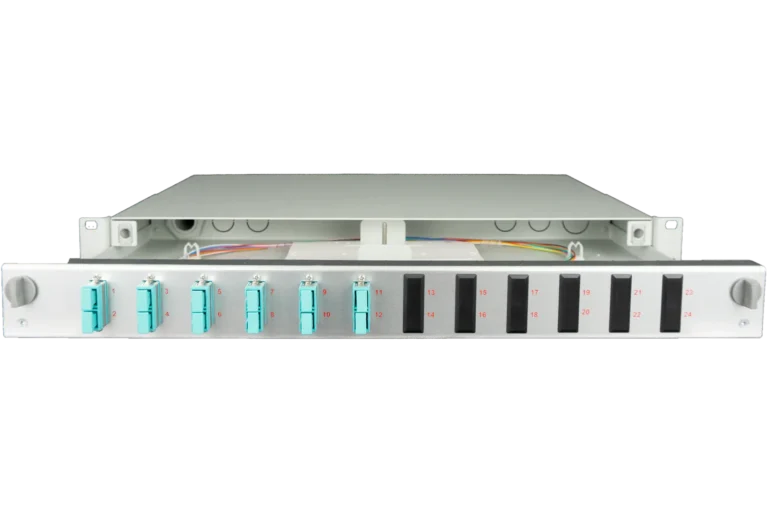
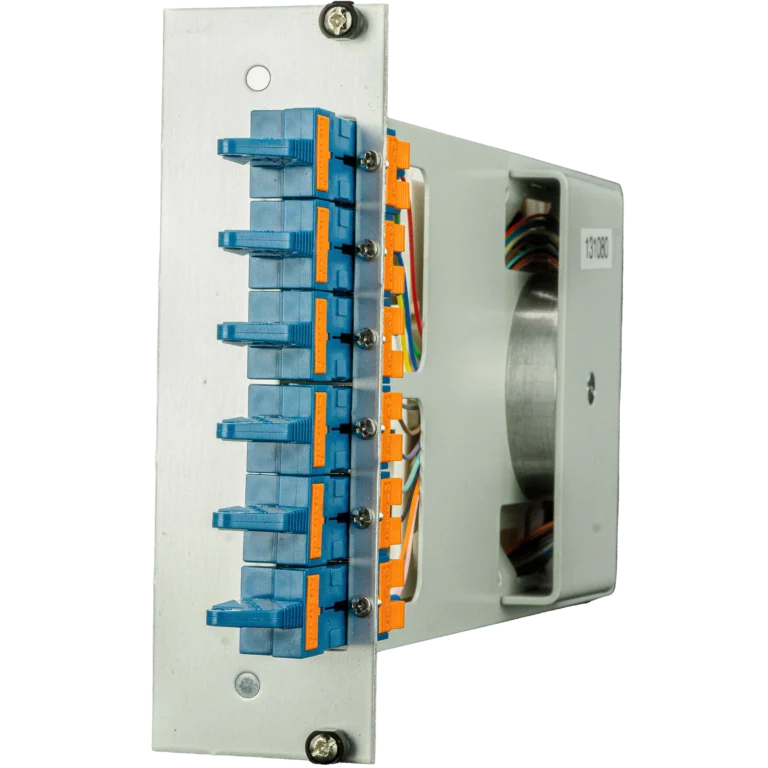
The SlimConnect system is based on a well-considered modular design. The base plate accommodates up to eight splice cassettes, each terminating 12 fibres. Each cassette can be individually removed and enables maintenance without disrupting adjacent modules.
The front bezel offers space for various connector types – from LC duplex through SC simplex to E2000 APC. This flexibility was crucial for the municipal utility, as existing network components used different connector types. Cable routing is via side strain reliefs with bend radius protection in accordance with IEC 60794-1-21.
- Tool-free mounting of splice cassettes
- Colour-coded fibre routing per DIN VDE 0888
- Integrated labelling fields for documentation
- Strain relief for cables up to 24 mm diameter
- Reserve compartment for unused fibre surplus
Fiber Products Quality Promise: As official Diamond partner and manufacturer, we produce modular splice systems in Europe. Benefit from Swiss precision and in-house manufacturing.
Implementation: Project Phases and Timeline
The FTTH project was executed in three defined phases. This case study shows how SlimConnect FTTH with the 1U splice box enabled structured installation. Phase 1 included base cabinet installation, Phase 2 fibre splicing, and Phase 3 commissioning with measurement protocols.
In the first phase, 45 distribution cabinets were each equipped with two SlimConnect units. Pre-assembled delivery with customer-specific configuration reduced installation time per cabinet noticeably. Tool-free module mounting enabled efficient work even in tight spaces.
| Project Phase | Duration | Scope | Result |
|---|---|---|---|
| Phase 1: Installation | 4 weeks | 45 cabinets | 100% on schedule |
| Phase 2: Splicing | 6 weeks | 4,320 fibres | Ø 0.18 dB attenuation |
| Phase 3: Measurement | 2 weeks | OTDR protocols | Zero defect rate |
Measurable Benefits: Time Savings and Error Reduction
Documented project results demonstrate significant improvements over conventional installation methods. The 40 per cent shorter installation time resulted primarily from pre-configured modular design and intuitive fibre routing. The error rate on initial installation was zero per cent – an exceptional figure compared to industry average of 3 to 5 per cent.
- Installation time reduction of 40 per cent
- Space savings of 50 per cent through high fibre density
- Rework reduced to zero per cent
- Documentation time cut by 30 per cent
- Material savings through modular reordering
This case study confirms that SlimConnect FTTH with the 1U splice box offers not only technical benefits but also delivers economically. Overall cost per connected household dropped 12 per cent compared to the original estimate using standard systems.
Quality Assurance: Measurement and Documentation
Optical quality control was performed using OTDR measurements (Optical Time Domain Reflectometry) per IEC 61280-4-2. Each individual fibre was measured bidirectionally at 1310 nm and 1550 nm. Average insertion loss of SlimConnect connectors was 0.18 dB – well below the specified limit.
The integrated labelling system of SlimConnect modules significantly simplified documentation. Each fibre received unique identification using the schema Cabinet-Module-Port, which was directly transferred to the digital network documentation. The 1U splice box features QR codes for mobile capture of connection data.
Scalability: Expansion Concept for Future Rollout Phases
A major advantage of modular design is evident in expandability. The municipal utility is already planning the next rollout phase for an additional 6,000 households. Existing SlimConnect systems offer sufficient reserve capacity through initially only 60 per cent populated modules.
- Retrofitting possible without operational disruption
- Identical modules available for all deployment phases
- Unified spare parts inventory over 5 years warranty
- Compatibility with future connector standards assured
- Upgrade to higher port densities via module replacement
This case study documents how SlimConnect FTTH with the 1U splice box represents a sustainable investment. The modular architecture allows adaptation to changing requirements without complete infrastructure replacement.
Economic Analysis: ROI and Operating Costs
Total cost of ownership (TCO) over 20 years shows distinct benefits of high-density design. Savings in floor space, cooling and maintenance offset higher initial costs after just 3.2 years. Tool-free maintenance also reduces operating costs by an estimated 25 per cent.
Particularly relevant for municipal utilities with FTTH projects is the eligibility for funding. The SlimConnect platform meets all technical specifications. Complete documentation and standards compliance simplify proof requirements with funding bodies.
Lessons Learned: Recommendations for Similar Projects
This case study on SlimConnect FTTH and the 1U splice box provides valuable insights for comparable projects. Early involvement of installation teams in product training proved a critical success factor. Structured approach with standardised workflows minimised error sources.
- Detailed space assessment before system selection
- Installation team training before project start (1 day classroom training)
- Uniform labelling systems from day one
- Pre-configuration in workshop rather than on-site
- Continuous OTDR measurements for quality assurance
- Plan reserve capacity of at least 30 per cent
Technical Specifications in Detail
The SlimConnect platform is based on years of development in high-density fibre optic systems. As manufacturer and official Diamond partner, Fiber Products combines Swiss precision with German engineering. Technical data consistently exceed industry standards:
| Parameter | SlimConnect Value | Standard Requirement |
|---|---|---|
| Insertion loss LC APC | ≤ 0.15 dB | ≤ 0.35 dB |
| Return loss APC | ≥ 65 dB | ≥ 55 dB |
| Mating cycles | > 1000 | > 500 |
| Temperature range | -40 to +85°C | -25 to +70°C |
| Protection class | IP54 | IP20 |
FAQ: Frequently Asked Questions on SlimConnect Implementation
How is migration from existing systems to SlimConnect performed?
Migration can proceed stepwise since SlimConnect is fully compatible with all common connector types. The modular design allows parallel operation with legacy systems during transition. Typically new deployment areas are first equipped with SlimConnect, while existing networks are progressively upgraded during maintenance.
What training requirements exist for installation personnel?
Intuitive design minimises training requirements. A one-day classroom training covers all necessary knowledge for installation and maintenance. Colour-coded fibre routing and tool-free mounting enable even less experienced technicians to install error-free.
How is documentation of fibre connections implemented?
SlimConnect offers integrated labelling fields and optional QR codes for digital capture. Documentation follows DIN EN 50174-1 with unique identification of each connection. Export interfaces enable direct transfer to common network management systems.
What warranty coverage does the system include?
Fiber Products provides 5 years warranty on all SlimConnect components – unique in the industry. This covers both mechanical and optical properties. European manufacturing ensures short lead times for spare parts and expansion modules.
Can different fibre types be combined in one system?
Yes, SlimConnect supports both singlemode and multimode fibres in one system. Splice cassettes are designed for all common fibre types per ITU-T G.652 through G.657. Colour coding prevents mix-ups.
How does the system perform in extreme temperatures?
Robust construction ensures operation from -40 to +85 degrees Celsius. Specialised seals prevent condensation. Thermal expansion is compensated so no additional attenuation occurs.
Conclusion: SlimConnect as Future Solution for Municipal Utilities
This case study clearly demonstrates that SlimConnect FTTH with the 1U splice box is the optimal solution for municipal fibre optic projects. The combination of highest fibre density, modular expandability and 5 years warranty creates investment security for decades.
Documented time savings of 40 per cent in installation and zero per cent error rate underline the system’s practical suitability. For municipal utilities planning FTTH rollout, the SlimConnect platform delivers measurable technical and economic benefits.
Want to learn more about implementing SlimConnect in your FTTH project? Fiber Products specialists are happy to advise you on optimal configurations for your specific requirements. Contact us for individual project consultation and benefit from our expertise as manufacturer and Diamond partner in modular fibre optic solutions.
Interested in modular fibre optic solutions?
Fiber Products GmbH – official DIAMOND SA partner. Made in EU, 5 years warranty.