ISO/IEC 11801 Structured Cabling: Fibre Optic Requirements for Modern Networks
ISO/IEC 11801 Structured Cabling: Fibre Optic Requirements for Modern Networks
The ISO/IEC 11801 international standard defines technical requirements for structured cabling and sets precise fibre optic standard specifications for performance classes, attenuation budgets and system components. This standard forms the technical foundation for every professional fibre optic installation and specifies minimum requirements from fibre through connectors to complete cabling systems.
For planners and system integrators, knowledge of these standard specifications is business-critical. Every tender for data centres, municipal utilities or public buildings requires ISO 11801-compliant cabling as a prerequisite.
Core elements of ISO/IEC 11801 for fibre optic cabling
The ISO/IEC 11801 is divided into several subcategories that define specific requirements for structured cabling. The fibre optic standard distinguishes between different fibre types and their applications.
| Fibre type | Category | Bandwidth | Range | Typical application |
|---|---|---|---|---|
| OM3 | Multimode 50/125µm | 10 Gbit/s | 300m | Building cabling |
| OM4 | Multimode 50/125µm | 40/100 Gbit/s | 150m | Data centres |
| OM5 | Multimode 50/125µm | 100 Gbit/s | 150m | High-performance data centre |
| OS2 | Singlemode 9/125µm | up to 400 Gbit/s | >10km | FTTH, long-haul |
The standard defines not only fibre types but also maximum attenuation values per connection. A splice module, for example, must guarantee < 0.25 dB attenuation per splice point to be compliant with the standard.
Loss budget calculation to ISO/IEC 11801
Loss budget is a central parameter of the ISO/IEC 11801 for structured cabling. The fibre optic standard specifies precise limit values that must be observed during planning.
- Fibre attenuation OS2: 0.4 dB/km at 1310nm
- Fibre attenuation OM4: 3.5 dB/km at 850nm
- Connector attenuation: max. 0.75 dB
- Splice attenuation: max. 0.3 dB
- Total channel budget: depends on transmission rate
For a typical building installation with 500m OM4 fibre, two splice modules and four connectors, the budget is as follows: 1.75 dB (fibre) + 0.6 dB (splices) + 3.0 dB (connectors) = 5.35 dB total attenuation.
Test procedures and measurement specifications
Quality assurance to ISO/IEC 11801 requires standardised measurement procedures. Every structured cabling installation must be documented and verified in accordance with the fibre optic standard.
Key test standards are IEC 61300-3-6 for return loss and IEC 61300-3-35 for visual inspection of fibre end faces. Modern splice modules must pass these tests before they can be used in critical infrastructure.
Fiber Products quality commitment: As an official Diamond Partner and manufacturer, we produce modular splice systems in Europe. Benefit from Swiss precision and 5 years warranty on our systems.
Fire safety requirements for fibre optic cables
An often overlooked aspect of ISO/IEC 11801 concerns fire safety ratings. Structured cabling must meet specific requirements depending on building classification. The fibre optic standard refers to supplementary standards in this regard.
- IEC 60332-1-2: Single wire flame test (basic level)
- IEC 60332-3-24 Category C: Bundle wire test for data centres
- EN 50575: Construction Products Regulation for permanent installation
- Fire class B2ca: Minimum requirement for public buildings
From February 2026, the VDE guideline 0800-730 will apply in Germany, which correctly classifies fibre optic cables as non-critical for fire safety purposes. This significantly simplifies installations and noticeably reduces costs.
Structured levels according to ISO/IEC 11801-1
The current version of the standard defines six structured levels for building cabling. Each level has specific requirements for fibre optic infrastructure.
| Level | Designation | Typical components | Fibre count |
|---|---|---|---|
| 1 | Campus distributor | Main distributor, splice box | 144–288 fibres |
| 2 | Building distributor | 19″ splice modules | 48–96 fibres |
| 3 | Floor distributor | Compact splice boxes | 24–48 fibres |
| 4 | Work point | Connection outlets | 2–4 fibres |
Modern splice boxes in 1U form factor now achieve packing densities of up to 96 fibres, significantly exceeding the minimum requirements of the standard.
Compatibility with German standards
The ISO/IEC 11801 harmonises with German standards for structured cabling. The fibre optic standard is supplemented and refined by national regulations.
The DIN EN 50173 series largely adopts the ISO specifications and adapts them to European conditions. Additionally, the new VDE 0800-730 defines specific requirements for FTTH installations in German buildings.
- Adoption of all ISO 11801 limit values
- Additional provisions for building installation
- Simplified fire safety requirements
- Practical installation guidelines
- Mandatory test protocols
Connector specifications of the standard
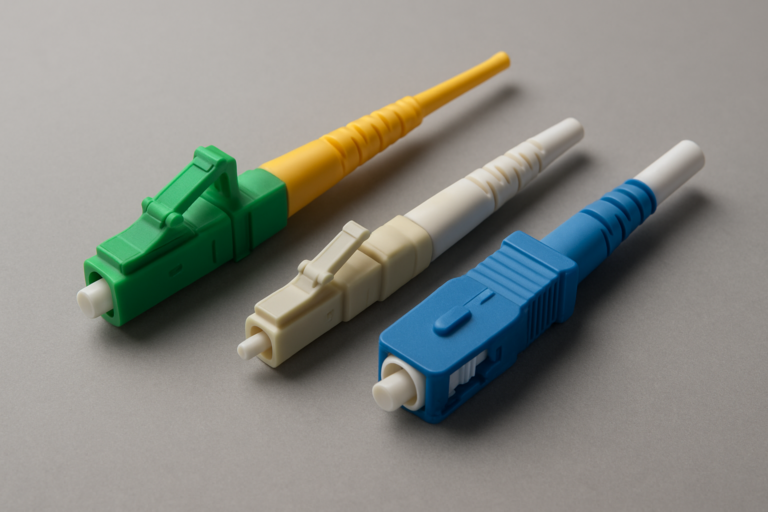
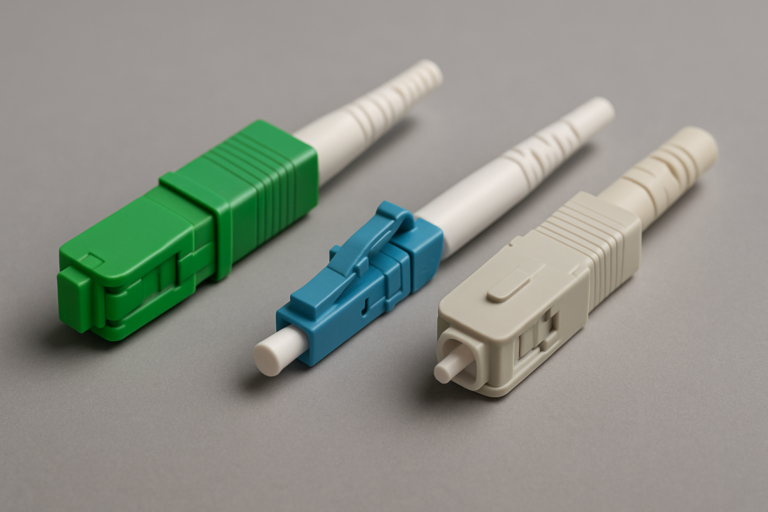
The ISO/IEC 11801 defines precise performance parameters for fibre optic connectors. Each connector type must meet specific requirements of structured cabling to comply with the fibre optic standard.
Particularly relevant are the specifications for attenuation and return loss. An LC connector with APC polish, for example, must achieve a return loss of at least 60 dB, while PC polish connectors achieve 45 dB.
| Connector type | Max. attenuation | Return loss PC | Return loss APC |
|---|---|---|---|
| LC | 0.5 dB | >45 dB | >60 dB |
| SC | 0.5 dB | >45 dB | >60 dB |
| E2000 | 0.3 dB | >50 dB | >65 dB |
| MPO/MTP | 0.75 dB | >35 dB | >60 dB |
Practical implementation in German fibre optic projects
Implementing ISO/IEC 11801 in real projects requires systematic planning. German municipal utilities and network operators strictly follow the fibre optic standard for structured cabling.
A typical FTTH project with 1,000 households requires approximately 20 kilometres of fibre optic cable, 50 distribution cabinets and over 4,000 splice connections. Every single component must be documented as ISO-compliant.
- Planning phase: Loss budget calculation to standard
- Material selection: Use only certified components
- Installation: Document all splice values
- Handover: OTDR measurement to IEC 61280-4-1
- Operation: Regular control measurements
Modular splice systems for standards-compliant installation
Modern splice modules must not only meet the technical specifications of ISO/IEC 11801 but also consider practical requirements of structured cabling. The fibre optic standard sets only the minimum requirement.
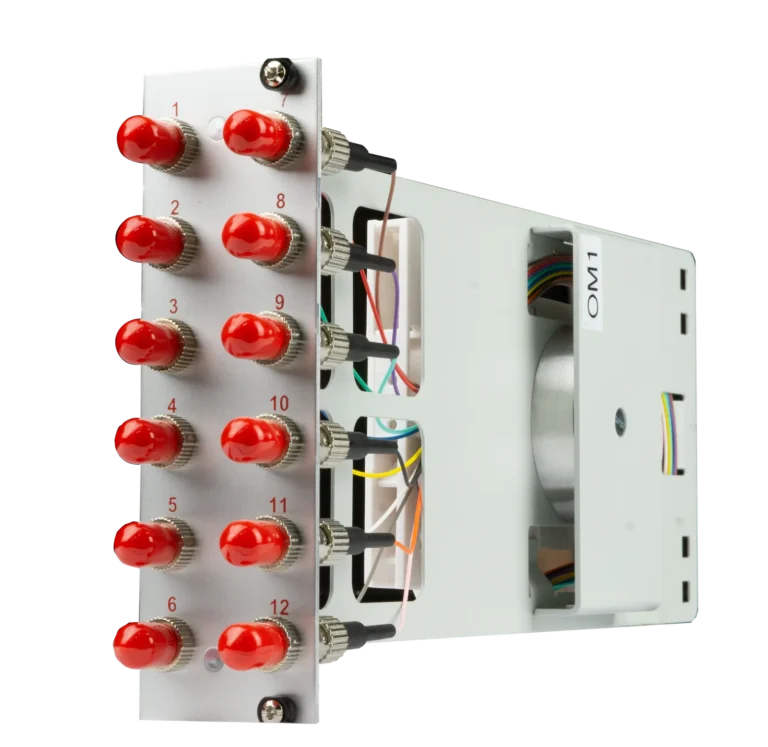
High-density systems such as the SlimConnect system achieve 96 fibres in just 1U, offering double the packing density compared to standard solutions. The modular design allows flexible combination of various connector types – from LC through SC to the industrial E2000 standard.
As a manufacturer and official Diamond Partner, Fiber Products offers the complete system solution with 5 years warranty – a unique selling point in the German market.
Measurement technology and documentation to ISO/IEC 11801
The standard requires complete documentation of all measurements. Every installation must be checked with calibrated measuring instruments and recorded in a protocol.
- OTDR measurements for line attenuation
- Microscope inspection of all connectors
- Power measurement with defined light source
- Documentation in database systems
- Handover of digital measurement protocols
Measurement accuracy must be ±0.1 dB, and equipment calibration must be verified annually. Professional splice modules feature integrated documentation systems that automatically meet these requirements.
Future-proofing through standards-compliant planning
The ISO/IEC 11801 continues to evolve. Current amendments address new transmission rates up to 400 Gbit/s and wavelength division multiplexing techniques. Structured cabling must already take these developments into account today. The fibre optic standard provides clear guidance here.
Particularly relevant is the forthcoming ISO/IEC 11801-7 for industrial environments. It defines for the first time requirements for vibration-resistant connections and extended temperature ranges from -40°C to +75°C.
Economic aspects of standards compliance
Strict adherence to ISO/IEC 11801 may incur additional costs initially, but pays off in the long run. Standards-compliant structured cabling to fibre optic standard reduces downtime and simplifies expansions.
| Cost factor | Without standard | With ISO 11801 | Saving |
|---|---|---|---|
| Troubleshooting/year | Higher | Lower | Reduced |
| Downtime | Higher | Lower | Reduced |
| Expansions | Completely new | Modular | Reduced |
| Maintenance | Monthly | Annually | Reduced |
A mid-sized data centre saves approximately 150,000 euros in operating costs over ten years through ISO-compliant installation.
Frequently asked questions on ISO/IEC 11801 in practice
Which measuring instruments are approved for ISO 11801-compliant handovers?
ISO/IEC 11801 specifies cabling design, not test equipment. Testing of installed fibre cabling is governed by ISO/IEC 14763-3, which uses a light source and power meter (LSPM) to measure link and channel attenuation, with OTDR as a complementary method for characterising individual events and components. Instrument calibration follows IEC 61315 for power meters and IEC 61746-1/-2 for OTDRs. The standard requires the test equipment to be documented and the measurement uncertainty of each method to be taken into account, but it defines no fixed instrument accuracy class and no mandatory calibration interval.
Does ISO/IEC 11801 apply to existing buildings?
During modernisation, the standard applies only to newly installed components. Existing cabling has grandfathering status but should be gradually upgraded to standard compliance during expansions.
How does ISO 11801 differ from EN 50173?
EN 50173 is the European counterpart to ISO/IEC 11801, published by CENELEC. Both series cover the same subject – cabling structure, channel, link and component performance and the test procedures for verifying conformance – and are closely harmonised, but they remain separate documents rather than identical texts. CE marking and reaction-to-fire classes for cables are not part of EN 50173: they follow the EU Construction Products Regulation, via the harmonised standard EN 50575 and the fire classification EN 13501-6.
What warranty periods are typical for ISO-compliant installations?
Fiber Products grants a 5-year manufacturer warranty on its modular splice systems.
Must all components come from the same manufacturer?
The standard does not mandate manufacturer binding but recommends coordinated systems. Mixed installations must be individually measured and documented, which means additional effort.
How often must an ISO 11801 installation be inspected?
The standard itself does not specify inspection intervals. German Occupational Safety and Health Regulations recommend annual visual inspections and measurement-based controls of critical connections every three years.
Conclusion: ISO/IEC 11801 as the foundation of professional fibre optic networks
The ISO/IEC 11801 forms the essential technical foundation for every professional structured cabling installation. The precise specifications of the fibre optic standard guarantee interoperability, future-proofing and cost-effective operation of modern fibre optic networks.
For planners and system integrators in the German market, standards compliance is non-negotiable – it is a prerequisite for public tenders and professional installations. With the substantial FTTH rollout and new regulatory requirements such as the GIA regulation, the importance of standards-compliant systems continues to grow.
Modular splice systems that exceed the standard’s minimum requirements offer decisive advantages: higher packing density, more flexible configuration and long-term investment security. The combination of Swiss precision engineering, European manufacturing and comprehensive system warranty creates measurable added value for demanding fibre optic projects.
Request a quote
Do you have questions about our fibre optic solutions? Our expert team will be happy to advise you – free and without obligation.