Fibre Optic Networks for Courts and Justice Systems – Secure Communication Infrastructure
Fibre Optic Networks for Courts and Justice Systems – Secure Communication Infrastructure
Fibre optic networks for courts and justice systems form the foundation of modern digital justice through high-security point-to-point connections featuring AES-256 encryption and inherent physical tap-proof security. Germany’s digitalisation of the justice system mandates fibre-based infrastructure under the updated Telecommunications Act (TKG) 2026, delivering up to 100 Gbit/s symmetric bandwidth for electronic case files, video hearings and secure data exchange between courts.
Justice ministries and court buildings across the DACH region face the challenge of protecting sensitive case data against cyber attacks whilst meeting EU digital sovereignty requirements. Fibre optic technology with E2000 connectors and modular splice systems meets these requirements through inherent electromagnetic interference immunity.
Why Fibre Optic Networks Are Essential for Courts and Justice Systems
Germany’s copper shutdown begins January 2026 regionally at 80% FTTH coverage according to BNetzA plans – justice authorities must migrate their critical communication networks in time. Unlike copper cables, optical fibres offer absolute tap-proof security since electromagnetic radiation is physically impossible.
- No electromagnetic radiation – TEMPEST compliant
- Instant detection of physical tampering attempts through loss monitoring
- Bandwidth reserves for future requirements (up to 400 Gbit/s per fibre)
- Failsafe redundancy through multi-fibre architectures
- Galvanic isolation between building sections
The Federal Court of Justice and Federal Administrative Court already operate fully fibre-based networks. BSI technical guideline TR-03116-4 explicitly mandates fibre optic networks for high-security government networks.
Technical Requirements for Court Networks with Fibre Optics
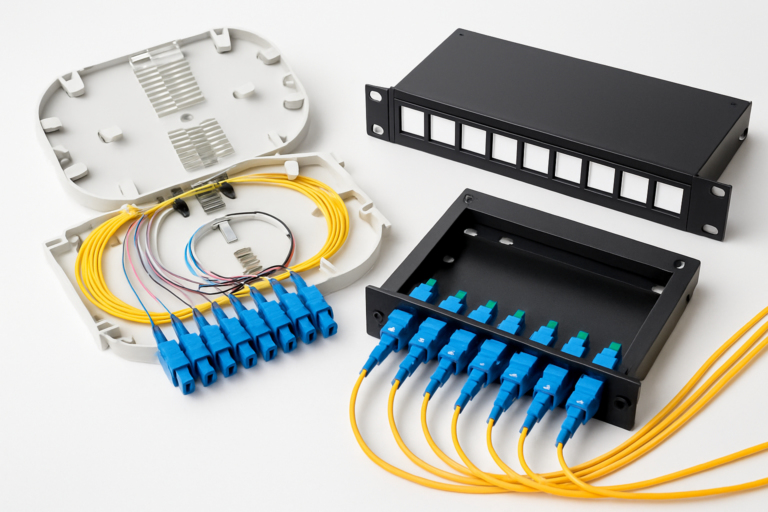
Justice authorities require specialised fibre optic solutions beyond standard office cabling. The modular design with 1U splice boxes accommodates up to 96 fibres in minimal space – ideal for the confined conditions in historic court buildings.
| Requirement | Fibre Optic Solution | Technical Specification |
|---|---|---|
| Tap-proof security | Singlemode OS2 | 9/125 µm, ITU-T G.652.D |
| Bandwidth | DWDM-capable | Up to 88 channels per fibre |
| Latency | Direct connection | < 0.1 ms in-building |
| Loss | Lowest attenuation | < 0.25 dB per splice |
| Service life | Future-proof | > 25 years operating life |
Fibre Optic Courts: Security Architecture for Sensitive Data
Network architecture in court buildings follows the principle of physical segmentation. Public areas, internal administration and highly sensitive hearing rooms use separate fibre strands with different security levels.
Critical connections between prosecution offices and courts operate over dedicated dark fibre routes with APC-polished connectors for minimal return loss. Standard IEC 61754-15 defines mechanical requirements for E2000 connectors, which provide additional security through integrated protective shutters.
- Redundant fibre routing across separate fire compartments
- Protocol-level encryption supplementing physical security
- Real-time optical power level monitoring
- Automatic failover on fibre break (< 50 ms)
Fiber Products Quality Commitment: As an official Diamond Partner and manufacturer, we fabricate modular splice systems in Europe. Benefit from Swiss precision engineering and in-house manufacturing.
Court Networks: Modular Splice Systems for Flexible Expansion
Justice system digitalisation demands scalable network infrastructure. Modular splice systems such as SlimConnect enable post-installation expansion without operational interruption. With VarioConnect 3U you can manage up to 288 fibres in a single system.
Pre-terminated MPO connectors reduce installation time. During active court operations, this time saving is crucial. The modular design also enables phased expansion aligned with budget availability.
| System type | Fibre density | Application | Key feature |
|---|---|---|---|
| SlimConnect 1U | Up to 96 fibres | Distribution rooms | Made in Europe |
| VarioConnect 3U | Up to 216 fibres | Main distribution frame | Modular expansion |
| VarioConnect 3U | Up to 288 fibres | Data centre | Highest packing density |
Justice Authority Fibre Networks: Standards-Compliant Installation to BSI Requirements
Fibre optic network installation in justice authorities is subject to strict security regulations. The BSI mandates in TR-03108 complete documentation of all fibre routes including OTDR measurement protocols. Each splice point must be documented with < 0.1 dB loss.
- Certified installers subject to security vetting
- Full fibre logging with unique identification
- Regular loss measurements per IEC 61280-4-1
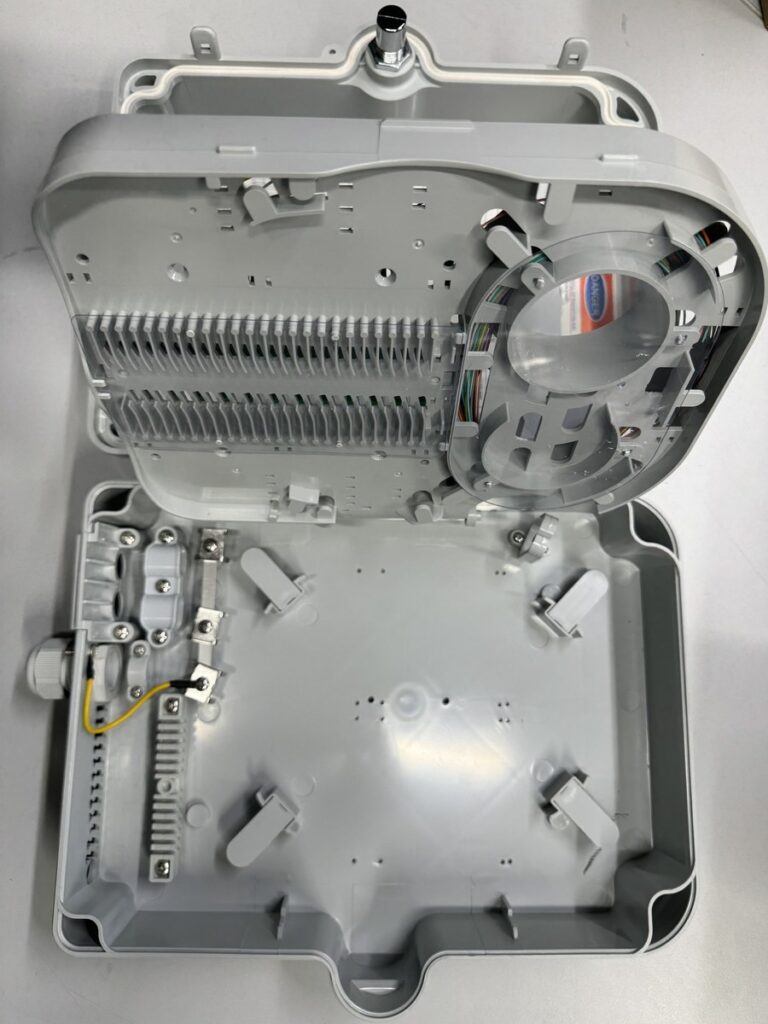
- Sealed splice boxes with tamper protection
- Redundant documentation in separate systems
E2000 connectors are particularly advantageous for government networks as the automatic protective shutter prevents contamination. Diamond quality guarantees return loss exceeding > 55 dB.
FTTH Rollout for Court Sites: Current Developments 2026
The Gigabit Infrastructure Act has accelerated fibre rollout for public buildings since November 2025. Justice authorities benefit from shortened approval procedures and prioritisation as "institutions of outstanding public interest" under the TKG Amendment 2026.
BREKO network operators invested a total of 4.9 billion euros in FTTH expansion during 2024. Regional municipal utilities are strategically connecting court sites with dedicated fibre links. Federal support programmes specifically assist court connections in structurally weak regions.
Video Conferencing and Electronic Case Files: Bandwidth Requirements
Electronic case files and HD video conferences for hearings require stable, high-performance networks. Each video stream requires minimum 4 Mbit/s symmetric bandwidth; multiple parallel hearings quickly aggregate to over 100 Mbit/s.
- eCase access: 10 Mbit/s per workstation
- HD video conferencing: 4–8 Mbit/s bidirectional
- Document scanner: 50 Mbit/s upload capacity
- Archive access: 1 Gbit/s backbone connection
- Failover reserve: 100% redundancy for critical systems
Fibre optic court networks must meet these requirements not only today but for the next 20 years. Singlemode fibre scalability with wavelength multiplexing ensures this future-proof capability.
Maintenance and Operation of Court Fibre Networks
Operating optical fibre networks in justice authorities requires specialist personnel and regular maintenance intervals. Preventive maintenance includes bi-annual loss measurements and cleaning of all connectors with IPA-saturated cleaning sticks.
Modular systems significantly simplify maintenance. Faulty modules can be swapped without splice work – a decisive advantage given the required 99.99% availability for justice systems. The 5 years warranty on Fiber Products systems further reduces operating costs.
Future Perspectives: Quantum Communication for Maximum Security
The next evolution of fibre optic court networks is quantum key distribution. Pilot projects between German federal authorities already employ quantum-secured connections over standard optical fibres. The physical properties of quantum entanglement make eavesdropping attempts not merely detectable but impossible.
This emerging technology requires high-quality singlemode fibres with minimal attenuation. Today’s installed OS2 fibres to ITU-T G.652.D are already quantum-ready and protect long-term investments.
FAQ: Frequently Asked Questions on Fibre Optic Networks for Courts
Which connector types are suitable for justice authority networks?
For justice authority fibre networks, E2000-APC connectors with integrated protective shutter are recommended. They offer maximum return loss (> 60 dB) and protection against contamination. Alternatively, LC-duplex connectors with ceramic ferrules suit high-density applications.
How many fibres does a mid-sized district court require?
A district court with 50–100 staff typically requires 48 to 96 fibres in the backbone. Plan 12–24 fibres per floor for horizontal cabling. Modular SlimConnect systems achieve this in 1–2 rack units.
Which standards apply to fibre optic networks in German courts?
DIN EN 50173-1 governs structured cabling, ISO/IEC 11801 sets international standards, and BSI guidelines TR-03108 and TR-03116-4 define security requirements. Installation must comply with DIN VDE 0888.
How is migration from copper to fibre conducted during ongoing operations?
Migration occurs in stages: parallel fibre infrastructure installation, then gradual switchover of individual departments. Pre-terminated MPO cassettes reduce downtime noticeably per segment. Legacy copper cabling remains as fallback until full migration completion.
What grants are available for fibre justice projects?
The Federal Broadband Promotion Programme supports fibre connections for public institutions with grants up to €50,000 per connection. Regional programmes also exist – for example Bavaria’s BayGibitR offers 90% funding for authorities in underserved areas.
How is tap-proof security guaranteed for optical fibres?
Optical fibres are inherently tap-proof through absent electromagnetic radiation. Additional security measures include real-time loss monitoring (OTDR surveillance), sealed joints and end-to-end protocol encryption. Tampering attempts produce immediately measurable loss changes.
Conclusion: Fibre Optic Networks as Foundation for Digital Justice
Fibre optic networks for courts and justice systems are no longer a future prospect – they are current necessity. With copper shutdown from 2030 onwards and rising security mandates, professional fibre optic solutions are unavoidable. Modular splice systems manufactured in Europe offer the flexibility and future-proofing needed for justice system digitalisation.
As manufacturer and official Diamond Partner, Fiber Products supports justice authorities with thoughtfully engineered system solutions – from compact SlimConnect boxes to high-density VarioConnect systems. The 5 years warranty and European manufacturing guarantee long-term investment security for critical justice infrastructure.
—
Request a Quote
Have questions about our fibre optic solutions? Our expert team is happy to advise you – free and without obligation.