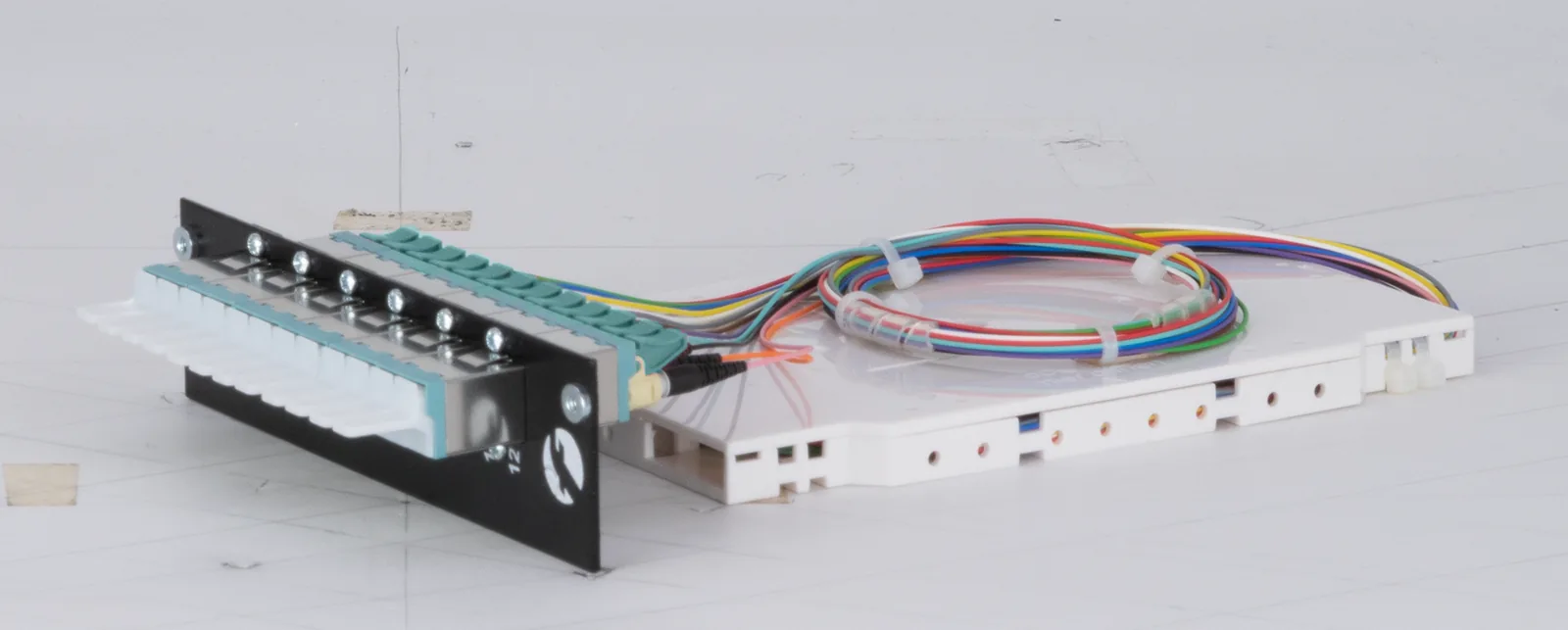
7TE modules: The modular system for flexible fiber optic distribution
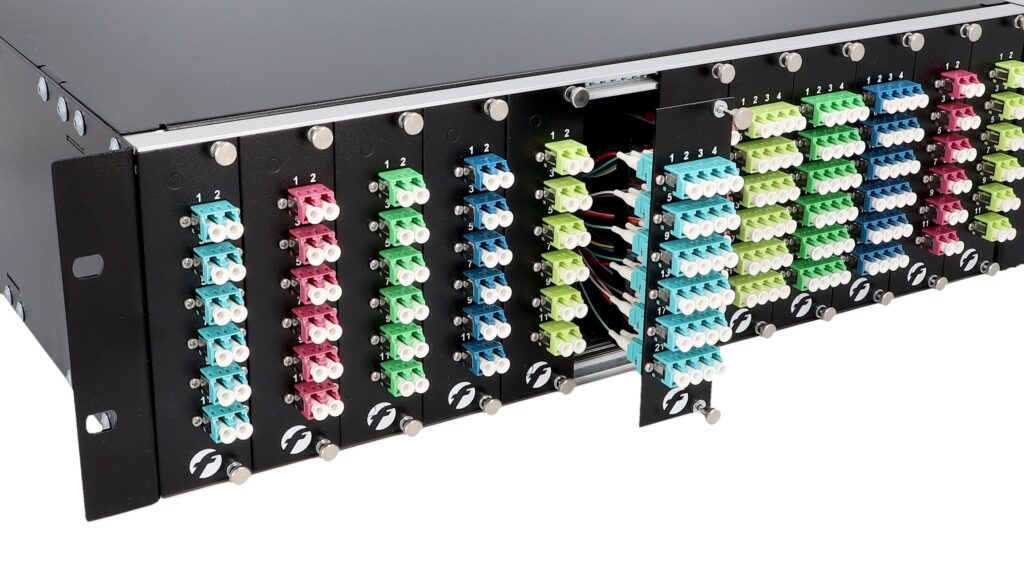
The 7TE module format has established itself as a universal component of modern fiber optic distribution and forms the technical foundation for both VarioConnect 3U systems and compact SlimConnect 1U solutions. This standardization is no coincidence, but the result of years of development and optimization: The 35.5 mm module width (7 × 5.08 mm pitch units) creates the optimum compromise between functionality, ergonomics and packing density.
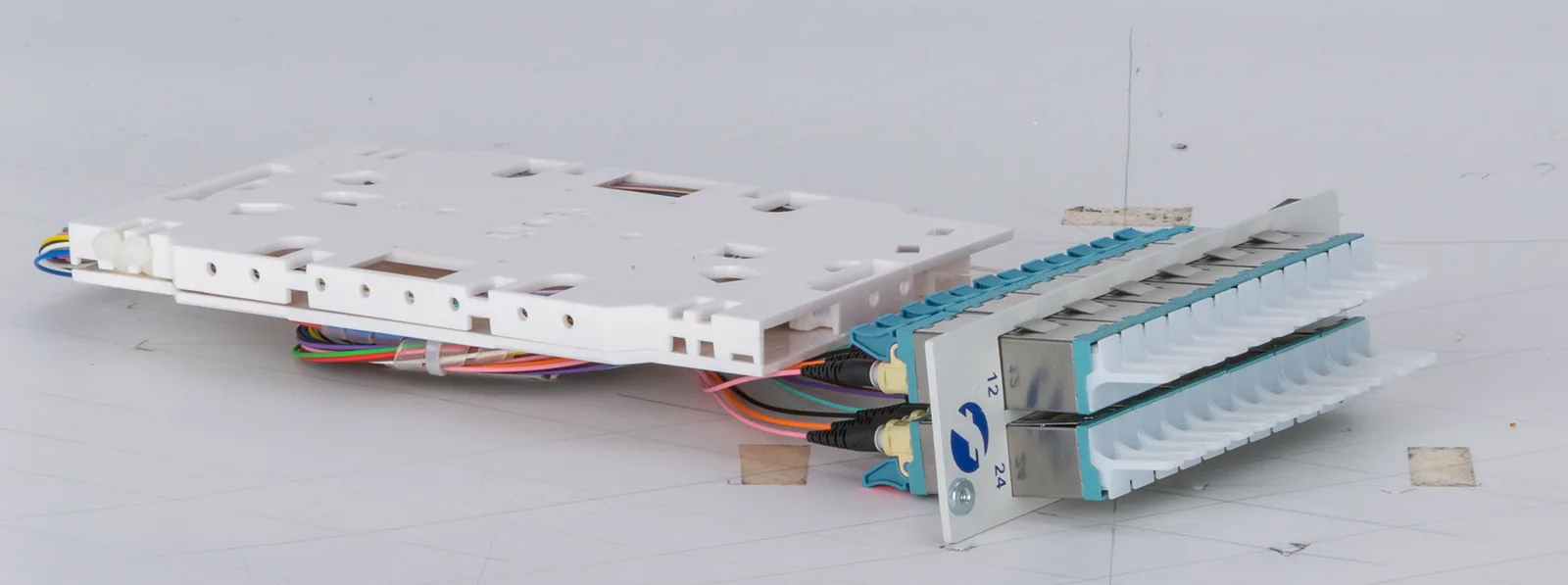
While other providers use proprietary module formats with unclear future security, the 7TE architecture is based on proven industry standards and therefore enables unique flexibility and scalability. The modular principle makes it possible to compose tailor-made solutions for a wide range of application scenarios from standardized basic modules – from compact 72-fibre installations to complex 288-fibre systems.
Development history and standardization
The development of the 7TE format is based on a systematic analysis of optimum module sizes for fiber optic distribution: Smaller formats limit functionality and fiber capacity, while larger modules compromise flexibility and ergonomics. The 35.5 mm width enables both sufficient fiber capacity (up to 24 connections) and convenient handling by service technicians.
19″ rack integration was a key design criterion right from the start: the 7TE format fits perfectly into standard partitioning grids and enables efficient use of space. Twelve 7TE modules fit exactly into 3U housings(VarioConnect systems), while 1U systems(SlimConnect). This mathematical precision is the basis of the high system efficiency.
International standardization based on proven electronics standards: The TE (dividing unit) system has been established in the electronics industry for decades and ensures compatibility with standard rack systems. This standardization reduces development costs and increases interoperability.
Technical specifications and dimensioning
Mechanical dimensions follow precise tolerances: 35.5 mm width, 160 mm depth and variable heights depending on the application create optimum space utilization. These dimensions are matched to standard rack geometries and enable tight packing without accessibility problems.
Internal architecture optimizes fibre guidance and capacity: Concentric guide rings with a diameter of 30-40 mm ensure standard-compliant bending radii even with bend-optimized G.657 fibres. The internal structuring supports up to 24 fibre optic connections per module with systematic organization.
Interface standardization enables universal compatibility: mechanical interlocking, optical through-hole plating and electrical contacts (if required) are uniformly specified. This standardization allows modules to be exchanged between different systems and manufacturers.
Module types and variety of applications
Splice modules for backbone distribution form the basis of many installations: These modules accommodate 12-24 splice connections and enable branching or looping of optical fibers. Integrated splice cassettes and optimized fibre guidance optimize quality and ease of maintenance.
Front modules with different connectors offer maximum flexibility: E2000, LC, SC and MTP variants cover all common application scenarios. Interchangeable front panels allow subsequent adaptations to changing requirements without the need for a complete replacement.
Breakout modules for transitions between cable types: Transitions from bundled cables to individual fibres or between different connectors are implemented using specialized modules. These transitions are optimized at the factory and outperform field installations in terms of quality.
Patch modules for flexible patching: Fully equipped modules with front connections enable simple patch panel configuration. These modules are particularly optimized for data centre applications with frequent rearrangements.
Compatibility of 7TE modules between VarioConnect and SlimConnect
Cross-system compatibility enables unique flexibility: 7TE modules can be migrated between VarioConnect 3U and SlimConnect 1U systems. This universality is unique in the industry and creates unprecedented investment security.
Migration scenarios use module compatibility: Growing installations can migrate from SlimConnect to VarioConnect without losing modules. Conversely, oversized VarioConnect systems can be rightsized through SlimConnect migration.
Unified Inventory Management reduces warehousing: a single module type can be used for different system configurations. This simplification reduces warehousing costs and simplifies procurement.
Service and support synergies: Service technicians only need to learn one modular system to master both product lines. This simplification reduces training costs and improves modular maintenance concepts.
Configuration flexibility and customizability
Mix-and-match configurations use different module types: Splice modules, front modules and special modules can be combined as required. This flexibility enables tailor-made solutions without any loss of standardization.
Field reconfigurable features enable customization: Interchangeable components such as front panels or adapter inserts can be swapped on site. This flexibility reduces warehousing and enables quick adjustments.
Graduated Density Options support different connection densities: Modules are available in 6-, 12-, 18- and 24-port variants. This graduation enables optimum adaptation to specific requirements without over- or under-provisioning.
Maintenance and lifecycle management
Predictive maintenance thanks to modular granularity: wearing parts or critical components can be identified in individual modules and replaced preventively. This granularity reduces unplanned downtime and optimizes maintenance cycles.
Hot-swap capabilities for critical applications: Modules can be swapped in redundant systems during operation. This capability is particularly valuable in 24/7 data center environments or critical infrastructures.
Modular Refresh Strategies extend system service life: instead of complete replacement, individual modules can be replaced with newer versions. This gradual modernization reduces costs and failure risks.
Systematic troubleshooting methods benefit considerably from the structured 7TE architecture, as problems can be isolated and rectified in a modular manner.
Quality assurance and certification
Manufacturing quality control in controlled environments: Factory production under clean room conditions outperforms field installation in terms of quality. Automated manufacturing processes guarantee reproducible quality.
100% testing of all critical parameters: Each module undergoes complete optical and mechanical testing before delivery. This quality assurance eliminates DOA (Dead on Arrival) and reduces field failures.
Standard compliance by design: modules meet all relevant standards (IEC, DIN, TIA) by design. This compliance is built-in, not subsequently tested.
Economic advantages of modularity
Economies of scale through standardization: High quantities of identical modules significantly reduce production costs. These cost benefits are passed on to customers and improve the competitive position.
Reduced time-to-market for new variants: New module variants use proven basic architecture and can be developed quickly. This agility enables a rapid response to market requirements.
Lower total cost of ownership through maintenance efficiency: Standardized modules reduce training costs, warehousing and maintenance times. These OPEX benefits add up to considerable savings over the operating time.
Investment protection through future-proofing: modules can be reused for system upgrades or technology changes. This flexibility protects investments from premature obsolescence.
Innovation and future development
Next-generation features through modular evolution: New technologies such as integrated monitoring, automatic patching or AI-based optimization can be integrated into future modules without changing the basic architecture.
Photonic integration readiness: Modules are prepared for the integration of photonic components. This future-proofing supports upcoming technologies such as silicon photonics or coherent optics.
Software-defined features through smart modules: Intelligent modules with microcontrollers can provide software-defined functions. This evolution from passive to active components is made possible by modular architecture.
Conclusion and strategic importance
The 7TE module format represents more than just a technical specification – it embodies a philosophy of standardization, flexibility and future-proofing in fibre optic technology. The universal compatibility between VarioConnect and SlimConnect systems creates unprecedented investment security and operational flexibility for users.
The continuous evolution of the 7TE standard without breaking changes proves the sustainability of this architecture. While proprietary solutions can lead customers down technological dead ends, the open 7TE ecosystem offers freedom of choice and the ability to innovate.
For system integrators, planners and operators, the 7TE architecture means a future-proof platform that both solves today’s challenges and supports future developments. Modularity is not an end in itself, but an enabler for efficiency, quality and sustainable operation of modern fiber optic infrastructures.
Contact us to explore together how the 7TE modular architecture can optimally support your specific fiber optic requirements and create long-term flexibility for your infrastructure.
Request a Consultation
Our experts will advise you on modular fiber optic solutions for your specific application — fast, personal and non-binding.