Business Park FTTH – Fibre optic deployment for commercial parks
Deployment of business park FTTH, commercial park fibre, enterprise park optical fibre is becoming a decisive location factor for modern business settlements across the DACH region. With bandwidths of up to 5 Gbit/s symmetrical and availability of 99.99%, direct fibre-optic connectivity forms the backbone of digital value creation in commercial parks.
Deutsche Telekom alone plans 2.5 million new FTTH connections for 2026, with commercial parks and business parks explicitly prioritised. In parallel, over 630 subsidised commercial park projects with a volume of 21 billion euros are driving comprehensive rollout nationwide.
Technical requirements for commercial park fibre-optic infrastructure
Fibre-optic deployment of commercial parks differs fundamentally from residential areas. Whilst private households are usually adequately served with 1 Gbit/s, enterprises require scalable systems with 10 to 100 Gbit/s backbone capacity.
- Redundant routing with at least two separate feeds
- Ring topologies for uninterrupted availability
- Modular distribution points with up to 288 fibres per location
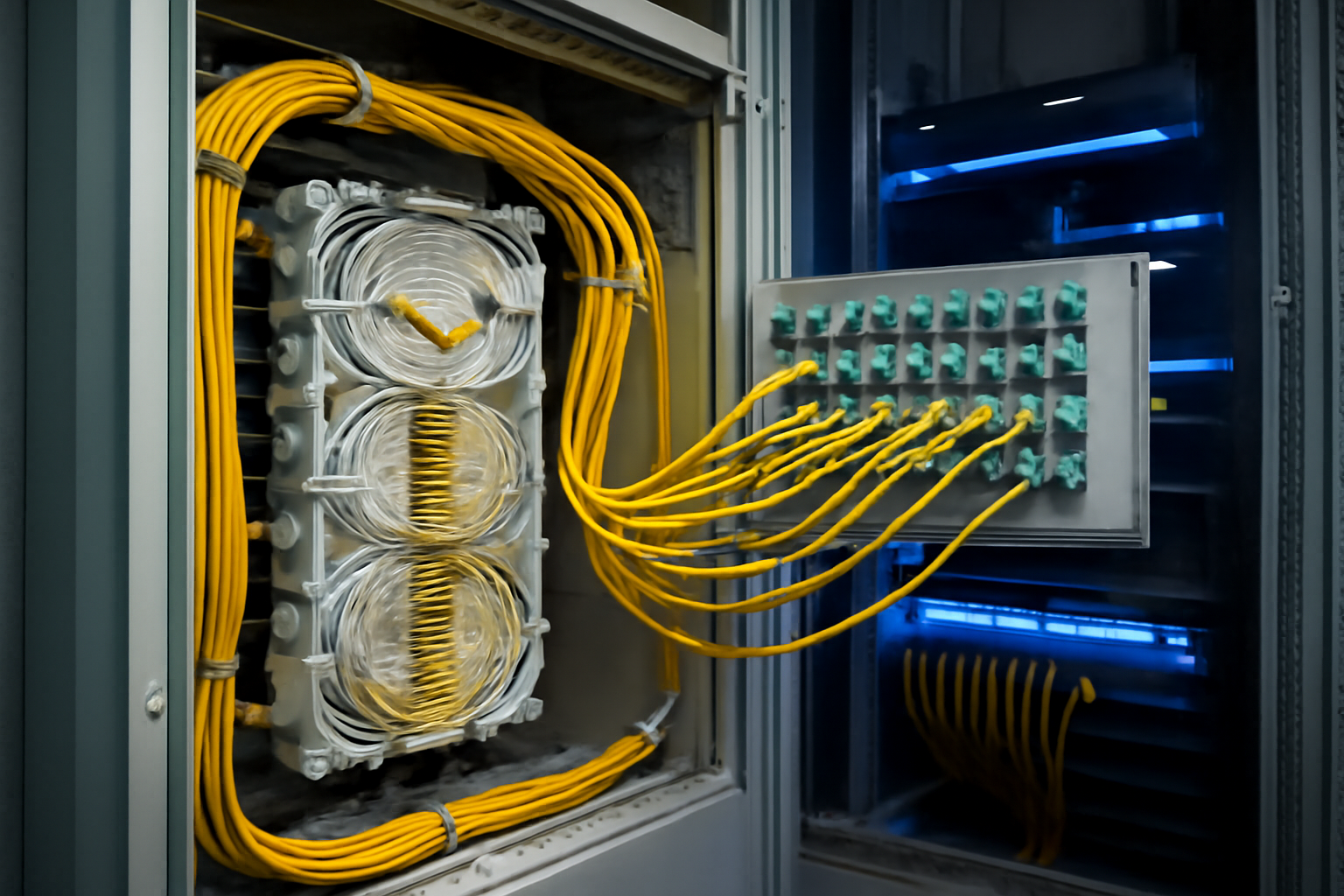
- Pre-terminated splice modules for rapid expansion
- Standardised handover points per DIN EN 50173-1 (VDE 0800-173-1)
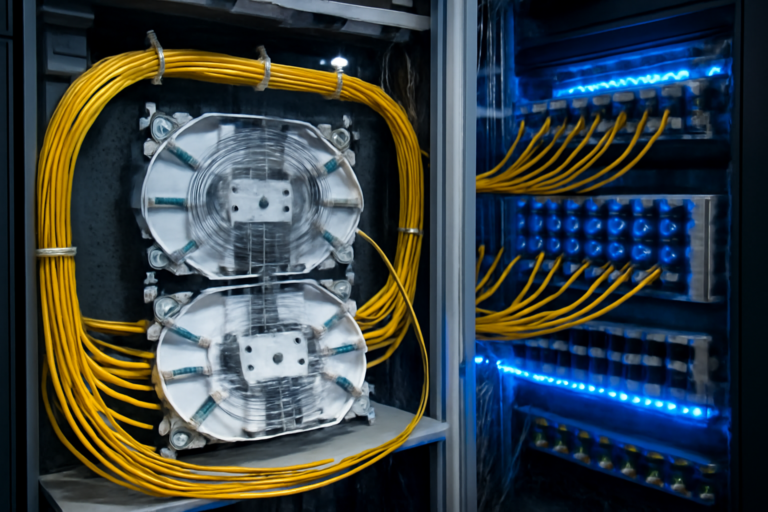
Modern business parks rely on high-density fibre-optic distribution systems capable of terminating 96 fibres in just one rack unit (1RU). This packing density enables space-saving installations in technical rooms with limited space.
Deployment strategies: from planning to operational business park fibre-optic infrastructure
Strategic deployment of a commercial park with FTTH occurs in three defined phases, with modular construction providing significant advantages.
| Deployment phase | Technical components | Timeline | Investment cost |
|---|---|---|---|
| Primary infrastructure | Main conduit, ducts Ø 100 mm, access points | 3–6 months | €150–250/m |
| Secondary distribution | Microducts, distribution cabinets, joints | 2–4 months | €80–120/m |
| Building connection | Splice modules, E2000/LC termination, handover point | 1–2 weeks per building | €2,500–4,000 per connection |
Municipal utilities and project developers particularly benefit from pre-terminated modular systems. Installation of a SlimConnect 1RU system with 48 ports requires only a fraction of the time, whereas conventional splicing work takes considerably longer.
Funding opportunities for business park FTTH across the DACH region
Federal funding for broadband rollout has allocated 21 billion euros for 3,850 projects since programme launch. Specifically for commercial parks, extended funding is available with subsidy rates of up to 90% of eligible costs.
- Gigabit Funding 2.0: Focus on underserved commercial parks
- Regional funding programmes: Baden-Württemberg invested an additional 231 million euros in 2025
- EU state aid framework: Simplified approval for commercial park fibre deployment since November 2025
- Special municipal utility funding: Cooperation models with private-sector partners
Fiber Products quality commitment: As an official Diamond Partner and manufacturer, we produce modular splice systems in Europe. Benefit from Swiss precision and in-house manufacturing.
Modular distribution systems for business park fibre-optic networks
Selecting the right distribution system determines scalability and maintainability of the entire fibre-optic infrastructure. Modular systems offer significant advantages over permanently spliced solutions when deploying commercial parks.
A modern VarioConnect system can terminate 288 fibres across 3 rack units whilst maintaining full backward compatibility with existing networks. Module interchangeability reduces downtime to a minimum.
| System type | Fibre density | Connector types | Application |
|---|---|---|---|
| SlimConnect 1RU | 96 fibres/RU | LC, SC, E2000 | Small to medium commercial parks |
| VarioConnect 3RU | 288 fibres/3RU | LC, SC, E2000, MPO | Large business parks, data centres |
| DIN rail | 24 fibres | E2000, SC | Industrial facilities, production halls |
Connector types and standards compliance for business park FTTH
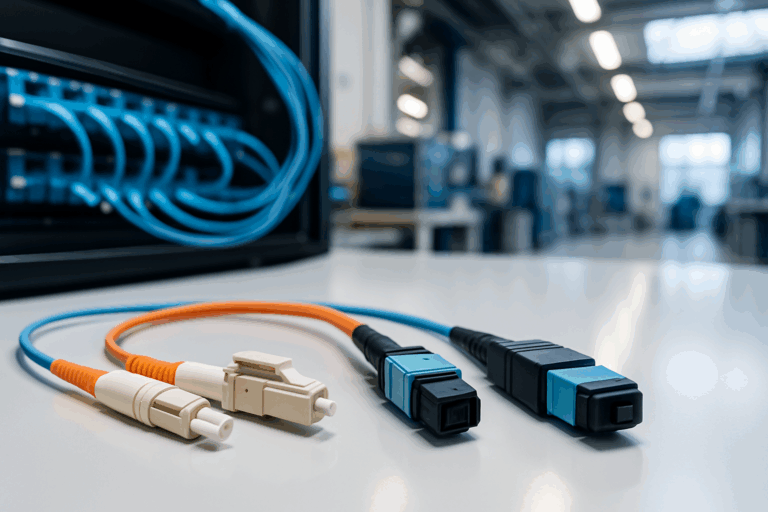
Selecting the correct connectors significantly determines performance and future-proofing of business park fibre-optic infrastructure. Whilst LC duplex connectors with < 0.25 dB loss set the standard for office buildings, E2000 connectors are increasingly adopted in industrial environments.
- LC-APC: FTTH standard, loss < 0.15 dB, return loss > 60 dB
- E2000-APC: Industrial standard with protective shutter, IP65 rated, vibration resistant per IEC 61300-2-1
- MPO/MTP: High-performance backbone connectors, 12/24 fibres, < 0.35 dB total loss
- SC-APC: Robust alternative, widely used by municipal utilities, compatible with legacy networks
The IEC 61754-15 standard defines precise requirements for mechanical and optical parameters. All components must additionally meet enhanced requirements of the TKG Amendment 2026.
Splicing technique and quality assurance in commercial parks
Professional splicing forms the foundation of every reliable commercial park fibre deployment. Modern fusion splicers achieve loss values of under 0.02 dB per splice.
Use of pre-terminated splice modules not only shortens installation time, but also guarantees consistent quality through factory test protocols per IEC 61300-3-35. Each module is supplied with an individual measurement certificate documenting compliance with all relevant parameters.
Municipal utilities as drivers of business park fibre-optic deployment
In the German market, municipal utilities are increasingly positioning themselves as competent partners for fibre-optic deployment of commercial parks. Successful projects in Munich, Hilden and Schweinfurt demonstrate that municipal operators bring ideal infrastructure experience.
- Existing duct infrastructure considerably reduces civil works costs
- Synergies with electricity and water supply routing
- Local presence guarantees responsive service level agreements
- Neutral network infrastructure enables provider diversity
- BREKO quality seal as proof of professional network quality
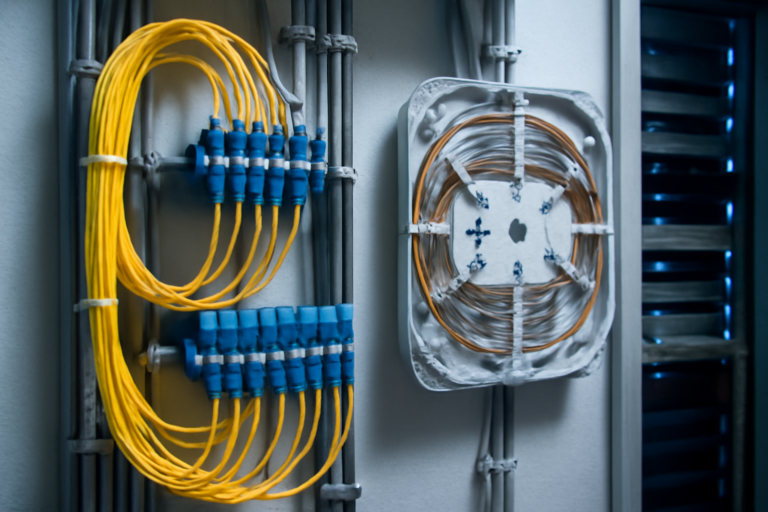
Modular splice box systems enable municipal utilities to adopt a standardised approach across different projects.
Future-proof scalable business park FTTH systems
Bandwidth requirements in business parks typically double every 24 months. Modern fibre-optic infrastructure must therefore be designed for growth from the outset.
Scalable modular systems allow gradual expansion from initial 10 Gbit/s to 400 Gbit/s and beyond without interrupting existing connections. Investment in high-quality singlemode fibres of category OS2 (ITU-T G.652.D) guarantees compatibility with future transmission technologies.
Practical implementation: from needs analysis to operational installation
Successful commercial park deployment with FTTH requires systematic planning and precise execution. Project developers should consider future network architecture already in the concept phase.
| Project phase | Core activities | Success factors |
|---|---|---|
| Needs analysis | Bandwidth calculation, redundancy planning | 150% capacity reserve required |
| Network design | Topology, distribution points, routing | Modular systems with 96 fibres/RU |
| Tender | Specifications, quality criteria | Demand standards compliance IEC 61300 |
| Installation | Civil works, splicing, documentation | OTDR measurement log for each fibre |
| Handover | Final measurement, acceptance, training | 5-year system warranty agreement |
Selection of high-quality fibre-optic components with extended manufacturer warranty minimises investment risk and ensures long-term low operating costs.
Maintenance and operation of business park fibre-optic networks
Following successful installation begins the critical phase of network operations. Professional commercial park fibre deployments require systematic maintenance programmes with defined intervals.
- Quarterly loss measurements on critical links
- Annual cleaning of all connectors with IPA cleaning pens
- Thermographic monitoring of distribution cabinets
- Network documentation updates per DIN EN 50174
- Spare module availability for short recovery times
Modular systems substantially simplify maintenance. Faulty modules can be replaced without splicing in very little time, dramatically reducing mean time to repair (MTTR).
FAQ: common questions on business park FTTH deployment
What bandwidths are realistic in a modern commercial park?
Current business park fibre-optic infrastructure delivers symmetrical bandwidths of 1 to 10 Gbit/s per enterprise. With appropriate backbone connectivity, 100 Gbit/s is technically achievable. Actual speed depends on chosen network topology and transmission systems used.
How long does complete commercial park deployment take?
Overall duration varies from 6 to 18 months depending on size. A 10-hectare commercial park with 20 enterprises typically requires 9 months from initial civil works to operational handover. Pre-terminated modular systems can shorten the installation phase.
Which connector types suit industrial environments?
Production halls and industrial facilities should use E2000 connectors with integrated protective shutter and IP65 protection class. These are vibration resistant per IEC 61300-2-1 and withstand temperature variations from -40°C to +85°C. Robust SC connectors in protective housings are a suitable alternative.
Can existing copper lines continue operating in parallel?
Yes, parallel operation is technically unproblematic and often sensible. Many enterprises use fibre for primary connections whilst retaining copper for non-critical systems. The TKG Amendment provides for gradual migration, with copper disconnection only at 80% FTTH coverage.
What funding is available for commercial parks in 2026?
Gigabit Funding 2.0 supports underserved commercial parks with up to 90% of eligible costs. Regional programmes such as Baden-Württemberg’s 231-million-euro budget are also available. The EU state aid directive has substantially simplified approval procedures since November 2025.
How important is selecting the right module system?
System selection substantially determines scalability and operating costs over the entire operational life. High-density modules with 96 fibres on 1RU save space versus conventional solutions. Investment in quality systems with 5-year warranty typically pays for itself through reduced downtime within 24 months.
Conclusion: leveraging business park FTTH as a location advantage
Professional deployment with commercial park fibre-optic infrastructure is evolving from an optional service to an indispensable location factor. With well-designed modular systems capable of terminating up to 96 fibres on a single rack unit, even demanding business park fibre projects can be economically realised.
As a manufacturer of modular fibre-optic solutions and official Diamond Partner, Fiber Products provides the complete system solution – from splice box to E2000 connector in Swiss precision quality. The consistent modularity of our systems guarantees investment security and enables demand-driven expansion without operational interruption.
Leverage current funding opportunities and position your commercial park with future-proof FTTH infrastructure in competition. The experts at Fiber Products are happy to support you in planning and implementing your fibre-optic project.
Request a quote
Have questions about our fibre-optic solutions? Our expert team is happy to advise you – free of charge and without obligation.