Water Utilities Fibre Optic – Remote Control Technology and Process Control
Water Utilities Fibre Optic – Remote Control Technology and Process Control
Water utilities fibre optic, remote control LWL and water supply network systems today form the technical backbone of modern drinking water supply, with fibre optic cables providing unlimited bandwidth and electromagnetic immunity enabling secure monitoring and control of pump stations, storage reservoirs and pressure-boosting stations across distances of up to 100 kilometres without repeaters. The transition to fibre-based remote control technology reduces downtime and enables real-time monitoring of critical parameters.
In the German water industry, over 60% of municipal utilities already rely on optical fibre infrastructure for their process control systems. The advantages are clear: fibre optic is immune to electromagnetic interference, offers virtually unlimited transmission capacity and enables secure separation of control and power networks.
Technical Foundations of Fibre Optic Remote Control in Water Utilities
Integration of water utilities fibre optic into existing remote control systems occurs via defined interfaces and enables bidirectional transmission of measurement data, control commands and video signals over a single fibre. Modern remote control stations use single-mode fibres OS2 with wavelengths of 1310nm and 1550nm for distances up to 100km.
| Parameter | Copper Cable | Fibre Optic LWL | Fibre Advantage |
|---|---|---|---|
| Transmission Distance | max. 1.2 km | up to 100 km | 83x greater range |
| Bandwidth | 2 Mbit/s | 10 Gbit/s+ | 5000x more capacity |
| EMC Immunity | susceptible | 100% immune | No downtime |
| Lightning Protection | complex | not required | Cost savings |
Connection between control centre and remote stations typically occurs via redundant ring structures with automatic switchover upon cable interruption. This topology guarantees 99.99% availability and thereby meets the requirements of DVGW W 1000 for critical infrastructure.
Splice Technology and Modular Distribution Systems for Water Utilities
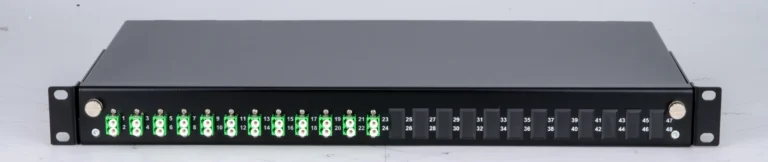
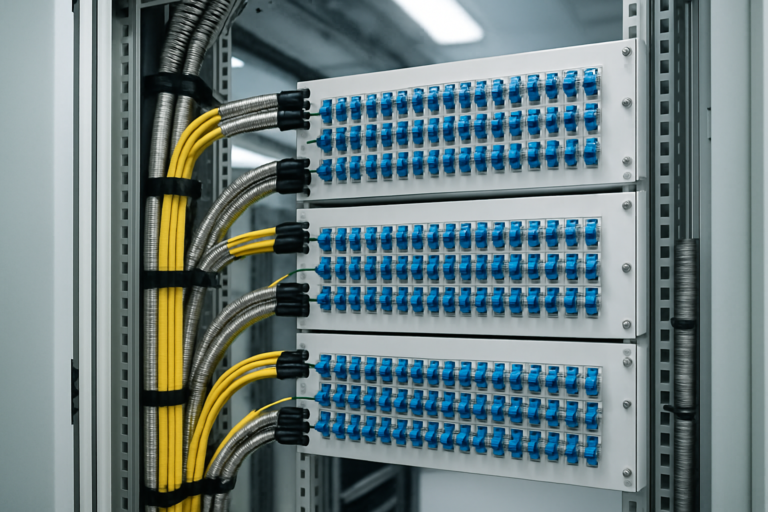
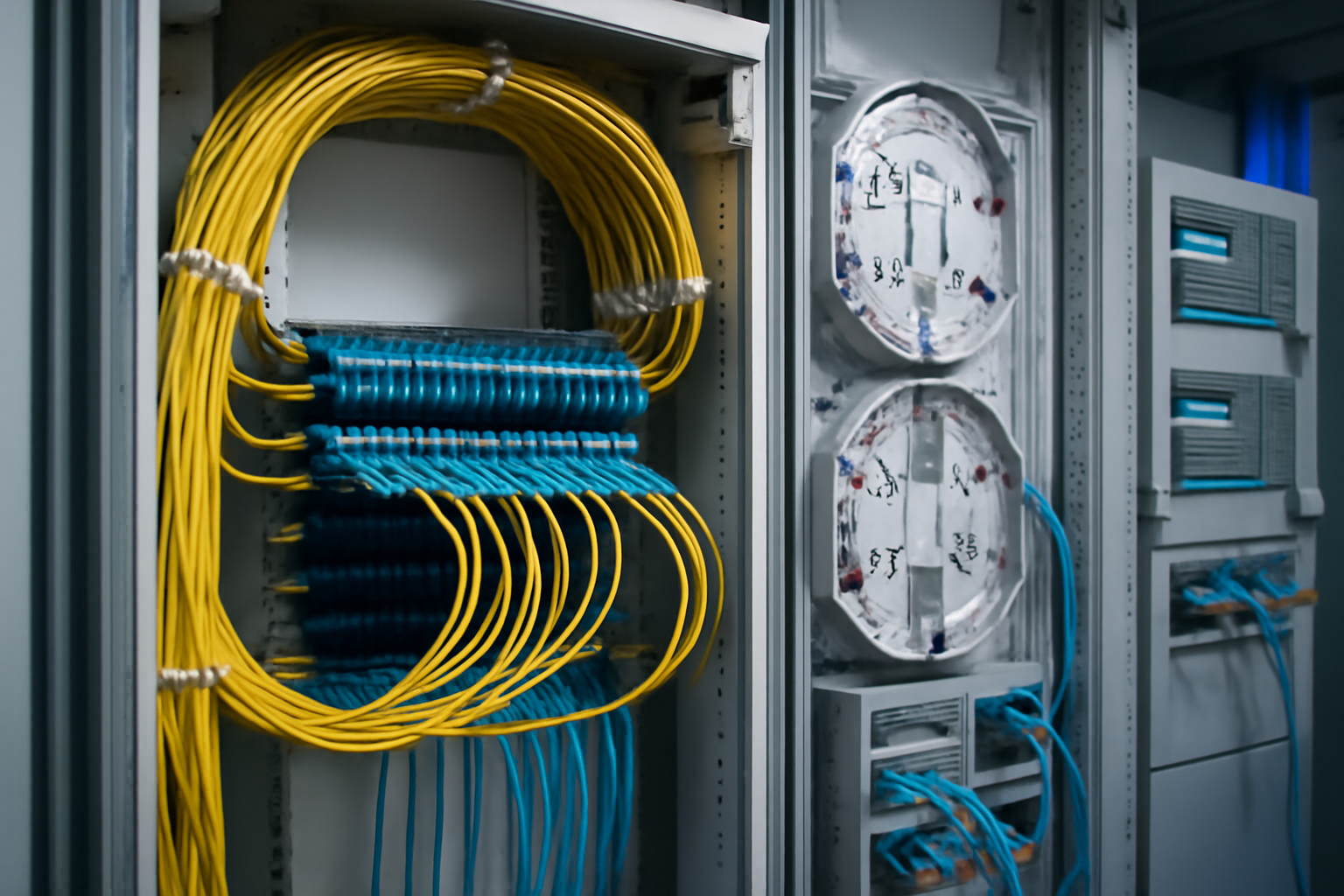
For professional installation of remote control LWL in water supply network environments, high-quality splice distribution systems are essential. Modern splice boxes in 1U form factor offer space for up to 96 fibres in minimal space and enable structured management of all fibre optic connections.
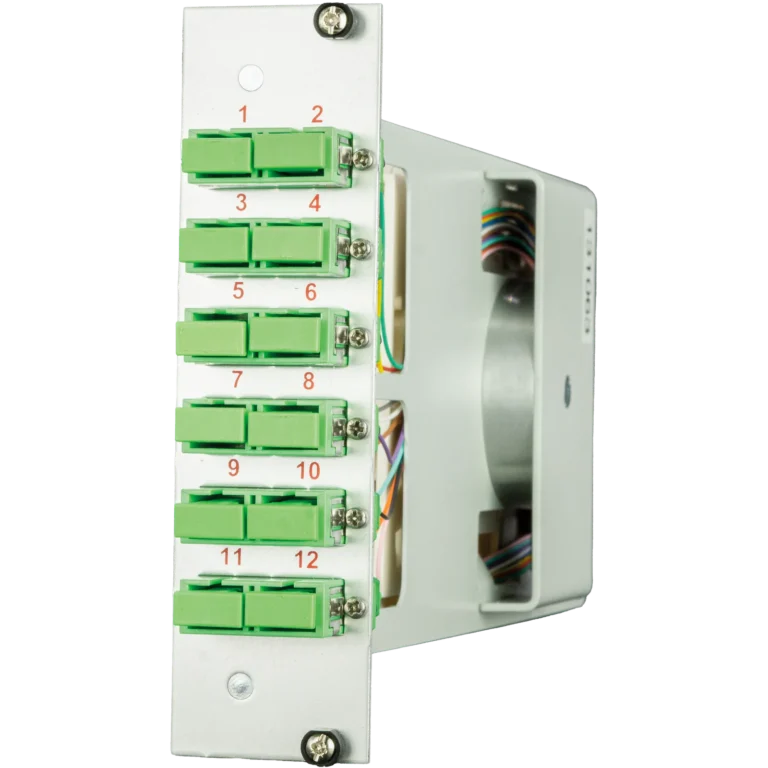
- Modular splice cassettes for easy expansion
- Front-facing connector access for LC, SC and E2000 connectors
- Integrated strain relief according to DIN EN 50173
- Label fields for clear documentation
- Dust protection covers per IP54 standard
Selection of the correct connector type is critical for operational safety. In industrial environments, E2000 connectors with integrated protective shutter and attenuation values < 0.2 dB have become the standard. These offer additional protection against contamination and mechanical damage.
Practical Implementation: From Planning to Installation
Implementation of fibre-based remote control technology for water utilities follows defined project phases. Initially, an inventory of existing infrastructure is undertaken, followed by network planning per FTTH standards.
Fiber Products Quality Promise: As an official Diamond Partner and manufacturer, we produce modular splice systems in Europe. Benefit from Swiss precision and in-house manufacturing.
During installation, specific requirements of the water industry must be observed. These include enhanced protection requirements in humid environments, vibration resistance at pump stations and integration into existing control systems.
- Fibre attenuation measurement with OTDR per IEC 61280-4
- Documentation of all splice values (typically < 0.05 dB)
- Redundant fibre routing for critical connections
- Labelling per DIN EN 50174-3
- Acceptance protocol per operator requirements
Ring Redundancy and Failure Safety in Water Supply
Water utilities fibre optic networks are preferably designed as redundant ring systems to ensure maximum availability. In case of fibre breakage, automatic switchover occurs within less than 50 milliseconds, allowing process control to continue uninterrupted.
| Network Topology | Availability | Switchover Time | Application |
|---|---|---|---|
| Star | 98.5% | not redundant | Small installations |
| Ring | 99.95% | < 50ms | Standard solution |
| Meshed Network | 99.99% | < 20ms | Critical infrastructure |
Implementation uses specialised industrial switches covering extended temperature ranges from -40°C to +75°C and featuring redundant power supplies. These components meet IP65 protection rating and are certified for use in harsh environments.
Integration of Video Surveillance and Sensors via Fibre Optic
Modern remote control LWL technology for water supply network applications enables parallel transmission of process data, video streams and sensor signals. Via wavelength-division multiplexing (WDM technology), multiple independent data channels can operate on a single fibre.
- High-resolution IP cameras with 4K resolution for facility monitoring
- Thermography systems for early leak detection
- Vibration sensors on pumps and aggregates
- Water quality sensors with real-time transmission
- Access control systems for sensitive areas
The bandwidth of a single single-mode fibre is sufficient to simultaneously connect over 1000 sensors and transmit their data in real time to the control centre. This enables comprehensive monitoring of all critical parameters.
Economic Viability and Investment Protection through Modular Systems
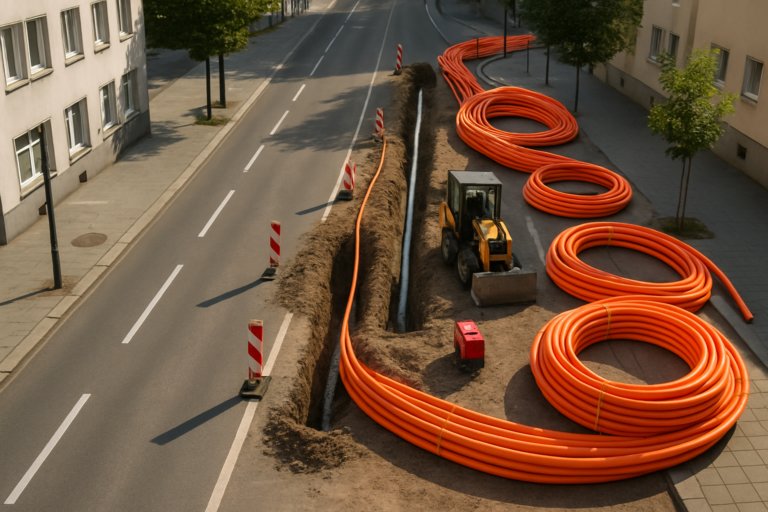
Investment in water utilities fibre optic infrastructure typically pays for itself through reduced operating costs and increased plant availability within 3 to 5 years. Municipal utilities and water operators benefit from synergistic effects when expanding jointly with broadband networks.
Modular splice systems such as the SlimConnect series enable gradual infrastructure expansion without operational interruption. With up to 96 fibres in just 1U, these systems offer double the packing density compared to conventional solutions.
- Reduction of downtime
- Reduction of maintenance costs
- Energy savings through passive transmission technology
- Future-proofing for at least 25 years
- 5 years manufacturer warranty on system components
Standards Compliance and Regulatory Requirements
Remote control LWL in water supply is subject to strict regulatory requirements. Installation must comply with DVGW Worksheet W 1000 and meet IT security requirements per BSI Baseline Protection.
Fibre optic components used must conform to applicable standards. These include IEC 61754 for connectors, IEC 60794 for fibre optic cables and EN 50173 for structured cabling. As a Diamond Partner, we ensure consistent compliance with all relevant standards.
Future Perspectives: AI and Predictive Maintenance
The combination of water utilities fibre optic with artificial intelligence opens new possibilities for predictive maintenance. Through analysis of sensor data, anomalies can be detected early and failures prevented.
- Pattern recognition for early leak detection
- Maintenance interval forecasting based on operational data
- Automatic optimisation of pump operating times
- Energy efficiency improvement through AI-controlled load distribution
- Self-learning alarm thresholds to reduce false alarms
The required computing power can be provided either decentrally in edge computing units or centrally at the control centre. The fibre optic infrastructure provides the necessary bandwidth for both approaches.
Best Practice: Successful Projects of German Water Utilities
Numerous German water utilities have already successfully transitioned to fibre-based remote control technology. Kelheim Municipal Utilities, for example, invested €7.7 million in their network infrastructure, with fibre optic being a central element of the modernisation.
Another example is Burghaun Water Supply in Hesse, which monitors its extensive network with modern remote control technology. By deploying LWL connections, response time to failures was reduced.
| Project | Investment | Fibre Route | Benefit |
|---|---|---|---|
| Kelheim Municipal Utilities | €7.7m | 45 km | Complete modernisation |
| Burghaun Water Supply | €2.1m | 28 km | Pipe break detection |
| Example Municipal Utilities | €3.5m | 62 km | Redundant ring network |
Maintenance and Operation of Fibre Optic Remote Control Systems
Operation of remote control LWL technology for water supply network applications requires specialist knowledge and appropriate measuring instruments. Regular attenuation measurements with OTDR instruments ensure functionality.
- Annual inspection of all connectors
- Cleaning ferrules with isopropanol-soaked cloths
- Documentation of all measured values in maintenance protocol
- Control of bend radius (minimum 30mm for single-mode)
- Verification of strain reliefs and cable entries
Modern monitoring systems enable continuous measurement of attenuation values and automatically report deviations to the control centre. This allows gradual deterioration to be detected early.
FAQ: Frequently Asked Questions on Fibre Optic in Water Supply
How are E2000 connectors integrated into existing remote control stations?
E2000 connectors are integrated via standardised adapter plates into 19-inch distribution frames. Installation is tool-free through snapping in the adapters. The integrated protective shutter ensures IP65 protection class in the connected state.
What funding is available in 2026 for municipal utilities undertaking fibre deployment?
The Telecommunications Act Amendment 2026 simplifies approval procedures and enables synergistic joint laying. Additionally, federal funds from the Gigabit Support Programme are available provided broadband joint-use is guaranteed.
What is the actual lifespan of fibre optic cables in water utilities?
Modern fibre optic cables have a lifespan of at least 25 years. In protected environments, even 40 years is realistic. Critical is professional installation without mechanical stress.
What advantages do modular splice systems offer compared to fixed systems?
Modular systems permit subsequent expansion without operational interruption, offer higher packing density and reduce installation time through pre-configured modules.
How is transition from copper to fibre optic managed during ongoing operation?
Migration occurs gradually through parallel operation of both systems. After successful commissioning of the fibre route, the old copper cable is retained as backup until the new infrastructure has proven itself.
What measured values must be documented upon acceptance of LWL routes?
Document attenuation values per connector (max. 0.5 dB), splice attenuation (max. 0.1 dB), total route attenuation and OTDR curves with event table per IEC 61280-4.
Request a Quote
Have questions about our fibre optic solutions? Our expert team is happy to advise you – free of charge and without obligation.