Fiber optic installation errors: 5 critical sources of error to avoid in attenuation measurements

The proper installation of fiber optic networks is crucial to their performance and reliability. Attenuation measurements are the most important quality criterion for assessing transmission quality. However, even small fiber optic installation errors can lead to significant signal loss and impair the overall network performance.
As an experienced network operator, you know that prevention is better and more cost-effective than subsequent troubleshooting. Typical fiber optic installation errors not only cause technical problems, but also lead to considerable additional costs due to rework and downtime. System integrators and installers can minimize these risks through systematic quality control.
The most common fiber optic installation errors can be divided into five main categories, each of which requires specific preventive measures. These findings are based on decades of experience in fiber optic technology and will help you to avoid costly problems from the outset.
Why attenuation measurements are crucial
The (insertion) loss (IL) must not exceed a value of 1.5 dB. The total return loss (ORL, Optical Return Loss) must not fall below a value of 30 dB. These limit values in accordance with DIN EN 50173 are not chosen arbitrarily, but guarantee the long-term functionality of your fiber optic connections.
Contamination continues to be the leading cause of fiber optic failure: dust, fingerprints and other oily substances cause excessive attenuation and sometimes result in permanent damage to connector end faces. This finding highlights the importance of systematic installation practices to avoid fiber optic installation failures.
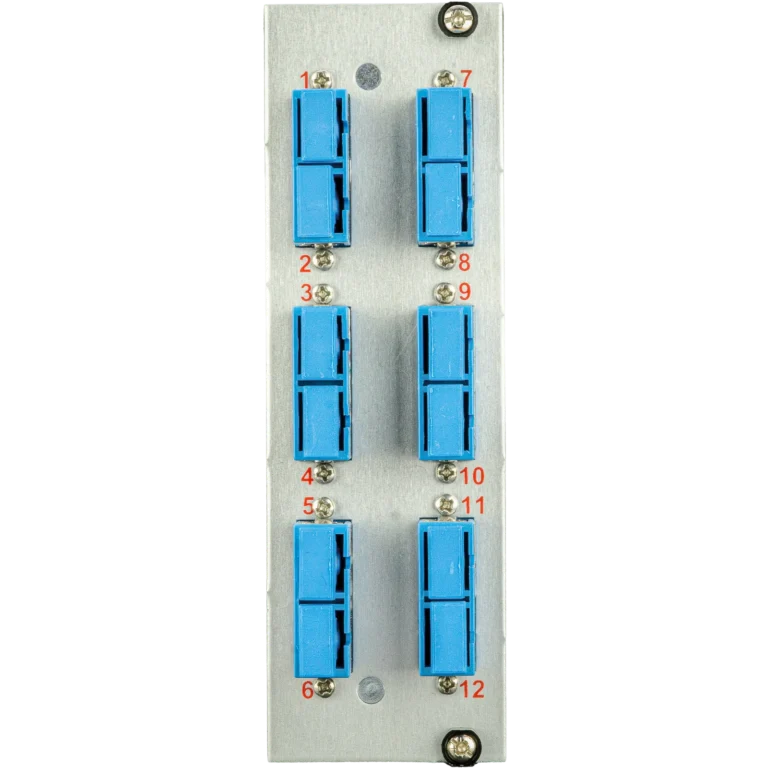
Modern splice modules with high-quality components support compliance with these critical limit values through optimized design and precise manufacturing tolerances.
Error 1: Neglecting to clean the plug connector
The most common and preventable fiber optic installation error is inadequate cleaning of the fiber optic connectors. A more common cause is a poor connection in the field, which leads to air gaps and high insertion loss, or scratches, defects and dirt on the end faces of the connector.
Consequences of dirty plug connectors
Typical fiberglass installation errors due to lack of cleaning lead to:
- Increased insertion loss above the limit value
- Permanent damage to the end faces
- Unreliable connections with fluctuating performance
- Costly rework and component replacement
Solution approach for professional cleaning
Establish a systematic cleaning protocol with lint-free cloths and special cleaning fluids. For dirty connections, use special cleaning tools for fiber optic cables, including lint-free cloths, cleaning fluids and special cleaning sticks.
1U splice boxes with optimized cleaning options reduce this risk through better accessibility to all connection points.
Error 2: Disregarding the minimum bending radius
The bending radius is a critical parameter that is often underestimated and leads to serious fiber optic installation errors. According to DIN EN 50174-2, the smallest bending radius for fiber optic installation cables should be at least 50 mm or 10 times the cable diameter, whichever is greater.
Typical bending radius errors
Common fiber optic installation errors in cable routing:
- Installation of fiber optic cables in cable ducts that are too narrow
- Use of standard device boxes without fiber optic optimization
- Sharp 90-degree bends without appropriate cable routing
- Insufficient cable routing for socket installation
For cables for the interior of installations, the bending radius of the fiber optic cable is 10 times the outer diameter of the cable without tensile load and 15 times the outer diameter of the cable when subjected to tensile load.
Practical implementation
Use special fiber optic installation boxes and cable guides that maintain the required bending radius. 7TE top-hat rail boxes offer optimized cable routing and avoid typical fibre optic installation errors due to tight radii. Allow sufficient space for cable loops and avoid point loads.
Error 3: Faulty splice connections
Splice faults are among the most costly fibre optic installation faults, as they are often only detected after commissioning. Experience has shown that many splice faults are due to breaks, which often do not occur directly at the splice connection but in the vicinity.
Common splice errors
Critical fiber optic installation errors during splicing:
- Insufficient fiber cleaning before the splicing process
- Unclean fiber splitting with “lips” or “fog”
- Misalignment of the fiber cores
- Inadequate splice protection installation
Good connections achieve insertion losses of just 0.02 dB. This value can only be achieved with professional execution and shows the importance of a qualified working method.
Quality assurance during splicing
The most important steps to avoid fiber optic installation errors when splicing are good cleaning, cleaving and splice protection. Invest in high-quality splicing equipment and make sure your installers are properly trained.
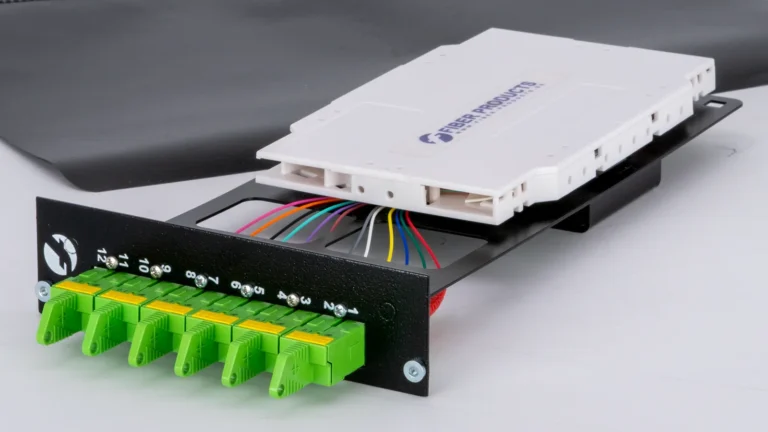
VarioConnect 3U ODF systems with integrated splice cassettes offer optimum conditions for high-quality splicing work and minimize installation errors.
Error 4: Inadequate measurement technology and documentation
Many fiber optic installation errors are caused by inadequate measurement techniques or incomplete documentation. To determine whether attenuation occurs on one or all fibers in a cable, it is best to use an LSPM or OLTS.
Metrological deficits
Typical fiber optic installation errors in the measurement technology:
- Use of unsuitable measuring devices for the respective application
- Missing bidirectional measurements
- Incomplete documentation of the measurement results
- No reference measurements before installation
Carry out OTDR measurements correctly
Bidirectional measurements are regularly required to record direction-dependent attenuations. This can be done by swapping the transmitter and receiver one after the other. Systematic measurements prevent fiber optic installation errors due to undetected signal losses.
Professional data center installations require particularly precise measurement technology and complete documentation of all parameters.
Fault 5: Inadequate cable management and tensile forces
Inadequate cable management can put stress on a connector causing misalignment, or the connector may not be properly seated and connected. These fiber optic installation errors are often difficult to diagnose.
Critical load factors
Frequent fiber optic installation errors due to mechanical stress:
- Exceeding the maximum tensile force during installation
- Insufficient strain relief at connection points
- Fastening elements too tight
- Lack of cable reserves for service and maintenance
For most outdoor fiber optic cables, the installation load is limited to less than 600 lbf (2,700 N). These limits must not be exceeded during installation to avoid fiber installation errors.
Preventive measures
Professional strain relief and systematic cable management prevent this type of fiber optic installation error. Modular fiber optic solutions with well thought-out cable routing support installation-friendly working methods.
Preventive measures for professional installations
Establish systematic quality control
To avoid fiber optic installation errors implement:
- Standardized workflows for all installation steps
- Regular training for the assembly teams
- Use of calibrated measuring devices
- Complete documentation of all measurements
Optimize material usage
Only use standardized components and high-quality measuring instruments. The measurement is carried out in the unconnected state between Gf-GV and Gf-TA, preferably at the two wavelengths 1310 nm and 1550 nm.
High-quality splice modules with precise tolerances systematically reduce fiber optic installation errors and ensure long-term reliability.
Economic impact of installation errors
Subsequent troubleshooting costs significantly more than preventive measures. Fiber optic installation errors typically cause the following costs:
Direct cost impact
Calculate the total cost of fiber optic installation errors including:
- Renewed travel costs (150-300% of the original costs)
- Network downtimes and lost revenue
- Component replacement and material waste
- Customer dissatisfaction and loss of reputation
ROI of preventive measures
Investments in quality assurance pay off several times over:
- Reduction in fiber optic installation errors through systematic training
- Less rework with professional measurement technology
- Lower long-term costs thanks to high-quality components
Standard-compliant installation as a success factor
Optical fibers for LAN cabling are divided into different performance classes (fiber categories) according to ISO/IEC 11801 and thus also according to DIN EN 50173. Compliance with these standards not only guarantees technical functionality, but also warranty claims and prevents fiber optic installation errors.
Central standard requirements
Follow these standards to avoid fiber optic installation errors:
- DIN EN 50173 for communication cable systems
- DIN EN 50174-2 for installation practices in buildings
- ISO/IEC 11801 for structured cabling
Certification and qualification
System integrators and installers should have appropriate certifications to minimize fiber installation errors.
Industry-specific features
Municipal utilities and municipal grids
Municipal utilities face particular challenges when it comes to fiber optic installation:
- Long outdoor routes with increased environmental impact
- High availability requirements
- Limited maintenance windows
Fiber optic installation errors can have particularly serious consequences here, as entire districts can be affected.
Industrial applications
Industrial customers require particularly reliable installations:
- Critical production environments
- 24/7 availability required
- Extreme environmental conditions
Educational institutions
Educational institutions have specific requirements:
- High user density
- Limited maintenance windows
- Budget optimization required
Modern test technologies and automation
Automated quality control
Modern test systems can detect fiber optic installation errors at an early stage:
- Automated OTDR measurements with AI-based evaluation
- Inline quality checks during installation
- Predictive maintenance through continuous monitoring
Integration into management systems
Digital documentation systems prevent fiber optic installation errors due to:
- Automatic data acquisition and evaluation
- Trend analyses to identify systematic problems
- Integration into facility management systems
Future trends and technology development
New fiber optic technologies
Developments such as ultra-thin fibers and new connector standards require adapted installation processes. Fiber optic installation errors can have more serious consequences with new technologies.
5G and edge computing
The requirements of 5G campus networks for fiber optic installations are continuously increasing. Latency-critical applications do not tolerate fiber optic installation errors.
Conclusion: Quality pays off in the long term
Avoiding the five critical fiber optic installation errors described above initially requires higher investments in training, tools and time. However, these investments pay off in the long term through lower maintenance costs, higher customer satisfaction and reliable networks.
Key findings for error prevention
Fiber optic installation errors can be systematically avoided by:
- Systematic quality control in all project phases
- Standard-compliant component selection and high-quality materials
- Expert fitters with current certification
- Complete documentation of all installation and measurement parameters
Investment in quality
Professional fiber optic installations are characterized by consistent error prevention. The initial additional costs for quality assurance are amortized through:
- Less rework
- Lower maintenance costs
- Higher customer satisfaction
- Long-term grid stability
Visit our online store for high-quality splice modules and modular fiber optic solutions. You can find more technical articles in our blog.
Contact us to develop the optimum solution for your fiber optic project together. Our modular systems with a 5-year guarantee help you to avoid fiber optic installation errors right from the start and to rely on the highest quality standards.
Request a Consultation
Our experts will advise you on modular fiber optic solutions for your specific application — fast, personal and non-binding.