Data Centers in Orbit: Why the Network on the Ground Decides
Data centers in orbit sound like science fiction — yet the concept keeps surfacing in more and more technical discussions, studies, and pilot projects. The reason is sober enough: on the ground, data centers are held back by three factors that appear to vanish in space. But think the idea through and one thing becomes clear fast — the real decision isn’t made 500 kilometers above us. It’s made in an unremarkable building back on Earth, and it comes down to classic fiber-optic infrastructure.
Why everyone is suddenly talking about data centers in orbit
Three bottlenecks are driving the debate. First, power: AI clusters draw enormous amounts of it, and at many sites the grid connection is the limiting factor. In orbit, the appeal is near-continuous solar exposure with no day-night losses and no weather. Second, cooling: on the ground it burns through water and electricity; in a vacuum, waste heat can in principle be shed through radiators. Third, land and permitting — no building sites, no neighbors, no water rights, no transmission corridors, at least on paper.
As tempting as that sounds, it remains conceptual. Orbital radiators are technically demanding, launch costs are high, and maintenance is essentially impossible. That’s why several providers are starting with small-scale pilot projects. For planners on the ground, though, one insight is already valuable today: no matter where the compute sits, the data still has to reach its users. And that path runs on light.
How a data center in orbit even communicates
There are no buried cable runs in space. Satellites have long communicated with one another over optical laser interlinks — free-space optical communication. A tightly focused laser beam carries data through the vacuum from satellite to satellite, with no physical medium in between. This is standard practice in modern constellations and the obvious foundation on which an orbital data center would talk to its surroundings.
It gets interesting with the cabling inside a satellite or an orbital platform. Here one hard rule applies: you don’t splice in orbit. There is no technician up there to strip a fiber, seat it, and fusion-weld it. Instead, the job is done with pre-terminated, radiation-hardened cable harnesses — built on the ground, tested, fitted with defined connector interfaces, and lifted up as a complete system. Anything that still gets connected in space is plugged in, not spliced. Radiation, thermal cycling, and vacuum place demands on these assemblies that go far beyond ordinary data-center cabling — a highly specialized corner of the aerospace world.
Interlinks alone aren’t enough to move large volumes of data back to Earth. At some point the light has to leave orbit and land again. And that’s exactly where the part many people underestimate begins.
The underestimated part: the ground station
The downlink — the leg from orbit to Earth — ends at a ground station, often called a teleport. Here, an optical signal that traveled through the vacuum becomes a signal on fiber again, ready to be processed in a data center and fed into terrestrial networks. The teleport is the seam between spaceflight and the ground network — and it's a perfectly ordinary, earthbound building with perfectly ordinary, earthbound infrastructure requirements.
Two topics dominate the planning of these sites:
- Downlink capacity: The volume of data brought down to Earth is the real bottleneck. Whatever gets computed in orbit is worthless if it can't come down with enough bandwidth. Every teleport has to take that capacity in cleanly, sort it, and hand it off.
- Weather redundancy: Optical downlinks are sensitive to clouds. A single site with rain overhead can lose the link. The answer is multiple, geographically distributed ground stations — if one drops out under cloud cover, another takes over. These sites have to be networked together over terrestrial fiber so the data stream can be rerouted seamlessly.
Anyone who plans large networks knows the pattern: high incoming capacity, multiple sites, hard availability requirements, clean redistribution. That's not spaceflight anymore — that's data-center and network planning. And this is exactly where it gets concrete.
What a ground station needs in terms of fiber infrastructure
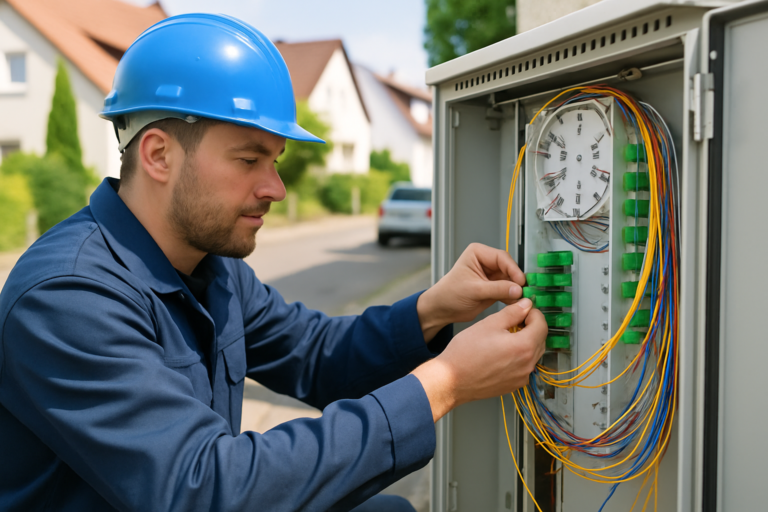
Once the signal is on the fiber, the same principles apply as at any other carrier or data-center site. At its core, a teleport is a node where many fibers come together to be terminated, patched, and redistributed. The building blocks for that are proven and down-to-earth:
| Task at the teleport | Ground-side infrastructure |
|---|---|
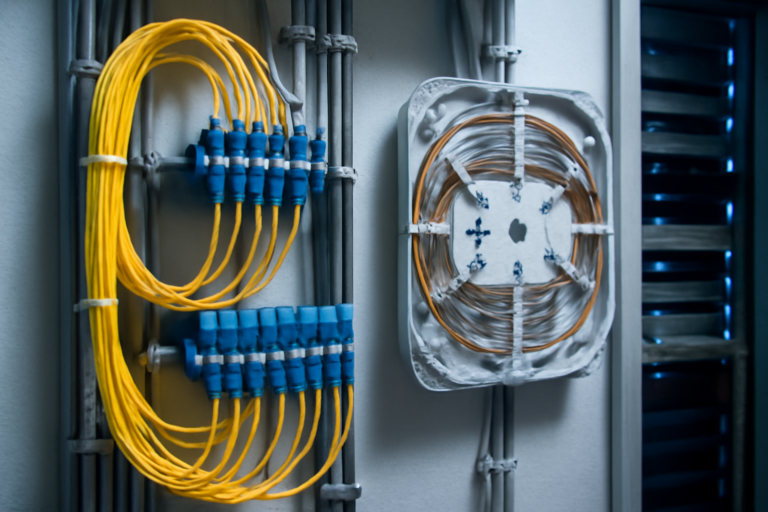
| Organize, terminate, and document fibers | Optical distribution frame (ODF) in a 19-inch rack |
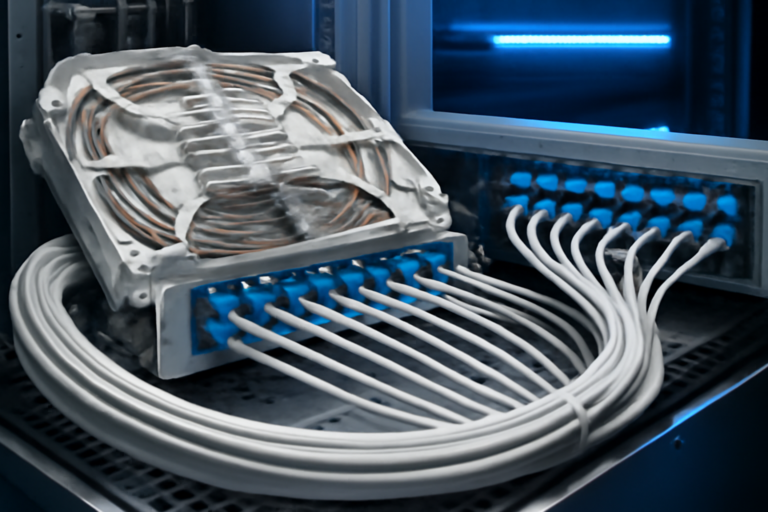
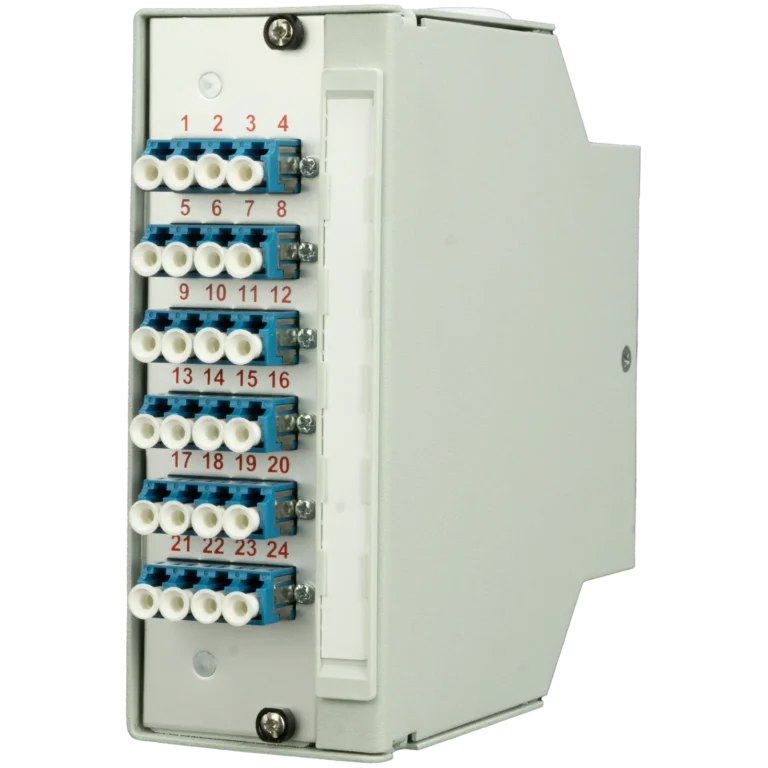
| Splice and protect incoming cables | Splice boxes and splice modules (7HP) |
| Switch and re-patch connections flexibly | Cross-connects via defined patch panels |
| Precise, low-loss plug connection | Connector interfaces such as E-2000 with shutter |
An ODF system handles the orderly termination and patching of the fibers, concentrating port density in the rack and simplifying documentation. Incoming cables are securely terminated and protected in a splice box — the foundation of any clean fiber management. For high-demand connectors, systems like E-2000 have become established: the integrated shutter keeps the end face clean and shields against laser light, a genuine advantage at a heavily loaded downlink site. Anyone planning the overall architecture of such a node will find the building blocks bundled in our data-center solutions.
One point in all honesty: Fiber Products supplies the ground-side infrastructure — ODFs, splice boxes, modules, E-2000 components. We don't manufacture space-qualified parts and we make no claim of space certification. The radiation-hardened harnesses in orbit are the domain of highly specialized aerospace suppliers. Our contribution begins where the light meets the Earth again.
Where multiple ground stations are networked across long distances, robust route engineering also comes into play — a topic closely related to solutions for energy utilities (OPGW), when routes run along overhead power lines or across difficult terrain.
What planners can take away today
Data centers in orbit are, for now, concepts and pilot projects. But the underlying logic is already worth every bit of thought — and it points in a clear direction:
- The ground decides. However exotic the placement of the compute, availability rests on the terrestrial network and on cleanly terminated fibers.
- Capacity ends at the fiber. Any downlink rate, however high, is only as good as the ODF that receives it and the patching that distributes it.
- Redundancy is a matter of sites. Multiple ground stations mean multiple fiber nodes equipped to the same high standard — standardization pays off.
- The connector interface is an architectural decision. At loss-critical, laser-intensive points, a cleanly protecting system like E-2000 is worth choosing from the start.
Anyone planning a data center, a teleport, or a redundant fiber node should factor the ground-side infrastructure in early rather than pushing it to the end as a detail. Our team supports you with hands-on project consulting; project pricing and volume discounts are available on request. Lead time depends on the project — we state the binding date in the quote. The fastest way to start the conversation is our contact form.
Frequently asked questions
Is fiber really never spliced in orbit?
Correct. In space there's no crew for classic splicing work. What's used instead are pre-terminated, radiation-hardened cable harnesses, built and tested on the ground. Connections in orbit are plugged, not spliced. Splicing happens only back on Earth — at the ground station.
What exactly is a ground station, or teleport?
It's the terrestrial endpoint of the downlink. Here the optical signal arriving from orbit is converted back onto fiber, terminated, and fed into data centers and terrestrial networks. Technically, it's an earthbound fiber node with an ODF, splicing hardware, and patching.
Why do you need multiple ground stations?
Optical downlinks are weather-dependent — clouds can disrupt a link. Multiple, geographically distributed sites ensure that when it's overcast above one teleport, another takes over. The sites are networked with one another over terrestrial fiber.
Does Fiber Products supply components for space?
No. We supply the ground-side fiber-optic infrastructure — ODF systems, splice boxes, modules, and E-2000 components for teleports, data centers, and network nodes. Space-qualified parts for orbit are not part of our range. For your ground-side needs, the best route is our contact form.