Fibre Optic Rollout Augsburg 2026: swa Municipal Utilities and FTTH Strategy
Fibre Optic Rollout Augsburg 2026: swa Municipal Utilities and FTTH Strategy for Municipal Network Operators
The fibre optic rollout in Augsburg by swa municipal utilities marks a decisive milestone in the FTTH Bavaria strategy, with over 32,000 residential units to be connected with state-of-the-art fibre optic technology by 2027. Stadtwerke Augsburg (swa), together with M-net, is pursuing comprehensive FTTH coverage rather than interim solutions, making the city a leader in Bavarian broadband expansion. This ambitious project demonstrates how municipal service providers advance the digital transformation of their regions through strategic partnerships and modern splicing technology.
Technical Dimension of the Augsburg FTTH Project
The “GoAugsburg – Glasfaseroffensive Augsburg” project encompasses 12,500 new fibre optic connections in the second expansion phase. Technical implementation follows the latest standards with continuous singlemode fibre OS2 in accordance with ITU-T G.652.D. Particularly noteworthy is the decision for direct FTTH connections in all new development areas.
- Haunstetten Südwest: 2,800 residential units with direct fibre optic connection
- University Clinic Area: complete coverage with 10 Gbit/s backbone connection
- Dehner Area: commercial high-speed connection up to 100 Gbit/s
- Gasworks Area: modern district solution with redundant network architecture
- Bismarck and Anton districts: densification of existing infrastructure
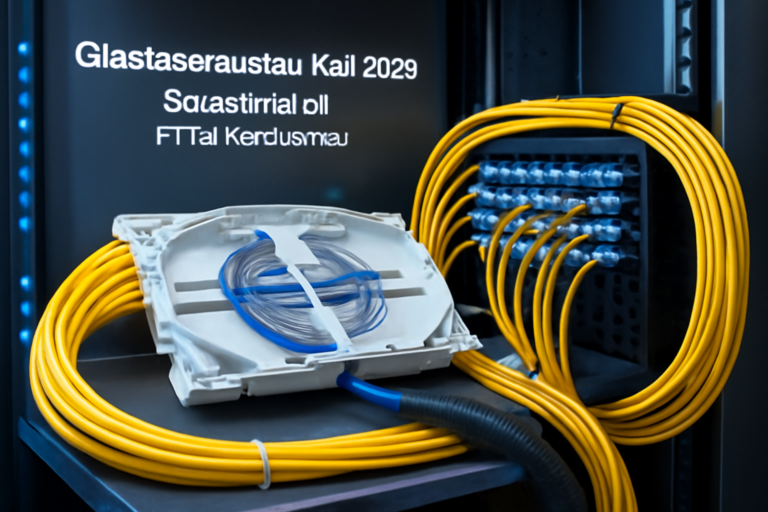
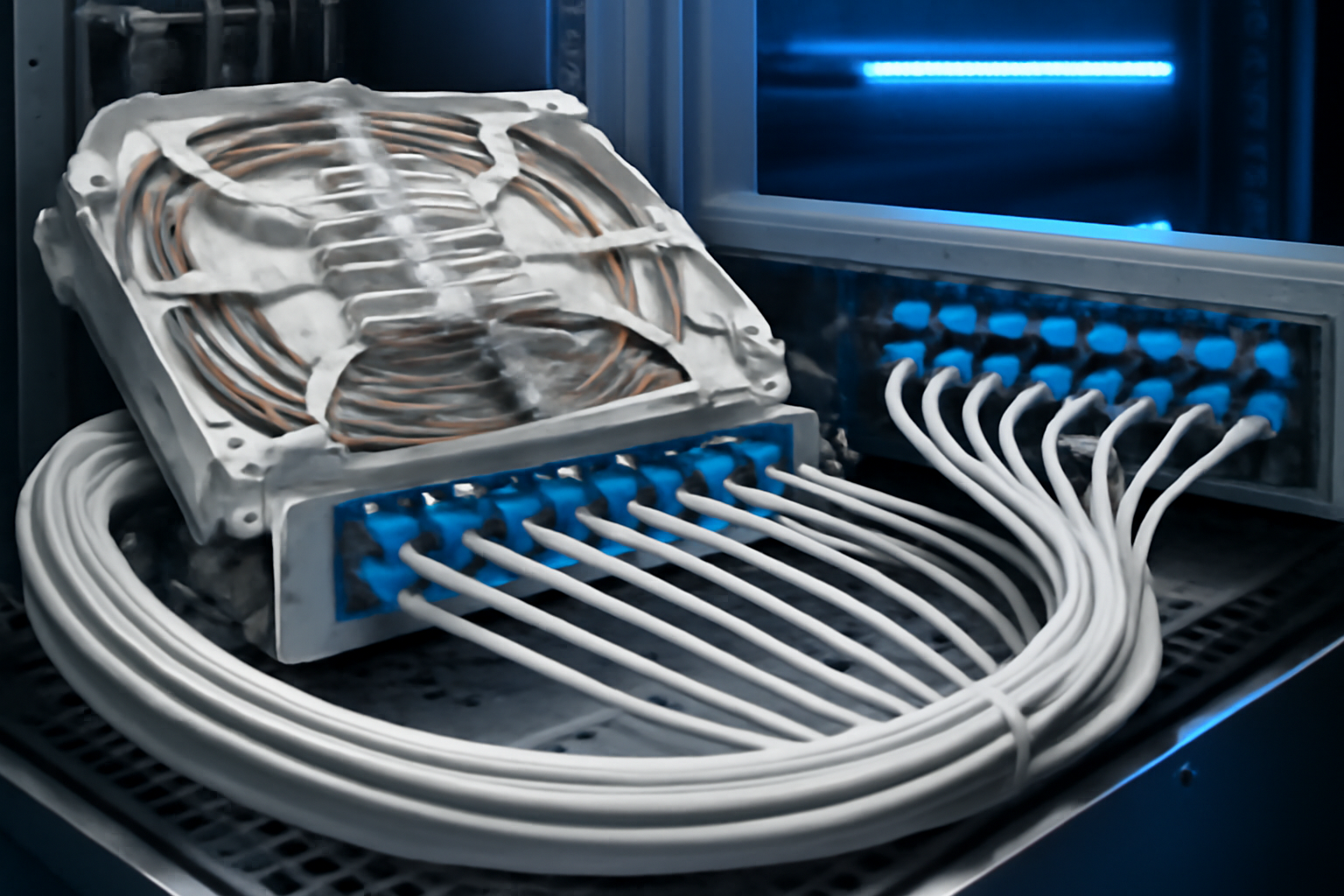
The network architecture is based on a PON system (Passive Optical Network) with central distribution points every 300–500 metres. Each distribution point uses high-density splice boxes with up to 96 fibres per 1HE, enabling structured fibre routing and simple documentation.
Splicing Technology and Network Distribution in the Municipal Context
The fibre optic rollout in Augsburg by swa municipal utilities relies on modern splicing technology according to IEC 61300-3-4 with maximum attenuation values of < 0.1 dB per splice. The distribution hierarchy follows a three-tier model: main distribution frame (HVt) in the data centre, cable distribution box (KVz) in the districts, and building distribution frame (GV) in individual buildings. This system is typical for FTTH Bavaria projects and ensures maximum flexibility.
| Network Level | Component | Fibre Count | Splice Type |
|---|---|---|---|
| Backbone | Main distribution frame | 288–432 fibres | Mass splice |
| Distribution | Cable distribution box | 48–96 fibres | Individual splice |
| Access | Building distribution frame | 12–24 fibres | Individual splice |
The splice boxes used must provide IP65 protection for outdoor areas and IK08 impact resistance. For indoor installations, IP54 is sufficient with enhanced fire safety requirements according to DIN 4102-B2.
Funding Structure and Financing of Municipal Fibre Optic Projects
The Bavarian gigabit directive enabled subsidies of up to 90 per cent of expansion costs in underserved areas. Since 2014, over €2.6 billion has been invested in Bavarian fibre optic infrastructure. The Augsburg fibre rollout benefits from this funding programme but combines it with commercial investments.
- Federal funding: 50 per cent basic subsidy plus surcharges
- Bavaria state funding: additional 40 per cent for grey spots
- Municipal utilities contribution: minimum 10 per cent of total costs
- Cooperation partner M-net: provision of active technology
Fiber Products Quality Commitment: As an official Diamond Partner and manufacturer, we produce FTTH trends and splice technology in Europe. Benefit from Swiss precision and in-house manufacturing.
Technical Standards and Regulatory Compliance in FTTH Rollout
swa municipal utilities apply international standards in the FTTH Bavaria project. All fibre optic cables comply with IEC 60794, connectors follow IEC 61754 standards. Particularly important for municipal network operators is compliance with VDE 0800-730 for building installations.
| Component | Standard | Requirement | Measured Value |
|---|---|---|---|
| Fibre OS2 | ITU-T G.652.D | Attenuation at 1310nm | < 0.35 dB/km |
| LC connector APC | IEC 61754-20 | Insertion loss | < 0.25 dB |
| Splice connection | IEC 61300-3-4 | Splice loss | < 0.1 dB |
| Return loss | IEC 61300-3-6 | APC connector | > 60 dB |
Quality assurance is carried out through OTDR measurements (Optical Time Domain Reflectometer) according to IEC 61280-4-1. Each route is measured bidirectionally at 1310nm and 1550nm and documented.
Network Architecture and Distribution Concepts for Municipal Utilities
The fibre optic rollout in Augsburg follows a hierarchical network structure with centralised management. swa municipal utilities use modern GPON technology (Gigabit Passive Optical Network) according to ITU-T G.984 with splitters in ratios of 1:32 or 1:64.
- Central technical locations with redundant power supply
- Distribution cabinets with modular splice systems for 48 to 288 fibres
- Pre-terminated breakout cables for rapid installation
- Colour coding according to DIN VDE 0888 for unambiguous fibre identification
- Documentation in compliance with TIA-606-B standard
The splice boxes in the distributors must be flexibly expandable. Modern systems allow subsequent insertion of additional splice cassettes without operational interruption. This is essential for organic growth of municipal networks.
Quality Assurance and Acceptance Procedures
Technical acceptance on the FTTH Bavaria project proceeds in multiple stages. First, each splice connection is created with a fusion splicer that automatically measures attenuation. Values exceeding 0.15 dB result in repetition of the splicing process.
After completion of a network section, total route measurement is carried out. The link attenuation for singlemode fibres must not exceed 0.4 dB/km plus 0.75 dB per connector. For a typical connection length of 2 km, this results in a maximum total attenuation of 2.3 dB.
- Visual inspection of all connectors with 400× magnification
- End-face inspection according to IEC 61300-3-35
- Documentation of all measured values in the digital network cadastre
- Handover protocol with georeferenced route runs
Integration into Existing Infrastructure
The fibre optic rollout in Augsburg by swa municipal utilities optimally utilises existing duct infrastructure. In established areas, microduct systems with diameters of 5/3.5mm or 7/5.5mm are blown in. These accommodate microcables with up to 24 fibres.
| Installation Method | Fibre Capacity | Duct Diameter | Blowing Distance |
|---|---|---|---|
| Single microduct | 12–24 fibres | 7/5.5mm | up to 1000m |
| Microduct bundle | 96–144 fibres | 4× 7/5.5mm | up to 600m |
| Direct laying | 48–288 fibres | – | – |
| Speedway | 24–48 fibres | 14/10mm | up to 2000m |
For building entry, special multi-service building entry systems according to DIN 18322 are used. These enable gas- and water-tight entry of multiple supply lines through a single core bore.
Operation and Maintenance of Municipal Fibre Optic Networks
Following completion of FTTH Bavaria expansion, swa municipal utilities assume permanent network operations. This requires specialised processes for fault management, preventive maintenance and network extensions. The mean time to repair (MTTR) for fibre damage is typically 4–6 hours.
- 24/7 network monitoring with OTDR continuous measurement of critical routes
- Preventive maintenance every 12 months with connector cleaning
- Digital documentation in GIS systems according to ALKIS standard
- Reserve fibres of at least 20 per cent for future extensions
- Spare parts inventory with splice boxes and pre-terminated cables
The splice boxes used must be designed for easy maintenance. Modular systems enable rapid replacement of individual components without interruption to adjacent fibres.
Scaling and Future-Proofing of Infrastructure
The fibre optic rollout in Augsburg already accounts for future bandwidth requirements. The deployed singlemode fibre OS2 supports wavelength division multiplexing (WDM) with up to 80 channels at 100 Gbit/s per channel. This enables theoretical transmission rates of 8 Tbit/s per fibre.
swa municipal utilities are already planning migration from GPON to XGS-PON (10 Gigabit Symmetric PON) according to ITU-T G.9807.1. This technology offers 10 Gbit/s symmetric and is fully backward-compatible with existing GPON installations.
| PON Generation | Standard | Downstream | Upstream |
|---|---|---|---|
| GPON | ITU-T G.984 | 2.5 Gbit/s | 1.25 Gbit/s |
| XG-PON | ITU-T G.987 | 10 Gbit/s | 2.5 Gbit/s |
| XGS-PON | ITU-T G.9807.1 | 10 Gbit/s | 10 Gbit/s |
| NG-PON2 | ITU-T G.989 | 40 Gbit/s | 10 Gbit/s |
Cooperation Models and Open Access
The FTTH Bavaria model of swa municipal utilities is based on open access principles. The passive infrastructure is fundamentally available to all service providers. This complies with the requirements of EU Directive 2014/61/EU on cost reduction in broadband expansion.
- Layer-1 access: dark fibre leasing at regulated prices
- Layer-2 bitstream: wholesale products with VLAN separation
- Layer-3 resale: complete products for service providers without own infrastructure
- Collocation in technical rooms according to EN 50600 standard
Technical handover takes place in centralised meet-me rooms with standardised interfaces. Typical interfaces are 10GBASE-LR or 100GBASE-LR4 according to IEEE 802.3. Splice handover occurs on neutral distribution frames with bilateral access capabilities.
Economics and Operating Costs
The fibre optic rollout in Augsburg demonstrates that municipal FTTH projects are economically viable with proper planning. Investment costs per household connection are €800 to €1,500 in densely built areas. Amortisation periods are typically 15 to 20 years.
Operating costs (OPEX) comprise network maintenance, fault clearance and energy. Per connected household, municipal utilities budget €50 to €80 annually for OPEX. The passive infrastructure used is largely maintenance-free.
| Cost Item | Share of CAPEX | Amount per Connection |
|---|---|---|
| Trenching | 60–70% | €480–€1,050 |
| Passive technology | 15–20% | €120–€300 |
| Active technology | 10–15% | €80–€225 |
| Planning/documentation | 5–10% | €40–€150 |
FAQ on Fibre Optic Rollout for Municipal Utilities
What splice box capacity do municipal utilities typically require?
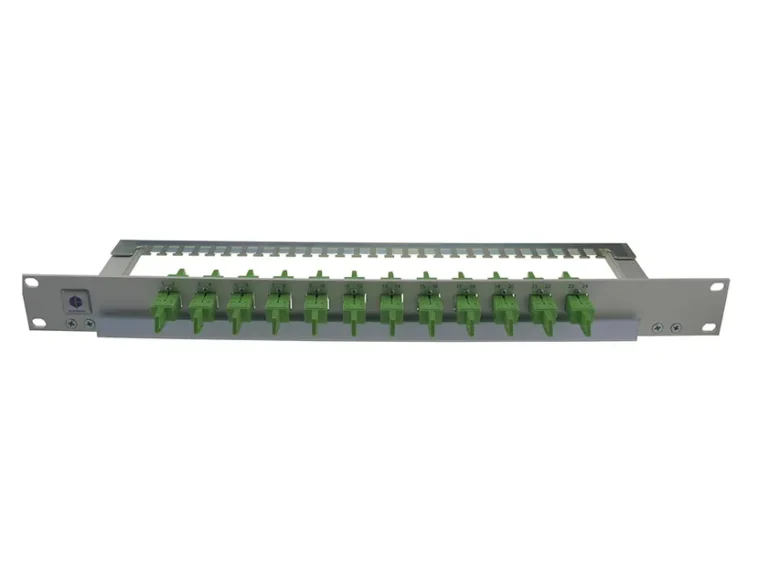
For municipal FTTH networks, splice boxes with 48 to 96 fibres per 1HE in distribution cabinets are recommended. Main distribution frames should accommodate 288 to 432 fibres across 3HE. Modular design allows for subsequent expansion.
How is quality assurance performed for splice connections?
Each splice connection is measured immediately after creation. Attenuation must be below 0.1 dB. Additionally, OTDR full-route measurement is performed at 1310nm and 1550nm according to IEC 61280-4-1.
Which connector types are optimal for FTTH networks?
For singlemode FTTH, municipal utilities predominantly use LC connectors with APC polish (return loss >60dB). In industrial environments, robust E2000 connectors are employed. SC connectors are still found in legacy networks.
What is the typical packing density in modern distribution frames?
Modern splice systems achieve up to 96 fibres per 1HE with front access. This represents double the density of conventional systems. VarioConnect systems achieve 288 fibres per 3HE.
Order directly from our shop: fiber-products.de
Request a quote today
Free consultation – personalised quote within 24 hours