NATO-Compliant Fibre Optic Components: Standards for Defence Infrastructure
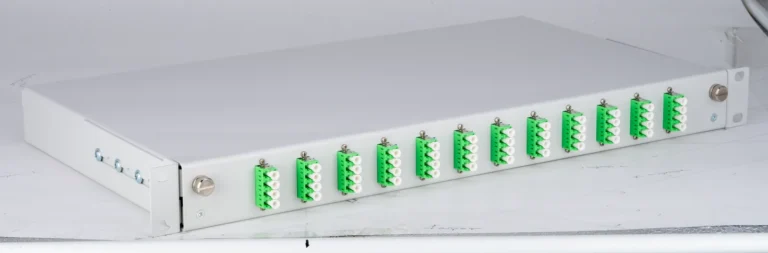
NATO fibre optic, military fibre optic networks and standards-compliant defence fibre form the technical foundation of modern security infrastructure, with NATO Standardization Agreements (STANAG) defining precise requirements for optical transmission systems with insertion loss < 0.25 dB and return loss > 70 dB. Implementation of these military standards is achieved through high-density fibre optic systems that terminate up to 96 fibres in 1U whilst meeting critical STANAG standards 3910, 4774 and 4778 for secure communication.
In German-speaking regions, NATO-compliant fibre optic solutions are gaining importance due to geopolitical conditions and the role as transit territory for European data flows. Authorities and defence facilities are increasingly adopting modular splice systems that satisfy both civilian VDE 0800 standards and military STANAG requirements.
STANAG 3910: The technical gold standard for military fibre optic networks
STANAG fibre optic specifications define detailed parameters for high-frequency bus connections in military platforms. The standard prescribes transmitter output power of -0.5 ± 3.5 dBm and receiver sensitivity of at least -37 dBm. These precise requirements ensure reliable data transmission over several hundred metres in protected environments.
- Complete immunity to electromagnetic interference (EMI)
- Protection against nuclear electromagnetic pulse (NEMP)
- Reflective star topology for optimal power budget
- Data rate of 20 Mbit/s in high-speed bus
- Transmitter initialisation time: maximum 2432 microseconds
Practical implementation is achieved through specialised fibre optic components deployed in both bunkers and mobile command centres. Modern splice modules enable flexible integration of various connector types whilst maintaining strict NATO compliance.
Physical security: eavesdropping protection through fibre optic technology
Unlike copper-based systems, optical fibres provide inherent eavesdropping security. Light signals are completely contained within 9 micrometre single-mode fibres and cannot be tapped without physical damage.
| Security feature | Fibre optic | Copper cable |
|---|---|---|
| Electromagnetic radiation | None | Measurable |
| Passive eavesdropping | Physically impossible | Possible with induction coils |
| Tampering detection | Immediate loss change | Difficult to detect |
| TEMPEST compliance | Fully achieved | Complex shielding required |
NATO fibre optic systems additionally employ integrated monitoring mechanisms. Any tampering results in measurable loss changes, immediately detected and reported to the security centre.
E2000 connectors as NATO standard for maximum precision
The E2000 connector has established itself as the preferred standard for standards-compliant defence fibre optic installations. With its self-closing metal shutter and robust push-pull mechanism, it meets the demanding requirements of military environments.
Technical specifications exceed conventional connectors significantly: insertion loss < 0.25 dB per IEC 61300-3-4, return loss > 70 dB with APC finish and a lifespan of at least 1,000 mating cycles with maximum loss change of 0.2 dB.
- Operating temperature range: -40°C to +85°C
- Zirconia ceramic ferrule with 2.5 mm diameter
- 8° angled physical contact (APC) for minimal reflections
- Automatic protective cap against contamination
- Colour coding per IEC 61754-15
Fiber Products Quality Promise: As an official Diamond Partner and manufacturer, we produce modular splice systems in Europe. Benefit from Swiss precision and 5 years warranty on all our systems.
High-density splice systems for protected infrastructure
Military command centres and bunker facilities require maximum port density within limited space. Modern splice systems achieve 96 fibres in just 44.45 mm rack height (1U), representing over 50 per cent space savings compared to conventional 48-port systems.
| System | Fibres per 1U | Space for 10,000 fibres | Space saved |
|---|---|---|---|
| Standard 48-port | 48 | 105 U | – |
| SlimConnect 1U | 96 | 55 U | 50 U |
| VarioConnect 3U | 288 (on 3U) | 35 U | 70 U |
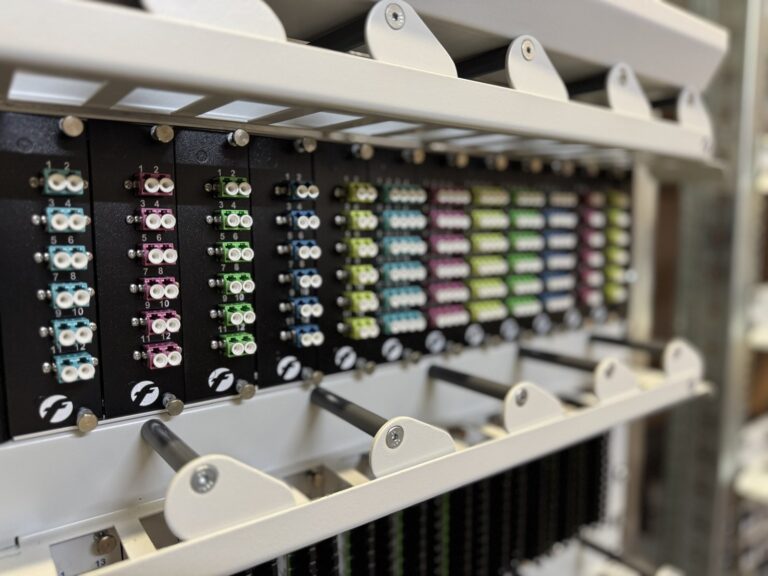
The modular architecture follows the 7TE module format to Eurocard standard. This enables flexible module exchange without system reconfiguration – essential for rapidly changing military network architectures.
STANAG 4774 and 4778: Cryptographic data security
STANAG fibre optic networks integrate advanced security mechanisms beyond physical transmission. STANAG 4774 defines trusted labels with cryptographic metadata for classification of secrecy levels.
STANAG 4778 governs the cryptographic binding of these labels to data objects. Even minute tampering renders the label automatically invalid and blocks data exchange. This end-to-end security is essential for decentralised military structures.
- XML security labels with creator information
- Defined recipient circles and expiration dates
- Automatic integrity checking at every access
- Compatibility with NATO-wide encryption systems
VDE 0800: German standards for defence infrastructure
The German standards series VDE 0800 harmonises civilian and military requirements for standards-compliant defence fibre optic. The 2024 updated VDE 0800-730 clarifies fire safety requirements for fibre optic cables in sensitive buildings for the first time.
Fibre optic cables are explicitly classified as non-combustible, simplifying installation in government buildings and defence facilities. The standard permits installation in metal ducts or as adhesive fibres in escape routes – critical for retrofitting existing infrastructure.
The standards committee DKE/AK 412.6.8 is currently developing the first systematic documentation standard for network level 3 fibre optic routes. This is essential for military organisations requiring precise records of all fibre optic infrastructure.
Redundancy and fault tolerance in critical networks
NATO fibre optic architectures require multiple redundancy at all levels. This begins with diversified route planning and extends to mirrored splice modules in separate fire compartments.
- Primary and secondary routes with minimum 50 metre separation
- Automatic switchover in less than 50 milliseconds
- Geographically distributed nodes
- Independent power supply per route
- Continuous OTDR monitoring of all links
Modern splice systems support these redundancy concepts through hot-swappable modules and pre-configured emergency patch fields. In case of fault, complete modules can be exchanged within minutes.
Integration into existing military infrastructure
Migration from copper to STANAG fibre optic systems typically occurs in stages. Hybrid splice modules enable parallel termination of fibre optic and copper connections in the same system.
For authorities with established infrastructure, modular migration paths are available. Starting with critical backbone connections, all transmission links are gradually converted to fibre optic. Compatibility with existing 19-inch racks and compliance with IEC 60297 standard ensures seamless integration.
Practical example: Upgrading a command centre
A typical modernisation project for standards-compliant defence fibre optic comprises several phases. Initially, an inventory is conducted with documentation of all transmission links per VDE 0800-710.
Phase two involves installing high-density splice systems terminating both existing and new fibres. Selection frequently falls on SlimConnect 1U systems with E2000-APC connectors for maximum future-proofing. The final phase includes integration of monitoring systems and training of technical personnel.
- Inventory and route planning: 2-3 weeks
- Splice system installation: 1-2 weeks
- Fibre splicing and documentation: 3-4 weeks
- Measurement acceptance per IEC 61280-4-1: 1 week
- System integration and redundancy testing: 2 weeks
Future perspectives: Quantum communication over NATO fibre optic networks
The next evolution of NATO fibre optic technology lies in integrating quantum cryptography systems. Existing single-mode fibres are already suitable for quantum key distribution (QKD) over distances up to 100 kilometres.
Current NATO research projects investigate QKD integration into existing STANAG-compliant networks. Technical requirements – particularly the extremely low loss values of modern fibres – are already met today. High-quality splice systems with splice loss < 0.02 dB create the prerequisites for this future technology.
Frequently asked questions about NATO-compliant fibre optic systems
Which STANAG standards are relevant for fibre optic installations?
The most important standards are STANAG 3910 for optical bus connections, STANAG 4774 for security labels and STANAG 4778 for cryptographic binding. Additionally, national standards such as VDE 0800 apply for technical implementation.
How do military fibre optic specifications differ from civilian ones?
Military specifications require extended temperature range (-40°C to +85°C), higher mechanical resilience and integrated security mechanisms. Optical parameters are identical, but documentation and redundancy requirements are significantly stricter.
Which connector types are suitable for defence applications?
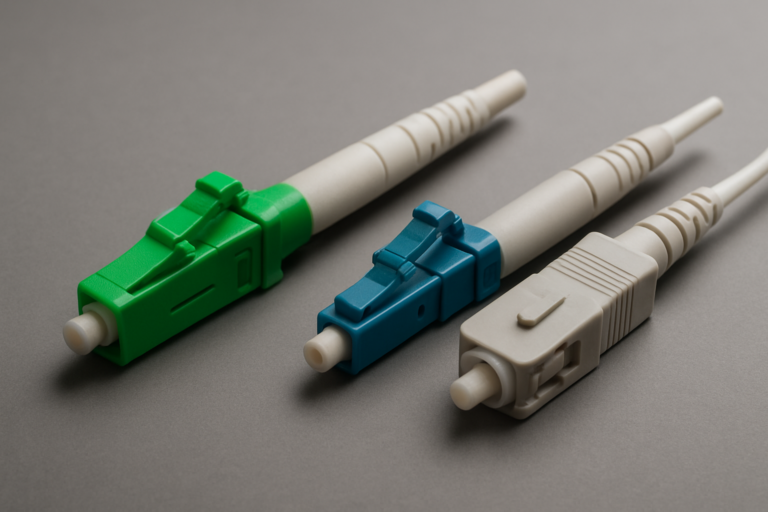
E2000-APC connectors are considered the standard for the highest requirements. LC-Duplex is used for high port density, whilst SC connectors are deployed for robust backbone connections. MPO/MTP enables high-speed connections with up to 24 fibres per connector.
How is eavesdropping security ensured in fibre optic networks?
Optical fibres are inherently secure against eavesdropping as light signals do not emit electromagnetically. Additionally, modern monitoring systems detect any physical tampering through loss changes. Cryptographic security is implemented separately at protocol level.
Which redundancy concepts are mandated for critical infrastructure?
NATO standards require at least two independent transmission paths with automatic switchover under 50 milliseconds. Additionally, geographically distributed nodes and independent power supplies are required.
Can existing copper networks be migrated gradually?
Yes, modern splice systems support hybrid configurations. Migration typically begins with critical backbone links, whilst non-critical connections can temporarily remain on copper.
For detailed advice on NATO-compliant fibre optic solutions and modular splice systems, our expert team is available. As a manufacturer with 5 years warranty on all systems, we support authorities in planning and implementing secure fibre optic infrastructure.
Interested in modular fibre optic solutions?
Fiber Products GmbH – official DIAMOND Partner. Made in EU, 5 years warranty.