Public Tender for Fibre Optic Networks: DACH Compliance Guide for Operators
Public Fibre Optic Tender, DACH Compliance and Procurement Law: Essential Guide for Network Operator Procurement
Public fibre optic tenders, DACH compliance and procurement law define the legal framework for municipal network operators when procuring fibre optic components with a contract value exceeding €215,000. These thresholds from EU Procurement Directive 2014/24/EU determine when public authorities and utilities must conduct Europe-wide tenders. Non-compliance with procurement regulations can result in award cancellation and damages claims.
Legal Foundations of Public Fibre Optic Tenders in the DACH Region
German procurement law for fibre optic infrastructure is based on the GWB (Act Against Restraints of Competition) and the VgV (Procurement Ordinance). Austria follows the BVergG 2018, while Switzerland applies the BöB (Federal Act on Public Procurement). All three countries implement EU procurement directives at national level.
Fibre optic projects must meet specific technical requirements under IEC 61300 and IEC 61754. These standards must be integrated into performance specifications in a technology-neutral manner to avoid discrimination.
- Open procedure: Unrestricted number of participants, minimum 30-day submission deadline
- Restricted procedure: Two-stage with pre-qualification, shortened timeframes possible
- Negotiated procedure: Only for complex fibre projects with technical innovation
- Framework agreements: Up to 4 years duration for recurring procurements
Thresholds and Procedure Types for Fibre Optic Components
Thresholds determine the applicable procurement procedure. For supply contracts of fibre optic components such as splice modules, patch panels or connectors, the EU threshold of €215,000 net applies for classical contracting authorities.
| Contract Value | Procedure Type | Minimum Deadline | Publication |
|---|---|---|---|
| < €1,000 | Direct award | None | None |
| €1,000 – €50,000 | Negotiated award | 10 days | Optional |
| €50,000 – €215,000 | Restricted tender | 14 days | National |
| > €215,000 | EU-wide tender | 30 days | TED database |
Sector operators such as energy utilities have a higher threshold of €431,000. This affects many municipal utilities that operate both electricity and fibre networks.
Technical Requirements in Fibre Optic Performance Specifications
Technology-neutral formulation of technical specifications presents challenges for contracting authorities. Instead of brand names, functional requirements must be defined. A bill of quantities for splice modules should specify packing density, attenuation values and connector types.
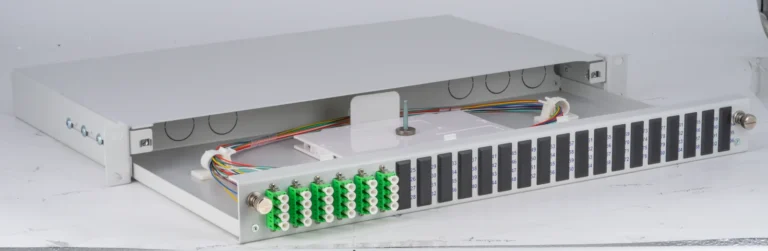
Typical technical parameters for 19-inch splice modules include fibre density per rack unit, with modern systems enabling up to 96 fibres per 1U. Return loss must be at least 45 dB for PC polishing and 60 dB for APC polishing.
- Insertion loss: maximum 0.25 dB for single-mode connections
- Temperature range: –40°C to +85°C for outdoor applications
- Protection class: minimum IP54 for distribution cabinets
- Connector types: LC, SC, E2000, ST or FC per IEC 61754
- Modularity: interchangeable front panels and splice cassettes
DACH-Specific Standards and Certifications
Germany requires DIN EN 50173 for structured cabling systems. Austria additionally mandates ÖNORM EN 50173, while Switzerland applies SN EN 50173. These national adaptations of the European standard must be considered in tenders.
Fire safety classification under CPR (Construction Products Regulation) has been mandatory since 2017. Fibre optic cables must meet at least class Dca-s2,d2,a2, often B2ca for critical infrastructure.
Fiber Products Quality Commitment: As an official Diamond Partner and manufacturer, we produce modular splice systems in Europe. Benefit from Swiss precision and in-house manufacturing.
Award Criteria and Evaluation Matrices
The most economically advantageous bid wins – not the cheapest. Contracting authorities must weight award criteria transparently. Typical weightings for fibre optic components are distributed across price (40–60%), quality (20–30%) and service (10–20%).
| Criterion | Weighting | Sub-criteria | Evidence |
|---|---|---|---|
| Price | 50% | Total cost, discounts | Price sheet |
| Quality | 25% | Standards, warranty | Certificates |
| Delivery time | 15% | Availability | Binding commitment |
| Service | 10% | Support, training | Concept document |
Qualification Documents and Pre-qualification
Bidders must demonstrate their technical, economic and professional capability. For fibre optic suppliers, this means reference projects from the last 3 years of comparable scope. A minimum turnover of twice the contract value may be required.
Technical evidence includes ISO 9001:2015 certification for quality management and ISO 14001:2015 for environmental management. Product certificates per IEC 61300-3 confirm compliance of fibre optic components.
- Business register extract not older than 6 months
- Tax clearance certificate and social security clearance
- Professional indemnity insurance minimum €2 million
- Reference list with at least 3 comparable projects
- Product datasheets and declarations of conformity
Documentation and Record-Keeping in Procurement Processes
Complete documentation protects against post-award challenges. Every decision must be justified in writing. The procurement record documents the entire process from needs assessment through award decision.
Electronic procurement platforms such as DTVP in Germany or simap.ch in Switzerland are mandatory for EU-wide tenders. End-to-end electronic processing will be compulsory for all public contracts from 2026 onwards.
Framework Agreements for Continuous Fibre Optic Procurement
Framework agreements enable flexible call-offs over up to 4 years. For continuous network rollout, municipal utilities can order fibre optic components as needed. Total quantity does not need to be precisely defined, but realistic estimates must be provided.
Mini-competitions within framework agreements optimise terms on specific call-offs. At least 3 framework partners should ensure adequate competition. Technical specifications remain unchanged during the agreement period.
- Maximum duration: 48 months plus extension option
- Call-off intervals: quarterly or project-based
- Price adjustment clauses for raw material costs
- Minimum purchase volumes: not legally binding
- Termination clauses for quality defects
Sustainability Criteria in Fibre Optic Tenders
Environmental aspects increasingly influence award criteria. Production carbon footprint, recyclable materials and short transport routes can account for up to 20% of the evaluation. European manufacturing scores particularly well here.
Longevity of fibre optic components reduces resource consumption. Modular systems with interchangeable components extend service life. A 5-year extended warranty signals quality and sustainability.
Common Errors in Public Fibre Optic Tenders
Product-specific requirements frequently trigger tender challenges. Requiring specific manufacturers or proprietary systems is only permitted with technical justification. Insufficient submission periods or unclear performance descriptions are also challengeable.
Breach of equal treatment by making subsequent changes or providing additional information to individual bidders may result in award cancellation. All bidder enquiries must be shared anonymously with all participants.
- Brand name without “or equivalent” clause
- Falling short of minimum deadlines by even one day
- Missing justification for bidder exclusion
- Changing award criteria after bid opening
- Award without prior publication when threshold exceeded
Digitalisation and E-Procurement for Fibre Projects
Electronic procurement is progressively becoming mandatory. Since 2018, EU-wide tenders must be handled electronically. From 2026, this applies to all public contracts regardless of value. XVergabe standards enable seamless processes.
Electronic catalogues simplify recurring purchases of standard components such as patch cables or adapters. Structured product data per BMEcat 2.0 or ETIM enables automated price comparisons.
Case Study: Municipal Fibre Network Rollout Tender
A mid-sized city plans fibre network expansion for 5,000 households. The estimated contract value of €450,000 for splice modules and distribution cabinets exceeds the EU threshold. The open procedure with 35-day submission deadline is selected.
The performance specification requires 19-inch splice modules with at least 72 fibres per 1U, interchangeable front panels for LC and SC connectors and a warranty of at least 3 years. Award criteria weight price at 55%, quality at 30% and delivery time at 15%.
FAQs on Public Fibre Optic Tenders
When is EU-wide procurement mandatory for fibre optic components?
For supply contracts for fibre optic components from an estimated net contract value of €215,000 for classical public contracting authorities or €431,000 for sector operators. Splitting into lots to undercut thresholds is prohibited.
Can specific connector types like E2000 be explicitly required?
Yes, if technically justified. The E2000 connector offers advantages in dusty environments through its protective shutter. However, the tender must allow equivalent alternatives with comparable technical properties.
What are the submission deadlines for fibre optic tenders?
In open procedures, minimum 30 days from publication. With electronic submission, the deadline shortens to 25 days. In urgent, justified cases, 15 days is possible.
Can existing systems be named as compatibility requirements?
Requiring compatibility with existing systems is permissible if technically necessary. However, the exact interface requirements must be described in technology-neutral terms.
What warranty duration can be required in tenders?
Statutory warranty is 2 years. Longer warranty periods can factor into the quality evaluation, but must not be an exclusion criterion. Bidders offering 5-year warranty receive correspondingly higher scores.
Must all technical standards be explicitly named in the tender?
Key standards such as IEC 61300 for test procedures and IEC 61754 for connectors should be mentioned. The phrase “in the currently valid version” avoids update issues.
Successful public fibre optic tenders require detailed knowledge of procurement law and technical understanding of fibre optic components. Specialist suppliers for public authorities support with compliant product portfolios and complete documentation packages. As a manufacturer of modular fibre optic solutions, Fiber Products offers the complete system range from splice modules to E2000 connectors in certified quality for public contracting authorities.
Order directly from our shop: fiber-products.com
Request a Quote Today
Free consultation – personalised quote within 24 hours