FTTH funding 2025: New gigabit funding regulations for municipal utilities and local authorities

For many municipalities and municipal utilities, federal FTTH funding is the key to successful fiber optic expansion. However, with the extension of the gigabit framework until 2028 and the new funding calls for 2025, important framework conditions are changing. What changes do the updated guidelines for gigabit funding for municipal utilities entail and how can applicants make the most of the funding opportunities?
Gigabit framework extended: planning security until 2028
The most important news first: On July 23, 2024, the EU Commission approved the revised gigabit framework regulation and extended it until 2028. The scheme, which was originally limited until the end of 2025, will be increased by 26 billion euros and adapted in a few points to the new EU broadband guidelines from 2023.
Why this extension is so important:
The Federal Ministry for Digital and Transport Affairs (BMDV) is thus gaining time for a possible fundamental revision of the framework regulation, which could respond to the advanced fiber optic expansion in Germany. At the same time, local authorities and municipal utilities are given planning security for their medium-term FTTH funding projects.
The funding quotas of 50%, 60% and 70%, graduated according to the tax capacity of the municipalities, remain in place. Only the threshold values for the calculation have been updated on the basis of more recent figures from the Federal Statistical Office.
FTTH funding 2.0: What will change in 2025
With the second amendment to the Gigabit Directive on January 13, 2025, important innovations will come into force that will structurally change the application process for gigabit funding for municipal utilities.
New procedural steps: Industry dialog becomes mandatory
The most significant innovation is the mandatory holding of sector dialogs prior to each market exploration procedure. This regulation, which has been in place since the 2024 funding calls, is intended to ensure that the potential of private-sector expansion is exploited to the maximum.
An industry dialog serves as an exchange between local authorities and local telecommunications providers in order to determine private-sector expansion prospects. It is the start of a series of talks in which expansion interests and expectations can be identified and forms the basis for possible cooperation agreements.
Practical effects of the industry dialog:
- Minimum duration of four weeks for implementation
- Bilateral one-on-one meetings with all participating telecommunications companies are mandatory
- Publication of the planned industry dialog for at least four weeks on the project sponsor’s platform
- Direct contact with telecommunications companies active in the region
Market exploration procedure with new rules
The market exploration procedure (MEV) was also revised. A key innovation is the introduction of a “relevant time horizon” for the inquiry into a possible private expansion.
The relevant time horizon is a minimum of three years and a maximum of seven years, but must be determined individually by the municipalities according to the expected duration of the planned FTTH funding project. This gives municipalities more flexibility in project planning.
In addition, the MEV must explicitly state that the subsidized network may be used to develop adjacent areas in the private sector. This “network expansion into adjacent areas” is intended to improve the economic viability of FTTH projects.
Funding calls 2025: New structure and evaluation criteria
The calls for funding for 2025 were already launched in January and show a changed structure with three different application options for gigabit funding for municipal utilities.
Standard call and fast lane call
In principle, FTTH funding applications can be submitted in two categories:
Standard call: for all eligible projects
Fast lane call: for projects with a particularly high score in the criteria catalog
The assessment is based on a transparent list of criteria, which ensures that the funding goes to areas with the greatest need for catching up and support. A new points compass on the online platform enables applicants to assess their chances of success in advance.
Gap closure pilot program as a third option
The Gap Closure Pilot Program was introduced as a special innovation. This is aimed at projects with total expenditure of a maximum of EUR 1 million, in which all eligible addresses in a municipality or a definable administrative district are to be developed.
The program is intended to support smaller municipalities in developing less economically attractive addresses and achieving nationwide gigabit coverage.
Eligibility to apply and eligible measures
Who can submit applications?
Local authorities are eligible to apply for FTTH funding, in particular:
- Municipalities and city states
- Legally independent districts in cities
- Districts and municipal special-purpose associations
- Other local authorities
- Companies in exclusively public ownership
Private individuals cannot apply for gigabit funding for municipal utilities. The funding is provided as a grant, which is passed on by the local authorities to private sector contractors.
What is supported?
KfW promotes various measures in the context of broadband expansion:
- Construction and expansion of passive FTTH or FTTB networks including backbone network
- Connection of other infrastructures such as mobile phone masts or data centers
- Active components of an FTTH or FTTB network including cabling in the building
- Planning and ancillary costs in connection with the projects
In addition to the grant funding, the KfW Digital Infrastructure Investment Loan and the KfW Digital Infrastructure Syndicated Loan are available for financing.
Technical requirements: Gigabit symmetrical as standard
An important aspect of the revised FTTH funding guidelines are the stricter technical requirements. Subsidized networks must provide every end user with a data rate of at least 1 Gbit/s symmetrically (download and upload) at peak load conditions.
Eligibility limit was raised
Network expansion is only eligible for funding in areas where there is not yet a network that provides every end user with at least 300 Mbit/s download and 150 Mbit/s upload. This increase compared to the previous threshold of 30 Mbit/s reflects the increased requirements for modern broadband provision.
Open Access as a funding requirement
Due to state aid regulations, all network infrastructures built by municipal utilities as part of the gigabit subsidy must provide open network access. The right of third parties to access the subsidized network, including active components, has been extended to ten years.
This means that other telecommunications providers can use the subsidized network at fair and transparent conditions, which strengthens competition and increases the variety of offers for end customers.
Timing and practical challenges
Extended lead times due to new processes
The introduction of mandatory industry dialogs significantly extends the time required for FTTH funding applications. Municipalities must allow for the following minimum times:
- Industry dialog: at least 4 weeks
- Market exploration procedure: another 12 weeks
- Application and approval: additional time
Overall, the time required to submit a funding application at all increases to at least four months. This does not include tenders for the commissioning of consulting companies.
Challenges for smaller municipalities
Smaller municipalities in particular face considerable challenges when it comes to gigabit support for municipal utilities:
- Limited personnel resources for the complex procedures
- High bureaucratic effort for the industry dialog
- Uncertainty about the assessment in the criteria catalog
- Competition for limited funding
The gap closure pilot program is intended to remedy this situation, but only reaches projects with a total expenditure of up to 1 million euros.
Country programs and co-financing
Increase by federal states
Many federal states are increasing FTTH funding through their own programs in order to achieve funding rates of up to 90%. Baden-Württemberg, for example, has set itself the goal of always achieving a funding rate of 90% by co-financing federal funding.
Different country programs
The design of the country programs varies considerably:
- Bavaria: Bavarian co-financing gigabit guideline 2.0 valid until 2029
- Lower Saxony: Gray spots directive and municipal broadband loan
- Brandenburg: Focus on structural change and digitalization
- Berlin: Gigabit strategy with focus on profitability gaps
Applicants should carefully check the specific regulations of their federal state, as funding quotas, procedures and application deadlines may differ.
Criticism and challenges from the field
Associations express concerns
The German Association of Local Utilities (VKU) criticizes the fact that several of the planned changes go beyond what is necessary to adapt to the EU broadband guidelines. In particular, the VKU fears that the new regulations could permanently weaken the subsidized fiber optic expansion or bring it to a partial standstill.
Bitkom complains that impractical requirements could be created for the subsidized digital infrastructure expansion, which could seriously jeopardize the expansion.
Planning uncertainty for ongoing projects
A particular problem arises for municipalities that have already applied for FTTH funding or have even received provisional funding decisions. The new regulations may not be applied retroactively to projects that have already been approved, but the distinction is often unclear in practice.
Limited funding vs. high demand
With only 23 million euros in the first call for 2024, there are significantly fewer funds available than would be needed. A maximum of 100 applications can be approved nationwide, leading to intense competition for gigabit funding for municipal utilities.
Strategic recommendations for applicants
Early planning is crucial
Due to the extended lead times, municipalities should start their FTTH funding projects at least six months before the desired application is submitted. The industry dialog should be strategically planned and professionally conducted, as its results are decisive for the further process.
Use professional advice
The complexity of the new regulations makes professional advice practically indispensable. The federal funding also includes funding for consultancy services that local authorities should make use of.
Examine inter-municipal cooperation
Regional cooperation can improve both the chances of success and the economic viability of gigabit promotion municipal utility projects. For example, industry dialogs can be held on a district-wide basis, which creates synergies and reduces the effort per municipality.
Use point compass strategically
The new points compass on the online platform should be used strategically and at an early stage. This enables local authorities to realistically assess their chances of success and adjust their project planning if necessary.
KfW programs as a supplement
Favorable loans for infrastructure projects
In parallel to FTTH grant funding, KfW offers low-interest loans for municipal broadband projects. The KfW Digital Infrastructure Investment Loan and the KfW Digital Infrastructure Syndicated Loan can close the financing gap that arises as a result of own contributions to the funding.
These instruments are particularly interesting for:
- Municipalities with a high credit rating that receive favorable conditions
- Projects that exceed the maximum funding limits
- Fast interim financing until the grants are paid out
Use possible combinations
The various financing instruments can be combined:
- FTTH funding as basic financing
- State funding to increase the quota
- KfW loans for own shares and additional investments
- Municipal own funds for strategic components
Technical implementation and quality requirements
Higher demands on the infrastructure
The required 1 Gbit/s symmetrically at peak load conditions sets high standards for the technical implementation of gigabit support for municipal utilities. This requires:
- Continuous fiber to the end customer (FTTH)
- High-quality passive components for long-term reliability
- Scalable active technology for future bandwidth increases
- Professional planning and installation
Consider the long-term perspective
Subsidized networks must be earmarked for at least ten years. During this period, they must meet the original FTTH funding objectives and be available to other providers on fair terms.
This underlines the importance of:
- Future-proof technology that will still be up to date in ten years’ time
- Modular systems that enable cost-effective expansions
- High-quality components that guarantee a long service life
Outlook: Developments until 2028
Further adjustments expected
The BMDV has announced that it will use the time until 2028 to develop a possible fundamental revision of the framework regulation. This could respond to the advanced fiber optic expansion in Germany by then.
Possible developments for FTTH promotion:
- Adjustment of eligibility thresholds to the market standard
- Simplification of procedures based on experience
- New funding instruments for special applications (5G backhauling, smart city)
- Stronger focus on underserved areas
Observe market development
The gigabit promotion Stadtwerke guidelines must also respond to market developments:
- Increasing private sector expansion activities reduce need for subsidies
- New technologies (5G, edge computing) create new requirements
- Climate protection and sustainability are becoming more important criteria
Conclusion: both a challenge and an opportunity
The revised FTTH funding 2025 brings both opportunities and challenges. The extension until 2028 creates planning security, while the new procedures increase the workload for applicants.
Success factors for municipalities:
- Early and strategic planning
- Professional advice and support
- Realistic assessment of your own chances of success
- Cooperation with other municipalities and private partners
For municipal utilities, gigabit funding means municipal utilities:
- Increased role as infrastructure provider
- New business opportunities through Open Access
- Long-term investment perspective through earmarking
- Higher quality requirements for technology and implementation
FTTH funding remains an important building block for the nationwide expansion of fiber optics in Germany. Those who understand the new regulations and use them strategically will also be able to successfully benefit from the funding opportunities in 2025.
When implementing funded fiber optic projects, choosing the right components is particularly important. The ten-year earmarking and the Open Access obligation require technology that not only works today, but is also reliable and expandable in ten years’ time.
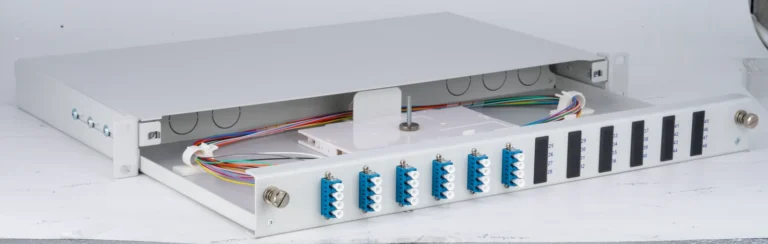
At Fiber Products, we understand the special requirements of subsidized projects. Our modular fiber optic solutions are specially developed for use in municipal networks and meet all relevant standards for subsidized infrastructures. From splice modules and splice boxes to ODF systems – our products support installers and system integrators in professional implementation.
At Fiber Products, we develop fiber optic components to meet the highest quality standards. Our modular systems combine proven technology with innovative features. With a 5-year guarantee and European production to German quality standards, we offer competitive prices and premium quality for professional fiber optic networks.
Discover our complete product range or visit our online store. Talk to us – together we will develop the optimum solution for your conveyor project. Contact us for an individual consultation or find out about other specialist topics in our fiber optic knowledge blog.