State Support for Fibre Optic Deployment in Bavaria 2026: Applications, Deadlines and Requirements
State Support for Fibre Optic Deployment in Bavaria 2026: Essential Information on BayernAtlas Breitband and Funding Applications for Municipalities
State funding for fibre optic deployment in Bavaria, documented in BayernAtlas Breitband, enables municipalities to apply for grants covering 80–90% of eligible costs for comprehensive fibre rollout. Following the expiry of the Bavarian Gigabit Framework (BayGibitR) on 31 December 2025, new federal programmes worth €1.8 billion will be available from 2026 onwards. Municipalities and network operators must prepare for revised application procedures, new technical specifications and expanded documentation requirements.
The transition from Bavarian to nationwide funding brings significant changes: intervention thresholds for grey-spot areas are set at 100 Mbit/s download for households and 200 Mbit/s symmetrical for commercial zones. BayernAtlas Breitband will receive a comprehensive update on 11 March 2026 with enhanced planning functionality.
Current funding landscape: from BayGibitR to federal support in 2026
The Bavarian Gigabit Framework shaped publicly funded fibre deployment across the state until the end of 2025. With maximum grant amounts of €2,500 to €6,000 per address and total allocations of €3 to €8 million per municipality, substantial investment in digital infrastructure was enabled. In 2025 alone, €15.5 million was distributed to ten municipalities, three schools and three town halls.
- Target bandwidths under previous funding: ≥1 Gbit/s symmetrical for commercial users
- Minimum requirement for households: ≥200 Mbit/s symmetrical
- Grant commitment period for funded networks: 7 years
- Grant recipients: municipalities, inter-municipal associations, public consortia
The Federal Ministry for Digital and Transport is planning new gigabit funding calls for 2026 with significantly increased budgets. Technical requirements for modular fibre solutions are correspondingly higher – particularly regarding port density and scalability of deployed splice systems.
BayernAtlas Breitband: central planning platform for funding applications
BayernAtlas Breitband serves as the digital survey and planning platform for broadband infrastructure coverage in Bavaria. The March 2026 release brings important improvements for application submission:
| Function | Current Status | Updates 2026 |
|---|---|---|
| Coverage analysis | Manual data entry | Automated network operator query |
| Eligible areas | Static maps | Dynamic real-time display |
| Documentation | Separate submission | Integrated upload function |
| Planning horizon | 1-year forecast | 3-year deployment plans |
When using BayernAtlas Breitband, municipalities must pay particular attention to accurate classification of white and grey-spot areas. Incorrect coverage data can lead to delays or rejection of funding applications.
Technical requirements for funded fibre optic networks
The new 2026 funding programmes impose higher technical specifications for fibre optic networks. Modular splice systems with high port density become a basic requirement for cost-effective funding applications. Systems must support at least 48 fibres per 1U and comply with standards IEC 61754 and ISO/IEC 11801.
- Minimum port density: 48 fibres per 1U rack unit
- Connector compatibility: LC, SC, E2000, ST, FC, MPO
- Insertion loss: < 0.25 dB for single-mode connections
- Return loss: > 65 dB for APC connectors
- Protection class: at least IP54 for outdoor installations
Fiber Products quality commitment: As an official Diamond Partner and manufacturer, we produce modular splice systems in Europe. Benefit from Swiss precision and in-house manufacturing.
Application procedure and deadlines for state fibre funding in Bavaria
The application procedure for new 2026 funding programmes is two-stage, conducted through competent regional authorities and digitisation offices. Municipalities must first perform a network operator survey, which takes at least one month and may be extended if required.
Submission is electronic via DOCX form to the central office kofinanzierung.bundesprogramm@ldbv.bayern.de. The following documents are mandatory:
- Municipal council resolution authorising the fibre deployment project
- Detailed financial plan with proof of co-financing
- Current coverage data from BayernAtlas Breitband
- Technical design including network architecture and splice plan
- Cost–benefit calculation covering 7 years of operation
Eligible costs and funding gap closure
Funding covers the economic gap between deployment costs and projected revenues. However, not all expenses are eligible. Precise calculation of eligible costs determines the success of a funding application.
| Cost Category | Eligible | Funding Rate |
|---|---|---|
| Civil works / trenching | Yes | 80–90% |
| Fibre optic cable | Yes | 80–90% |
| Splice modules / splice boxes | Yes | 80–90% |
| Active equipment | Partial | 50–70% |
| Planning costs | Yes | 80–90% |
| Operating costs | No | 0% |
Particularly important for municipalities: hardship provisions allow financially constrained communities to claim enhanced funding rates of up to 90 percent. Proof is provided through municipal fiscal equalisation records.
Modular splice systems: the key to efficient funding utilisation
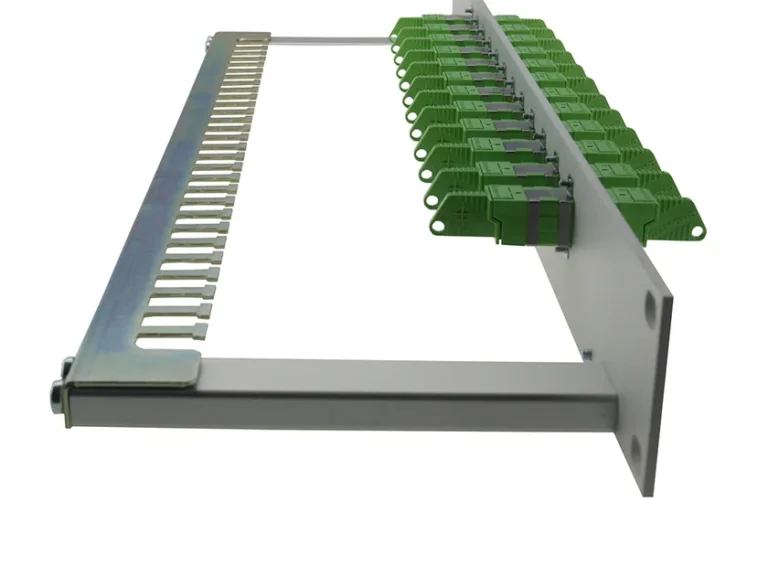
Modern fibre optic projects rely on modular designs that combine flexibility and cost-effectiveness. Compared with conventional splice boxes, modular systems reduce installation time and deliver port densities of up to 96 fibres per 1U – double the capacity of conventional solutions.
- Space savings versus conventional distribution frames
- Replaceable modules with no service interruption
- Pre-terminated cassettes for rapid installation
- Scalability from 12 to 288 fibres per system
- Compatibility with all common connector types
The SlimConnect product line, for example, achieves in a single rack unit the packing density that previously required three. For larger projects, VarioConnect systems with 3U housings accommodate up to 288 fibres in a single chassis.
E2000 connectors and Diamond-grade quality for highest demands
Connector selection significantly influences network quality and operational reliability. E2000 connectors offer decisive advantages for municipal utilities and public network operators through integrated shutters and precise ferrule geometry.
Diamond-grade manufacturing guarantees insertion loss of less than 0.1 dB and return loss of over 65 dB with APC polishing. These values significantly exceed minimum funding framework requirements and ensure long-term transmission stability.
| Connector Type | Insertion Loss (dB) | Return Loss (dB) | Typical Application |
|---|---|---|---|
| E2000 APC | < 0.1 | > 65 | Municipal utilities, industrial |
| LC APC | < 0.15 | > 60 | Data centres |
| SC APC | < 0.2 | > 60 | Distribution networks |
| MPO/MTP | < 0.35 | > 35 | High-density applications |
Special considerations for grey-spot areas in Bavaria
Grey-spot areas present particular challenges because a network operator is already active but coverage falls below intervention thresholds. State funding for fibre in Bavaria defines clear eligibility criteria through BayernAtlas Breitband: households must have less than 100 Mbit/s download, commercial areas less than 200 Mbit/s symmetrical.
When planning fibre deployment in grey-spot areas, municipalities must address:
- Evidence of underserving based on current measurements
- Survey of existing deployment plans (3-year horizon)
- Documentation of commercial demand
- Prioritisation of schools and public facilities
- Compliance with open-access requirements
Integration with existing municipal infrastructure
Successful implementation of funded fibre projects requires seamless integration with existing municipal systems. Authorities and administrations must coordinate technical, legal and organisational aspects.
Synergies emerge from co-installation during planned civil works. Documenting these synergies in the funding application can significantly improve approval prospects. Modular splice systems with DIN rail mounting enable space-efficient installation in existing equipment rooms.
Quality assurance and acceptance protocols for funded networks
Funding frameworks require comprehensive documentation and quality verification. Every fibre optic connection must be measured and recorded. Required test protocols include:
- OTDR measurements of all routes with loss budget below 0.35 dB/km
- Individual connector loss documented: maximum 0.25 dB
- Chromatic dispersion testing for routes over 10 km
- Polarisation mode dispersion for high-speed networks
- Geometric survey with GPS coordinates
Use of certified components with factory test certificates significantly simplifies acceptance. Systems with 5-year manufacturer warranty provide additional security throughout the required commitment period.
Cost–benefit analysis and operator models
Choice of operator model significantly influences funding levels and long-term viability. Municipalities can select from several models:
| Operator Model | Advantages | Challenges |
|---|---|---|
| Economic gap closure model | Lowest co-financing share | Operator dependency |
| Operator model | Network control | Higher administrative burden |
| Lease model | Long-term revenue | Investment risk |
| Co-operation model | Shared risk | Complex agreements |
Total cost of ownership (TCO) over the seven-year commitment period must be calculated realistically. Modular systems reduce operating costs through simplified maintenance and expandability.
Practical implementation: from planning to commissioning
Following funding approval, the deployment phase begins. Timeline must comply with funding framework requirements: construction start within 6 months of approval, completion within 24 months.
Project phases are structured as follows:
- Months 1–2: Detailed design and tender of works
- Months 3–6: Civil works and cable installation
- Months 7–9: Splice module and distribution equipment installation
- Months 10–11: Measurement-based acceptance and documentation
- Month 12: Commissioning and handover to network operator
Timely procurement of passive infrastructure is critical for project success. Lead times for specialised splice systems can extend several weeks.
FAQ: Common questions about state fibre funding in Bavaria
What documents do I need for a funding application via BayernAtlas Breitband?
You require a municipal council resolution, detailed financial plan, current coverage data from BayernAtlas Breitband, a technical design including splice plan, and a cost–benefit calculation covering seven years. All documents must be submitted electronically in DOCX format.
What are the funding rates for grey-spot areas in Bavaria in 2026?
Funding rates for grey-spot areas are 80 to 90 percent of eligible costs. Per address, €2,500 to €6,000 is available, with a maximum of €3 to €8 million per municipality. Financially constrained communities may claim enhanced rates through hardship provisions.
What technical requirements apply to modular splice systems in funded projects?
Funded projects require splice systems with minimum 48 fibres per 1U, compliance with IEC 61754 and ISO/IEC 11801, insertion loss below 0.25 dB and return loss above 65 dB for APC connectors. Systems must also meet IP54 protection class.
How long does the application process for state funding take?
The process includes network operator survey (minimum one month), application preparation (two to three months) and approval phase (three to four months). Overall, municipalities should expect six to eight months until funding approval.
Can existing fibre networks be extended with state funding support?
Yes, expansion of existing networks is eligible provided the extensions serve underserved white or grey-spot areas. Network extension must meet the same technical and documentation standards as new deployments.
Request a quote
Have questions about our fibre solutions? Our expert team is happy to advise you – free and without obligation.