Fiber optic fiber guide rings: Why bending radius determines network quality
Fiber guide rings are among the most inconspicuous but most important components in fiber optic networks. These often overlooked components determine whether a fiber optic network delivers stable signal quality for years or loses performance due to gradual attenuation losses. While optical fibers can theoretically transmit almost loss-free, even minor violations of the minimum bending radius standards lead to measurable signal losses, which can add up to considerable problems over an entire network.
The bending radius – the smallest radius at which a glass fiber can be bent without suffering damage – is a physical property that is non-negotiable. Although modern glass fibers tolerate much tighter bends than previous generations, they also have absolute limits. Fibre guide rings ensure that these limits are not exceeded in practice and at the same time create systematic, maintenance-friendly cable organization.
The quality of the fiber routing often only becomes apparent years later: While correctly installed glass fibers retain their original performance, improperly routed installations gradually deteriorate. Micro-bends, pressure points and excessively tight radii initially cause barely measurable losses, but these can increase over time and with temperature fluctuations. Professional fiber guide rings prevent these problems from the outset and create the basis for long-term stable fiber optic networks.
Physical principles of the bending radius
Understanding the physical relationships is crucial for the correct application of fiber guide rings and optimum glass fiber performance.
Light guidance in optical fibers and critical parameters
Glass fibers function according to the principle of total internal reflection: light is guided in the fiber core because it is completely reflected at the interface to the fiber cladding. However, this total reflection only works if certain geometric conditions are met.
If the bending is too strong, the angle at which the light hits the core-cladding interface changes. If this angle falls below a critical value, light escapes from the core into the cladding or even completely out of the fiber. This loss of light manifests itself as measurable attenuation, which fiber guide rings systematically prevent.
Critical parameters for optimum fiber guidance:
- Numerical aperture (NA) of the fiber
- Refractive index difference between core and cladding
- Wavelength of the transmitted light
- Fiber geometry and tolerances
Physics is relentless: If the critical bending radius is not reached, losses inevitably occur, regardless of the fiber quality or other factors. Fiber guide rings ensure compliance with these physical limits.
Macro and micro bending: Different types of damage
Glass fibers can be damaged by two different types of bending, which have different causes and require different countermeasures using fiber guide rings.
Macrobends:
- Visible bends with radii in the millimeter to centimeter range
- Arise due to improper installation or cable routing
- Cause immediately measurable, often irreversible attenuation losses
- Avoidable by adhering to the minimum bending radii with professional guide rings
Microbends:
- Microscopic deformations of the fiber geometry
- Formed by mechanical pressure, temperature fluctuations or ageing
- Causes gradual increase in attenuation over time
- Minimizable due to pressure-free bearing and soft guides
The fiber guide rings primarily address macrobends, but also help to prevent microbends by enabling even cable distribution without pressure points.
Temperature influences and mechanical stresses
Glass fibers react sensitively to temperature fluctuations and mechanical loads that can change the effective bending radius – an aspect that high-quality fiber guide rings must take into account.
Thermal effects:
- Elongation of cables when heated
- Shrinkage on cooling can lead to tighter bends
- Different expansion coefficients of fiber and cable
- Temperature cycles can increase microbending
Mechanical loads:
- Tensile forces can reinforce bends
- Vibrations lead to dynamic loads
- Ageing of the cable sheathing changes mechanical properties
- Settlement of buildings or cable routes
Fiber guide rings with sufficient safety reserves compensate for these influences and ensure stable performance even under changing conditions.
Structure and function of professional guide rings
Modern fiber routing rings are precisely designed components that do far more than simply redirect cables. They combine mechanical protection with systematic cable organization for data centers, telecommunications providers and industrial companies.
Design principles and radius optimization
Radius optimization: Guide rings are manufactured with defined radii that are safely above the critical limit values for all fibre types used. Typical values:
- Standard single-mode fibers: 30mm minimum radius
- Bend-insensitive fibers: 15mm minimum radius
- Multimode fibers: 30-50mm depending on type
- Safety margin: factor 1.5-2.0
Surface design for optimum fiber guidance:
- Smooth, edge-free surfaces prevent damage
- Defined guide grooves for systematic cable arrangement
- Materials without sharp edges or burrs
- Antistatic properties to prevent dust attraction
Material selection for long-term stability:
- High-quality plastics with lasting dimensional stability
- UV-resistant formulations for outdoor applications
- Antistatic additives for clean surfaces
- Temperature resistance according to application
Different designs for different applications
Solid rings for standard applications:
- Closed fiber guide rings for permanent installations
- High mechanical stability
- Standard radii from 30-100mm
- Stackable versions for multiple fibers
Separable rings for ease of maintenance:
- Hinged or separable construction of guide rings
- Subsequent installation without removing the plug
- Snap-in connections for a secure hold
- Particularly important for service work in modular systems
Miniature rings for compact installations:
- Reduced dimensions for confined spaces
- Optimized for bend-insensitive fibres
- Radii from 15-25mm
- High packing density in 1U systems
Stacking rings for high fiber counts:
- Multiple guide levels in one fiber guide ring component
- Systematic separation of different fiber groups
- Color coding for easy assignment
- Optimized for ODF systems and data centers
Critical application areas for fiber guidance
Certain areas in fiber optic networks are particularly susceptible to bend radius problems and require careful planning of the guide ring implementation.
Splice housing and distributor
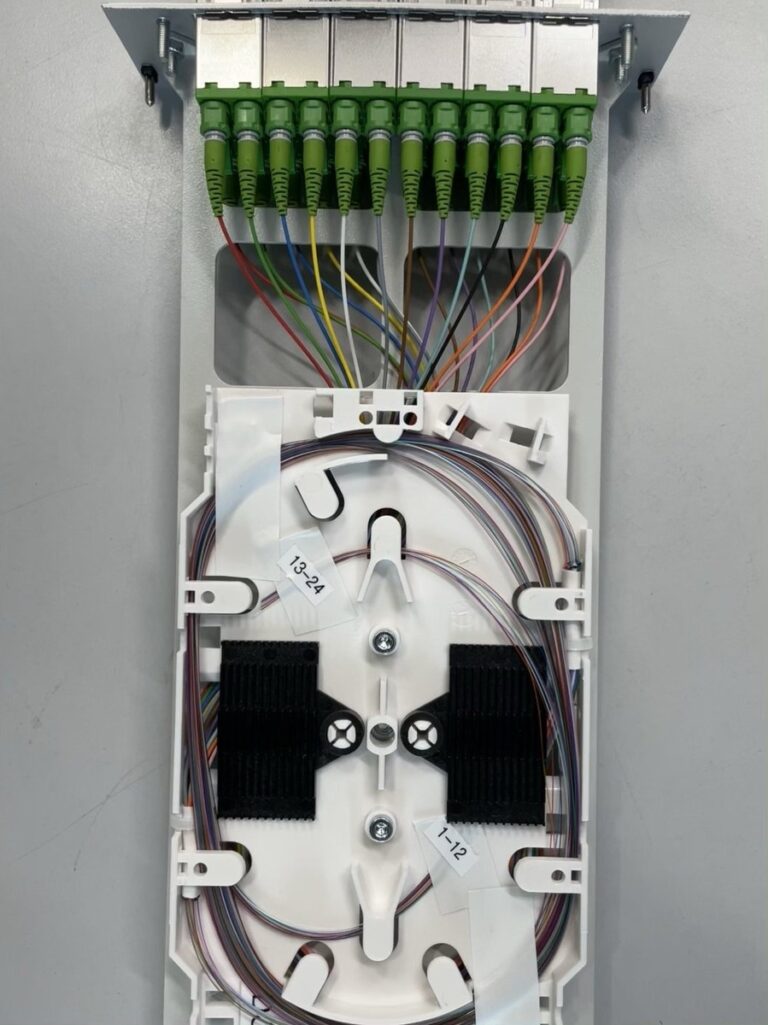
Splice enclosures concentrate many optical fibers in a small space and are especially critical for proper guide ring application.
Challenges in splice enclosures:
- Many fibers in a limited space
- Service loops must be accommodated
- Different fiber directions and lengths
- Maintenance access must not impair fiber guidance
Solution approaches with professional guide rings:
- Staggered guide rings for different service loop lengths
- Color-coded rings for different cable directions
- Separable rings for maintenance-friendly access
- Modular splicing systems for flexible configuration
Patch panels and active components
In patch panels and for connections to active components, uncontrolled bends often occur due to patch cables that are too short or where space is limited – typical problem areas for guide ring use.
Typical problem areas:
- Transition from rigid cables to flexible patch cables
- Connections to switch ports in densely packed racks
- Cable management for frequent reconnections
- Service access during ongoing operation
Preventive measures through systematic fiber management:
- Plan sufficient patch cable lengths
- Guide rings at critical transition points
- Systematic cable management with defined routing paths
- Training of maintenance personnel
Building penetrations and outdoor transitions
Transitions between different environments are particularly critical for guide ring implementation, as mechanical and thermal loads occur here.
Stress factors:
- Building settlements and movements
- Temperature change between indoor and outdoor areas
- Wind loads for aerial cables
- Moisture and condensation
Protective measures:
- Generous bending radii at all transitions with professional fiber guide rings
- Flexible cable routing with movement reserves
- Weather protection for guide rings
- Regular inspection of critical points
Installation and best practices
The professional installation of fiber guide rings requires a systematic approach and observance of physical limits.
Planning principles for optimum fiber guidance
Radius dimensioning for guide rings:
- Determine the minimum radius of the fiber types used
- Apply a safety factor of 1.5-2.0
- Consider temperature influences and ageing
- Different fiber types in one system: use the largest minimum radius
Space requirement calculation:
- Service loop lengths according to maintenance concept
- Reserves for future expansions
- Accessibility for maintenance work with fiber guide rings
- Compatibility with other components
Service loop management with professional guide rings
Service loops are fiber reserves that enable maintenance work and repairs without having to replace the entire cable – a critical area of application for fiber guide rings.
Dimensioning of service loops:
- Standard length: 2-3 meters per connection
- Critical connections: up to 5 meters
- At least 2-3 complete rotations in the guide ring
- Consideration of all connected fibers
Organization of several service loops:
- Different lengths for staggered maintenance
- Color coding for clear assignment
- Separate routing according to cable direction
- Documentation of loop lengths and positions
Tools and aids for professional installation
Special tools for fiber guidance:
- Guide ring templates for even loops
- Bending radius measuring devices for quality control
- Cable pulling systems for gentle installation
- Optical microscopes for damage detection
Measurement technology for control:
- OTDR measurements for bending radius analysis
- Power meter for attenuation measurements
- Visual fault locator for major damage
- Endoscopes for hard-to-reach areas
Quality control and measurement methods
The quality of the guide ring implementation can be objectively assessed and monitored using various measurement methods.
Optical measurements for fiber guide quality
OTDR analysis: OTDR devices (Optical Time Domain Reflectometer) can precisely localize and quantify bending losses caused by inadequate fibre guide rings.
- Characteristic signature of bending losses
- Localization of problematic areas to within a few meters
- Quantitative assessment of the loss variables
- Comparative measurements before/after guide ring optimization
Attenuation measurements:
- End-to-end measurements of the entire route
- Segment-by-segment measurements for localization
- Different wavelengths for complete analysis
- Temperature-dependent measurements
Mechanical inspections and documentation
Visual inspection of the guide rings:
- Compliance with minimum bending radii
- Even cable distribution without pressure points
- Damage to cables or guide ring
- Proper fixing and labeling
Systematic documentation:
- Photographic documentation of critical areas
- Measurement protocol of all optical parameters
- Cable diagram with marked guide rings
- Maintenance history and change log
Avoid common mistakes and problems
Certain errors in management ring implementation occur again and again and can be avoided by knowing the causes.
Planning errors with fiber guide rings
Insufficient radius dimensioning:
- Use of guide rings that are too small
- Not taking into account different fiber types
- Lack of safety reserves
- Ignoring temperature influences
Lack of space problems:
- Enclosures too small for required service loops
- Subsequent cable additions without space reserves for guide rings
- Conflicts with other components
- Inaccessible maintenance positions
Installation errors and damage prevention
Mechanical damage:
- Overstretching of cables during pulling in
- Sharp edges on temporary guides
- Excessive cable tension forces
- Damage to the fiber guide rings during installation
Organizational deficiencies:
- Confusion of different fiber types
- Missing or incomplete labeling
- Incomplete documentation of the guide rings
- Disregard of maintenance requirements
Future developments and new technologies
Guide rings are constantly evolving, driven by new fiber technologies and increasing density requirements.
Bend-insensitive fibers and more compact solutions
Modern bend-insensitive glass fibers tolerate significantly tighter bends than conventional fibers and enable more compact guide ring installations.
New possibilities:
- Guide rings with 15mm radius instead of 30mm
- Higher packing densities in distributors
- Easier installation in confined spaces
- Reduced service loop lengths
Observe the limits:
- Bend-insensitive fibers also have physical limits
- Not all wavelengths are equally insensitive to bending
- Long-term behavior not yet fully researched
- Mixed installations with conventional fibers require adapted guide rings
Intelligent monitoring and predictive maintenance
Sensor integration in guide rings:
- Strain gauges in guide rings
- Continuous monitoring of mechanical loads
- Automatic alarm in the event of critical conditions
- Integration into network management systems
Predictive maintenance:
- Prediction of failures through trend analysis
- Optimized maintenance intervals based on real loads
- Automatic documentation of changes
- Machine learning for damage forecasts for guide rings
New materials and manufacturing processes
Improved materials for guide rings:
- Self-healing plastics for a longer service life
- Antimicrobial surfaces for hygiene applications
- Conductive materials for EMC protection
- Biodegradable alternatives for sustainability
Additive manufacturing:
- 3D printing for customer-specific fiber guide rings
- Complex geometries for optimized functionality
- Rapid prototyping for fast development
- On-demand production for special requirements
Industry-specific applications
Municipal utilities and municipal grids
Municipal utilities face particular challenges when implementing a management ring:
- Long-term investment protection requirements
- Maintenance-friendly solutions for smaller teams
- Cost-optimized standard solutions
- High reliability requirements
Industrial applications
Industrial companies require robust fiber guide rings for special environments:
- Chemical and temperature-resistant materials
- Vibration and shock-resistant designs
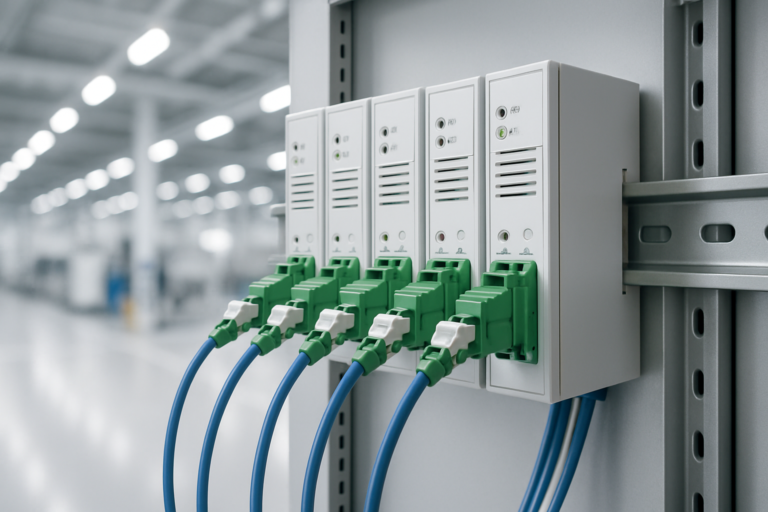
- Integration in 7TE top-hat rail boxes
- Fast maintenance in production environments
Conclusion: Fiber guidance as a foundation for quality
Fiber guide rings are the invisible quality foundation of every professional fiber optic installation. They determine whether a network delivers stable performance over decades or loses reliability due to gradual degradation. The physical laws of light guidance are inexorable – if the critical bending radius is not reached, losses inevitably occur.
The most important success factors for optimal fiber guide rings:
- Generous dimensioning with sufficient safety reserves
- Systematic planning of service loops and maintenance accesses
- High-quality components with precise surface quality
- Professional installation in compliance with all physical limits
- Regular checks through visual measurements and inspections
Application recommendations according to priority:
- Critical connections: Oversized fiber guide rings with maximum safety reserves
- Standard installations: Proven standard radii with a factor of 1.5-2.0 Safety
- Compact systems: Bend-insensitive fibers with adapted miniature rings
- High-maintenance areas: Separable guide rings for service-friendly access
- Outdoor installations: UV-resistant materials with weather protection
Investing in high-quality fiber guide rings pays off in terms of avoided faults, reduced maintenance costs and long-term stable network performance. Fiber guidance is not an area for compromise – this is where the foundation for decades of reliability is laid.
Precise fiber guidance for long-lasting performance
Optimal fiber optic performance requires sophisticated fiber guidance with precisely designed guide rings. Systematic service loop organization and maintenance-friendly design create the basis for long-term stable networks.
At Fiber Products, we develop fiber guide rings according to the strictest quality standards. Our guide systems combine generous bending radii with compact design and maintenance-friendly construction. From standard guide rings to special miniature designs, all components are designed for optimal fiber organization and easy service.
With a 5-year guarantee and Europe-wide production, we offer the precision that professional fiber optic networks need for long-term stable performance. Discover our complete portfolio and benefit from our expertise in guide ring solutions.
Contact us – together we will develop the optimum fiber guide for your network and guarantee long-term performance with precise fiber guide rings.
Request a Consultation
Our experts will advise you on modular fiber optic solutions for your specific application — fast, personal and non-binding.