The Best Splice Modules for FTTH Deployment 2026
When municipal utilities plan FTTH deployment, they face an early central technical decision: which splice modules fit your network structure – today and in ten years’ time? From packing density through connector compatibility to standards compliance, modern systems must simultaneously meet regulatory requirements, high fibre capacities and rapid installation. This guide shows what matters in the selection process – and where practical differences really become apparent.
Technical Requirements for Modern Splice Modules in Municipal FTTH Networks
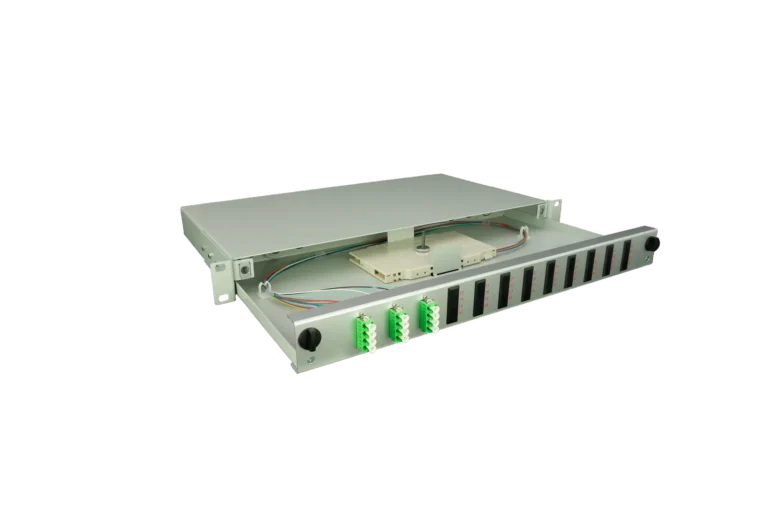
Selecting suitable splice modules begins with precise analysis of network topology and expected fibre capacities. Municipal utilities primarily need 19″-compatible systems to IEC 60297-3-100, suitable for both existing distribution cabinets and new PoP (Point of Presence) locations. Packing density plays a central role: while standard splice modules typically accommodate 48 fibres on 1RU, high-density systems such as the SlimConnect Series enable up to 96 fibres at the same height – doubling capacity with identical rack footprint.
The VDE guideline 0800-730, published in February 2026, defines unified material requirements for FTTH fibre networks in buildings for the first time. Splice modules must accordingly not only meet mechanical requirements to EN 50173-1, but also enable continuous documentation of splice quality with attenuation values below 0.1 dB for fusion splices. Integration of splice cassettes with defined bend-radius guidance (minimum 30 mm for single-mode fibres) is mandatory to ensure long-term stable transmission properties.
Modular Designs: SlimConnect 1RU vs. VarioConnect 3RU for Different Expansion Stages
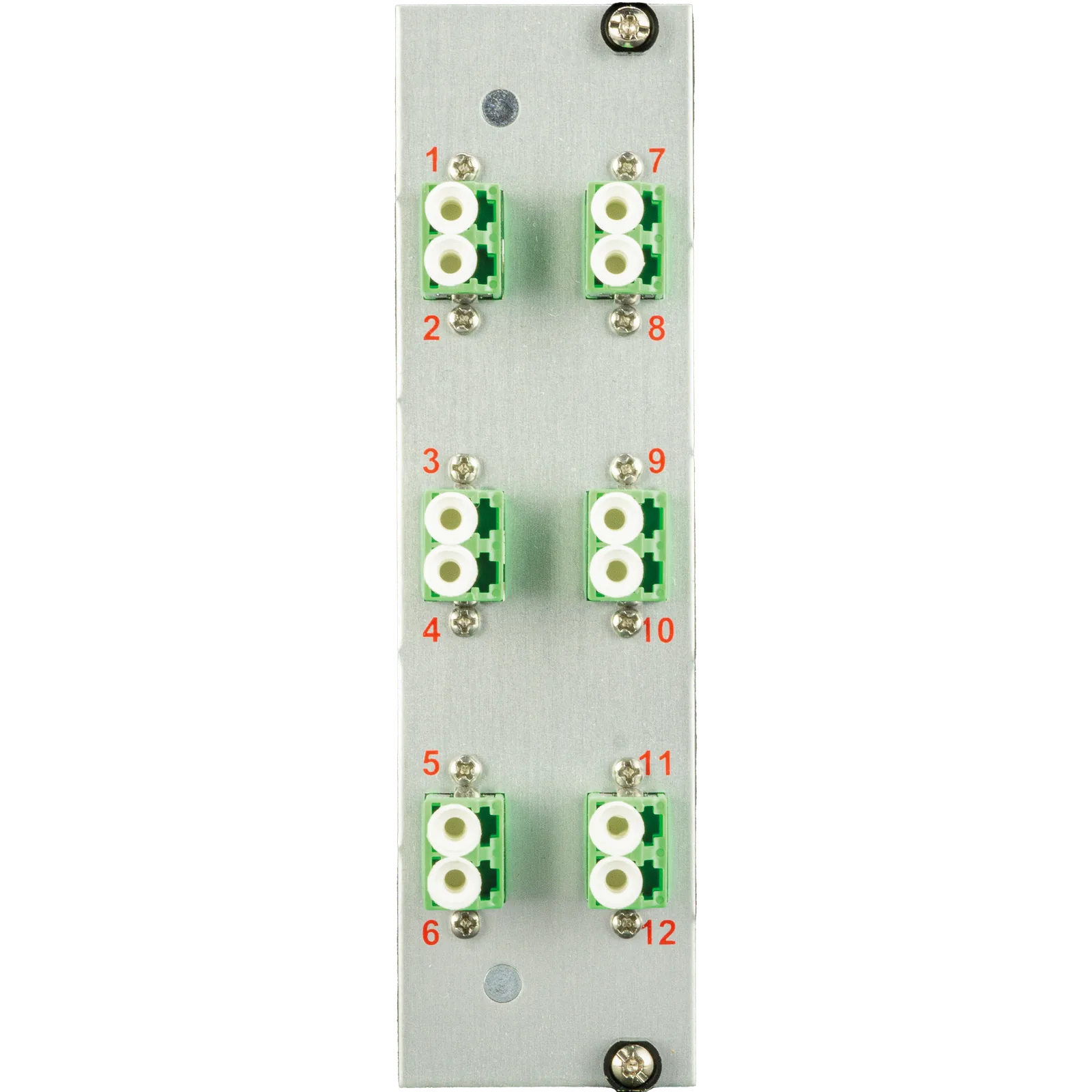
The modular design of splice modules allows municipal utilities to expand their FTTH infrastructure incrementally according to actual customer demand. The SlimConnect system works with interchangeable front modules for different connector types (LC, SC, E2000, ST, FC), with each module terminating 12 or 24 fibres. This flexibility reduces inventory costs and enables rapid adjustments to changing customer requirements – particularly relevant for the heterogeneous existing infrastructure of municipal networks.
VarioConnect systems in 3RU form factor are optimal for central distribution points with high fibre termination. With up to 288 fibres in a 3RU system, they provide the scalability needed for growing districts or commercial areas. The continuous separation of splice and patch areas prevents unintended damage during rearrangement work – a critical factor for the required 99.5 percent network availability specified in municipal procurement.
Fibre Optic Splicing: Fusion Splice vs. Mechanical Connections in the FTTH Context
Fibre optic splicing using fusion splice technology remains the gold standard for permanent connections in FTTH networks. With typical attenuation values of 0.02 dB and return losses exceeding 60 dB, fusion splices meet all requirements of modern PON systems (XGS-PON, 25G-PON). Investment in high-quality fusion splicers pays for itself in municipal projects through significantly lower attenuation margins – critical with splitter stages of 1:64 or higher.
Mechanical splices in FTTH splice modules are primarily used for emergency repairs or temporary connections. With attenuation values around 0.2 dB and the option for non-destructive separation, they are suitable for testing during commissioning. Modern splice modules therefore offer combined accommodation for both splice types, with splice cassettes providing unambiguous colour coding for different connection types.
Connector Spectrum and Compatibility: LC, SC, E2000 for Different Network Levels
Connector selection in splice modules follows the hierarchical structure of municipal FTTH projects. While E2000/APC connectors with their automatic protective shutter and return losses exceeding 60 dB commonly dominate the backbone area, LC/APC connectors are increasingly established at the subscriber level. As an official Diamond Partner, Fiber Products offers the complete E2000 system solution with guaranteed Swiss precision quality – from the splice box to pre-connectorised patch cables.
SC/APC connectors remain relevant in existing building distribution point (BDP) installations, which is why modern FTTH splice modules often accommodate mixed adapter panels with various connector types. Packing density varies considerably: LC duplex enables 48 ports on 1RU, while SC simplex is limited to maximum 24 ports. The choice of connector system thus directly influences the required number of splice modules and overall investment.
Standards Compliance and Certifications: IEC, EN and VDE Standards for Municipal Procurement
Municipal procurement explicitly requires compliance with European and international standards. Splice modules must demonstrably meet mechanical requirements per IEC 61300-3-4 (vibration) and IEC 61300-3-1 (temperature cycles from -25°C to +70°C). Optical performance parameters follow EN 50173-1 with maximum attenuation values of 0.75 dB for LC connectors and 1.0 dB for MPO/MTP multi-fibre connectors.
CE marking in accordance with Low Voltage Directive 2014/35/EU is mandatory, even though fibre optic systems themselves present no electrical hazard. Additionally, many utilities require RoHS compliance and REACH documentation as proof of environmental compatibility. Fiber Products splice modules meet all relevant standards and, uniquely among manufacturers in the DACH region, offer a 5-year warranty – a decisive advantage in total cost of ownership evaluation over the typical 20-25 year service life.
Splice Cassette Management and Fibre Routing in High-Density Installations
Structured fibre routing within splice modules determines maintainability and operational safety. Modern splice cassettes operate with a drawer system that is individually removable, allowing work on specific fibres without affecting adjacent connections. Cassettes must accommodate space for at least 12 individual fibre fusion splices or 24 ribbon splices, with excess-length routing performed at defined bending radii.
For FTTH splice modules, separation of the patch area (front-facing) and splice area (rear-facing or in separate cassettes) has become established best practice. This arrangement minimises the risk of unintended damage during rearrangement work and simplifies documentation. Colour-coded cassettes to DIN VDE 0888-100 (blue for single-mode, orange for multimode) additionally increase operational safety.
Integration into Existing Infrastructure: Migration from Copper to Fibre
Copper-to-fibre migration presents utilities with the challenge of gradually converting existing distribution cabinets to fibre optic technology. Splice modules must therefore coexist in standard 19″ racks alongside active components such as OLTs (Optical Line Terminals) and splitters. Thermal decoupling through perforated enclosures and maintaining a minimum distance of 1RU from heat-generating components is essential for the long-term stability of optical connections.
From 2026, the Federal Network Agency requires minimum 12-month migration notice before ending copper marketing. Utilities use this timeframe to install FTTH infrastructure, with pre-connectorised splice modules featuring tool-free connectors reducing installation time. Parallel operation of copper and fibre services during the transition phase requires unambiguous labelling and separate cable routing.
Economics and TCO Consideration: Investment vs. Operating Costs
The Total Cost of Ownership (TCO) of splice modules comprises not only acquisition costs but particularly installation and maintenance expenses over the entire operational period. High-quality splice modules with integrated cable management and modular construction amortise themselves through reduced assembly times and simplified troubleshooting. Over a calculated service life of 25 years and average maintenance interventions of twice per year, personnel costs accumulate to many times the initial hardware investment.
Federal and state subsidy programmes explicitly consider the quality of installed components. The Gigabit subsidy programme with funding rates up to 90 percent in rural areas rewards demonstrably future-proof solutions with higher fibre density and expandable architecture. Utilities additionally benefit from German-made quality in public procurement, where regional value creation counts as an evaluation criterion.
Practical Installation: Step-by-Step from Cable Pulling to Commissioning
Proper splice module installation begins with cable preparation: stripping the cable jacket to defined length (typically 2–3 metres), separating fibre bundles and assigning them to designated splice cassettes. Modern FTTH splice modules feature multiple cable entries with variable diameters (8–20 mm), enabling flexible cable routing from above or below.
After splicing, systematic documentation of each connection proceeds via OTDR measurement (Optical Time Domain Reflectometer). Measured attenuation values are transferred to cassette labelling and digitally stored in the network documentation. Fibre optic splicing requires clean-room conditions – portable splicing tents provide the necessary dust-free environment even in existing technical spaces.
Future-Proofing: 25G-PON, 50G-PON and Beyond
The evolution of PON standards from GPON (2.5 Gbit/s) through XGS-PON (10 Gbit/s) to 25G-PON and prospectively 50G-PON places increased demands on the optical quality of splice modules. While current FTTH networks primarily operate at 1490 nm and 1550 nm, future standards will employ extended wavelength ranges to 1625 nm. Splice modules must therefore be designed today for these extended spectral requirements.
Return loss gains additional importance at higher data rates. While GPON functions with 32 dB return loss, 25G-PON systems demand minimum 45 dB. Premium splice modules with APC-polished connectors and precision splice cassettes achieve values exceeding 60 dB, providing adequate margins for future technology generations.
FAQ: Common Technical Questions on Splice Modules in FTTH Use
How many fibres should a splice module accommodate for typical municipal utility projects?
For municipal utilities, splice modules with 48 to 96 fibres on 1RU are recommended. This capacity covers typical distribution points serving 32–64 households and leaves reserves for commercial customers. For larger distribution points, 3RU systems with up to 288 fibres provide the necessary scalability.
Which connector types are optimal for municipal FTTH networks?
LC/APC connectors dominate modern FTTH installations through their compact form factor and excellent optical performance. E2000/APC is particularly suited to critical backbone connections thanks to automatic laser safety shutter and highest return loss.
How is documentation handled in modern splice modules?
Professional splice modules offer labellable cassettes, colour-coded fibre routing and QR-code labels for digital documentation systems. Integration into network management systems occurs via standardised interfaces per TIA-606-C.
What environmental conditions must splice modules in outdoor cabinets meet?
Outdoor splice modules require extended temperature resistance (-40°C to +85°C), IP65 protection class against dust and spray water, and condensation-proof enclosures. Mechanical stability per IEC 61300-2-1 is essential for vibration-subjected locations.
How do splice modules for PON differ from point-to-point architectures?
PON splice modules frequently integrate splitters directly in the enclosure and offer asymmetrical port configurations (1 uplink to 32/64 downlinks). Point-to-point modules focus on maximum port density with symmetrical 1:1 mapping.
What advantages do pre-connectorised modules offer compared to field-spliced modules?
Pre-connectorised modules shorten installation time noticeably and guarantee factory-tested attenuation values. For projects with standardised requirements, the price premium amortises through labour savings already from 20 connections.
Conclusion: The Optimal Splice Module Strategy for Successful FTTH Projects
Selection of the right splice modules substantially determines success and economics of municipal FTTH projects. Modular systems with high packing density, flexible connector options and future-proof scalability form the foundation of sustainable fibre optic infrastructure. For utilities, investment in high-quality splice modules with extended warranty represents long-term protection of network infrastructure.
Upcoming regulatory requirements from copper-to-fibre migration and technical evolution to 25G-PON and beyond require forward-looking planning today. With the right combination of technical excellence, modular flexibility and professional support from experienced manufacturers such as Fiber Products as an official Diamond Partner, utilities successfully master FTTH deployment challenges. Contact our experts for individual advice on your FTTH project at /request/.
All modular fibre optic components are available directly in the Fiber Products Shop – with 5 years manufacturer warranty.