Federal Government Fibre Optic Solutions – FTTH Deployment in Administrative Buildings
Federal Government Fibre Optic Solutions – Technical Requirements and Implementation Strategies for FTTH in Public Administration
Federal government fibre optic infrastructure and public sector FTTH face the challenge in 2024 of replacing obsolete copper cabling with modern optical fibre technology. With accelerated copper-to-fibre migration through 2030–2035 and the new Telecommunications Act amendments, fibre deployment now carries overriding public interest status – a decisive factor for the digital transformation of German administrative buildings.
Regulatory Framework for Fibre Optics in Federal Authorities
The public sector benefits from streamlined approval procedures under the 2025 Telecommunications Act amendments. In place of lengthy regulatory approvals, many rollout projects now require only notification procedures. This significantly reduces planning timelines for FTTH projects in administrative buildings.
The German Federal Network Agency acts as the central regulatory body and establishes transparent conditions for the technology transition. The principle of equivalent or superior service provision applies – a criterion particularly relevant for security-critical government networks.
- Accelerated procedures through “overriding public interest” designation
- Notification requirement instead of approval process for defined projects
- Mandatory fibre cabling in new buildings from 2026
- Full deployment rights in multi-unit housing and administrative complexes
- Multi-stakeholder model at 80% FTTH coverage enables copper decommissioning
Technical Requirements for Public Sector FTTH and Government Networks
Federal authorities require fibre optic infrastructure meeting the highest security and availability standards. The standard IEC 61754-15 defines requirements for optical fibre connectors, whilst ISO/IEC 11801 governs structured cabling.
| Requirement Criterion | Standard Office Building | Critical Infrastructure |
|---|---|---|
| Attenuation Values | < 0.35 dB | < 0.25 dB |
| Redundancy Concept | Optional | Mandatory |
| Fibre Density per RU | 48 Fibres | Up to 96 Fibres |
| Documentation Requirement | Basic | Full Measurement Records |
| Access Control | Standard | Multi-Layer Security |
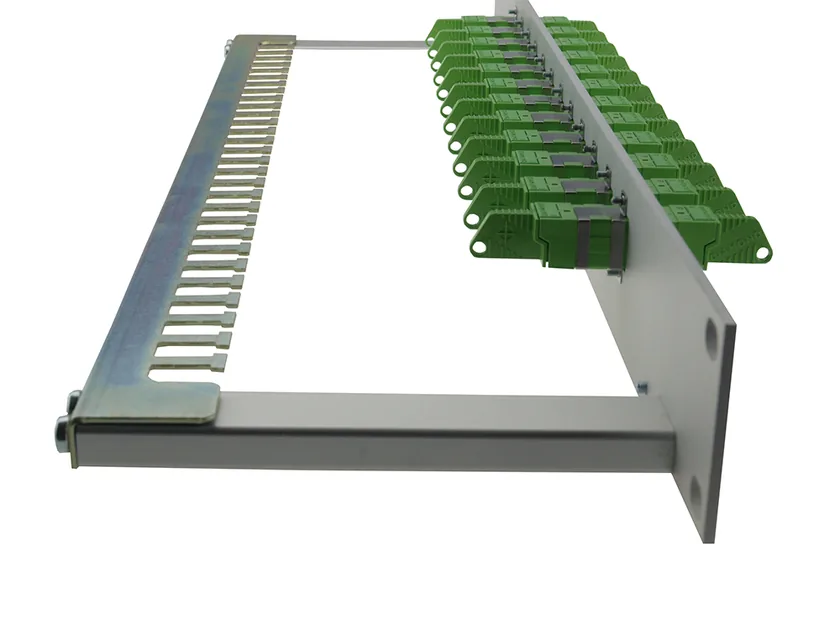
The choice of appropriate splice systems determines the long-term performance of government networks. Modular systems in 1U form factor enable maximum fibre density whilst maintaining flexibility for future expansion.
Splice Box Systems for the Public Sector: Modularity as Key
Modern administrative buildings deploy modular splice box systems that adapt to changing requirements. The combination of pre-terminated splice cassettes and interchangeable front modules reduces downtime during modifications or expansions.
- Splice cassettes with 12 or 24 fibres per module
- Front modules for LC, SC, E2000, ST and FC connectors
- Tool-free module exchange during operation
- Integrated cable management systems per DIN EN 50173
- Colour coding to international standards for unambiguous identification
Fiber Products Quality Commitment: As an official Diamond Partner and manufacturer, we produce modular splice systems in Europe. Benefit from Swiss precision and in-house manufacturing.
Copper-to-Fibre Migration in Federal Authorities: Timeline and Implementation
The systematic replacement of copper infrastructure occurs in three phases. Existing network architecture is first documented, then fibre routes planned, and finally migration executed. The nationwide migration plan targets complete transition by 2035 at the latest.
For federal government fibre optic deployment, this means: inventory of current copper cabling, bandwidth requirement analysis, and planning of redundant fibre routes. Technical implementation follows the principle of uninterrupted migration – critical systems remain available throughout the transition.
| Migration Phase | Timeline | Actions |
|---|---|---|
| Inventory Analysis | 2024–2025 | Documentation, requirement assessment |
| Infrastructure Expansion | 2025–2028 | Splice box installation, cabling |
| Technology Transition | 2028–2030 | Gradual migration, testing |
| Copper Decommissioning | 2030–2035 | Legacy infrastructure removal |
Security Aspects of Public Sector Fibre Optic Infrastructure
Government networks are subject to special security requirements under BSI Baseline Protection. Physical security of fibre optic infrastructure must be guaranteed through lockable splice boxes and tamper-evident connections.
- Secured 19-inch cabinets with access control
- Attenuation monitoring to detect unauthorised access
- Redundant route planning for critical connections
- Documentation of all splice points per DIN VDE 0888
- Regular transmission quality measurements
Funding and Financing of Public Sector FTTH
Fibre deployment in federal authorities is supported through various grant programmes. Whilst 88.3 percent of prior deployment was funded commercially, grant funding focuses on structurally disadvantaged regions and specific government sites.
Public sector investment in modern fibre optic infrastructure amortises through reduced operating costs and increased bandwidth capacity. An average administrative building with 500 workstations requires a minimum of 96 fibres for future-proof cabling – achievable in 1U with modular systems.
Technical Implementation: From Planning to Installation
Installation of fibre systems in government buildings follows standardised procedures. Following route planning, splice boxes are mounted in equipment rooms. Modern 1U splice boxes provide optimal fibre density with clear organisation.
- Site analysis and fibre count determination
- Selection of appropriate splice modules by connector type
- Installation of main distribution frames in server rooms
- Fibre cable installation per DIN EN 50174
- Splicing and attenuation measurements
- Documentation in fibre asset registry
The choice between APC and PC connectors depends on specific requirements. Whilst PC connectors suffice for standard applications, APC variants with their 8-degree angle provide superior return loss – essential for high-speed transmission in government networks.
Federal Government Fibre: Challenges with Historic Building Stock
Many administrative buildings occupy historic structures with special challenges for fibre installation. Heritage protection regulations require minimally invasive installation techniques and concealed cable routing.
The solution lies in utilising existing cable ducts and installing compact splice systems. Fibre optic solutions specifically designed for the public sector address these requirements through flexible mounting options and space-saving form factors.
Municipal Utilities as Partners for Public Sector Fibre Optic Deployment
Local municipal utilities play a key role in FTTH expansion for administrative buildings. As local network operators, they understand local conditions and can deliver tailored solutions for federal government fibre projects.
| Cooperation Model | Advantages | Application |
|---|---|---|
| Full Provision | Complete turnkey solution | Large administrative centres |
| Partial Provision | Cost-optimised | Individual buildings |
| Backup Solution | Redundancy for critical systems | Security authorities |
| Managed Service | Maintenance included | Smaller administrations |
Future Outlook: Public Sector FTTH Through 2030
The EU Gigabit Infrastructure Directive obligates Germany to provide gigabit-capable coverage nationwide by 2030. For federal authorities, this means accelerated modernisation processes and increased investment in future-proof fibre optic infrastructure.
Modular splice systems with Swiss precision quality and 5-year warranty provide necessary investment security. Scalability from 48 to 96 fibres per rack unit enables demand-driven expansion without complete replacement.
- Bandwidth from 10 Gbit/s to 100 Gbit/s per fibre
- Latency under 1 millisecond locally
- Energy savings up to 40 percent versus copper
- Service life exceeding 25 years with proper installation
- Immune to electromagnetic interference
Quality Assurance and Measurement Technology for Public Sector Fibre Optics
Acceptance of fibre installations in government facilities requires comprehensive measurement per IEC 61280-4-2. Every splice point is documented and overall link attenuation recorded.
Modern OTDR instruments not only capture attenuation values but also locate potential weaknesses. For federal government fibre projects: only certified installations with complete documentation meet requirements.
FAQ: Frequently Asked Questions on Federal Government Fibre Optics
Which standards apply to fibre optic installations in federal authorities?
Key standards are DIN EN 50173 for structured cabling, DIN VDE 0888 for optical fibre cables, and BSI Baseline Protection requirements for critical infrastructure. Additionally, European standards IEC 61754 series apply to connectors.
How many fibres does an average administrative building require?
Plan a minimum of 24 fibres per 100 workstations. For future-proof installations, 48 to 96 fibres in modular 1U systems offer demand-driven scalability.
Which connector types suit public sector FTTH?
Standard: LC duplex connectors for high density. For demanding applications: E2000 connectors with integrated shutter and APC finish for optimal return loss.
How long does copper-to-fibre transition take?
Physical installation takes 2 to 8 weeks depending on building size. Complete migration including planning, testing and documentation typically spans 3 to 6 months.
Can existing cable ducts be used for fibre?
Yes, existing cable trays and conduits are typically reusable. Modern fibre cables allow bend radii from 15 millimetres, enabling even tight routing.
What redundancy concepts are required for critical government networks?
A physically separate dual-feed design with separate routing paths is recommended. Modular splice systems enable clear management of redundant connections in a single system.
Conclusion: Fibre Optic Expansion as Foundation for Digital Government
Deploying federal government fibre optic infrastructure and public sector FTTH is not optional but essential for digital transformation of public administration. With the right technical solutions – from high-quality splice boxes through precise measurement technology to modular expansion concepts – migration can be executed efficiently and future-proof. Investment in high-quality components with extended warranty periods pays dividends through reduced maintenance costs and maximum availability.
„
Request a Quote
Have questions about our fibre optic solutions? Our expert team is happy to advise you – free and without obligation.