EN 50173 Fibre Optic Standard: What Planners and Installers Need to Know
EN 50173 is the European standard series for generic cabling and is technically aligned with the international ISO/IEC 11801. A standard is not binding in itself — it becomes binding when a contract or a public tender calls it up. The standard sets mandatory specifications for transmission classes, attenuation values, and link budgets that planners and installers must observe during fibre network design and deployment. In practical terms, this means: maximum channel attenuation of 2.55 dB at 850 nm (1.95 dB at 1300 nm) for multimode links up to 300 metres (class OF-300) and 3.5 dB for singlemode up to 2000 metres (class OF-2000).
Fundamental Requirements of EN 50173 for Fibre Optic Cabling
EN 50173 comprises several part standards covering specific application areas. EN 50173-1 defines general requirements, while EN 50173-2 focuses on office buildings. For industrial environments, EN 50173-3 applies, imposing enhanced requirements for mechanical resilience and environmental conditions.
When designing to EN 50173, planners work with the hierarchy of the cabling subsystems it defines. Primary cabling connects sites with routes up to 3000 metres. Secondary cabling within buildings allows up to 500 metres. Tertiary cabling from the floor distributor to the workplace is limited to maximum 100 metres.
| Cabling Level | Maximum Route Length | Typical Fibre Type | Attenuation Budget |
|---|---|---|---|
| Primary cabling | 3000 m | OS2 Singlemode | 3.5 dB |
| Secondary cabling | 500 m | OM3/OM4/OS2 | 2.5 dB |
| Tertiary cabling | 100 m | OM3/OM4 | 1.5 dB |
Transmission Classes and Performance Requirements per EN 50173
Earlier editions of the standard defined fixed optical channel classes for different link lengths; the current edition (EN 50173-1:2018) instead works with calculated link attenuation budgets, while the OF classes remain a common reference model. Class OF-300 supports Gigabit Ethernet over 300 metres with OM3 fibres. Class OF-500 covers multimode links up to 500 metres — note that for 10 Gigabit Ethernet, IEEE 802.3 specifies a maximum reach of 300 metres on OM3 and 400 metres on OM4 fibres. For singlemode applications, Class OF-2000 specifies transmission up to 2000 metres.
- OM3 fibres: 2000 MHz·km at 850 nm, optimised for VCSEL lasers
- OM4 fibres: 4700 MHz·km at 850 nm, extended bandwidth
- OM5 fibres: Wavelength multiplex capable for 850–950 nm
- OS2 fibres: Singlemode for long-distance links up to 40 km
In the current edition, EN 50173 works with a calculated limit value per link instead of fixed class tables. Link loss comprises fibre attenuation (length × dB/km) plus connector and splice losses. For example, an OM4 installation over 150 metres with four connectors yields: 0.45 dB fibre attenuation plus 1.0 dB connector losses equals 1.45 dB total attenuation.
Measurement Requirements and Documentation per DACH Cabling Standard
Documentation and administration are not covered by EN 50173 but by EN 50174-1, whose scope names installation specification, quality assurance documentation and procedures, documentation and administration, and operation and maintenance. Acceptance measurement of installed cabling follows IEC 61280-4-1 for multimode and IEC 61280-4-2 for single-mode; EN 50346 covers the testing of installed cabling on the European side. Measurements are performed bidirectionally at 850 nm and 1300 nm for multimode and 1310 nm and 1550 nm for singlemode.
Installers must document the following measurement values: link attenuation in both directions, reflectance attenuation at all connectors, and the optical length of the link. Reflectance attenuation must be at least 20 dB for multimode and 35 dB for singlemode; the higher values of 45 to 60 dB apply to individual connectors as grade requirements (Grade A to C), not to the installed link.
- OTDR measurement for fault location and route characterisation
- Attenuation measurement with light source and power meter
- Microscopic endface inspection per IEC 61300-3-35
- Polarity verification for multi-fibre connectors such as MPO/MTP
- Documentation in digital asset registry
Connector Requirements in EN 50173
The standard permits various connector types but defines strict quality criteria. LC connectors per IEC 61754-20 dominate the tertiary segment due to their compact form factor. SC connectors per IEC 61754-4 are common in existing installations. The E2000 connector per IEC 61754-15 offers optimum contamination protection with its integrated shutter.
| Connector Type | Insertion Loss | Return Loss PC | Return Loss APC |
|---|---|---|---|
| LC | < 0.25 dB | > 45 dB | > 60 dB |
| SC | < 0.30 dB | > 45 dB | > 60 dB |
| E2000 | < 0.20 dB | > 50 dB | > 65 dB |
| MPO/MTP | < 0.35 dB | > 35 dB | > 60 dB |
Fiber Products Quality Promise: As an official Diamond Partner and European manufacturer, we produce modular splice systems in-house. Benefit from Swiss precision engineering and in-house manufacturing.
Practical Implementation of EN 50173 in Splice Modules
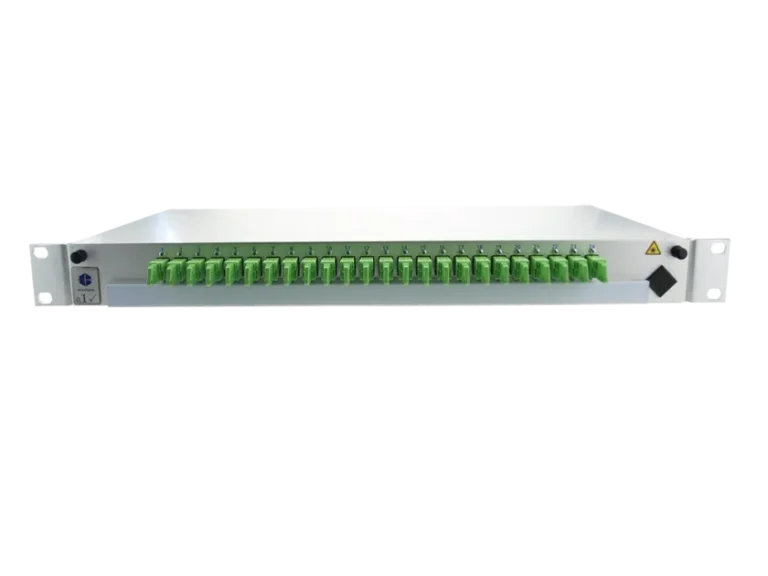
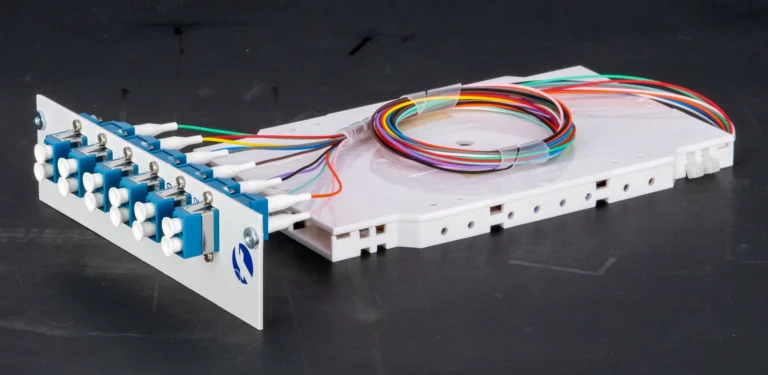
Splice modules form the central nodes in structured cabling per EN 50173. The standard mandates clear identification of all fibres and ports plus adequate bend radii of at least 30 mm for singlemode and 25 mm for multimode. Modern splice modules meet these requirements through pre-configured cassettes with integrated fibre management.
Packing density plays a decisive role in planning. EN 50173 recommends filling no more than 60 percent of available distributor capacity to allow for future expansion. In a 19-inch distributor with 96 fibres per 1 RU, initially only 60 fibres should be installed.
- Reserve at least 1 metre of slack per fibre
- Separate routing of singlemode and multimode
- Colour coding per DIN VDE 0888
- Strain relief for all incoming cables
- Dust shutters for unused ports
Fire Safety and Environmental Requirements of the European Fibre Optic Standard
Fire behaviour is explicitly outside the scope of EN 50173. Reaction to fire of cables in the EU is governed separately by the Construction Products Regulation (EU) No 305/2011 and the harmonised standard EN 50575; which Euroclass applies follows from national building law and the client’s specification. Cables must be classified per EN 50575 and contribute only limitedly to flame spread in case of fire. Smoke production must meet class s2 and dripping behaviour class d1.
Different building areas have specific requirements. Escape routes mandate halogen-free cables of class B2ca. Risers require class Cca. Standard office areas are satisfied with class Dca. Documentation of cable types used is relevant for inspection.
Quality Assurance and Acceptance Criteria per EN 50173
Standards-compliant acceptance of a fibre installation requires systematic testing. Every installed link must meet defined limit values. Total attenuation must not exceed the calculated link budget. Optical return loss must meet minimum values.
- Visual inspection of all connectors at 200× magnification
- Optical Fibre Attenuation measurement
- OTDR reference measurement for asset documentation
- Verification of mechanical strain relief
- Inspection of minimum bend radius compliance
- Completeness check of labelling
The acceptance report must contain all measurement results, measurement instruments with calibration dates, and names of testing personnel. Warranty services from many manufacturers require standards-compliant installation and documentation.
Integration of Modern Transmission Technologies in the DACH Cabling Standard
EN 50173 accommodates current and future transmission technologies. For 40 and 100 Gigabit Ethernet, the standard defines special requirements for multi-fibre connectors. MPO/MTP connectors enable parallel transmission over 12 or 24 fibres. Polarity must be configured per Method B.
Wavelength multiplexing techniques expand transmission capacity of existing fibres. EN 50173 supports CWDM with 18 channels and DWDM with up to 96 channels. Spectral attenuation must be specified for the range 1260 to 1625 nm. OM5 fibres additionally enable SWDM in the range 850 to 950 nm.
Special Requirements for Industrial Environments per EN 50173-3
Industrial environments impose heightened demands on fibre optic cabling. EN 50173-3 uses the MICE classification with four parameters — M (mechanical), I (ingress), C (climatic/chemical), and E (electromagnetic) — each graded in three severity levels. The resulting profiles range from M1I1C1E1 (office environment) to M3I3C3E3 (heavy industrial).
| MICE Parameter | Environmental Aspect | Severity Levels |
|---|---|---|
| M | Mechanical (shock, vibration, crush) | M1–M3 |
| I | Ingress (particles, liquids) | I1–I3 |
| C | Climatic and chemical (temperature, humidity, contaminants) | C1–C3 |
| E | Electromagnetic (EMC interference) | E1–E3 |
Future-Proof Design Through Standards-Compliant Planning
EN 50173 continues to evolve and integrate new technologies. The current edition already accommodates 400 Gigabit Ethernet and Terabit transmission. Planners should factor in reserves for future bandwidth demands. An oversizing of 30 percent has proven effective in practice.
Selecting high-quality components pays off long-term. Singlemode cabling offers virtually unlimited bandwidth reserves. Modular distributor systems allow flexible adaptation without recabling. The initial additional investment is recovered through reduced operational costs and extended service life.
- Use OS2 singlemode for all links exceeding 100 metres
- Install OM5 multimode for short high-speed links
- Provision for MPO breakout cassettes
- Consider microcables for future extensions
- Document in digital twin for operational management
Practical Tools for EN 50173 Implementation
Various software solutions assist planners in standards-compliant design. Calculation programmes automatically determine attenuation budgets and verify limit values. CAD systems with integrated standards libraries simplify documentation. Project management tools help coordinate complex installations.
The right test equipment is critical for quality assurance. Modern OTDR instruments provide automatic evaluation per EN 50173. Video microscopes with image analysis objectively assess connector endfaces. Cloud-based documentation systems enable central management of all test reports.
Frequently Asked Questions About EN 50173 European Fibre Optic Standard
Which fibre categories are suitable for 10 Gigabit Ethernet?
For 10 Gigabit Ethernet, IEEE 802.3 specifies 10GBASE-SR at up to 300 m on OM3 and up to 400 m on OM4; 10GBASE-LR runs on OS2 single-mode over the reach its PMD defines. Note that the optical fibre class concept (OF-300, OF-500, OF-2000) belongs to the older editions of the cabling standards and was removed from EN 50173-1 with the 2018 edition — plan by the reach the application needs and by the measured channel loss.
How many connectors are permitted at maximum?
EN 50173 does not cap the number of connections — the channel attenuation budget does. How many mated pairs fit depends on how much of that budget the connecting hardware consumes and on the length of the link; every additional connection is usually paid for in reach. Work it out from the power budget of the application and the specified loss of the components you actually use, rather than from a fixed connector count.
Which measurements are mandatory at acceptance?
Bidirectional attenuation measurement at specified wavelengths and documentation of all values are mandatory. OTDR measurements are recommended but not required. Endface inspection is considered standard practice in modern installations.
Does EN 50173 apply to existing networks?
The standard primarily applies to new installations. For expansions of existing networks, new components should meet current requirements. Full retrofitting is necessary only during major modernisations.
How does EN 50173 differ from ISO/IEC 11801?
EN 50173 is the European (CENELEC) counterpart to the international ISO/IEC 11801 series and is technically aligned with it, while referencing European component standards. Safety – including fire – and EMC are explicitly outside the scope of EN 50173. Reaction-to-fire performance of cables in the EU is governed separately by the Construction Products Regulation (EU) No 305/2011 and the harmonised standard EN 50575.
What documentation must be retained?
Documentation requirements come from EN 50174-1, not from EN 50173. Its scope names installation specification, quality assurance documentation and procedures, documentation and administration, and operation and maintenance. In practice that means network plans, measurement records and component lists, updated after every change and kept for the life of the installation. EN 50173 itself defines cabling design and performance. As a manufacturer of modular fibre optic solutions, Fiber Products supports you with standards-compliant systems.
Consistent application of EN 50173 as the central DACH cabling standard safeguards investment in modern fibre infrastructure. Planners and installers adhering to defined standards create future-proof networks with guaranteed performance. As a manufacturer of modular fibre optic solutions, Fiber Products supports you with standards-compliant systems meeting all EN 50173 requirements and renowned for Swiss precision quality.
Request a Quote
Have questions about our fibre optic solutions? Our expert team is happy to advise you — free of charge and without obligation.
Related product
Splice Module 7 TE
Tray and module form one unit running on the subrack rails — a module can be removed at one point and refitted at another without opening the splices.