FTTH vs FTTB: Which Splice Solution to Choose?
The FTTH vs FTTB comparison determines the correct splice box selection in municipal utility network deployment – while FTTH delivers continuous fibre optics all the way to the home, enabling future-proof bandwidths exceeding 10 Gbit/s, FTTB provides only 100–250 Mbit/s through remaining copper runs. The optimal splice solution depends on three factors: the chosen deployment technology, the required fibre density per distribution point, and regulatory requirements of the Gigabit Infrastructure Ordinance (GIA), which effectively mandates FTTH for new buildings from February 2026 onwards.
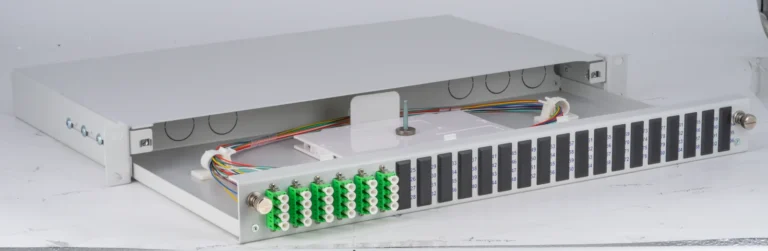
For municipal utilities, this decision has practical implications: in rural FTTH projects, modular 1U splice boxes with up to 96 fibres have proven effective, while urban FTTB installations often require 3U systems with 288 fibres in building basements. Investment costs differ significantly – FTTH averages €1,200–1,400 per connection in rural areas, while FTTB using existing in-building cabling costs €600–800.
Technical Fundamentals: FTTH versus FTTB in Direct Comparison
Technical differences between FTTH and FTTB directly impact splice box selection in municipal utility network deployment. FTTH (Fibre to the Home) runs optical fibre continuously to the optical termination point in the home. This architecture requires more splice points, as each dwelling unit is provisioned separately.
| Criterion | FTTH | FTTB |
|---|---|---|
| Maximum bandwidth | 10+ Gbit/s | 100–250 Mbit/s |
| Loss budget | 28–32 dB | 20–25 dB |
| Splice points per building | 8–24 (depending on dwelling units) | 1–2 (handover point) |
| Fibre demand per 100 units | 100–200 fibres | 12–24 fibres |
| Power consumption | 0.5 W/connection | 2–3 W/connection |
FTTB (Fibre to the Building), by contrast, terminates in the building basement or equipment room. Distribution from there proceeds over existing copper or coaxial cabling. This architecture significantly reduces the number of splice points but limits achievable bandwidth due to remaining copper runs.
- FTTH splice boxes require higher fibre capacity per distribution point
- FTTB installations work with more compact splice solutions
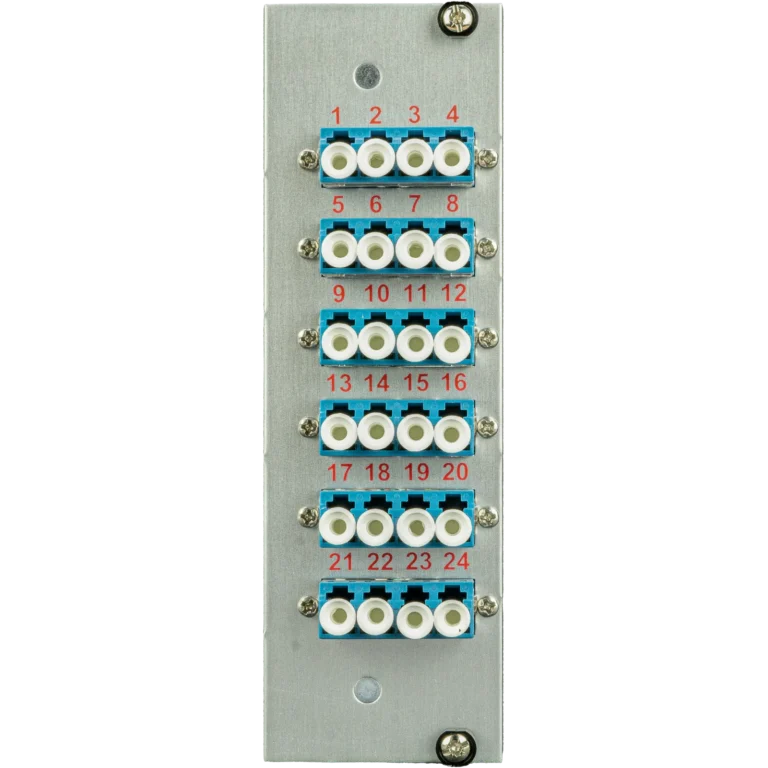
- Connector type selection differs: FTTH primarily uses LC-APC or E2000-APC
- FTTB systems often employ SC-APC for building connections
- Modular systems enable later migration from FTTB to FTTH
Regulatory Requirements in FTTH vs FTTB Comparison
The Gigabit Infrastructure Ordinance (GIA) fundamentally changes the framework for splice box selection in municipal utility network deployment. From 12 February 2026, all new buildings and comprehensively renovated buildings must be equipped with gigabit-capable infrastructure up to the dwelling unit boundary. This effectively makes FTTB solutions obsolete for new construction projects.
Transition rules apply to existing buildings. Municipal utilities may continue choosing between FTTH and FTTB but must ensure long-term migration capability. Funding guidelines under Gigabit Support 2.0 clearly favour FTTH projects with higher subsidy rates of up to 70 percent of deployment costs.
The minimum technical requirement for subsidised networks is 1 Gbit/s symmetric – a threshold FTTB solutions can achieve only under optimal conditions. Additionally, all subsidised networks must guarantee open network access for at least 10 years.
Splice Box Dimensioning for Different Deployment Concepts
Correct splice box dimensioning depends critically on the chosen deployment concept. The FTTH vs FTTB comparison shows that FTTH networks require significantly higher fibre density at distribution points.
- FTTH distribution point for 48 dwelling units: 96 fibres (2 fibres per unit)
- FTTB handover point for the same building: 12–24 fibres
- Reserve capacity for commercial units: an additional 25–30 percent
- Patch area for active components: 50 percent of splice capacity
- Growth reserve for future densification: minimum 20 percent
Fiber Products Quality Promise: As an official Diamond partner and manufacturer, we produce modular splice systems in Europe. Benefit from Swiss precision and 5 years warranty on our systems.
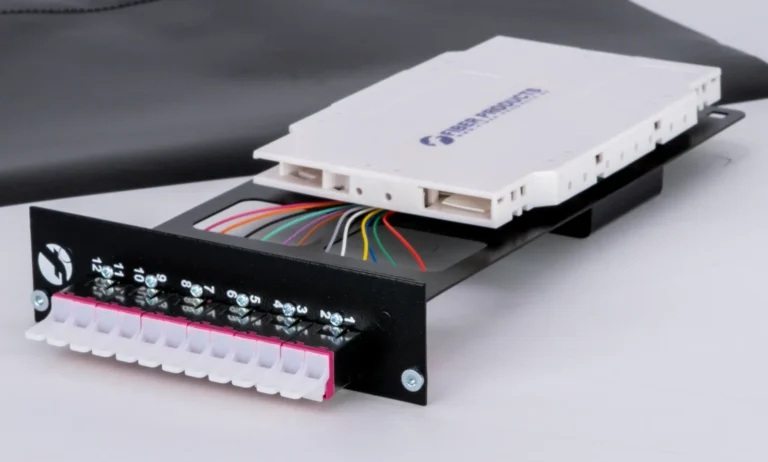
Modular splice systems such as the SlimConnect 1U platform enable staged expansion. With up to 96 fibres in a single rack unit, they offer the highest packing density on the market. The 7-slot modular design allows flexible switching between different connector types without system replacement.
Economic Considerations: Capital and Operating Costs
The FTTH vs FTTB comparison for splice box selection in municipal utility network deployment reveals significant cost differences. FTTH capital investment is higher, but operating costs are lower.
| Cost Item | FTTH (per connection) | FTTB (per connection) |
|---|---|---|
| Splice box hardware | €45–60 | €25–35 |
| Installation time | high | low |
| Maintenance (annual) | €2–3 | €8–12 |
| Energy costs (annual) | €6 | €24–36 |
| Service life | 30–40 years | 15–20 years |
Total operating costs over 20 years demonstrate that FTTH is more economical despite higher initial investment. The break-even point typically occurs at 7–9 years, depending on utilisation and local electricity rates.
Connector Technology: LC, SC or E2000 for FTTH and FTTB
Connector technology selection significantly influences splice box choice in municipal utility network deployment. For FTTH networks, the LC-APC connector has become the standard, while FTTB installations often still use SC-APC.
The E2000-APC connector delivers the best optical performance with a return loss of ≥60 dB. Its integrated protective shutter prevents contamination and makes it ideal for harsh environments. The 8-degree angled physical contact technology minimises reflections, which is particularly critical in PON systems.
- LC connector: Compact (1.25 mm ferrule), high packing density, ideal for data centres
- SC connector: Robust (2.5 mm ferrule), easy handling, cost-effective
- E2000 connector: Highest return loss, protective shutter, optimal for FTTH PON
- MPO/MTP: Multi-fibre (12–24 fibres), for backbone connections
Modern splice boxes support all common connector types through interchangeable adapter plates. Pre-terminated E2000-APC reduces installation time compared to field assembly.
Splicing Technology: Fusion Splicing or Mechanical Connections
In the FTTH vs FTTB comparison, splicing technology plays a central role in network quality. Fusion splices achieve loss of only 0.02–0.05 dB, while mechanical splices are rated at 0.1–0.3 dB.
For permanent FTTH installations, fusion splicing is standard. Modern splicing equipment with core alignment technology guarantees repeatable results. Splice time is 6–8 seconds per fibre, including automatic quality control.
FTTB projects more frequently use mechanical connectors for temporary or semi-permanent installations. These enable quick reconfigurations without specialist tools but exhibit higher loss and are more vulnerable to environmental effects.
Documentation and Network Management for FTTH and FTTB
Professional documentation is essential in splice box selection for municipal utility network deployment. FTTH networks, with their higher complexity, require detailed fibre management plans.
- Colour coding per DIN VDE 0888 for unambiguous fibre identification
- Labelling all splice cassettes with QR codes for digital documentation
- OTDR measurement reports for every route with loss budget confirmation
- Geo-referenced network maps in the GIS system of the municipal utility
- Audit-trail archiving over 30 years per telecommunications law
Modern splice boxes integrate RFID tags for automatic inventory management. Digital twin technology enables virtual network inspections and accelerates fault location.
Future-Proofing: Migration from FTTB to FTTH
The FTTH vs FTTB comparison shows that many municipal utilities plan gradual migration. Initial FTTB deployment can be upgraded to FTTH later if the correct splice boxes are selected.
Modular systems like the VarioConnect 3U platform enable this migration without system replacement. 7-slot modules can be reconfigured from FTTB with minimal fibres to FTTH with high fibre density. Investment in future-proof splice boxes pays for itself through avoided redundant installations.
Gigabit Support 2.0 explicitly supports such migration paths. Municipal utilities can first deploy FTTB for rapid area coverage, then selectively upgrade to FTTH where demand justifies it.
Practical Recommendations for Municipal Utilities in Network Deployment
Based on the FTTH vs FTTB comparison, clear recommendations emerge for splice box selection in municipal utility network deployment:
| Scenario | Recommended Solution | Rationale |
|---|---|---|
| New development area | FTTH with 1U SlimConnect | GIA-compliant, future-proof |
| Existing building upgrade | FTTB with migration option | Cost-optimised, upgradeable |
| Commercial district | FTTH with E2000-APC | Maximum bandwidth, SLA-capable |
| Rural area | FTTH with subsidy | 70% subsidy rate possible |
| Dense urban area | FTTB with 3U system | Space-efficient, economical |
The decision should always be based on detailed cost-benefit analysis incorporating subsidies, expected take-rate, and long-term operating costs. Specialised FTTH solutions provide the necessary flexibility for different deployment strategies.
Quality Assurance and Acceptance Criteria
Regardless of the FTTH vs FTTB comparison, strict quality criteria apply to splice box selection in municipal utility network deployment. DIN EN 50173-1 defines limit values for structured cabling.
- Maximum insertion loss per splice point: < 0.1 dB
- Return loss on APC connectors: > 60 dB
- Bending radius in splice boxes: minimum 30 mm
- Cable strain relief: 1500 N for outdoor cables
- Enclosure protection class: minimum IP54
Acceptance testing comprises OTDR measurements in both directions at 1310 nm and 1550 nm. Additionally, loss measurement at 1625 nm is recommended for future monitoring systems. All measurement reports must be digitally archived and handed over to the network operator.
FAQ: Common Questions on FTTH vs FTTB Splice Box Selection
What subsidies are available in 2026 for FTTH projects by municipal utilities?
Gigabit Support 2.0 funds FTTH projects with up to 70 percent of eligible costs. Requirement is deployment in underserved areas with less than 100 Mbit/s. The application must be submitted by the municipality; implementation may be carried out by the municipal utility.
Can an FTTB installation later be upgraded to FTTH?
Yes, with modular splice boxes such as the 7-slot systems, migration is possible. The base infrastructure remains; only fibre routing and connector modules are expanded. Additional costs are approximately 30–40 percent compared to direct FTTH installation.
Which connector types are optimal for PON networks?
For PON networks (Passive Optical Networks), E2000-APC or LC-APC is standard. The 8-degree angled physical contact minimises reflections below -60 dB, which is essential for sensitive PON splitters. Green colour coding clearly identifies APC connectors.
How many fibres should be planned per dwelling unit?
For FTTH, a minimum of 2 fibres per dwelling unit is standard – one active and one reserve. For multi-family buildings, 4 fibres are recommended for future services. Cost of additional fibres is marginal compared to later retrofitting.
What is the service life of modern splice boxes?
High-quality splice boxes made from stainless steel and aluminium last 30–40 years in outdoor installations and 40+ years in protected environments. The optical components (splice cassettes, adapters) have similar longevity when kept clean and protected from UV radiation.
Interested in modular fibre-optic solutions?
Fiber Products GmbH – official Diamond Partner. Made in EU, 5 years warranty.
Order directly from our shop: fiber-products.de