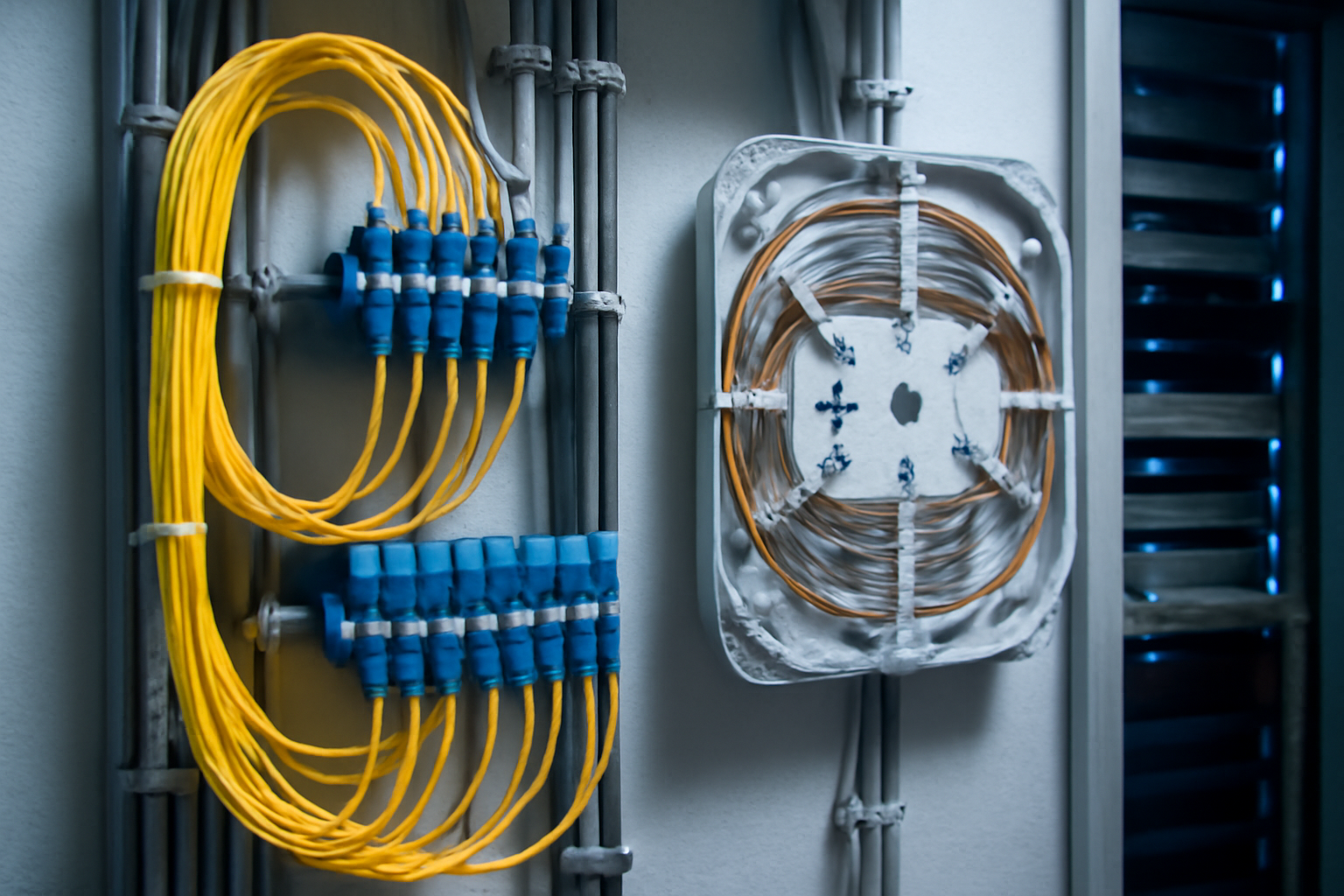
Fibre to the Home (FTTH) Multi-Dwelling Unit (MDU) Guide 2026: Complete In-Building Deployment
Fibre to the Home (FTTH) Multi-Dwelling Unit (MDU) and Residential Fibre Deployment – Technical Guide for In-Building Infrastructure 2026
Deploying fibre optics in multi-dwelling units (FTTH MDU) presents municipal utilities with the central challenge of the final network tier: whilst external infrastructure to property boundaries has reached 42.9% availability in Germany, more than 80% of residential units in apartment buildings remain without active fibre-optic connections. The technical solution lies in systematic deployment of network layer 4 (NE4) using modular splice systems, pre-terminated rising cables, and the new VDE guideline 0800-730, which has drastically simplified installation in escape routes since February 2026.
Technical Architecture of MDU Fibre-Optic Deployment in Apartment Buildings
Fibre-optic in-building cabling in multi-dwelling units requires a multi-stage system architecture. The fibre building distribution frame (Gf-GV) forms the central handover point in the basement or plant room, from which rising cables with minimum 25mm outer diameter run to individual residential units. Standard design provides two fibres per residential unit; commercial applications require four fibres.
Distribution uses exclusively single-mode fibres to ITU-T G.652.D or bend-insensitive G.657.A2 fibres. Maximum total attenuation in the building network must not exceed 1.5 dB – a figure quickly reached through improper installation.
- Fibre building distribution frame with LC-APC or E2000-APC connectors
- Rising cable ducts with microduct blowing up to 150 metres length
- Floor distribution frames for buildings over four storeys
- Pre-terminated connection outlets in residential units
- 30% spare capacity for future expansion
FTTH vs. FTTB: The Critical Decision Point for Municipal Utilities
When deploying fibre optics in residential buildings and MDU environments, municipal utilities must choose between two fundamental architectures. FTTB (Fibre to the Building) ends in the basement and uses existing copper cabling for the final metres – a solution accounting for 36% of previous installations but limited long-term.
| Criterion | FTTB (Copper In-Building) | FTTH (Fibre In-Building) |
|---|---|---|
| Bandwidth per unit | Max. 250 Mbit/s | 10 Gbit/s and beyond |
| Installation effort | Low (legacy infrastructure) | Medium to high |
| Future-readiness | 5–8 years | 25+ years |
| Maintenance burden | High (active components) | Minimal (passive) |
| Investment cost | €300–500 per unit | €600–900 per unit |
FTTH provides each residential unit with dedicated fibre optics and enables symmetric gigabit-range bandwidth. Higher initial costs are recouped through lower operating costs and avoidance of future retrofitting within 7–10 years.
New VDE Guideline 0800-730: Breakthrough for Escape-Route Installation
The VDE guideline 0800-730 published in February 2026 transforms fibre-optic installation in apartment buildings. Fibre optic cables may now be routed in escape routes using simple metal channels or self-adhesive systems – delivering cost savings compared to previously mandated fire-rated ducts.
The new regulation enables installations in escape routes without complex fire-protection measures. Requirements include halogen-free flame-resistant cable to IEC 60332-1 and proper documentation of installation routes.
Fiber Products Quality Promise: As an official Diamond partner and European manufacturer, we produce modular splice systems in Europe. Benefit from Swiss precision engineering and 5 years' warranty on all systems.
Modular Splice Systems for Efficient MDU Deployment
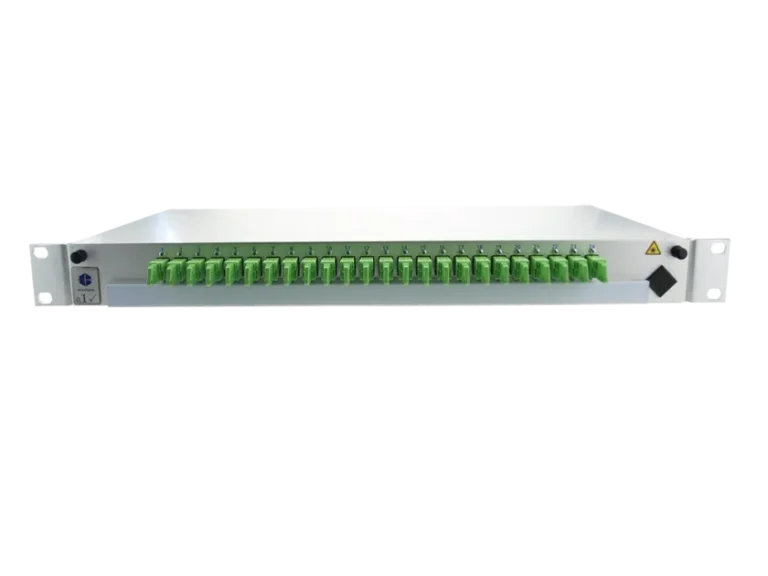
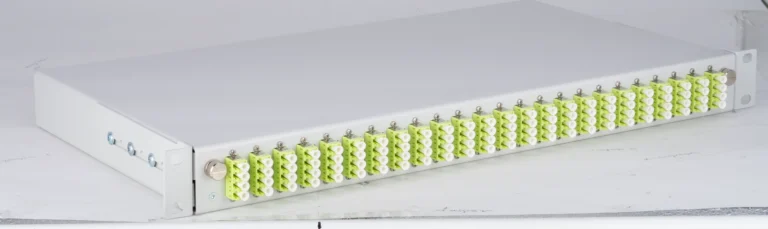
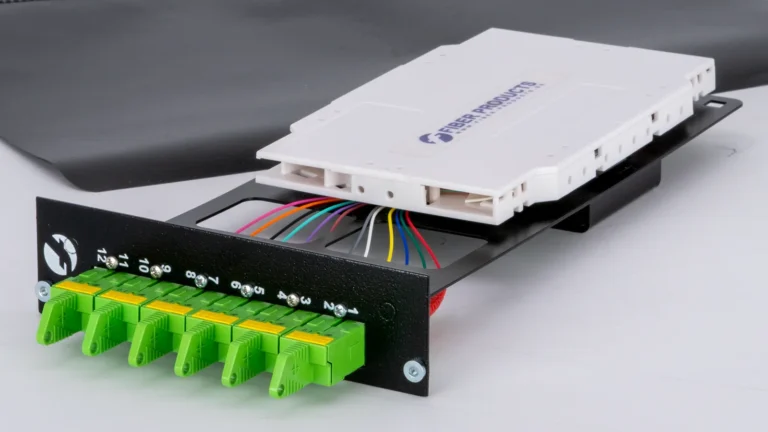
Selection of the correct splice system in the building distribution frame largely determines installation maintainability and scalability. Modern modular systems accommodate up to 96 fibres in just 1 rack unit (1RU) – a packing density crucial in confined basement plant rooms.
- SlimConnect 1RU: Up to 96 fibres in one rack unit
- VarioConnect 3RU: Up to 288 fibres with front-panel expansion
- 7HP architecture: 72 fibres in just 44.45mm height
- Pre-terminated modules: Plug-and-play installation
- DIN colour-coding: Unambiguous fibre assignment
The splice box 1RU is ideal for smaller apartment buildings up to 48 units. For larger complexes, modular systems provide the flexibility needed for phased expansion.
Connector Types and Application in FTTH-MDU Infrastructure
Connector choice defines long-term network compatibility and performance. The LC-APC connector has become the standard for high packing density, whilst E2000-APC excels in low-maintenance environments through automatic dust shutters.
| Connector Type | Insertion Loss | Return Loss | Application |
|---|---|---|---|
| LC-APC | < 0.25 dB | > 60 dB | Standard applications |
| E2000-APC | < 0.20 dB | > 65 dB | Premium installations |
| SC-APC | < 0.30 dB | > 55 dB | Legacy networks |
The Diamond E2000 connector with its precision-ground ferrule achieves insertion loss below 0.15 dB and suits demanding backbone connections between building complexes.
Pre-Terminated Solutions for Rapid Residential Deployment
Pre-terminated rising cables significantly reduce average installation time per unit. Factory-mounted connectors eliminate on-site splicing – a decisive advantage when deploying in occupied properties.
Plug-and-play systems include pre-terminated fibre connection outlets with integrated LC-duplex couplers, pre-assembled patch cables in standard lengths of 2, 5 and 10 metres, and colour-coded identification systems to DIN VDE 0888.
- Installation time reduction
- No splicing equipment required on-site
- Factory-verified insertion loss below 0.3 dB
- Consistent quality from industrial manufacturing
- Minimal resident disruption
Funding and Economics of FTTH MDU Deployment
For fibre-optic residential building deployment, multiple funding programmes are available. The Federal Broadband Promotion Programme supports infrastructure in underserved areas with up to 50% of eligible costs. KfW programmes 124 and 430 additionally support energy efficiency renovation integrated with fibre deployment.
Economic analysis shows: at an average connection rate of 40% and monthly fees of €35–45, FTTH installation amortises within 8–12 years. Modular construction enables demand-driven scaling without over-investment.
Quality Assurance and Acceptance Protocols to DIN VDE
Standards-compliant documentation and measurement are essential for long-term operational safety. Every single-mode link is measured to IEC 61280-4-2 — attenuation and optical return loss of the installed cable plant, with the OTDR as one of the methods it describes. Attenuation limits are 0.4 dB/km at 1310 nm and 0.3 dB/km at 1550 nm.
The acceptance protocol documents attenuation measurements on all fibres, return loss at all connectors (minimum 35 dB for PC, 60 dB for APC), OTDR curves with event table, and photographic documentation of distribution frame installation. This documentation provides the foundation for warranty claims and future expansion.
Practical Example: 120-Unit Complex with Modular Deployment
A typical municipal utility project comprises a residential complex with 120 units across four buildings. Installation uses a central main distribution frame (VarioConnect 3RU with 288-fibre capacity) and four sub-distribution frames (each SlimConnect 1RU with 96 fibres).
Rising cables are installed as 24-fibre bundles in existing service shafts. Per floor, distribution occurs via compact floor distribution frames with 12 LC-duplex ports. Total installation time using pre-terminated systems is approximately 15 working days for the complete project.
FAQ: Technical Questions on FTTH MDU Deployment
What minimum bend radius applies to fibre-optic cable in residential buildings?
Standard G.652.D fibres require a minimum bend radius of 30 mm, whilst bend-insensitive G.657.A2 fibres allow 7.5 mm. In practice, 15 mm should not be undercut to avoid long-term fibre damage.
How many fibres are required per residential unit?
Standard design specifies two fibres per unit – one active, one reserve. For mixed commercial use or smart-home applications, four fibres per unit are recommended.
What attenuation values are acceptable for FTTH installation?
German FTTH in-building specifications (network level 4) typically require max. 1.5 dB total loss between building distributor and subscriber outlet, measured to EN 61280-4-2. EN 50173-1 / ISO/IEC 11801 permit up to 0.75 dB per single-mode mated connection and 0.3 dB per splice; in practice LC/APC connectors of attenuation grade B (0.25 dB) per DIN EN 61755-1 are specified and fusion splices above 0.1 dB are redone.
Can existing empty ducts be used for fibre optics?
Ducts with minimum 20 mm inner diameter suit microduct blowing. Ducts below M32 are limited to maximum 12 fibres.
What advantages does E2000 offer over LC connectors?
The E-2000 carries an integrated spring-loaded metal shutter that closes over the ferrule end face whenever the connector is unmated — DIAMOND specifies it for laser-eye and dust protection — together with a push-pull latch and 500 mating cycles. Datasheet optics: insertion loss typ. 0.1 dB, max. 0.3 dB; return loss min. 50 dB for PC and min. 70 dB for APC. That protection concept is what makes it attractive for low-maintenance premium installations.
How long does installation take per residential unit?
With pre-terminated systems, pure installation time per unit is short. On-site splicing increases effort considerably.
Related product
F4P Splice Box 1 U
LC, SC, E-2000 and ST adapters · as an empty housing, equipped or ready to splice · housing in RAL 7035 grey or RAL 9005 black · Made in Europe
Summary and Outlook for Municipal Utilities
Deploying fibre optics in residential buildings becomes a critical success factor for municipal utilities in 2026. With the new VDE guideline, modular splice systems and pre-terminated solutions, all technical tools for efficient implementation are in place. Investment in FTTH rather than FTTB secures future-readiness for the next 25 years.
Fiber Products supports deployment as manufacturer and Diamond partner with complete system solutions – from SlimConnect splice boxes through E2000 connectors to technical consultation. The 5-year warranty on all splice systems reflects our confidence in Swiss precision quality. Contact us for bespoke project advice on optimal FTTH MDU deployment.
Order directly from our shop: fiber-products.com
Request a Quote Today
Free consultation – personalised quote within 24 hours