Fibre Capacity Planning: How Many Fibres Does Your FTTH Network Need?
Fibre Capacity Planning: How Many Fibres Does Your FTTH Network Need?
Calculating the correct fibre capacity, FTTH planning and determining fibres per household is critical: planners typically calculate 2 to 4 fibres per household for future-proof FTTH networks, with the exact number depending on factors such as network topology, redundancy requirements and expected bandwidth growth. This rule of thumb forms the foundation of modern fibre optic planning in the DACH region, where by March 2026 for the first time 50% of all German households will be reached with FTTH/FTTB connections.
Municipal utilities and network operators face the challenge of dimensioning their fibre infrastructure for the next 30 years. Fibre capacity must not only meet current needs but also account for future technology shifts and rising bandwidth demands.
Fundamentals of Fibre Capacity in FTTH Networks
In FTTH planning, experts distinguish between three network layers with different capacity requirements. In the backbone area, network operators work with 144 to 288 fibres, while the distribution network manages with 48 to 96 fibres. The last mile to the customer typically requires 2 to 4 fibres.
- Backbone network: 144–288 fibres (redundancy and scalability)
- Distribution network: 48–96 fibres (area connectivity)
- Access network: 2–4 fibres per household (direct customer connection)
- Reserve capacity: 30–50% for future expansion
The calculation follows a proven formula: Fibre capacity = Number of households × Fibres per household × Redundancy factor × Future reserve. A typical residential area with 100 households therefore requires at least 200 fibres under standard configuration, plus 30% reserve yields a total capacity of 260 fibres.
Fibres per Household: Determining the Right Number
Calculating fibre capacity and FTTH planning is based on different connection scenarios. Single-family homes typically require 2 fibres – one active fibre plus redundancy. Multi-family homes, on the other hand, require 4 to 8 fibres per unit, depending on the number of parties and desired services.
| Building Type | Fibres per Unit | Typical Configuration | Splice Modules |
|---|---|---|---|
| Single-family home | 2 fibres | 1 active + 1 reserve | 12-fibre cassette |
| Multi-family home (4 units) | 16 fibres | 4 × (2 active + 2 reserve) | 24-fibre cassette |
| Residential block (20 units) | 80 fibres | 20 × (2 active + 2 reserve) | 96-fibre module |
| Commercial building | 8–16 fibres | 4 active + redundancy | 48-fibre module |
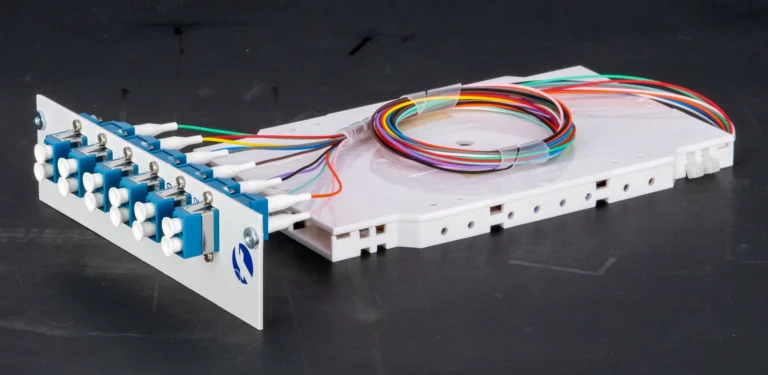
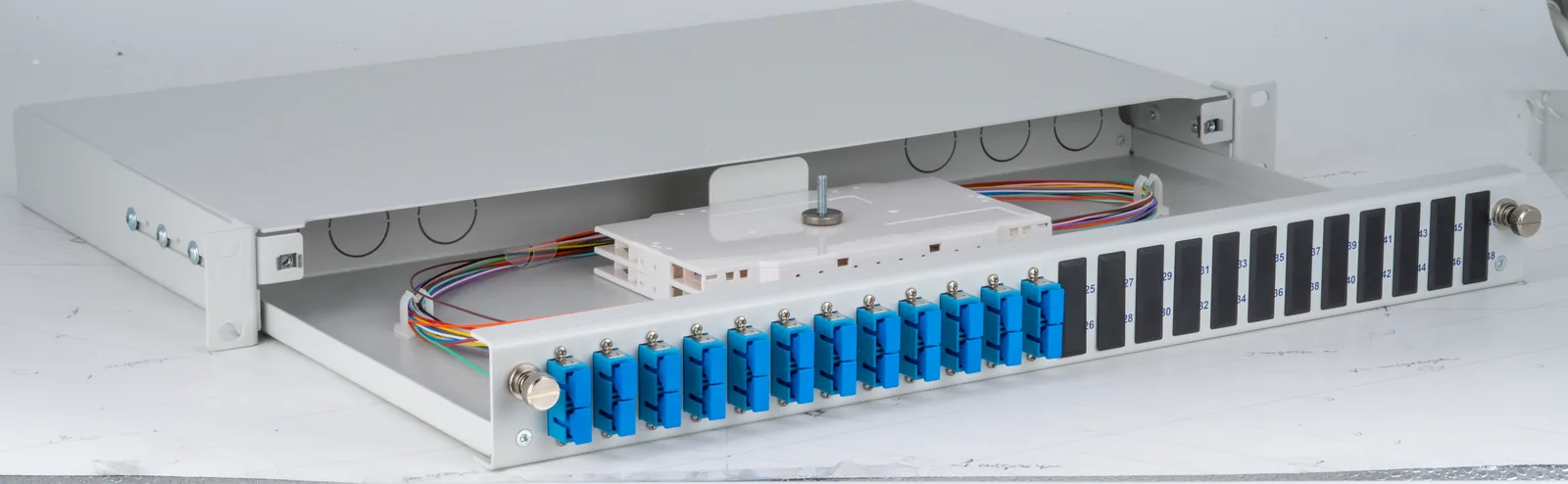
Modern splice systems such as SlimConnect 1HE modules allow accommodation of up to 96 fibres in just one rack unit – increased packing density compared to conventional systems.
Network Architecture and Topology Impact
The chosen network topology significantly influences the required fibre capacity. In point-to-point (P2P) architectures, each household requires a dedicated fibre from the main distribution point, resulting in high fibre numbers in the backbone. PON networks (Passive Optical Networks), on the other hand, share fibres via splitters, reducing the fibre count in the distribution network to 1/32 or 1/64.
- P2P architecture: 1:1 fibre ratio (maximum flexibility)
- GPON standard: 1:32 splitter ratio (cost-optimised)
- XGS-PON: 1:64 splitter ratio (maximum efficiency)
- Hybrid solutions: combination for optimal coverage
Fiber Products Quality Promise: As an official Diamond Partner and manufacturer, we produce modular splice systems in Europe. Benefit from Swiss precision and 5 years of warranty on our systems.
Scaling Factors for Future-Proof Planning
Municipal utilities must factor in various growth factors when calculating fibre capacity and FTTH planning. Bandwidth demand typically doubles every 3 to 4 years, driven by new services such as 8K streaming, virtual reality and smart home applications. Additionally, the penetration rate increases from an initial 30–40% to over 80% after 5 years.
Reserve planning is carried out in stages: 20% immediate reserve for short-term connections, a further 30% medium-term reserve for the next 5 years and 50% long-term reserve for technology shifts. This staged approach enables economical initial investment while ensuring future security.
- Immediate reserve: 20% for unplanned connections
- 5-year reserve: 30% for growth
- Technology reserve: 50% for new standards
- Total reserve factor: 2.0 (doubling of base capacity)
Calculation for Different Settlement Structures
Fibre capacity varies significantly depending on settlement type. Rural communities with 500 households require approximately 1,500 fibres in the total network at 2 fibres per household and 50% reserve. Medium-sized cities with 10,000 households plan for 30,000 fibres, while urban quarters with high commercial density quickly reach 50,000 fibres and more.
| Settlement Type | Households | Fibres/HH | Total Capacity | Recommended System |
|---|---|---|---|---|
| Village centre | 200 | 2 | 600 fibres | SlimConnect 1HE |
| Small town | 2,000 | 3 | 9,000 fibres | VarioConnect 3HE |
| Urban quarter | 5,000 | 4 | 30,000 fibres | VarioConnect 3HE |
| Commercial zone | 100 businesses | 16 | 2,400 fibres | Combination solution |
For municipal network operators, a modular design is recommended, enabling step-by-step expansion. This allows initial investment to be optimised whilst securing growth potential.
Technical Implementation with Modular Splice Systems
Modern splice systems must efficiently manage calculated fibre capacity. The VarioConnect series offers up to 288 fibres across 3 rack units, the highest packing density on the market. Through modular design, different connector types such as LC, SC, E2000 and MPO can be flexibly combined.
The splice cassettes accommodate 12, 24 or 48 splice points depending on configuration and enable structured fibre management according to IEC 61756-1 standard. The front modules are hot-swap capable and allow expansion during operation without service interruption.
- Splice cassettes: 12/24/48 fibres per unit
- Bending radius: min. 30 mm per IEC standard
- Attenuation: < 0.25 dB per connection
- Installation time: reduced through pre-configuration
Cost Optimisation in Fibre Planning
Investment costs for FTTH networks are distributed at 70% for civil works and only 30% for active technology. This makes generous dimensioning of fibre capacity worthwhile, as subsequent lay-ins are disproportionately expensive. An additional fibre bundle with 48 fibres costs only 5–10% extra during initial deployment but saves later civil works costing tens of thousands of pounds.
Municipal utilities can reduce total costs through intelligent fibre capacity calculation and FTTH planning. The key is the right balance between over-capacity and cost-effectiveness. Modular systems allow step-by-step outfitting – hardware is expanded only as needed.
Practical Example: FTTH Rollout in a Medium-Sized City
Using the example of a medium-sized city with 25,000 households, the complexity of fibre planning becomes clear. The municipal utility plans 3 fibres per household plus 40% reserve, totalling 105,000 fibres overall capacity. These are distributed across 5 main distribution points with 21,000 fibres each, 20 area distribution points with 2,500 fibres each and 150 street distribution points with 300 fibres each.
- Phase 1: Backbone with 288-fibre cables (Q1–Q2)
- Phase 2: Area connectivity 96-fibre cables (Q3–Q4)
- Phase 3: Household connections 12–48-fibre cables (following year)
- Pre-marketing rate: 35–40% for viability
Technical equipment comprises central technical rooms with VarioConnect 3HE systems for main distribution points and SlimConnect 1HE modules for decentralised distribution points. This combination ensures maximum flexibility with optimal space utilisation.
Maintenance and Documentation of Fibre Capacity
Precise documentation of fibre capacity is essential for operation and maintenance. Modern fibre management systems capture every splice, connection and reserve digitally. Identification follows DIN VDE 0888-100 with unique colour coding and numbering.
Regular capacity audits every 6 months identify bottlenecks early. When utilisation exceeds 70%, expansion should be planned. Modular systems allow uninterrupted upgrades through hot-swap capability.
Standards and Regulations for Fibre Planning
Technical implementation follows established standards such as IEC 61300 for connectors and IEC 60794 for fibre optic cables. The new VDE guideline GIA-PM (February 2026) standardises specifically fibre installation in buildings up to the property boundary.
| Standard | Scope of Application | FTTH Relevance |
|---|---|---|
| IEC 61300 | Connectors | Attenuation values, test procedures |
| IEC 60794 | Fibre optic cables | Cable construction, environmental resistance |
| DIN VDE 0888 | Identification | Colour coding, labelling |
| EN 50173-1 | Cabling | Structured cabling systems |
As a certified manufacturer, Fiber Products guarantees compliance with all relevant standards with 5 years of warranty on complete system technology – unique in the industry.
FAQ: Frequently Asked Questions on Fibre Capacity
How many fibres do I need per single-family home?
For a single-family home, 2 fibres are standard – one active plus one spare fibre. For more demanding requirements or home office use, 4 fibres are recommended for additional services and double redundancy.
What reserve capacity should be planned?
Experts recommend at least 30–50% reserve capacity above initial demand. With a 30-year service life, the reserve should even be 100% to account for technology shifts.
How do I calculate fibre capacity for a new residential area?
Multiply the number of residential units by 3 fibres (average value), add 40% reserve and round up to the next standard cable size (12, 24, 48, 96, 144, 288 fibres).
What is the difference between PON and P2P in fibre planning?
P2P requires one dedicated fibre per household from the main distribution point; PON shares one fibre via splitters to up to 64 households. PON saves fibres in the backbone, P2P offers more bandwidth and flexibility.
Can existing conduits be used for FTTH?
Yes, existing conduits with at least 40 mm diameter are suitable for FTTH cables. Microduct systems even allow the use of 7 mm microtubes for up to 96 fibres.
How long does fibre optic cabling last?
Fibre optic cables have a service life of over 30 years. Connectors should be inspected after 20 years and renewed if necessary. Modern splice connections last practically indefinitely.
Conclusion: Correctly Dimensioned Fibre Capacity Secures the Future
Careful fibre capacity calculation and FTTH planning with an average of 2–4 fibres per household forms the foundation of successful fibre optic projects. Municipal utilities and planners who dimension generously today and rely on modular systems avoid costly retrofits and secure competitive advantage in the dynamic broadband market.
With the right combination of precise needs analysis, forward-looking reserve planning and high-quality system technology, sustainable FTTH networks are created that can meet rising bandwidth requirements for decades to come. The investment in quality, modular splice systems with long warranty periods pays for itself through low operating costs and high availability.
Order directly from our shop: fiber-products.com
Request a Quote Now
Free consultation – personalised quote within 24 hours