Outsourcing fibre optic rollouts: What general contractors should know
Outsourcing fibre optic work, general contractor fibre deployment and FTTH subcontracting represent critical levers for efficient project execution in the market. When strategically planning fibre rollout projects, general contractors must focus particularly on selecting qualified subcontractors, adhering to technical standards such as IEC 61754-15 for connectors, and integrating modular splice systems with up to 96 fibres per 1RU.
The FTTH market continues to show strong growth with 12.5 million connections and coverage of 35 per cent. For general contractors, this represents significant opportunities but also complex coordination challenges when managing subcontractors.
Market dynamics and regulatory requirements in fibre optic outsourcing
Current market conditions show a clear trend towards increased outsourcing in fibre deployment. With an investment volume of 4.2 billion euros in the DACH region, of which 1.8 billion euros relates to outsourced work, general contractors position themselves as central players. The EU Gigabit Regulation mandates universal coverage with 1 Gbit/s by 2026, increasing pressure for efficient deployment processes.
Network operators and municipal utilities increasingly rely on general contractor expertise to achieve ambitious rollout targets. Modular systems play a key role in infrastructure scalability.
- Installation time reduction of up to 40 per cent through pre-configured modules
- Space savings of 60 per cent compared to traditional splice boxes
- Flexible adaptation to changing project requirements
- Simplified documentation and quality assurance
Technical standards and compliance for general contractor fibre deployment
Adherence to technical standards forms the foundation of successful FTTH projects. General contractors must ensure all deployed components meet current standards. Particular importance attaches to standards DIN EN 61756-1 for modular splice boxes and IEC 61754-19 for E2000 connectors in industrial applications.
| Standard | Application | Critical parameters |
|---|---|---|
| IEC 61754-15 | LC connectors | Attenuation < 0.25 dB |
| IEC 61754-19 | E2000 connectors | Attenuation < 0.1 dB, IP65 |
| DIN EN 61756-1 | Modular splice boxes | Packing density, accessibility |
| IEC 61300-3-6 | Return loss | APC > 60 dB, PC > 50 dB |
The choice between APC and PC connectors has direct impact on network quality. While PC connectors suffice for standard transmission spans, critical applications require APC connectors with superior return loss characteristics.
Subcontractor qualification and management in FTTH subcontracting
Selection of qualified subcontractors is decisive for project success. General contractors should implement a structured evaluation system that considers technical competence, certifications and reference projects.
- Evidence of certifications for fibre installation and splicing techniques
- Documented experience with at least 10,000 splice connections
- Availability of specialised tools for various connector types
- Quality management system per ISO 9001
- Training records for current standards and technologies
Professional subcontractor management includes regular quality inspections, standardised documentation processes and clear escalation procedures. Integration of digital documentation platforms enables real-time monitoring of construction progress.
Modular splice systems as efficiency guarantee
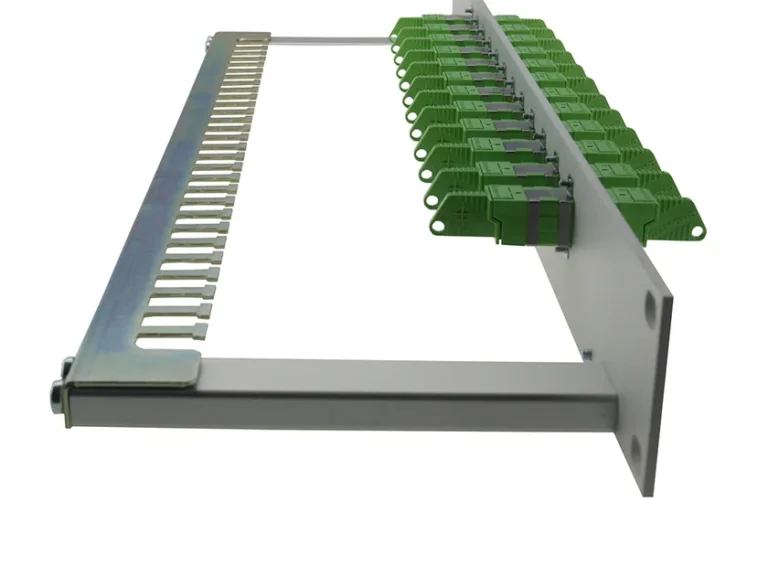
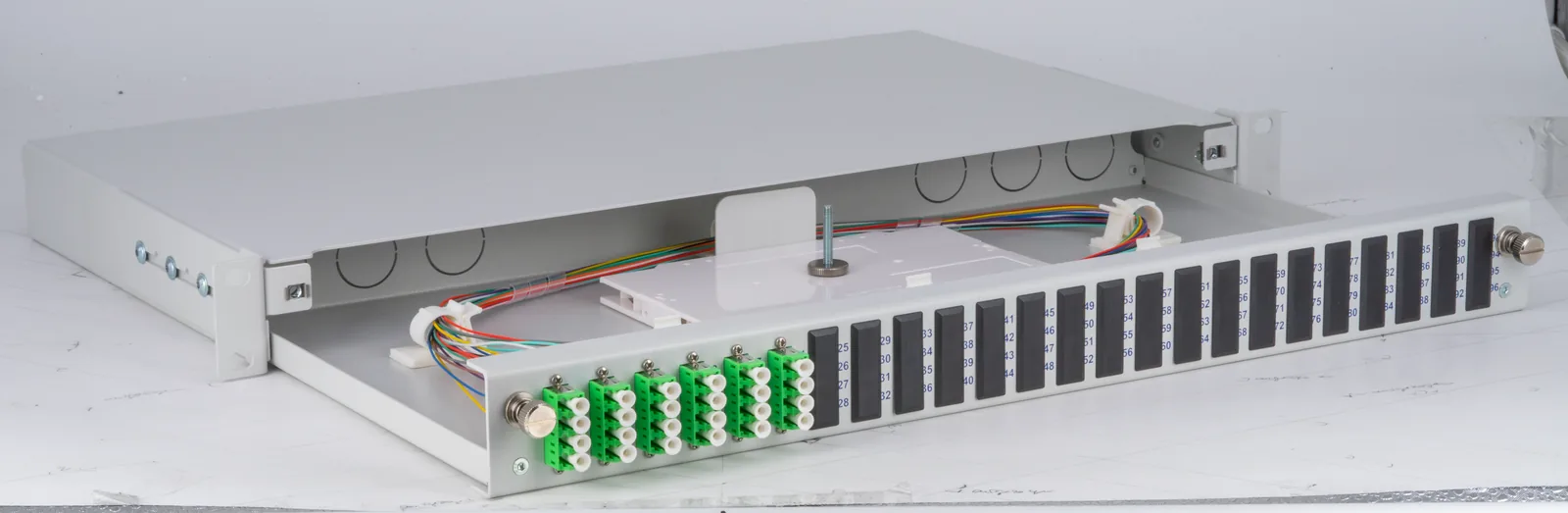
Modern fibre projects require maximum packing density with simultaneous flexibility. Modular splice systems such as SlimConnect and VarioConnect offer with up to 96 fibres per 1RU or 288 fibres per 3RU optimal conditions for scalable infrastructure.
Fiber Products quality promise: As an official Diamond Partner and manufacturer, we produce modular splice systems in Europe. Benefit from Swiss precision and in-house manufacturing.
The advantages of modular systems are particularly evident in fibre optic outsourcing: pre-configured modules reduce installation times significantly and minimise error sources. Exchangeable front panels enable subsequent adjustments without service interruption.
- Tool-free module replacement in under 30 seconds
- Compatibility with all common connector types (LC, SC, E2000, ST, FC, MPO)
- Integrated cable management for structured routing
- Colour coding per DIN EN 50173 for unambiguous assignment
Risk management and quality assurance in general contractor fibre deployment
Successful general contractors implement multi-stage quality assurance systems. Measurement of critical parameters such as attenuation, return loss and chromatic dispersion follows standardised protocols per IEC 61280-4-1.
| Test parameter | Limit value | Measurement method | Documentation |
|---|---|---|---|
| Splice attenuation | < 0.05 dB | OTDR measurement | Protocol per splice |
| Connector attenuation | < 0.3 dB | Light source measurement | Acceptance certificate |
| Total attenuation | < 0.35 dB/km | End-to-end | Span protocol |
| Return loss | > 50 dB | Reflectometer | Quality report |
Systematic documentation of all measurements forms the basis for warranty claims and facilitates later maintenance work. Digital documentation systems with automatic protocol generation significantly increase efficiency.
Cost optimisation through strategic material procurement
In FTTH subcontracting, material procurement plays a central role in profitability. General contractors benefit from framework agreements with established manufacturers, enabling price advantages of up to 25 per cent compared to single orders.
- Standardisation on a limited range of proven product lines
- Inventory of critical components for rapid availability
- Long-term supply agreements with guaranteed capacity
- Quality assurance through manufacturer warranties of at least 5 years
- Preference for European production for short delivery times
The choice of high-quality components such as modular splice boxes in 1RU design reduces long-term maintenance costs and minimises downtime. Investments in quality deliver lower lifecycle costs.
Project control and scheduling in fibre optic outsourcing
professional fibre optic project management. Modern planning software enables visualisation of dependencies and critical paths. General contractors should plan buffer times of at least 15 per cent to mitigate unforeseen delays.
Successful projects are characterised by clear milestones and regular progress checks. Weekly coordination meetings with all stakeholders ensure information flow and enable early corrections if deviations occur.
- Definition of measurable intermediate targets on a weekly basis
- Real-time documentation of construction progress via app
- Establish escalation procedures for schedule delays
- Use contractual penalties as a control instrument
- Implement bonus system for early completion
Optimise interfaces with network operators
Collaboration with network operators requires standardised processes for acceptance, documentation and handover. General contractors must understand the specific requirements of each client and integrate them into their processes.
Network operators increasingly value digital documentation with GIS integration. Complete capture of all route corridors, splice points and distribution points in georeferenced systems is becoming standard. Investments in appropriate software and training pay off through more efficient acceptance procedures.
| Documentation type | Format | Handover timing | Retention period |
|---|---|---|---|
| Route plan | DXF/Shape | Weekly | 30 years |
| Measurement records | PDF/XML | After section | 10 years |
| Splice plans | PDF/CAD | Upon acceptance | Indefinite |
| Material statement | Excel/CSV | Monthly | 5 years |
Technology trends and future perspectives in general contractor fibre deployment
The fibre market continues to evolve. General contractors must recognise technology trends early and incorporate them into their planning. Migration to higher transmission rates already requires consideration of 400G-capable components today.
- MPO/MTP connectors for backbone links with 12 to 72 fibres
- Bend-insensitive fibres per ITU-T G.657.A2 for tight bend radii
- Automated splicing equipment with AI-assisted quality control
- Pre-terminated breakout cables for rapid installation
- Hybrid cables with copper and fibre strands for special applications
Integration of E2000 connectors, available through Diamond partnerships of leading manufacturers, enables particularly low-loss connections with attenuation values below 0.1 dB. This technology is particularly suitable for demanding industrial environments with high vibration resistance requirements.
Sustainability and environmental aspects in FTTH subcontracting
Sustainability aspects are gaining increasing importance in tender procedures. General contractors can differentiate themselves through environmentally conscious practices. Use of recyclable materials, optimised logistics concepts and energy-efficient site facilities become competitive advantages.
Modern splice systems from European production reduce transport distances and associated emissions. The extended 5-year warranty on high-quality components contributes to resource conservation through longer service life.
- Establish CO2 balance sheets for fibre projects
- Prefer local suppliers to reduce emissions
- Deploy reusable packaging and transport containers
- Digital documentation to avoid paper
- Train staff in sustainable work practices
FAQ: Frequently asked questions on fibre optic outsourcing
Which certifications should subcontractors provide for FTTH projects?
Subcontractors should hold at minimum certification per DIN EN ISO 9001 for quality management. Additionally, industry-specific qualifications such as evidence of fibre splicing training per ZN G 6401 and safety certificates per SCC are required. Experience documentation of successfully completed projects with at least 5,000 household connections underscores competence.
How can quality defects be avoided in FTTH subcontracting?
Preventive quality assurance begins with detailed specifications and clear technical requirements. Regular sampling with OTDR measurements, documented interim acceptance after each construction section and use of high-quality components with manufacturer warranty minimise risks. A four-eyes principle for critical work steps further increases process security.
What advantages do modular systems offer compared to traditional splice boxes?
Modular systems reduce installation time by up to 40 per cent and save 60 per cent space compared to conventional splice boxes. Flexibility through exchangeable modules enables subsequent adjustments without service interruption. With packing densities of up to 96 fibres per 1RU, they significantly optimise space utilisation in distribution cabinets.
How does one calculate realistic time buffers for general contractor fibre deployment projects?
Based on industry experience, general contractors should plan 15–20 per cent time buffer for unforeseen events. Critical factors include weather impacts, permit procedures and material availability. Analysis of comparable projects and regional characteristics aids realistic estimation. Seasonal fluctuations must also be considered.
Which documentation standards apply to fibre optic outsourcing?
Documentation must comply with VDE 0888 requirements and the specifications of the respective network operator. Standard requirements include georeferenced route plans, splice protocols per IEC 61300-3-35, OTDR measurement records and material usage statements. Digital capture in GIS-compatible formats is increasingly mandatory.
How can long-term maintainability be assured in FTTH subcontracting?
Through standardisation on a limited range of proven product lines and use of components with long-term availability warranties. Selection of manufacturers with at least 5 years warranty and European production ensures spare parts supply. Detailed documentation of all installed components including serial numbers greatly facilitates later maintenance work.
Conclusion: Success factors for sustainable partnerships
Successful fibre optic outsourcing, professional general contractor fibre deployment and efficient FTTH subcontracting require systematic approach and high-quality technical solutions. General contractors who rely on proven modular systems with guaranteed quality create the foundation for long-term project success.
As a manufacturer of modular fibre optic solutions and official Diamond Partner, Fiber Products offers the complete system solution – from splice box to E2000 connector.
Request a quote
Have questions about our fibre optic solutions? Our expert team is happy to advise you – free of charge and without obligation.