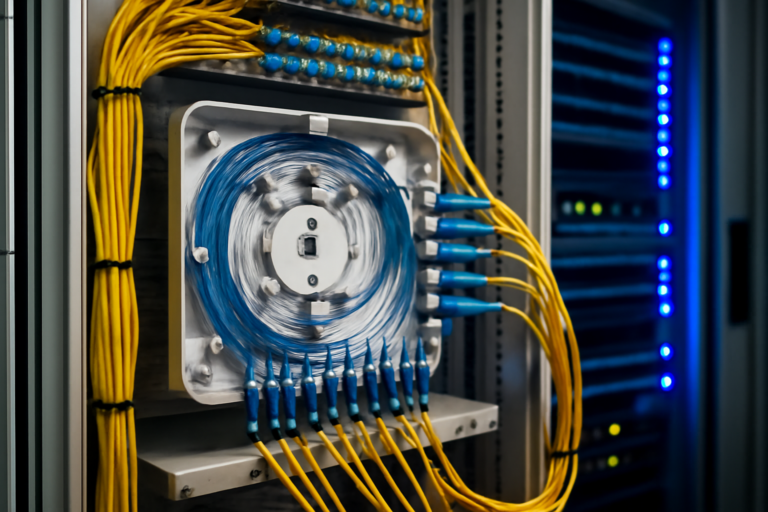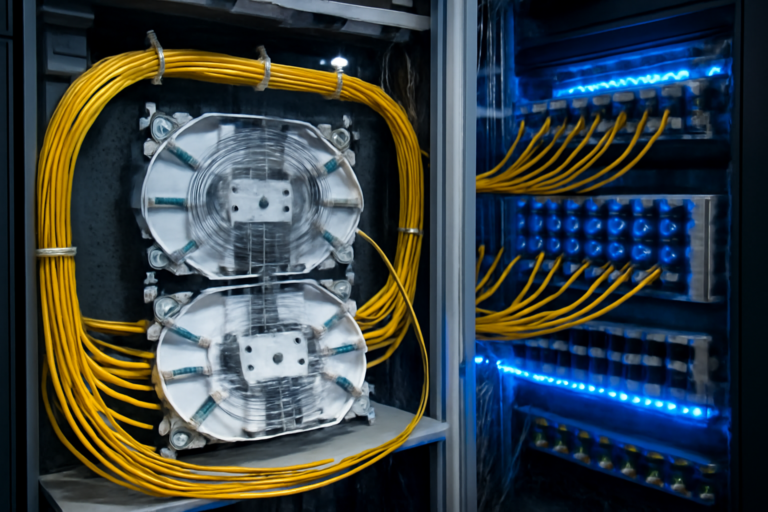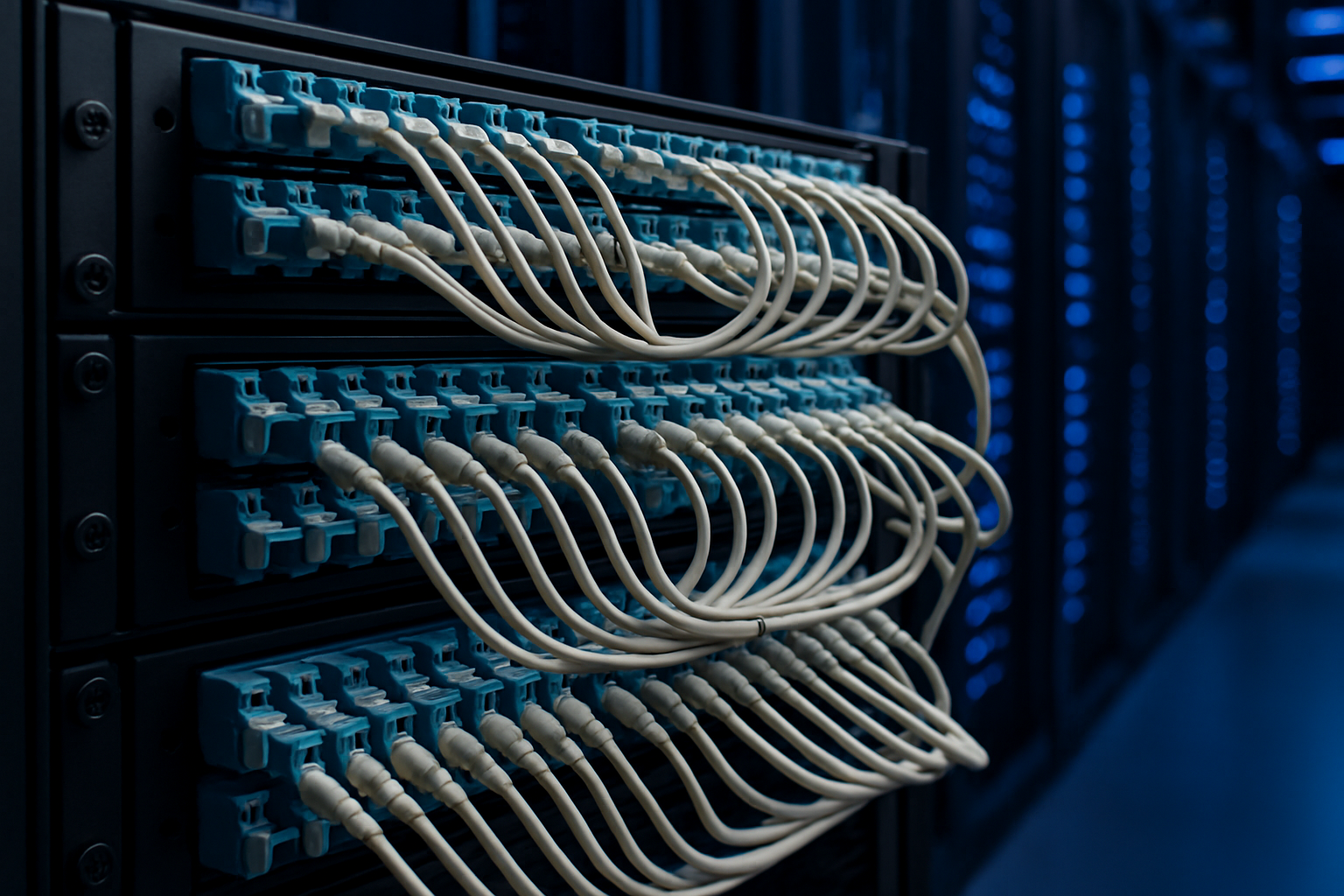
High Density Data Center: Cabling strategies for 400G/800G

The migration to 400G and 800G Ethernet is revolutionizing the requirements for high-density data center cabling and making high-density fibre optic solutions a technical necessity. While 100G connections were still feasible with single fibers, 400G already requires 8 parallel fibers per direction and 800G even 16 fibers per direction – a fourfold or eightfold increase in the required fiber optic infrastructure.
These exponentially increasing requirements can only be met by intelligent high-density data center strategies without having to completely rebuild data centers. Modern spine-leaf architectures with hundreds of 400G/800G ports per rack place extreme demands on port density, cable management and thermal design.
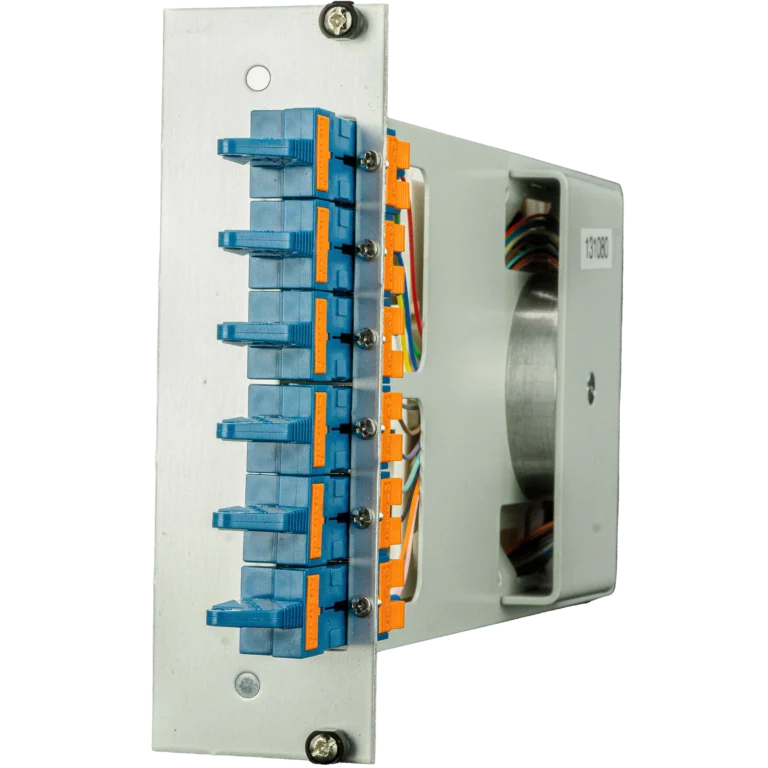
Modular 3U/4U systems with 288 fibers on 3U enable 18 fully-fledged 400G connections or 9 future-proof 800G links per housing. The challenge lies not only in the sheer number of fibers, but also in the systematic planning of migration paths, redundancy concepts and scalable expansion strategies.
For data center planners, this means a paradigm shift: from traditional point-to-point cabling to structured high-density data center architectures with modular scalability.
400G/800G Physical infrastructure requirements
Parallel optics technology and fiber requirements
400G Ethernet is based on parallel transmission over 8 fibers per direction at 50 Gbit/s each, which requires a total of 16 fibers per 400G port. This parallel optics technology uses SR8 transceivers for multimode connections up to 100 meters or DR8/FR8 for single mode applications. The high degree of parallelism places new demands on fibre-to-fibre synchronization and the mechanical precision of the connectors, as even small delay differences between the parallel channels can lead to signal errors.
800G doubles these requirements again for high-density data center installations: 16 parallel channels with 50 Gbit/s each require 32 fibers per port. Current 800G implementations use two parallel 400G streams or native 800G transceivers with correspondingly higher parallelism. The mechanical requirements for connectors and cable routing increase disproportionately, as the tolerances for mechanical inaccuracies decrease with higher data rates.
Breakout strategies for flexible port utilization
Breakout strategies enable flexible use of high port capacities in high-density data center environments: One 400G port can be split into four 100G connections, enabling different server connections with a common infrastructure. This flexibility requires corresponding modular cassette systems with integrated breakout functions and configurable fiber routing.
Reach requirements differentiate between various high-density data center application scenarios: SR8 transceivers for 400G reach 100 meters over OM4 multimode fibers, while single mode variants can span several kilometers. Data center architectures must take these ranges into account when selecting fiber optic types.
Thermal challenges
Power consumption of 400G/800G transceivers generates significant heat loads in high density data center installations: 400G transceivers typically consume 12-15 watts, 800G variants 20-25 watts per port. High density installations with dozens of ports per rack generate kilowatt loads that challenge thermal management. The fiber optic infrastructure must allow appropriate air circulation and avoid thermal hotspots.
Spine-leaf architectures and scaling requirements
Fully meshed network topologies
Modern spine-leaf architectures require structured cabling between spine and leaf switches with hundreds of parallel connections in high-density data center environments. Each leaf switch typically requires 32-64 uplinks to different spine switches, while spine switches provide several hundred downlinks to the leaf tiers. This full meshing creates extreme demands on the structured cabling and makes high-density solutions indispensable.
Oversubscription factors determine the required spine bandwidth in high-density data center architectures: Typical 2:1 or 3:1 oversubscription means that not all servers can use maximum bandwidth at the same time. Although this design reduces the required spine capacity, it requires flexible cabling for different traffic patterns. High density systems must offer appropriate reconfiguration options.
Multi-tier hierarchies
Multi-tier architectures in large data centers use additional super-spine tiers for pod-to-pod communication. These hierarchical structures require different cabling strategies for different tiers: Higher tiers usually use single mode fibers for longer reach, while access tiers make do with multimode. Modular high-density data center systems must support both fiber types.
Traffic engineering and load balancing influence high-density data center cabling requirements: ECMP (Equal Cost Multi-Path) routing uses all available paths equally and requires corresponding symmetry in the physical cabling. Asymmetries can lead to suboptimal load distribution and hotspots.
Fabric expansions for growing requirements require scalable high-density data center cabling concepts: It must be possible to integrate additional spine switches or leaf pods without completely rewiring. Modular systems with pre-reserved capacities enable such expansions without service interruptions.
Planning guidelines for High Density 400G/800G
Strategic capacity planning
Capacity planning for high-density data center installations takes into account both current and future requirements: A 400G port requires 16 fibers, with planned 800G migration 32 fibers per port should be planned. This provision initially seems oversized, but avoids costly new cabling. VarioConnect systems with 288 fibers offer sufficient capacity for 18 x 400G or 9 x 800G ports with expansion reserves.
Redundancy concepts are particularly important with high port densities in high-density data center environments: the failure of a high-density system can affect dozens of 400G/800G connections simultaneously. A/B paths via separate systems or physically separate routing are usually indispensable. Planning must eliminate single points of failure and provide sufficient backup capacity.
Migration and rollout strategies
Phased rollout strategies enable gradual high-density data center migration without service interruptions: New high-density systems are installed in parallel with existing 100G infrastructures before gradual migration takes place. This parallelism requires corresponding rack capacities and temporary overfitting.
Standardization of cable types and connectors simplifies high-density data center installation and maintenance: Standardized MTP-24 connectors for all 400G/800G applications reduce inventory and the risk of mix-ups. Color-coded cables for different application areas support systematic installation.
Documentation strategies must cope with the complexity of high-density data center 400G/800G installations: Hundreds of parallel connections require systematic labeling and digital management. CAD-based planning tools can optimize cable routes and avoid collisions. Asset management systems with barcode or RFID integration enable automated inventory management.
Cable management and routing concepts
Structured cable routing with high density
Structured cable routing is vital for high-density data center installations: 400G/800G installations can require hundreds of MTP cables per rack, which must be systematically organized. Multi-level routing systems with different guide levels prevent cable chaos and enable traceable installation. Color-coded guide rails support systematic assignment.
Bend radius management for MTP cables requires special attention in high-density data center environments: The 24 fibers in an MTP-24 cable have different positions in the connector and therefore different bend radii for cable bends. Inadequate cable routing can lead to different attenuations of the parallel channels. Professional routing systems ensure uniform bending radii for all fibers.
Service concepts and maintainability
Service loops and fiber reserves must be sufficiently dimensioned despite the lack of space in high-density data center installations: MTP-24 cables are more difficult to re-terminate than single fibers, which is why sufficient length reserves are important for repairs. Standard reserves of 2-3 meters make it possible to reterminate cables without replacing them. Intelligent cassettes systematically take up these reserves.
Cable bundling and harnessing reduce high-density data center installation complexity: Cables that belong together are bundled into harnesses and routed together. This bundling simplifies installation and reduces the risk of confusion. However, thermal aspects must be taken into account, as dense bundles can hinder heat dissipation.
Patch management for high-density data centers 400G/800G requires special strategies: High cable volumes make manual patch management impossible. Automated patch management systems with electronic recording are indispensable. Intelligent patch panels can automatically document connection changes and transfer them to asset management systems.
Migration from 100G to 400G/800G
Step-by-step migration paths
Migration paths must take into account existing 100G infrastructures in high-density data center environments: Complete replacement is usually uneconomical, so gradual migration is required. 400G breakout to 4x100G enables transition scenarios in which new 400G infrastructures supply existing 100G servers. This flexibility requires corresponding breakout cassettes in high-density systems.
Hybrid operation at different speeds places demands on high-density data center cabling flexibility: 100G, 400G and 800G systems operated in parallel require separate or adaptable cabling. Modular high-density systems with configurable cassettes support such hybrid scenarios.
Migration timing and service continuity
Timing aspects of high-density data center migration minimize service interruptions: Maintenance windows for critical systems are limited, so migration must be efficient. Preparation of all components, test scenarios and rollback plans are essential. Modular systems enable partial migration without complete shutdown.
Investment protection through future-proof high-density data center infrastructures: Cabling typically has a service life of 15-20 years and should outlast several technology generations. High density systems with sufficient capacity reserves protect against premature obsolescence. This future-proofing justifies higher initial investments.
Interoperability between different manufacturers requires standards-compliant high-density data center cabling: Vendor-specific solutions can lead to lock-in situations. Standardized MTP connectors and standard-compliant cabling ensure vendor independence.
Redundancy and high availability concepts
Physical redundancy strategies
Physical redundancy requires separate cabling paths in high-density data center architectures: A/B paths should use different rack rows, route levels or even parts of the building. High density systems must be duplicated accordingly, whereby spatial separation avoids single points of failure. Although this redundancy doubles cabling costs, it is essential for critical applications.
Logical redundancy through multi-path protocols uses multiple physical paths simultaneously in high-density data center installations: LACP (Link Aggregation) or ECMP can bundle multiple 400G/800G connections into higher bandwidth virtual links. These protocols require appropriate symmetry in the physical cabling and even load distribution.
Failure domain management
Failure domain isolation limits the impact of failures in high-density data center environments: Separate high-density systems for different service areas prevent individual failures from affecting the entire data center. This isolation requires appropriate capacity planning and can reduce cabling efficiency.
Automatic failover in the event of cabling failures requires intelligent switches and corresponding physical high-density data center infrastructure: Rapid Spanning Tree or other failover protocols can switch to backup paths in the event of cabling failures. The physical cabling must support such scenarios and provide sufficient backup capacity.
Testing and validation of high-density data center redundancy concepts: Regular failover tests validate both physical and logical redundancy. These tests uncover design flaws and ensure that backup paths actually work. Documentation of test results supports continuous improvement.
Thermal management for High Density 400G/800G
Thermal load calculation and thermal design
Heat load calculation takes into account transceiver consumption and cable density in high-density data center installations: 400G transceivers generate 12-15 watts, 800G variants 20-25 watts per port. With 32 ports per switch, 400-800 watts of additional heat load are generated. Dense cabling can impede air circulation and increase hotspots.
Airflow optimization requires coordinated planning of switches and high-density data center cabling systems: Cold aisle/hot aisle concepts must be considered in cabling routing. Cables should not block or divert air flows. High density systems require appropriate perforation and air ducts.
Monitoring and preventive measures
Monitoring of operating temperatures in high-density data center environments: Temperature sensors at critical points monitor thermal conditions. Intelligent rack management systems can trigger alarms or initiate cooling measures if limit values are exceeded. This monitoring is essential for high-density data center 400G/800G installations.
Preventive measures against thermal problems: Oversized cooling, redundant fan systems and thermal buffers reduce failure risks in high-density data center installations. These measures cost energy, but are usually more cost-effective than thermally induced failures.
Future-proof scaling strategies
Next-generation technologies
1.6T Ethernet as the next development stage requires a further doubling of the number of fibers in high-density data center architectures: Initial 1.6T implementations use 32 or 64 parallel channels, which means 64-128 fibers per port. This development requires even higher port densities. High density systems should provide for corresponding expansion capacities.
Photonic integration promises higher data rates with reduced fiber counts for high-density data center applications: Silicon photonics may enable higher bit rates per fiber and reduce the required parallelism. However, these technologies are not yet ready for the market. Cabling planning should consider different technology paths.
Edge computing and 5G influences
Edge computing and 5G create new requirements for high-density data center cabling: Low latency requires local data centers with appropriate fiber optic connections. High density solutions enable professional cabling even in smaller edge locations. This decentralization multiplies cabling requirements.
Cloud-native architectures and container orchestration influence high-density data center traffic patterns: East-west traffic between servers increases disproportionately to north-south traffic to clients. This shift requires appropriate spine-leaf dimensioning and cabling strategies. Software-defined networking enables more flexible use of the physical infrastructure.
Profitability and ROI considerations
CAPEX optimization through modular systems
Capex optimization through high-density data center solutions: VarioConnect systems with 288 fibers replace multiple conventional distributors and reduce hardware costs. Modular design enables needs-based initial equipment with subsequent expansions. This flexibility reduces overcapacity and initial investment.
OPEX reduction through simplified maintenance and management in high-density data center installations: Fewer systems mean lower maintenance costs and reduced complexity. Standardized modules simplify spare parts management and staff training. These savings add up considerably over the operating time.
Energy efficiency and sustainability
Energy efficiency through optimized air circulation in high-density data center environments: Structured high-density cabling improves cooling efficiency and reduces energy costs. PUE improvements of 0.1-0.2 are realistic and lead to considerable savings in large data centers. These efficiency gains quickly amortize additional costs.
Risk mitigation through professional high-density data center cabling: High-quality installations reduce failure risks and the associated business losses. Service level agreements are easier to comply with. This risk reduction is difficult to quantify, but is certainly relevant for the overall economy.
Future proofing protects investments from premature obsolescence in high-density data center projects: Sufficient capacity reserves avoid costly rewiring during technology upgrades. The longer service life amortizes higher initial investments. TCO considerations over 10-15 years usually show clear advantages of modular high-density solutions.
Implementation recommendations for high-density data centers
Systematic planning approaches
High density data center cabling strategies are not optional for 400G/800G installations, but technically necessary. The exponentially increasing number of fibers can only be managed by intelligent modular systems with 288 fibers on 3U. Successful implementations take into account both current requirements and future scaling needs.
Systematic planning is the key to high-density data center success: capacity requirements, redundancy requirements and migration paths must be considered from the outset. Modular high-density systems offer the necessary flexibility for different scenarios and protect investments from premature obsolescence.
Modular architecture advantages
The 7TE modular architecture has proven to be optimal for balancing port density and maintainability in high-density data center environments. This standardized approach enables flexible configurations while simplifying the management of complex cabling structures.
Future-oriented investments in high-density data center infrastructures: The future belongs to fully structured data centers with modular, scalable cabling architectures. 1.6T Ethernet and beyond will further increase the requirements. High density fiber optic systems with sufficient expansion capacities form the foundation for this development.
Industry-specific solutions
Telecommunications providers and industrial companies benefit equally from high-density data center concepts, as scaling requirements are increasing across all industries. The modular approach makes it possible to serve different application scenarios with standardized system components.
Professional consulting and implementation: Take advantage of our expertise in modular fiber optic systems and proven high-density data center concepts. From initial capacity planning to the implementation of future-proof scaling strategies, we support you in the realization of your 400G/800G migration.
Conclusion: High density as the key to 400G/800G success
High density data center cabling strategies enable data centers to keep pace with the increasing demands of digitalization. The combination of modular fiber optic systems, intelligent cable management concepts and future-proof scalability forms the basis for successful 400G/800G migrations.
Your next step: Professional high-density planning
Discover our complete high density portfolio and benefit from our many years of experience in high-density data center projects. Our experts will work with you to develop the optimum cabling strategy for your 400G/800G data center and proven modular concepts that grow with your increasing requirements.
*Contact us to find the optimum high-density cabling strategy for your 400G/800G
Request a Consultation
Our experts will advise you on modular fiber optic solutions for your specific application — fast, personal and non-binding.