FTTH development strategies 2025: FTTH development in hard-to-reach areas
The FTTH development of hard-to-reach areas presents municipal utilities and regional providers with complex economic and technical challenges. While urban agglomerations are already largely supplied with fiber optics, rural regions, outlying areas and geographically difficult areas often remain underserved. These “blank spots” on the broadband map require innovative development strategies that challenge traditional business cases and necessitate new financing models.
The pressure to expand is constantly increasing: working from home, digital education and IoT applications make gigabit connections indispensable, even in peripheral locations. At the same time, regulatory requirements and political targets for nationwide fiber optic coverage are becoming more stringent. Municipal utilities are faced with the dilemma between social responsibility and economic rationality.
Successful FTTH development in hard-to-reach areas combines technical innovation, creative financing and strategic cooperation to create holistic solutions. The trick is to develop sustainable business models, even under unfavorable initial conditions, that both meet the requirements of public services and ensure long-term profitability.
Challenges of hard-to-reach areas
Low connection density as a cost driver
Low connection density is the fundamental problem of rural FTTH development in hard-to-reach areas: While urban areas allow 200-500 households per kilometer of fiber optic network, sparsely populated regions often only have 10-50 connections over the same distance. This discrepancy dramatically worsens profitability, as infrastructure costs are spread over significantly fewer paying customers.
Statistical analyses show that the costs per household increase by a factor of 3-5 for connection densities below 30 households/km. This is where modular fiber optic solutions that enable flexible scaling become crucial.
Geographical barriers and approval procedures
Geographical obstacles make routing and installation considerably more difficult: mountainous terrain, bodies of water, nature reserves or historical areas require complex bypass solutions or special procedures. Rocky subsoil makes civil engineering extremely cost-intensive, while flood plains require special protective measures.
Approval procedures can be particularly lengthy in complex areas: crossings of federal highways, railroad lines or bodies of water require extensive coordination with various authorities. Nature conservation requirements can limit construction times to a few months per year.
Willingness to pay and market acceptance
Low willingness to pay in rural areas reduces revenue potential for FTTH development in hard-to-reach areas: While urban customers pay EUR 50-80 per month for gigabit connections, rural households often expect prices below EUR 40. This price sensitivity significantly reduces ARPU (average revenue per user).
Technical solutions for difficult areas
Innovative installation techniques
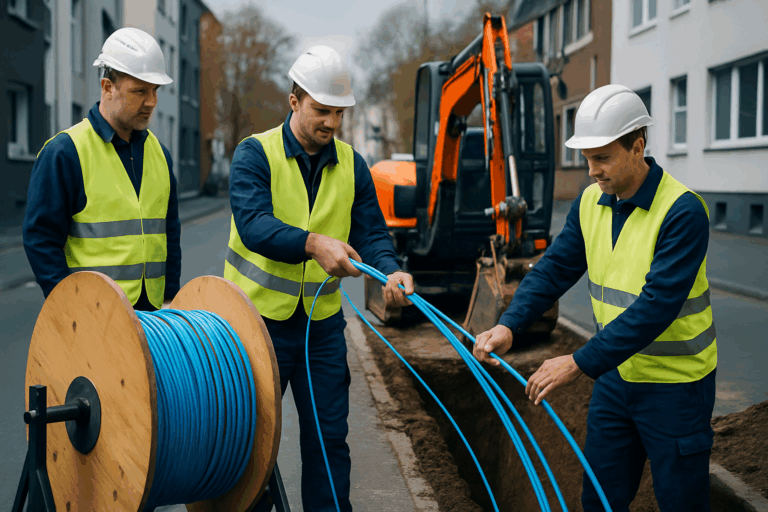
Micro-trenching reduces civil engineering costs by 40-60% compared to conventional installation: Specialized milling machines create slots only 3-5 cm wide into which microtubes are inserted. This technique is particularly advantageous in paved areas or in difficult ground conditions.
Aerial cable laying uses existing infrastructure: electricity pylons, telephone lines or specially erected poles carry self-supporting fiber optic cables (ADSS). This technology is more cost-effective than underground installation, especially in mountainous or rocky terrain.
Highly efficient splicing technology
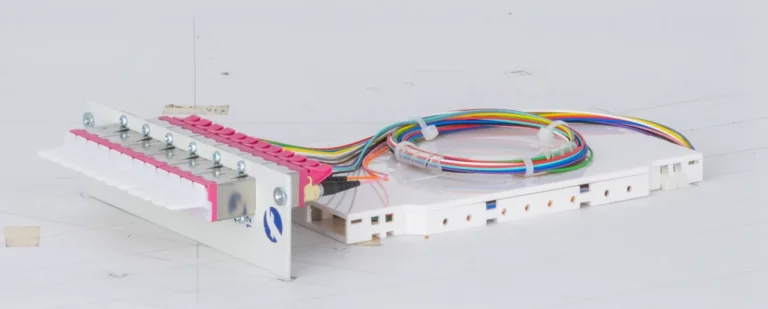
Successful FTTH development in hard-to-reach areas requires reliable splicing technology. Splice modules with a high port density reduce infrastructure costs per connection. Point-to-multipoint fiber optic technologies such as PON systems distribute fibers to up to 128 households.
Modern XGS-PON or NG-PON2 offer sufficient bandwidth even for demanding applications. These technologies reduce fiber kilometers and thus expansion costs, especially in sparsely populated areas. Compact 1U SlimConnect systems enable space-saving installation.
Innovative financing models
Cooperative models and citizen participation
Cooperative models mobilize private capital for joint projects in the FTTH development of hard-to-reach areas: Citizens, companies and municipalities participate as cooperatives in fiber optic expansion and benefit from long-term returns and lower tariffs. Successful cooperatives achieve equity ratios of 30-50%.
Sale-and-lease-back structures enable pre-financed development: investors pre-finance the expansion and lease the infrastructure back to municipal utilities on a long-term basis. These models reduce investment risks and enable development even with limited own funds.
Subsidies and public-private partnerships
Funding stacking combines various funding programs: Federal, state and EU funding can complement each other and enable funding rates of up to 90%. Public-private partnerships share risks between the public sector and private investors.
Crowd-funding platforms enable citizen participation even without cooperative structures: online platforms collect small amounts from many supporters and use them to finance local fiber optic projects.
Cooperation strategies and synergies
Intercommunal cooperation
Inter-municipal cooperation reduces planning and expansion costs for FTTH development in hard-to-reach areas: Joint tenders achieve larger lot sizes and better conditions. Shared planning costs and coordinated approval procedures reduce overhead costs by 20-30%.
Shared use of existing infrastructure minimizes civil engineering costs: sewers, district heating pipes or gas pipes often offer capacity for additional pipe systems. These synergies reduce expansion costs by 30-50%.
Wholesale models and B2B partnerships
Wholesale models enable infrastructure sharing: municipal utilities build passive infrastructures and market them to various service providers. Open access networks can achieve higher capacity utilization and better profitability.
Partnerships with mobile network operators open up new business areas: 5G campus networks and small cell backhaul require fiber optic connections. Municipal utilities can also market their FTTH infrastructures for mobile backhaul.
Funding landscape and regulatory framework
Federal funding programs
The federal government’s gigabit funding program supports FTTH development in hard-to-reach areas with a funding rate of up to 90%. The prerequisite is usually that no private sector would expand economically. Application procedures are complex, but promising for structurally weak regions.
State funding programs supplement federal funding with different priorities. Bavaria promotes rural areas in particular, NRW focuses on commercial areas and Schleswig-Holstein supports coastal regions.
EU structural funds and municipal financing
EU structural funds such as ERDF and EAFRD can co-finance fiber optic expansion. These programs have longer terms and enable strategic planning over several years. Special municipal levies can finance own contributions.
Regulatory simplifications speed up approval procedures: Simplified notification procedures for fibre optic construction, standardized permits and one-stop stores reduce bureaucratic effort.
Successful implementation strategies
Prioritization and demand aggregation
Step-by-step development according to economic efficiency prioritizes profitable areas for FTTH development in areas that are difficult to reach: Even in difficult areas, there are usually sub-areas with better connection density. These are developed first and help finance later expansion stages.
Demand aggregation bundles demand before expansion begins: Binding preliminary contracts with at least 40-50% of households create planning security and improve financing conditions.
Modular expansion and community building
Modular expansion enables step-by-step expansion: backbone infrastructures are planned oversized, house connections are added as required. DIN rail boxes 7TE support flexible distribution solutions.
Community building creates acceptance and demand: information events, local ambassadors and demonstrations of concrete benefits motivate people to follow suit. Successful projects invest 5-10% of the budget in communication and marketing.
Technology alternatives and transition scenarios
Fixed wireless access and hybrid networks
Fixed wireless access via 5G offers fast development: Modern 5G FWA achieves 100+ Mbit/s and can serve as a bridge to FTTH expansion. This technology requires significantly lower investments.
Hybrid networks optimally combine different technologies: fiber optic backbone with FWA distribution, vectoring for existing customers and satellites for peripheral areas create flexible solutions for the FTTH development of hard-to-reach areas.
FTTC as a compromise solution
FTTC (Fiber to the Curb) as an intermediate step: fiber optics to the street cabinet, short copper lines to the house reduce expansion costs by 40-60%. This strategy enables a faster basic supply with subsequent premium expansion.
Measurement and success criteria
Key Performance Indicators
Connection rates as the main indicator of project success: Successful FTTH development in hard-to-reach areas achieves 60-80% connection rates after 3-5 years. Return on investment over the entire life cycle: FTTH investments usually only pay for themselves after 8-12 years.
Customer Acquisition Cost and Customer Lifetime Value: CAC should not exceed 20-30% of CLV. High acquisition costs must be compensated by higher customer loyalty.
Monitoring and optimization
Network utilization and traffic development justify FTTH investments retrospectively. Successful networks show 20-30% annual traffic growth. Customer satisfaction and Net Promoter Score above 50 are considered excellent.
Regionally adapted strategies
Target group-specific approaches
Rural areas with little tourism need a different approach to business locations: purely residential areas are less willing to pay, but also have lower expectations. The focus is on area coverage instead of premium services.
Tourism and leisure regions benefit from seasonal peaks: Vacation homes and hotels require high-quality connections, but have a higher willingness to pay. Marketing should emphasize locational advantages for digital nomads.
Business locations and commuter areas
Business locations with industrial estates enable cross-subsidies for FTTH development in hard-to-reach areas: B2B customers pay higher prices and stabilize business cases. Industrial customers can become anchor tenants.
Commuter communities in the commuter belt have a high digital affinity: home office use and high incomes increase willingness to pay. Premium services with guaranteed upload rates appeal to this target group.
Future prospects and trends
IoT and smart applications
Internet of Things in agriculture drives demand for FTTH development in hard-to-reach areas: Smart farming with sensor networks, drones and autonomous machines requires area-wide connectivity. Precision agriculture is becoming an important driver of rural digitalization.
5G campus networks for industry and agriculture: Private 5G networks require fiber optic backhaul and create new business models for public utilities. B2B services with high margins compensate for low consumer revenues.
Digital transformation
E-government and digital services of general interest: Digitalization of public services makes broadband a critical infrastructure. Telemedicine, digital education and e-administration require reliable high-speed connections.
Climate change and the energy transition: Smart grids for decentralized energy generation require communication infrastructures. Controlling photovoltaics, wind power and battery storage requires real-time data connections.
Conclusion and recommendations for action
FTTH development in hard-to-reach areas requires customized strategies that combine technical innovation with creative financing. Blanket solutions fail due to the diversity of local conditions – successful projects take into account the geographical, demographic and economic characteristics of their target areas.
Modular fiber optic solutions such as splice modules enable flexible implementation of various development concepts. Cooperation and subsidies are indispensable success factors: no municipal utility can develop difficult areas economically on its own.
The future belongs to intelligent multi-technology approaches: Fiber optics remains the goal, but hybrid solutions can bridge transition phases economically. A long-term strategy that takes various technology cycles into account is crucial.
Visit our online store for high-quality splice modules and modular fiber optic solutions. You can find more technical articles in our blog. Contact us to jointly develop the optimum development strategy for your coverage area.
Request a Consultation
Our experts will advise you on modular fiber optic solutions for your specific application — fast, personal and non-binding.