Fibre Optic Pharma Networks – GMP-Compliant Infrastructure for Regulated Environments
Fibre optic pharma networks and GMP-compliant systems with optical fibres form the critical infrastructure for modern pharmaceutical manufacturing in regulated environments. Implementation of optical fibres in pharmaceutical cleanrooms and production facilities requires validated system components according to EU GMP Annex 11, documented qualification procedures and interference-resistant transmission paths with attenuation values below 0.35 dB per connection. Pharmaceutical manufacturers rely on modular fibre optic systems with E2000 connectors for maximum contact reliability and APC polish to minimise back reflection in critical process controls.
Digital transformation of the pharmaceutical industry with networked production lines, real-time quality control and automated batch records places the highest demands on network infrastructure. Fibre optic cabling ensures the required electromagnetic compatibility, eavesdropping resistance and bandwidth up to 100 Gbit/s for process data and image processing.
Regulatory Requirements for Pharma Fibre Optics in GMP Environments
Installation of fibre optic pharma networks is subject to strict regulatory requirements of the EU GMP Guidelines and FDA 21 CFR Part 11. Every network component must be qualified and included in the system validation. This applies to splice boxes, patch panels and active components equally.
- Comprehensive documentation of all fibre optic connections with OTDR test protocols
- Validated cleanroom suitability per ISO 14644-14 for all passive components
- Redundant routing for critical process controls
- Qualified suppliers with GDP certification for pharmaceutical environments
- Change control procedures for every modification to the network
Special attention must be paid to material selection. Cable jackets must be halogen-free (LSZH) and resistant to disinfectants such as isopropanol or hydrogen peroxide. Fire classification is determined per EN 50575 Class Cca-s1a,d1,a1.
Technical Specifications for GMP Network Infrastructure
Designing a GMP network with pharma fibre optics requires precise planning of optical budgets and transmission paths. In pharmaceutical production facilities, single-mode OS2 fibres are mainly used for backbone connections and multi-mode OM4/OM5 fibres for shorter distances.
| Parameter | Single-Mode OS2 | Multi-Mode OM4 | Application |
|---|---|---|---|
| Wavelength | 1310/1550 nm | 850 nm | Process data transmission |
| Maximum Distance | 40 km | 550 m | Building interconnections |
| Attenuation | 0.4 dB/km | 3.0 dB/km | Cleanroom cabling |
| Bandwidth | 100 Gbit/s | 40 Gbit/s | Image processing/AI |
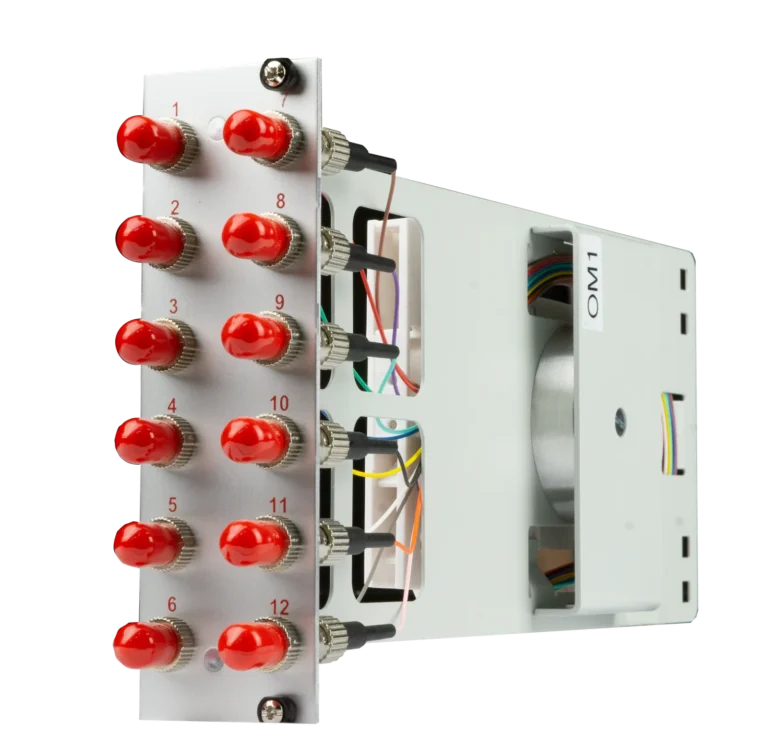
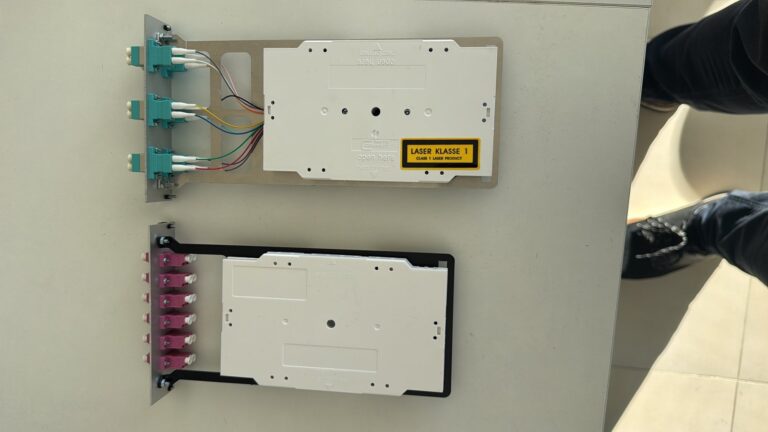
Modular splice systems with pre-terminated cassettes have proven effective for structured cabling in cleanrooms. These enable rapid changes without contaminating the production environment.
Fibre Optic Pharma Networks: Connectors for Critical Applications
Selecting the correct connector type is crucial for GMP network reliability. In the pharmaceutical industry, E2000 connectors with automatic shutter mechanism and LC duplex connections for high packing density dominate.
- E2000 APC: Shutter mechanism prevents contamination, ideal for cleanrooms
- LC Duplex: Compact design for up to 96 fibres in 1U
- SC Simplex: Robust design for industrial environments
- MPO/MTP: Multi-fibre connector for 12 or 24 fibres simultaneously
Fiber Products Quality Promise: As an official Diamond Partner and manufacturer, we produce modular splice systems in Europe. Benefit from Swiss precision and in-house manufacturing.
Validation and Qualification of Pharma Fibre Optic Installations
Validation of a fibre optic pharma network occurs in three phases: Design Qualification (DQ), Installation Qualification (IQ) and Operational Qualification (OQ). Each phase must be documented and released by quality assurance.
During IQ, all fibre optic connections are measured with calibrated OTDR instruments per IEC 61280-4-1. Attenuation values must remain within specified limits. Typical limit values for pharmaceutical applications:
- Splice connection: maximum 0.1 dB
- Connector: maximum 0.3 dB
- Complete link: below 3 dB for critical connections
- Return loss: minimum 60 dB with APC connectors
Integration into Existing Automation Systems
Connecting GMP network components to existing process control systems requires careful planning of media converters and network topology. Modern pharmaceutical facilities use redundant ring topologies with automatic switchover upon link failure.
| System Level | Fibre Type | Protocol | Availability |
|---|---|---|---|
| Process Control System | Single-Mode OS2 | Ethernet/IP | 99.999% |
| SCADA/HMI | Multi-Mode OM4 | PROFINET | 99.99% |
| Building Automation | Multi-Mode OM3 | BACnet | 99.9% |
| Video Surveillance | Single-Mode OS2 | IP Camera | 99.95% |
Use of industrial-grade fibre optic solutions with IP65 protection class ensures reliable operation even in wet areas and during cleaning processes.
Security Aspects of Fibre Optic Pharma Networks
Pharma fibre optics offer inherent security advantages over copper-based networks. The eavesdropping resistance of optical fibres prevents unauthorised access to sensitive production data and formulations. Additionally, risks from electromagnetic interference or potential equalisation problems are eliminated.
- No electromagnetic radiation – TEMPEST secure
- Physical tampering immediately detectable through attenuation monitoring
- Galvanic isolation between building sections
- No spark generation in hazardous areas
- Immunity to radio frequency interference from production equipment
Maintenance and Upkeep of GMP Network Infrastructure
Preventive maintenance of fibre optic pharma installations follows a defined maintenance schedule with annual inspection intervals. Critical connections are verified semi-annually with reference measurements.
Modern DIN rail fibre boxes enable decentralised installation of fibre optic distribution systems directly in control cabinets. This reduces maintenance effort and enables rapid reconfigurations without cleanroom access. Modular design with exchangeable splice cassettes minimises downtime during repairs.
- Visual inspection of connectors with 400x video microscope
- Ferrule cleaning with 99.9% IPA and lint-free wipes
- OTDR reference measurement for trend analysis of attenuation values
- Documentation of all maintenance work in electronic maintenance log
- Training of maintenance personnel per IEC 61300-3-35
Future Perspectives for Pharma Fibre Optics and Industry 4.0
Continuing digitalisation of the pharmaceutical industry with artificial intelligence, process analytics and continuous manufacturing increases requirements for GMP network capacity. Fibre optic pharma infrastructure must be designed for data rates exceeding 400 Gbit/s.
New application fields emerge through integration of augmented reality for maintenance work and digital twins of production facilities. These require low-latency fibre optic connections with delays below 1 millisecond.
Cost Analysis and Investment Security
Investment in a GMP network with pharma fibre optics pays for itself through reduced downtime and simplified validation. Compared to copper cabling, fibre optics offers decisive advantages:
| Criterion | Fibre Optic | Copper Cat6a | Fibre Advantage |
|---|---|---|---|
| Lifespan | 25+ years | 10–15 years | Longer service life |
| Bandwidth | 100 Gbit/s | 10 Gbit/s | 10× capacity |
| Maximum Distance | 40 km | 100 m | No repeaters needed |
| EMC Immunity | Complete | Limited | Interference immunity |
With a 5-year warranty on modular splice systems, pharmaceutical manufacturers secure their investment long-term. Spare parts availability and backward compatibility ensure asset protection for decades.
Practical Implementation: Checklist for GMP-Compliant Fibre Installation
Successful implementation of a fibre optic pharma project requires systematic planning. This checklist supports project managers in GMP-compliant execution:
- Planning Phase: Create specifications with bandwidth requirements and availability targets
- Supplier Qualification: Audit fibre optic system suppliers per ISO 9001
- Material Release: Verify certificates for cleanroom suitability and fire safety
- Installation: Deploy qualified personnel with FTTx certification
- Documentation: Maintain complete records of all splice protocols and measurements
- Validation: Conduct IQ/OQ per predefined test protocols
- Training: Instruct operations staff in fibre optic handling
FAQ: Common Questions on GMP Networks and Pharma Fibre Optics
Which connector types are suitable for cleanroom environments?
For the highest cleanroom requirements, E2000 connectors with protective shutter are recommended, preventing ferrule contamination. LC duplex connectors with protective cap are suitable for less critical areas. Use of APC polish for minimal return loss is essential.
How is validation of fibre optic networks per EU GMP Annex 11 performed?
Validation comprises risk assessment per ICH Q9, followed by DQ, IQ and OQ. Critical parameters such as attenuation and bandwidth are verified with calibrated instruments. Documentation occurs in validated electronic systems with audit trail.
What fibre count should be planned for future-proof pharma installations?
Plan for at least 30% spare capacity. For medium-sized production buildings, 48 to 96 fibres in the backbone are typical. Modular systems enable later expansion without full system revalidation.
How are fibre optic cables routed in hazardous areas?
In hazardous zones, armoured fibre optic cables with metal protective conduit are used. Installation follows the ATEX Directive 2014/34/EU. Fibre optics are intrinsically safe as no spark generation is possible.
What maintenance intervals are required for GMP-compliant networks?
GMP guidelines do not prescribe fixed intervals but require risk-based maintenance. Typical practice includes annual inspections of critical connections and semi-annual OTDR measurements for backbone links.
Can existing copper networks be gradually migrated to fibre optics?
Yes, migration is possible through media converters and parallel operation. Begin with critical backbone connections and expand progressively. Modular design of modern splice systems optimally supports this strategy.
Implementation of fibre optic pharma networks with GMP-compliant components forms the foundation for digital transformation in pharmaceutical manufacturing. Modular splice systems with Swiss precision quality ensure maximum availability and investment security for regulated environments.
Request a Quote
Do you have questions about our fibre optic solutions? Our expert team is happy to advise you – free and without obligation.