Fiber optic solutions for municipal utilities 2025: Mastering challenges in municipal network expansion now

Fiber optic solutions for municipal utilities – Municipal utilities face particular challenges when setting up municipal fiber optic networks – from planning and technology selection to cost-effective operation. These hurdles can be successfully overcome with specialized fibre optic solutions for robust use in municipal networks.
The new role of municipal utilities in fiber optic expansion
More and more municipal utilities and municipal special-purpose associations are playing a key role in broadband expansion in their regions. This development is no coincidence: as local infrastructure providers, municipal utilities already have the essential prerequisites for successful fiber optic expansion – from existing cable routes and civil engineering expertise to long-standing customer relationships.
The term “urban fibre” has established a separate segment in the broadband market that underlines the special role of municipal companies in network expansion. However, entering this technology brings with it specific challenges that differ from those of traditional telecommunications providers.
Specific challenges for municipal grid operators
Municipal utilities and municipal network operators face special challenges when it comes to fiber optic expansion:
1. heterogeneous network structure
Unlike pure telecommunications providers, municipal utilities often have to network very different locations:
- Administration buildings and town halls with classic office IT
- Power plants and technical facilities with industrial requirements
- Schools and public facilities with special security requirements
- Urban districts and rural villages with different building densities
This diversity requires flexible fiber optic components that can be optimally used in different environments – from data centers and industrial cabinets to outdoor distributors.
2. robustness under difficult environmental conditions
Municipal networks often also connect external locations such as:
- Water supply pumping stations
- Wastewater treatment plants in peripheral locations
- Traffic guidance systems and smart city applications
- Substations and power grid components
In these locations, conventional indoor fiber optic components quickly reach their limits. Weatherproof splice boxes with an IP65 protection class or higher are essential here to cope with weather influences such as moisture, dust and extreme temperatures.
3. human resources and expertise
In contrast to large telecommunications companies, many municipal utilities do not yet have extensive experience and personnel in the field of fiber optic technology. The components must therefore:
- Be easy to install, ideally largely pre-assembled
- Be standardized and uniform across the entire network to minimize training costs
- Low-maintenance and reliable operation, as specialized technicians are often not available for rapid response
4. long-term planning horizons
Municipal companies plan with significantly longer cycles than private providers. Investments in infrastructure are typically made for 20-30 years. This requires:
- Highest quality and durability of the components used
- Modularity and expandability for future requirements
- Manufacturer warranties that extend beyond the standard 2 years in the industry
Optimal fiber optic solutions for municipal network operators
In order to master these special challenges, municipal utilities and municipal network operators need tailor-made fiber optic solutions.
Modular systems for maximum flexibility
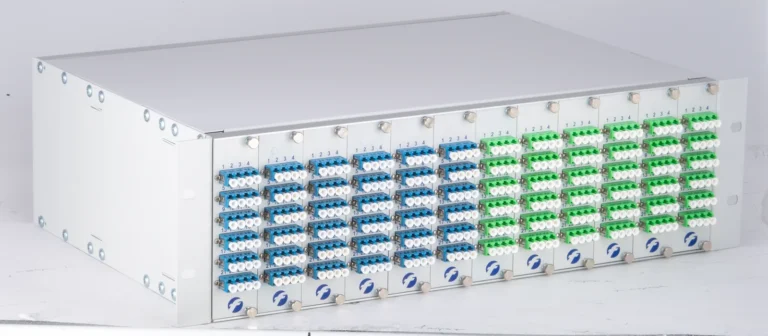
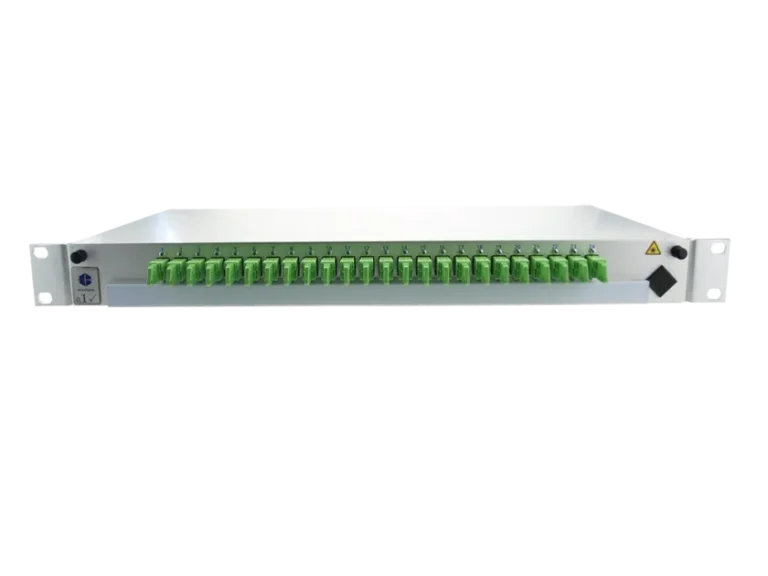
A modular system such as the SlimConnect and VarioConnect products from Fiber Products offers decisive advantages for municipal networks:
- Standardized basic components (1U, 3U and 4U subracks) for all locations
- Flexibly equippable front modules depending on local requirements (LC, SC, E2000, etc.)
- Scalability from small connection boxes (24 fibers) to high-density distributors (288 fibers)
- Identical handling and accessories across all locations, which simplifies training and maintenance
This modular design makes it possible to cover different application scenarios with a standardized system. Technical rooms in town halls can be equipped with the same basic components as industrial facilities or schools – only the equipment varies according to requirements.
Robust design for any environment
The robustness of the components is crucial for the demanding conditions in municipal grids:
- Reinforced sheet steel (1.25 mm) for high mechanical stability
- IP65 protection class for outdoor applications to reliably keep out moisture and dust
- Secure cable routing with defined bending radii for long-term signal stability
- Lockable housing to protect against unauthorized access
The robust design ensures that the components function reliably even under difficult environmental conditions – whether in damp basements, dusty industrial environments or distribution boxes installed outdoors.
Practical example: Municipal grid operator in southern Germany
A municipal network operator in southern Germany provides an illustrative example of the successful implementation of modular fiber optic solutions. When expanding its network, it was faced with the challenge of building a versatile network that would integrate both its own business premises and new FTTH connections.
The solution consisted of a standardized concept based on modular components:
- Central technology rooms were equipped with VarioConnect 3U/4U systems, which offer a high port density and good accessibility at the same time
- Smaller distribution points received SlimConnect 1U systems with up to 96 fibers
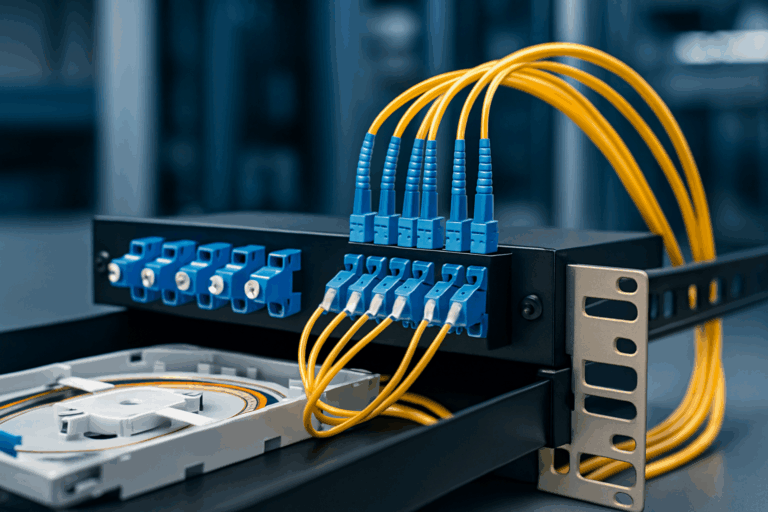
- Outdoor locations were developed with robust IP65 splice boxes
- Industrial systems received top-hat rail boxes that could be perfectly integrated into existing control cabinets
This uniform system not only enabled the network operator to shorten the installation time, but also to minimize the amount of training required for its technicians. Standardizing on a modular system also simplified warehousing and accelerated the response time for expansions.
Fibre optic solutions for municipal utilities – Optimized solutions for regional backbone networks
Many municipal utilities and municipal special-purpose associations are initially building a regional backbone network that connects various towns and important locations. Special features are important for these backbone nodes:
- High fiber density for bundling many connections
- Clear patch panel management with clear labeling
- Redundancy capability for high reliability
- Expandability for future connections
The modular systems from Fiber Products enable a structured setup of such backbone network nodes. Thanks to the clear arrangement of the patch panels and the clear labeling options, network managers can maintain an overview even in complex topologies.
Economic aspects: More than just acquisition costs
For municipal network operators who operate with public funds, economic efficiency is a key aspect. However, this is about far more than just the purchase price:
Total Cost of Ownership (TCO)
The total cost of ownership over the service life of the components is crucial:
- Installation effort: pre-assembled systems significantly reduce installation time
- Maintenance costs: high-quality components minimize downtime and reworking
- Expansion costs: Modular systems allow cost-effective expansions without complete replacement
- Service life: 5-year guarantee (instead of the usual 2 years) indicates long-term reliability
A TCO analysis shows that high-quality components can be significantly more economical over their service life than supposedly cheaper alternatives, despite slightly higher acquisition costs.
Looking at long-term profitability
When considering the total cost of ownership (TCO) for a municipal network, all relevant cost factors should be taken into account:
- Acquisition costs: High-quality components often have a higher purchase price
- Installation costs: Pre-assembled, sophisticated systems can significantly reduce installation costs
- Maintenance costs: Robust design and high-quality materials minimize malfunctions and maintenance work
- Expansion costs: Modular systems allow cost-effective adaptations without complete replacement
Experience shows that high-quality fiber optic systems often prove to be more economical over the life cycle of 10 years or more, despite a higher initial investment. The lower operating and maintenance costs as well as the greater flexibility for expansions compensate for the higher acquisition costs and lead to better overall cost-effectiveness – an important aspect for municipal decision-makers who have to use public funds responsibly.
Future-proof: preparing for the smart city and IoT
Municipal networks must be equipped today for the requirements of tomorrow. Smart city applications and the Internet of Things (IoT) will play an increasingly important role for municipalities in the coming years:
- Traffic control systems and intelligent traffic lights
- Environmental sensor networks for air quality, weather and noise
- Smart grids and charging infrastructure for e-mobility
- Public Wi-Fi hotspots and 5G connections
These applications require a flexible, expandable fiber optic infrastructure that can adapt to new requirements. Modular systems offer decisive advantages here:
- Simple recompression with increasing fiber requirements
- Adaptation to new connector technologies thanks to interchangeable modules
- Orderly migration to higher speeds
- Integration of special solutions such as splitters for PON networks or WDM components
Standardization and conformity to standards
Compliance with relevant norms and standards is particularly important for public clients such as municipal utilities:
- Compatibility with standard 19″ racks according to IEC 60297
- Compliance with fiber optic standards such as IEC 61753 for connection technology
- Fire protection conformity in accordance with EN 13501 for indoor applications
- IP protection classes according to IEC 60529 for outdoor applications
Fiber Products’ products meet all relevant standards for use in municipal networks, making it easier to tender and accept projects.
Conclusion: Tailor-made solutions for municipal requirements
Municipal utilities and municipal network operators face particular challenges in the expansion of fibre optics, which require specialized solutions:
- Versatile, modular systems for heterogeneous network structures
- Robust, weatherproof components for demanding environments
- Easy to install and low-maintenance technology for efficient use of resources
- Durable, high-quality products for sustainable investments
With the right components, municipal utilities can make the most of their unique position in the local market and successfully drive fiber optic expansion in their region – as a reliable infrastructure provider for the digital future of their municipality.
About Fiber Products
Fiber Products is a leading provider of high-quality fiber optic solutions for municipal network operators, public utilities and energy suppliers in the DACH region. With a focus on German engineering, manufacturing in Europe and a 5-year guarantee, we offer robust and future-proof products for municipal networks – from the modular SlimConnect 1U system to weatherproof IP65 solutions and industrial-grade DIN rail boxes.
Arrange a consultation now or visit our online store
Request a Consultation
Our experts will advise you on modular fiber optic solutions for your specific application — fast, personal and non-binding.