Fibre optic fundamentals: learning path for network technicians and planners
Fibre optic fundamentals: learning path for network technicians and planners
Structured acquisition of fibre optic fundamentals, optical fibre basics and a systematic learning path form the foundation for successful network installations in modern FTTH deployments. With exponential growth of fibre infrastructure across Europe – over 42 percent of households already have gigabit-capable connections – the demand for qualified specialists is rising dramatically. This comprehensive guide provides essential knowledge in optical fibre technology, from physical principles and standards compliance to practical installation techniques, and outlines systematic qualification pathways for network technicians and planners across Central Europe.
Why fibre optic fundamentals are essential today
The telecommunications industry is undergoing critical transformation. While network operators deploy over 120,000 new fibre connections monthly, thousands of qualified technicians are needed for installation, maintenance and planning. Fibre deployment is no longer a specialist discipline – it is now central to every modern network infrastructure.
For network technicians, this represents a fundamental shift: traditional copper cabling is increasingly replaced by optical fibre. The complexity of fibre technology requires specific expertise beyond conventional electrical installation. From correct handling of sensitive fibres, through precise splicing techniques to metrological validation – every work step demands solid technical knowledge.
- Physical fundamentals of light transmission and total internal reflection
- Distinction between singlemode and multimode fibres
- Standards knowledge per VDE 0800 and IEC 61754
- Practical skills for splicing, measurement and documentation
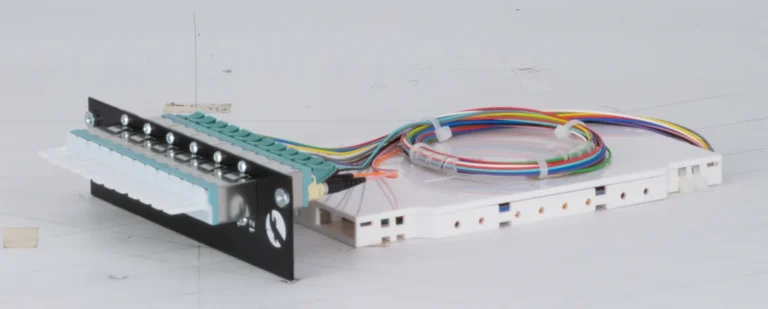
- Understanding modular splice systems and their integration
Physical fundamentals of optical fibre technology
The optical fibre basics course begins with understanding light propagation in optical fibres. Light waves travel through the fibre core via total internal reflection – a phenomenon that occurs when light in a denser optical medium strikes the boundary with a less dense medium. The critical angle determines whether light is reflected or refracted.
| Fibre type | Core diameter | Wavelength | Range | Application |
|---|---|---|---|---|
| Singlemode OS2 | 9 µm | 1310/1550 nm | up to 40 km | FTTH, long-haul |
| Multimode OM3 | 50 µm | 850 nm | up to 300 m | Data centres |
| Multimode OM4 | 50 µm | 850 nm | up to 550 m | High-speed links |
| Multimode OM5 | 50 µm | 850–953 nm | up to 550 m | WDM applications |
Attenuation is the most important quality parameter. Modern singlemode fibres achieve attenuation values of just 0.2 dB/km at 1550 nm. Each connection point, whether connector or splice, adds additional loss. Professional fusion splices achieve values below 0.02 dB, while connectors typically introduce 0.3 dB loss.
Standards-compliant installation per VDE and IEC standards
The VDE guideline 0800-720 has defined mandatory quality criteria for fibre installations since 2019. This standard ensures durable, reliable installations and is recognised by authorities as established best practice. Of particular relevance for the fibre learning path is the new VDE 0800-730 from 2024, which brings significant simplifications for in-building installations.
Since this update, fibre cables can be routed in escape routes without expensive fire protection conduits. This substantially reduces installation costs and accelerates FTTH deployment in existing buildings. The standard distinguishes between different installation methods and defines corresponding requirements for cable construction.
- Minimum bend radius: 15× cable diameter for standard fibres
- Bend-optimised fibres G.657.A2: only 10 mm bend radius
- Tensile load during installation: maximum 1000 N
- Temperature range: −20°C to +60°C for outdoor cables
- Documentation requirement per DIN EN 50173-1
Fiber Products quality commitment: As official Diamond partner and European manufacturer, we produce modular splice systems with Swiss precision engineering. Benefit from 5-year warranty on all systems.
Splicing techniques and connection methods in detail
Fusion splicing is the cornerstone of professional fibre installation. In this process, two fibres are fused together using an electric arc at approximately 2000°C. Modern splicers operate fully automatically with image processing for precise core alignment.
The splicing procedure follows a standardised sequence: first, stripping the coating over 30–40 mm length. After cleaning with isopropanol, the fibre is broken at 90-degree angle using precision tooling. A clean fracture face is critical for minimal loss.
| Connection type | Attenuation | Effort | Cost | Application |
|---|---|---|---|---|
| Fusion splice | < 0.02 dB | High | High | Permanent connections |
| Mechanical splice | 0.2–0.5 dB | Moderate | Moderate | Temporary repairs |
| Connector | 0.3 dB | Low | Low | Patch panels |
After splicing, a heat-shrink sleeve protects the vulnerable connection point. These 40–60 mm protective elements contain a reinforcement rod and ensure mechanical strength. Proper management in modular splice boxes with defined bend radii completes the installation.
Measurement techniques and documentation for fibre networks
Optical time-domain reflectometry (OTDR) is the standard method for characterising fibre links. An OTDR transmits short light pulses into the fibre and analyses backscattered signals. From signal travel time and intensity, attenuation, reflections and fault locations can be determined precisely.
Modern OTDR instruments provide automated test sequences for different wavelengths. For singlemode networks, measurements at 1310 nm and 1550 nm are standard, optionally supplemented by 1625 nm for in-service maintenance measurements. Dynamic range should be at least 35 dB to reliably characterise longer distances.
- Event dead zone: typically < 1 m with modern instruments
- Attenuation dead zone: < 5 m for accurate short-range measurements
- Spatial resolution: 10 cm for short-distance measurements
- Measurement time per fibre: 10–30 seconds for standard tests
- Documentation per IEC 61280-4-2 for acceptance records
Structured learning path: from fundamentals to certification
Systematic development of optical fibre competency ideally follows structured modules building on each other. The VDE guideline 0800-200 defines competency profiles for different qualification levels. From theoretical foundations through practical exercises to certified specialist status, the Central European training market offers diverse options.
Basic courses typically cover 16–24 teaching units and provide foundational knowledge of fibre types, splicing methods and measurement techniques. Advanced modules with 40–80 hours deepen splicing techniques, OTDR measurements and network documentation. The qualification as “Fibre Network Infrastructure Specialist” under VDE requires minimum 120 hours training plus practical experience.
| Qualification level | Duration | Content | Certificate |
|---|---|---|---|
| Fundamentals | 2–3 days | Theory, basic assembly | Attendance certificate |
| Advanced | 5–10 days | Splicing, measurement | Manufacturer certificate |
| Specialist | 15–20 days | Design, fault analysis | VDE/Chamber certificate |
| Expert | 6 months | Network design, project management | Technician qualification |
Practical exercises for successful entry
Hands-on training is essential for acquiring fibre fundamentals. From correct fibre handling – never kink, always transport in protection tubes – through precise coating removal to the first successful splice. Professional training centres offer specialised practice setups with realistic FTTH scenarios.
A typical practice course includes installation of a complete home connection link. From the main distribution through modular splice boxes to the subscriber connection termination, all steps are performed practically. Subsequent OTDR measurement validates installation quality – attenuation exceeding 0.5 dB per connection requires rework.
- Fibre preparation: 50 practice splices for confident technique
- Connector assembly: various types (LC, SC, E2000) termination
- Cassette mounting: correct fibre management with 30 mm minimum radius
- OTDR interpretation: event recognition and assessment
- Fault finding: systematic analysis for excess loss
Specialisations and career paths in fibre technology
After successfully completing the optical fibre basics course, various specialisation directions open. Demand for qualified technicians significantly exceeds supply – experts forecast need for over 50,000 additional specialists by 2030 in Central Europe alone.
Network planners focus on network sizing and documentation. With knowledge of GIS systems and network calculation software, they plan optimal cable routes and splitter configurations. Average salary ranges from €55,000 to €75,000 annually. Test technicians specialise in OTDR analysis, chromatic dispersion measurement and polarisation mode dispersion. Their expertise is particularly sought for high-speed networks above 100 Gbit/s.
fibre optic project management from planning through commissioning. With budgets of several million euros and teams of 20–50 technicians, they carry significant responsibility. The position requires technical expertise plus business and leadership skills.
Future trends and emerging technologies in fibre
Fibre technology continues evolving. Current trends including 400G and 800G Ethernet demand new fibre types and more precise connection techniques. Multicore fibres with up to 19 cores in one cable promise massive capacity increases. Hollow-core fibres reduce latency by 30 percent through air-guided light propagation.
For installers, these developments require continuous learning. New splicers for multicore fibres, advanced measurement methods and adapted installation techniques must be mastered. The fibre learning path becomes a lifelong companion for technicians in this dynamic sector.
- Space-division multiplexing: multiple signals in single fibre
- Photonic integration: optical chips replace discrete components
- AI-assisted network monitoring: predictive maintenance reduces downtime
- Bend-insensitive fibres: installation without bend radius constraints
- Bio-photonics: sustainable materials for eco-friendly cables
Integration into existing network infrastructure
Migration from copper to fibre rarely happens as complete replacement. Hybrid networks with parallel operation of both technologies are standard. The fibre fundamentals course must therefore also cover media converters, SFP modules and wavelength multiplexing.
Data centre transitions happen incrementally. Backbone links already use exclusively fibre with 100G or 400G data rates. Structured cabling uses pre-terminated trunk cables and modular patch fields. Fiber Products supplies specialised high-density solutions with up to 96 fibres on 1RU – double standard systems.
Edge computing and 5G mobile networks drive increasing fibre backhaul demand. Each 5G base station requires minimum 10 Gbit/s backhaul capacity. With rising data rates and lower latency requirements, fibre becomes essential infrastructure for digital transformation.
Frequently asked questions about the fibre learning path
What prior knowledge do I need for an optical fibre basics course?
Basic electrical knowledge is helpful but not mandatory. More important are practical skill, precision and care when handling sensitive components. Most courses start from fundamentals and build physical knowledge progressively.
How long does training to certified fibre specialist take?
Basic qualification under VDE 0800-200 requires minimum 120 teaching units plus practical experience. Full-time, this equals about 3–4 weeks intensive training. Part-time studies extend over 2–3 months.
What measurement instruments are required for professional fibre work?
Essential equipment includes an OTDR, a light source and power meter, a visual fault locator and a microscope for connector inspection. ITU-T G.650.3 recommends the light source and power meter method (IEC 61280-4-2) for link attenuation, the OTDR for splice loss and fault location, and IEC 61300-3-35 for end-face grading. The OTDR dynamic range required follows from the link’s loss budget and is traded off against pulse width and resolution — no standard prescribes a fixed value.
Do fibre fundamentals differ for different applications?
The physical
Order directly from our shop: fiber-products.de