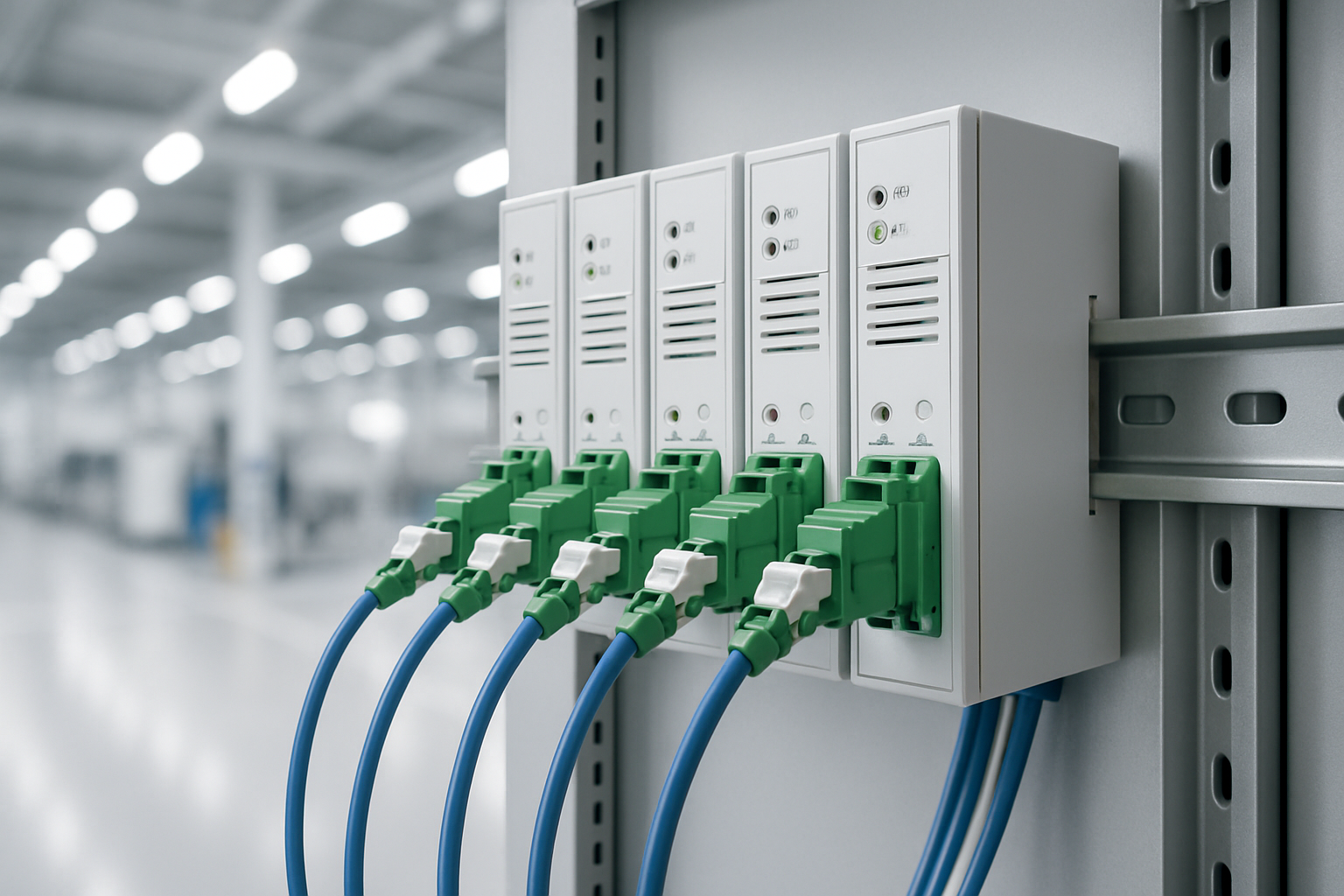
5G campus networks: 5G fiber optic backhaul for Industry 4.0
Private 5G campus networks are revolutionizing industrial communication with ultra-fast, low-latency and highly available wireless connections directly in production environments. The backbone of these networks, however, is a high-performance 5G fiber optic backhaul that connects 5G base stations to central data centers. While 5G provides the wireless “last mile” to machines and sensors, the 5G fiber back haul transports the enormous amounts of data between radio cells and edge computing systems.
Modern production facilities with thousands of networked devices generate terabytes of real-time data that can only be handled by 5G fiber optic backhaul. For public utilities and industrial companies new business models are emerging: as operators or partners of private 5G networks, they can monetize their fibre optic infrastructures and at the same time support industrial customers with digitalization.
The combination of 5G mobile communications and 5G fiber optic backhaul enables applications such as autonomous vehicles, augmented reality or precise robot control that overwhelm traditional Wi-Fi networks. Campus networks can only be successful with a well thought-out 5G fiber optic backhaul architecture that takes into account both today’s 5G requirements and future 6G developments.
5G requirements for fiber optic backhaul
Bandwidth requirements
5G base stations require gigabit capacities: A single 5G cell can theoretically achieve 1-5 Gbit/s throughput, realistically 100-500 Mbit/s per sector are required. With three sectors per base station, 5G fiber backhaul requirements are 300-1500 Mbit/s. These capacities significantly exceed traditional copper backhauls and make fiber optics indispensable.
Ultra-low latency requirements of less than 1 millisecond require short fiber optic distances in the 5G fiber optic backhaul: Industry 4.0 applications such as robot control or autonomous vehicles require end-to-end latencies of less than 1 ms. The light propagation time in fiber optics alone is 5 µs per kilometer, which is why edge computing locations can be a maximum of 10-20 km away from production facilities.
Quality of Service Integration
Network slicing requires Quality of Service (QoSl: 5G enables virtual networks with guaranteed properties for different applications. Critical control traffic, video streams and sensor data can be transmitted in parallel but separately. The 5G fiber optic backhaul must support this differentiation through VLAN, MPLS or SD-WAN.
Massive IoT connections load asymmetrically: production facilities can contain tens of thousands of sensors that send small data packets but rarely receive data. This asymmetry generates high upstream traffic with moderate downstream. 5G fiber optic backhaul systems must be dimensioned accordingly.
Industrial application scenarios
Autonomous systems
Autonomous Guided Vehicles (AGV) use 5G for real-time navigation: Automated guided vehicles in production halls require permanent connectivity for positioning, route planning and collision avoidance. Handover between 5G cells must be seamless, which requires dense cell coverage and fast 5G fiber backhaul.
Augmented reality (AR) for maintenance and training requires high bandwidths: AR glasses transmit high-resolution 3D graphics and video data in real time. Bandwidth requirements can reach 100+ Mbit/s per user. At the same time, low latencies are essential for natural interaction. 5G enables mobile AR applications, the backhaul must provide the corresponding capacities.
Production integration
Machine vision and quality control generate massive data streams for 5G fiber optic backhaul: industrial cameras with 4K/8K resolution and high-speed recordings generate gigabytes per minute. This data needs to be transferred to edge computing systems for processing. 5G enables wireless camera connectivity, 5G fiber backhaul transports the data volumes to AI analysis systems.
Robot control over 5G requires deterministic communication in the 5G fiber optic backhaul: Industrial robots require precise timing signals for coordinated movements. Time-Sensitive Networking (TSN) over 5G is enabled with guaranteed latency and jitter.
Network architecture and topology design
RAN architectures
Distributed Radio Access Network (D-RAN) places all 5G functions in base stations and minimizes requirements: This architecture reduces backhaul traffic as signal processing takes place locally. Fiber optic backhaul only transports user data between base stations and core network. D-RAN is suitable for smaller campus networks with a limited number of cells.
Centralized RAN (C-RAN) centralizes signal processing in data centers and increases 5G fiber backhaul requirements: Base stations become “remote radio heads” without local intelligence. The fiber backhaul must transport Common Public Radio Interface (CPRI) or evolved CPRI (eCPRI) signals with high bandwidths.
Edge Computing Integration
Multi-access edge computing (MEC) servers are coupled directly with 5G base stations and optimized: These systems process sensor data locally and reduce backhaul traffic. 5G fiber optic backhaul connects edge locations with central data centers for higher-level functions.
Network slicing implementation segments physical infrastructure: Different applications receive isolated network slices with guaranteed resources. The 5G fiber backhaul must support this segmentation through VLAN, VPN or SD-WAN.
Fiber optic technologies for 5G backhaul
Fronthaul and midhaul
Fronthaul fiber between antennas and base stations mostly uses single-mode fibers for 5G fiber backhaul: CPRI/eCPRI signals require high bandwidths (1-25 Gbit/s per antenna) with low latencies. Standard OS2 fiber easily achieves the required distances of 10-40 km. Bidirectional transmission via one fiber reduces cabling costs.
Midhaul connections between distributed units and centralized units require flexible bandwidths in the 5G fibre optic backhaul: depending on the function split, requirements vary between 100 Mbit/s and 25 Gbit/s. Ethernet-based transmission with dynamic bandwidth allocation offers the necessary flexibility.
High-capacity backhaul technologies
Backhaul to the core network typically uses 10-100 Gbit/s Ethernet: Aggregated traffic from all base stations is transported via high-capacity fiber optic connections. DWDM systems can transmit hundreds of gigabits over one fiber. These connections are similar to traditional data center networks.
Passive Optical Networks (PON) can reduce 5G fiber backhaul costs: 10G-PON or XGS-PON enable point-to-multipoint connection of multiple base stations. This topology reduces fiber consumption with slightly higher latencies.
Latency optimization and edge computing
Physical optimization
Fiber optic latency budget takes physical and processing times into account: Light propagation time is 5 µs/km, transceivers and switches add 1-10 µs per hop. With a total latency budget of 1 ms, only a few hundred microseconds remain for signal processing. Every millisecond gain enables more complex edge applications.
Edge data center placement optimizes latency-to-distance ratio: Locations within 10-20 km of production facilities enable sub-millisecond latencies. Existing substations or telecommunication sites often provide suitable infrastructure.
Deterministic networks
Deterministic Networking ensures predictable latencies: Time-Sensitive Networking (TSN) standards define timing requirements for industrial applications. 5G fiber backhaul switches must support TSN and use hardware-based forwarding.
Synchronization and timing distribution: Precise time synchronization is essential for coordinated 5G operations. Precision Time Protocol (PTP) via 5G fiber optic backhaul enables nanosecond-precise synchronization.
Planning guidelines for campus fiber optic networks
Capacity and redundancy planning
Capacity planning takes into account 5G evolution paths for 5G fiber optic backhaul: Current 5G implementations only use partial functions of the standard. Full 5G-Advanced and 6G will have significantly higher requirements. Infrastructure should provide 10x overprovisioning for future developments.
Redundancy design eliminates single points of failure: ring topologies with automatic protection switching ensure sub-50ms failover times. Physically separated paths avoid common causes of failure.
Integration and scaling
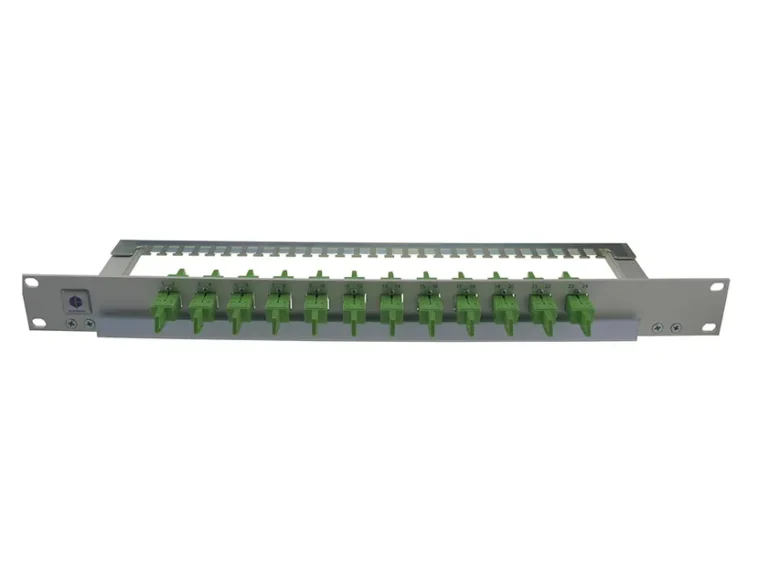
Scaling strategies enable organic growth of 5G fiber optic backhaul: Modular fiber optic systems such as VarioConnect support gradual expansion without new cabling. Oversized conduit systems accommodate additional cables.
Integration into existing IT infrastructures: 5G campus networks must interact with enterprise networks, ERP systems and cloud services. 5G fiber backhaul design takes these connectivity requirements into account right from the start.
Security requirements and compliance
Network Security
Network security for production-critical systems: 5G campus networks transport sensitive production data and control signals. End-to-end encryption and network slicing isolate critical from non-critical data streams in the 5G fiber optic backhaul.
Compliance with industrial security standards: IEC 62443 defines cybersecurity requirements for industrial automation systems. 5G campus networks must meet these standards. Infrastructure must support appropriate segmentation and monitoring.
Physical Security
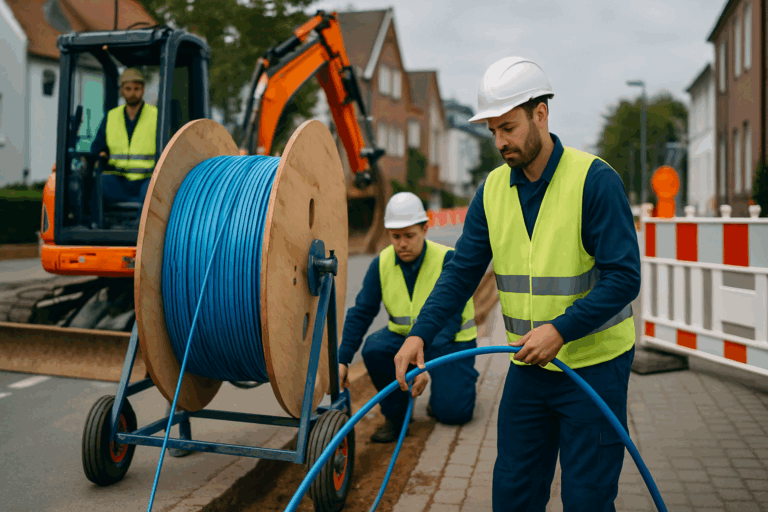
Physical security of the infrastructure: Outdoor fiber optic cables are susceptible to sabotage or accidental damage. Redundant cabling and monitoring systems detect interruptions quickly.
Zero Trust Network Architecture: Traditional perimeter security is inadequate for 5G campus networks. Every network access is authenticated and authorized. Backhaul infrastructure must support corresponding policy enforcement points.
Business models for municipal utilities
Service-oriented models
Infrastructure-as-a-Service (IaaS) for 5G fiber optic backhaul: Public utilities provide backhaul and data center infrastructure while customers operate 5G equipment. This model minimizes technology risks and enables a focus on core infrastructure competencies.
Network-as-a-Service (NaaS) offers complete outsourcing: municipal utilities operate complete 5G campus networks and charge usage-based fees. These models require 5G expertise, but offer higher margins through full 5G fiber backhaul services.
Wholesale and partnership models
Wholesale services for mobile network operators use 5G fiber optic backhaul: Public 5G networks also require backhaul capacity in commercial areas. Public utilities can lease their 5G fiber optic backhaul networks to Vodafone, Telekom or O2.
Edge computing services and data analytics via 5G fiber optic backhaul: data center capacities at the edge can provide additional cloud services for local companies. AI analysis of production data, backup services and disaster recovery create new business areas.
Technical integration and interoperability
Open standards and multi-vendor
Open RAN architectures enable multi-vendor scenarios: Standardized interfaces between 5G components from different manufacturers reduce vendor lock-in. 5G fiber backhaul infrastructures must support this flexibility through standards-compliant interfaces.
Integration with existing enterprise systems: 5G campus networks must interact with ERP, MES and SCADA systems. Application programming interfaces (APIs) and standard protocols enable this integration.
Cloud and hybrid architectures
Cloud integration for hybrid architectures via 5G fiber optic backhaul: Edge computing is supplemented by public cloud services. Connection to AWS, Azure or Google Cloud enables seamless workload migration.
IoT platform integration for device management: Industrial IoT platforms manage thousands of 5G-connected devices. Over-the-air updates, configuration and monitoring require bidirectional communication in the 5G fiber backhaul.
Future prospects and 6G preparation
6G evolutionary paths
6G requirements significantly exceed 5G and place new demands on 5G backhaul: Terabit data rates, sub-millisecond latencies and massive device networking require expanded fiber optic capacities. Coherent optics and photonic integration enable corresponding backhaul capacities.
Holographic communication and extended reality require multi-gigabit 5G fiber backhaul: Immersive applications require data rates in the multi-gigabit range per user. Backhaul capacities must scale accordingly for industrial training and remote maintenance.
Sustainability and AI integration
Sustainable Communications and Green Networking for Backhaul: Energy efficiency is becoming a critical factor for 6G systems. Fiber optic backhaul is inherently energy efficient and supports sustainable network architectures.
AI-native networks with self-optimizing backhaul properties: Artificial intelligence will automate and optimize network management. Infrastructures must support corresponding data collection and processing.
Conclusion and implementation recommendations
5G campus networks cannot be realized without powerful backhaul – the wireless revolution is built on optical foundations Public utilities have the unique opportunity to monetize their fiber expertise and at the same time support industrial customers with digitalization.
Successful 5G campus deployments require well-designed 5G fiber backhaul architectures with sufficient spare capacity for future developments. The investment in high quality, modular fiber optic systems creates the basis for flexible 5G services and later 6G migration.
Critical success factors:
- Redundancy and high availability (99.9%+ uptime)
- Latency optimization through edge integration
- Scalable capacity planning with 10x overprovisioning
- Standard-compliant interfaces for multi-vendor scenarios
- Comprehensive safety concepts for industrial applications
The future of industrial communication will be shaped by the convergence of 5G mobile communications and 5G fiber optic backhaul. Municipal utilities that intelligently combine these technologies are positioning themselves as indispensable partners for industrial digitalization and creating sustainable business models.
Contact us to jointly develop the optimal backhaul strategy for campus networks and benefit from our expertise in modular fiber optic systems to benefit.
Related topics:
- Fiber optic solutions for industry
- VarioConnect 3U systems
- Fiber optic solutions for municipal utilities
- Data center networking
- Store
Request a Consultation
Our experts will advise you on modular fiber optic solutions for your specific application — fast, personal and non-binding.