Fibre Optic Certifications: CE, RoHS and International Standards Explained
Fibre Optic CE Certification, RoHS Compliance, ISO IEC 11801: The Complete Guide for Compliant Fibre Installations
Fibre optic CE certification, RoHS compliance, and ISO IEC 11801 form the regulatory foundation for every professional fibre installation in Europe. These three certification standards ensure not only legal compliance of your fibre components, but also define technical minimum requirements for attenuation values, material quality, and system compatibility in modern FTTH networks.
With the new Gigabit Infrastructure Regulation effective from November 2025 and Germany’s TKG Amendment Act 2026, requirements for certified fibre products are increasing significantly. Network operators and installers must now provide comprehensive evidence that all installed components comply with European standards.
CE Marking for Fibre Optic Components: Legal Foundations and Practical Implementation
CE marking confirms conformity with all relevant EU directives and is mandatory for placing fibre optic products on the European single market. For passive fibre optic components such as splice modules, distribution cabinets and patch panels, the Construction Products Regulation (EU) 305/2011 applies primarily.
The manufacturer must prepare a declaration of conformity and comply with the following standards:
- EN 50173-1 structured cabling: Structured cabling – General requirements
- EN 61754 series: Connectors for optical fibres
- IEC 61300 series: Basic test and measurement procedures
- Attenuation values below 0.25 dB for optical connectors
- Return loss above 45 dB for PC connectors, above 60 dB for APC
CE compliance applies not only to the final product, but to the entire production chain. As an official Diamond Partner and European manufacturer, our SlimConnect and VarioConnect systems meet all CE requirements during the production process.
RoHS Directive for Fibre Optic Products: Substance Restrictions and Documentation Requirements
RoHS compliance under Directive 2011/65/EU restricts ten hazardous substances in electrical and electronic equipment. Although pure fibre optic cables are primarily composed of silicon dioxide, connectors, housings and coatings are subject to strict threshold values.
| Substance | Maximum Threshold | Affected Components |
|---|---|---|
| Lead (Pb) | 0.1% | Solder, metal contacts |
| Cadmium (Cd) | 0.01% | Coatings, pigments |
| Mercury (Hg) | 0.1% | Electronic components |
| Chromium VI (Cr6+) | 0.1% | Corrosion protection |
| DEHP, DBP, BBP, DIBP | each 0.1% | Plastic housings, cable sheaths |
In addition to RoHS compliance, manufacturers must observe the REACH Regulation (EC) 1907/2006. The continuously updated SVHC list of the European Chemicals Agency requires regular material testing and, if necessary, substitution measures.
ISO IEC 11801: The International Standard for Structured Fibre Optic Cabling
ISO IEC 11801 technical parameters for structured cabling systems and is the foundation for measurable quality in fibre optic installations. The standard specifies hierarchical network structures with three cabling levels and establishes precise limits for optical parameters.
- Primary cabling: Campus backbone up to 3,000 metres in length
- Secondary cabling: Building backbone up to 500 metres
- Tertiary cabling: Horizontal cabling maximum 90 metres
- Total attenuation budget: 2.0 dB for OM5, 1.5 dB for OS2
Fiber Products Quality Commitment: As an official Diamond Partner and manufacturer, we produce modular splice systems in Europe. Benefit from Swiss precision and 5-year warranty on our systems.
Fibre Categories According to ISO IEC 11801: OM and OS Classification in Detail
Fibre optic CE certification, RoHS compliance, and ISO IEC 11801 standards distinguish between multimode (OM) and singlemode (OS) fibre categories with specific performance parameters. Modern FTTH networks primarily use OS2 fibres for maximum range and bandwidth.
| Fibre Category | Core Diameter | Attenuation at 1310nm | Typical Application |
|---|---|---|---|
| OM3 | 50 µm | 3.0 dB/km | Data centres up to 300m |
| OM4 | 50 µm | 2.5 dB/km | Data centres up to 550m |
| OM5 | 50 µm | 2.3 dB/km | WDM applications |
| OS1 | 9 µm | 1.0 dB/km | Building cabling |
| OS2 | 9 µm | 0.4 dB/km | FTTH, long distance |
The choice of fibre category directly influences the required certification measurements. A Tier-1 test according to ISO/IEC 14763-3 measures insertion loss, while Tier-2 tests using OTDR additionally locate reflection events.
New Requirements from the Gigabit Infrastructure Regulation from 2025
From 12 November 2025, the first provisions of the European Gigabit Infrastructure Regulation take effect. For fibre optic installations, this means stricter documentation requirements and expanded technical minimum standards. From February 2026, all new buildings must be equipped with fibre-ready infrastructure.
The practical consequences for installers and network operators:
- Mandatory installation of at least four fibres from the network termination point
- Continuous connection of at least one fibre to the residential level
- Complete documentation of all components in the new Gigabit Registry
- Proof of CE and RoHS compliance for all installed products
- Compliance with DIN 18220 for modern construction methods
Test Procedures and Measurement Methods According to International Standards
Fibre optic CE certification, RoHS compliance, and ISO IEC 11801 require standardised test procedures for quality assurance. Every professional installation must be validated through standards-compliant measurements.
Required measurements for acceptance documentation include optical attenuation per IEC 61280-4-1, return loss per IEC 61300-3-6, and polarisation mode dispersion per IEC 61280-4-4. Our European-manufactured SlimConnect modules achieve attenuation values below 0.15 dB per connection.
Connector Types and Their Standards-Specific Requirements
Different connector types are subject to specific standard requirements according to ISO IEC 11801. The choice of the correct connector affects both the optical performance and the certification requirements of the overall installation.
- LC Connector (IEC 61754-20): Standard in data centres, attenuation < 0.20 dB
- SC Connector (IEC 61754-4): Telecommunications, attenuation < 0.25 dB
- E2000 Connector (IEC 61754-15): Industry standard, attenuation < 0.15 dB
- MPO/MTP (IEC 61754-7): High-density applications, 12/24 fibres
As the only complete provider in the European market, we supply all connector types from a single source – from LC simplex to MPO-24 in consistent Diamond quality.
Documentation Obligations and Conformity Evidence for Network Operators
Fibre optic CE certification, RoHS compliance, and ISO IEC 11801 conformity must be thoroughly documented. Network operators bear the proof obligation to regulatory authorities and must maintain the following documents:
- CE declarations of conformity for all installed components
- RoHS compliance certificates from manufacturers
- Test reports according to ISO/IEC 14763-3
- Installation plans with fibre types and attenuation budgets
- Maintenance documentation and splice records
Frequently Asked Questions on Fibre Optic Certifications
Does CE marking also apply to passive fibre optic components?
Yes, passive components such as splice boxes, distribution cabinets and patch panels are subject to the Construction Products Regulation and require CE marking. Conformity applies to mechanical safety and fire protection requirements.
What measurement equipment is required for ISO IEC 11801 compliant tests?
For Tier-1 tests, an OLTS (Optical Light Source and Power Meter) with accuracy of ±0.2 dB is sufficient. Tier-2 tests additionally require an OTDR with resolution < 1 metre for event localisation.
Must pre-connectorised patch cables also be RoHS compliant?
Yes, all components including patch cables must be RoHS compliant. This particularly affects the connectors, cable sheaths and adhesives used with threshold values below 0.1% for restricted substances.
Which fibre category does ISO IEC 11801 recommend for FTTH installations?
For FTTH networks, the standard recommends OS2 singlemode fibres with 0.4 dB/km attenuation. These enable transmission distances up to 40 kilometres without intermediate amplification.
How often must certification measurements be repeated?
After initial installation, measurements are required whenever the topology changes. Preventive control measurements are recommended every 24 months or after mechanical stress.
Are German special standards to be observed in addition to ISO IEC 11801?
Yes, DIN 18220 for modern construction methods and the technical rules of the German Federal Network Agency pursuant to §126 TKG supplement international standards with national requirements.
Your Partner for Certified Fibre Optic Solutions
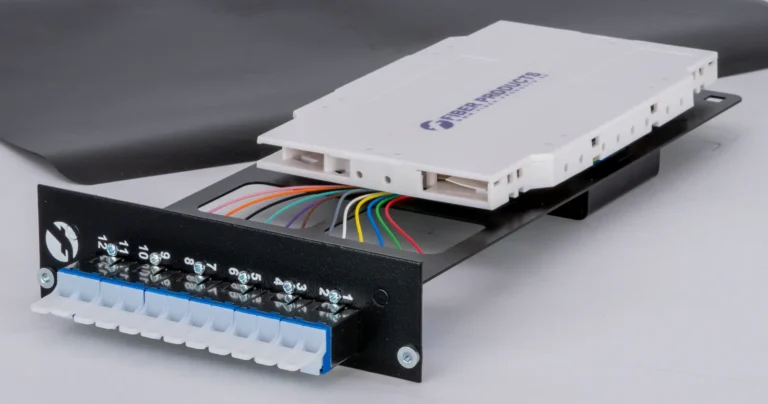
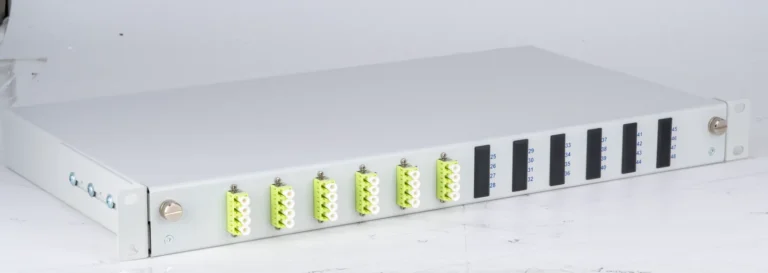
Compliance with fibre optic CE certification, RoHS standards, and ISO IEC 11801 requires well-designed system solutions from planning to documentation. With our modular SlimConnect and VarioConnect systems, we offer up to 96 fibres in just 1HE – the highest packing density on the market with full standards compliance.
As a manufacturer with our own production in Europe, we guarantee not only compliance with all relevant certifications, but as the only provider offer 5-year warranty on the complete system portfolio. From the DIN rail enclosure for industrial applications to the high-density data centre distributor – all products meet current and future standards requirements for professional fibre optic installations.
Order directly from our shop: fiber-products.de
Request a Quote
Free consultation – personalised quote within 24 hours