Fibre rollout Mannheim 2026: MVV and FTTH infrastructure
Fibre rollout Mannheim, MVV Energie, FTTH Mannheim: technical requirements for comprehensive deployment through 2026
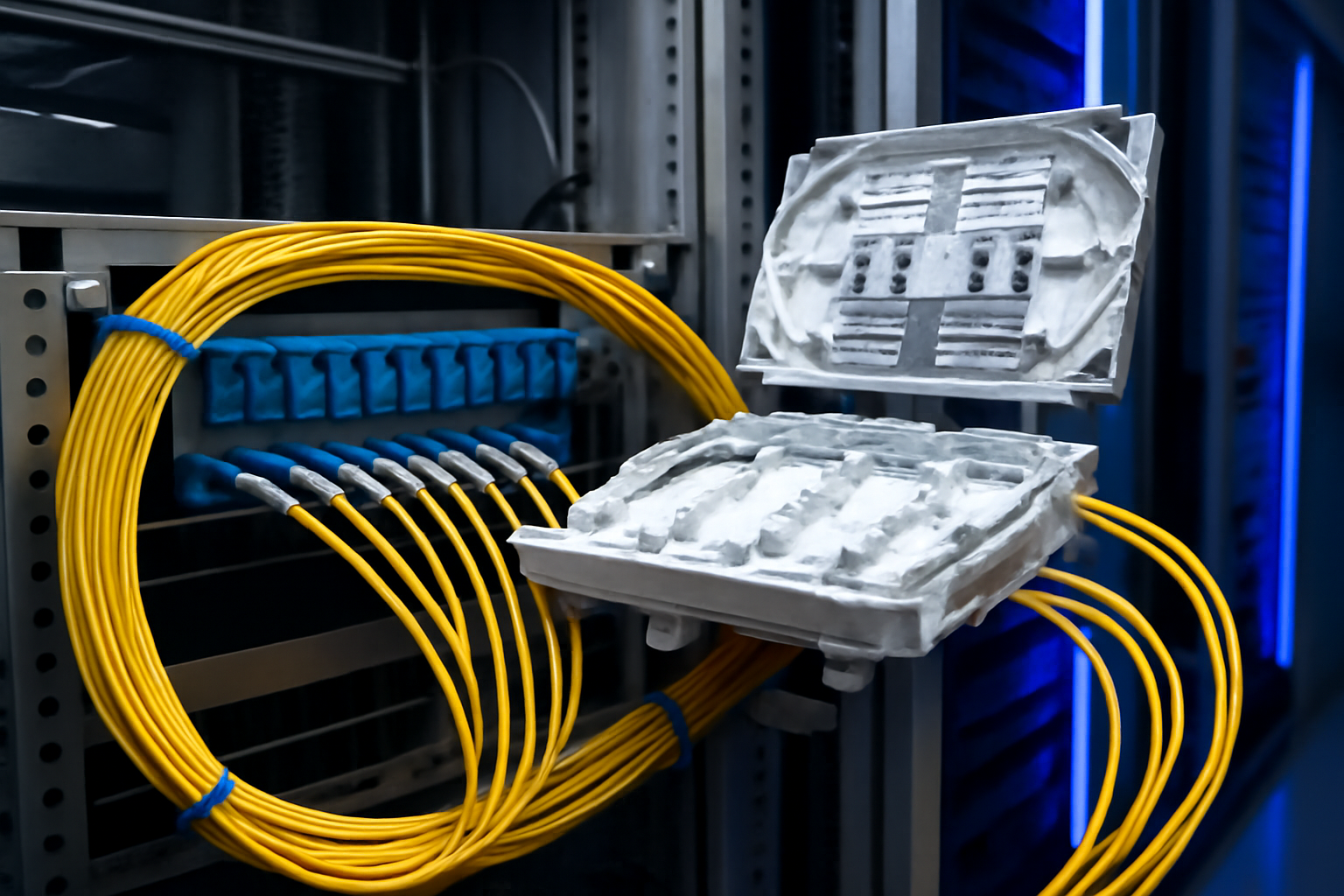
The other major German FTTH rollouts reaches a decisive phase in 2026: with the initiative to connect over 55,500 households without pre-marketing requirements and the strategic engagement of MVV Energie as infrastructure partner, a model project emerges for the Rhine-Neckar metropolitan region. Technical implementation requires precisely planned splice infrastructure with up to 288 fibres per distribution point and standards-compliant installation systems per VDE 0800-730.
For municipal utilities and energy suppliers, this presents concrete challenges: integration of fibre optic infrastructure into existing utility corridors, selection of appropriate splice systems for different network tiers, and ensuring IEC 61754 compliant connectors. As an official Diamond Partner and manufacturer of modular fibre optic solutions, Fiber Products supports these projects with proven system solutions from European production.
Technical dimensions of FTTH deployment in Mannheim
The planned FTTH infrastructure for Mannheim is based on a multi-tier network architecture with central distribution points, district distributors and in-building splice boxes. With 55,500 households and an average of 1.5 fibres per dwelling unit, total requirement reaches approximately 83,000 active fibres at full deployment.
- Main distribution point (PoP): 288 to 576 fibres per site
- District distributor: 96 to 144 fibres in weather-resistant enclosures
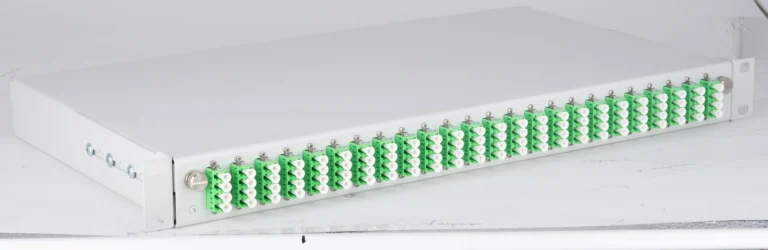
- Building distributor: 12 to 48 fibres in compact 1HE splice boxes
- Redundancy planning: 20% spare fibres for fault tolerance
- Attenuation budget: maximum 0.25 dB per splice connection
The network architecture follows either point-to-point (P2P) or point-to-multipoint (PON) principle with split ratios of 1:32 or 1:64. For Mannheim’s topography, featuring dense inner-city development and more dispersed outlying districts, flexible splice systems are required that offer both high packing density and simple expandability.
MVV Energie: synergies between district heating and fibre optics
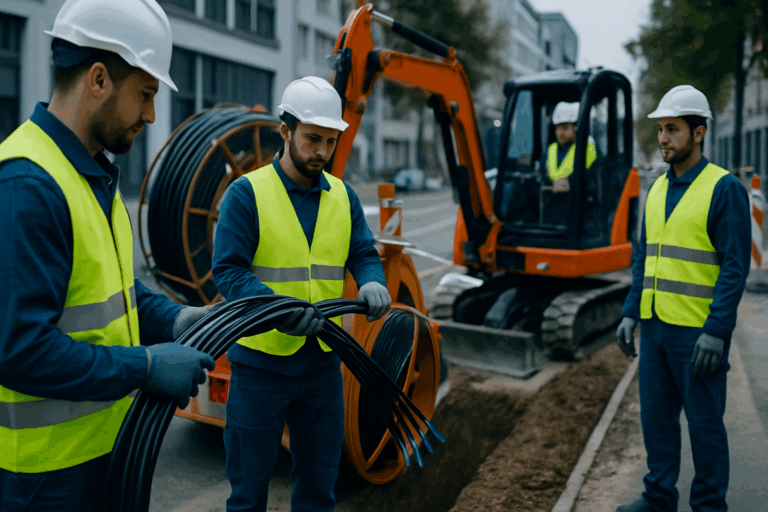
MVV Energie operates a 600-kilometre district heating network extending from Mannheim through Heidelberg to Speyer, Brühl and Schwetzingen. These existing corridors offer significant cost savings for fibre rollout Mannheim, MVV Energie, FTTH Mannheim through shared use of civil works infrastructure.
| Corridor type | Length (km) | Fibre optic capacity | Cost savings |
|---|---|---|---|
| Main corridors | 120 | 288 fibres | Reduced costs |
| Distribution corridors | 280 | 96 fibres | up to 35% |
| Building connections | 200 | 12-48 fibres | up to 25% |
The technical challenge lies in thermal decoupling: district heating pipes reach temperatures up to 130°C, while fibre optic cables are specified only to 70°C. Specialised protection tube systems with minimum 10 cm spacing and temperature-resistant cable types per IEC 60794 are mandatory.
Splice infrastructure for different network tiers
The fibre rollout Mannheim, MVV Energie, FTTH Mannheim requires a tiered splice architecture for optimal network performance. Each network tier presents specific requirements for packing density, accessibility and environmental resilience of splice systems.
Backbone tier: high-capacity splice modules
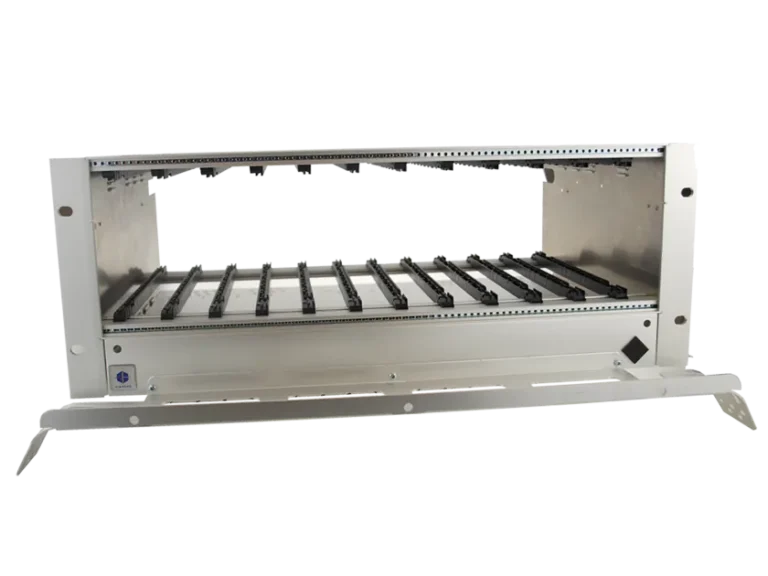
In central equipment rooms, 19-inch splice modules with capacity up to 288 fibres in 3HE are deployed. These systems must deliver maximum packing density while maintaining excellent accessibility for maintenance work.
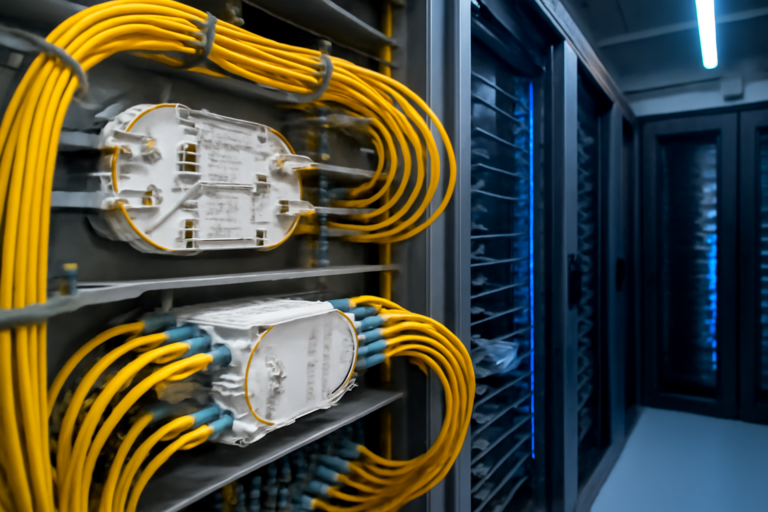
- Modular splice cassettes for 12 or 24 fibres
- Colour coding per DIN VDE 0888
- Integrated cable strain relief up to 1000 N
- Front access for rapid fault diagnosis
- Documentation system per EN 50174
Distribution tier: compact outdoor distributors
For district distributors in Mannheim residential areas, weather-resistant enclosures rated IP65 with integrated splice management are required. Systems must withstand temperature swings from -25°C to +60°C.
Fiber Products quality promise: As official Diamond Partner and manufacturer, we produce modular splice systems in Europe. Benefit from Swiss precision and in-house manufacturing.
In-building installation under new VDE standard
The revised VDE 0800-730 has significantly simplified fibre optic installation since February 2025. For fibre rollout Mannheim, MVV Energie, FTTH Mannheim, this means concrete cost savings in building connection work.
| Installation type | Previous requirement | New VDE 0800-730 | Cost savings |
|---|---|---|---|
| Escape routes | Fire-rated F90 duct | Metal duct sufficient | up to 60% |
| Vertical shafts | Separate routing | Bundling permitted | Reduced costs |
| Flat connection | Surface-mounted duct | Adhesive mounting allowed | up to 50% |
Particularly for Mannheim historic buildings with tight installation shafts, microcables with 5 mm diameter and pre-terminated connectors enable rapid, clean installation without labour-intensive on-site splicing.
Connector systems and attenuation budgets in FTTH networks
Selection of the correct connectors is critical for network quality. In fibre rollout Mannheim, MVV Energie, FTTH Mannheim, various connector types are deployed depending on network tier and specific requirements.
Connector system comparison
- LC duplex: standard for end-user connections, < 0.25 dB attenuation
- SC/APC: provider standard, < 0.20 dB, 8° angled polish
- E2000/APC: highest precision, < 0.15 dB, integrated shutter
- MPO/MTP: multi-fibre, 12/24 fibres, for data centres
For industrial environments in Mannheim commercial zones, E2000 connectors are recommended, featuring integrated protective shutter and return loss > 65 dB. These systems guarantee consistent transmission quality even under challenging conditions.
Quality assurance and acceptance testing
Every fibre optic installation within fibre rollout Mannheim, MVV Energie, FTTH Mannheim requires comprehensive acceptance testing per IEC 61280. Documentation of these measurements is prerequisite for warranty claims and network quality.
Required testing comprises OTDR analysis (optical time domain reflectometry) at 1310 nm and 1550 nm wavelengths, attenuation measurement of complete routes and return loss at all connectors. Limits are maximum 0.35 dB/km fibre attenuation and 0.5 dB per connector.
- OTDR measurement: bidirectional at 1310/1550 nm
- Total attenuation: maximum 20 dB for PON networks
- Chromatic dispersion: < 17 ps/nm/km
- Polarisation mode dispersion: < 0.5 ps/√km
Splice box sizing for different building types
Correct sizing of splice boxes is critical for cost-effectiveness and future-proofing. Mannheim exhibits various building structures, each requiring specific solutions.
Apartment buildings (5-20 units)
For typical Mannheim multi-family buildings, 1HE splice boxes with 24 to 48 fibres are suitable. The SlimConnect series offers here 96 fibres in 1HE — double the packing density of standard solutions — providing reserves for future expansion.
Commercial properties and office complexes
Commercial users often require redundant connections and higher fibre capacity. 3HE systems with up to 288 fibres are deployed here. The modular design enables incremental expansion without service interruption.
Integration into existing utility infrastructure
The fibre rollout Mannheim, MVV Energie, FTTH Mannheim benefits from integration into existing utility structures. Beyond district heating corridors, electricity cable channels and gas supply lines offer synergy potential.
When co-routing with electricity corridors, electromagnetic compatibility and adequate separation distances must be observed. Fibre optic cables require minimum 5 cm spacing from low-voltage cables and 20 cm from medium-voltage cables.
| Corridor type | Minimum spacing | Protection measure | Standard |
|---|---|---|---|
| Low voltage | 5 cm | Partition | VDE 0855 |
| Medium voltage | 20 cm | Separate duct | VDE 0855 |
| District heating | 10 cm | Thermal protection | AGFW FW 401 |
Timeline and deployment phases through 2026
Implementation of fibre rollout Mannheim, MVV Energie, FTTH Mannheim proceeds in coordinated phases. The first deployment phase focuses on commercial zones and densely populated residential districts with high connection density.
By end of 2025, 20,000 households should be ready for connection, primarily in the districts of Neckarau, Feudenheim and Käfertal. The second phase through mid-2026 covers a further 35,500 households in remaining city areas. Active network technology build-out in technical sites proceeds in parallel.
- Q4/2025: 20,000 households ready for connection
- Q2/2026: 40,000 households reached
- Q4/2026: 55,500 households fully deployed
- Activation rate: targeted 40% in first year
Maintenance and operation of fibre optic infrastructure
Following deployment completion, the permanent operations phase begins. For municipal utilities, this means establishing maintenance routines and fault management for fibre networks.
Preventive maintenance includes annual attenuation measurements of critical routes, visual inspection of outdoor distributors and connector cleaning in equipment rooms. With an average failure rate of < 0.1% annually under professional maintenance, fibre networks deliver maximum availability.
Subsidies and economics of FTTH deployment
Although Mannheim’s deployment is economically self-sustaining, neighbouring municipalities benefit from subsidy programmes. The federal support scheme funds underserved areas with up to 50 million euros per project. The economic gap is closed 50-70% by federal and state funds.
For municipal utilities, this creates an attractive business model: at average deployment costs of €500-800 per household and monthly wholesale revenues of €15-25, investments amortise within 8-12 years.
FAQ: technical questions on Mannheim fibre rollout
What splice box capacity do municipal utilities need for typical residential areas?
For residential areas with multi-family buildings, 1HE splice boxes with 48-96 fibres are recommended. These provide sufficient capacity for 20-40 dwelling units plus 20% reserve. The modular SlimConnect series enables future expansion without complete replacement.
How are commercial customers with elevated bandwidth requirements connected?
Commercial customers receive dedicated fibres with redundant routing. Standard is 2×2 fibres across separate corridors. Termination uses E2000/APC connectors for maximum transmission quality with < 0.15 dB attenuation.
What environmental requirements must outdoor distributors meet?
Outdoor distributors require IP65 protection rating, temperature resilience from -25°C to +60°C and UV stability per ISO 4892. Enclosures must be vandalism-resistant and equipped with pressure relief valves.
How are existing copper lines protected during migration?
Copper-to-fibre migration occurs in parallel. Legacy customers remain on copper until fibre connection activation. Parallel routing requires minimum 5 cm spacing to prevent induction interference.
What test equipment is required for acceptance?
Acceptance requires an OTDR with 1310/1550 nm, a power meter and a video microscope unit. Measurement dynamic range should be minimum 35 dB for routes up to 20 km.
How is fibre optic infrastructure documented?
Documentation follows EN 50174 with unique fibre numbering, GPS coordinates of distributors and digital route documentation. Each fibre receives a unique ID in format MHM-[distributor]-[cable]-[fibre].
Outlook: Mannheim as fibre model city
The fibre rollout Mannheim, MVV Energie, FTTH Mannheim positions the city as a digital pioneer.
Order directly from the shop: fiber-products.de
Request a quote
Free consultation – personal quote in 24 hours