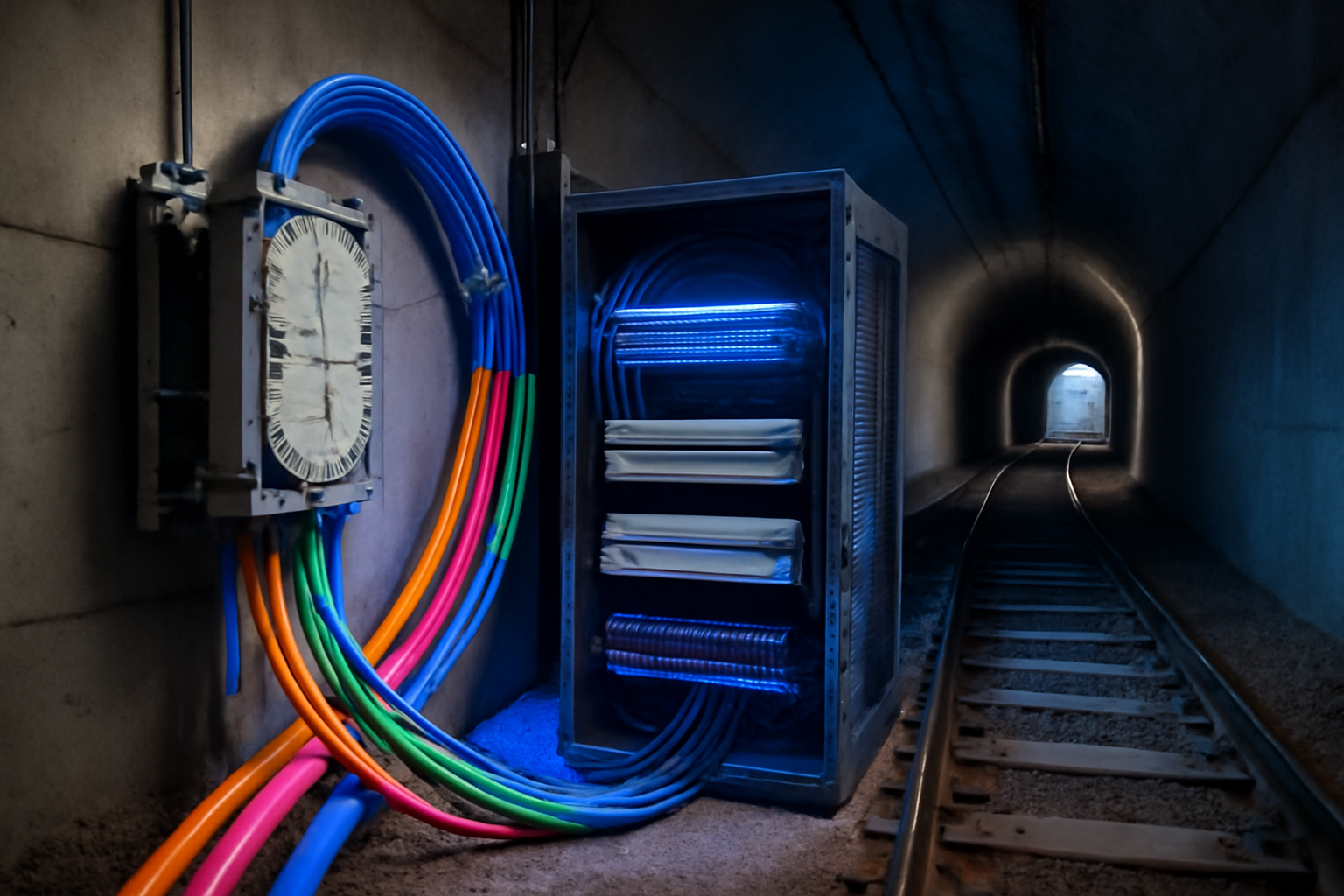
Fibre Optic Tunnel Installation – Network Technology for Road and Rail Tunnels
Fibre Optic Tunnel Installation – Network Technology for Road and Rail Tunnels
Fibre optic tunnels, tunnel fibre installations and tunnel network security demand specialised vibration-resistant fibre optic solutions with IP65 protection rating and EMC resilience that operate reliably even at extreme temperature variations from -40°C to +85°C. The unique challenges in road and rail tunnels – from constant vibrations through electromagnetic interference fields to high humidity – make robust modular splice systems with E2000 connector safety standards the first choice for critical infrastructure.
With the substantial expansion of tunnel infrastructure across Europe, demands for secure data transmission continue to rise. German Rail operates over railway fibre optic infrastructure along its rail routes and plans to add a further 8,200 kilometres by 2027 for digital signalling systems and diagnostic equipment.
Technical Requirements for Fibre Optics in Tunnel Environments
Tunnel infrastructure presents extreme challenges to network technology. Constant vibrations from rail traffic reach frequencies of 10 Hz to 1 kHz with accelerations up to 5g. Additionally, fibre optic systems must withstand electromagnetic interference from overhead lines at 15 kV/16.7 Hz as well as temperature fluctuations between tunnel entrance and centre of up to 30 Kelvin.
- Vibration resistance: Mechanical loads per IEC 61373 for rail applications
- EMC protection: Galvanic isolation via fibre optics eliminates interference
- Temperature stability: Operating temperature -40°C to +85°C per EN 50155
- Protection rating: Minimum IP65 against dust and water spray
- Fire safety: Halogen-free cables per EN 45545-2 for rail vehicles
Fibre Optic Tunnels: Advantages over Copper Cabling
Weight reduction of 40 per cent compared to copper cables not only simplifies installation in confined cable ducts. Fibre optics also offers scalability from 1 Gbit/s to 100 Gbit/s without replacing the cabling – a decisive advantage over operational lifespans exceeding 15 years in tunnel infrastructure.
| Property | Fibre Optic | Copper Cable |
|---|---|---|
| Weight per 100m | 2.8 kg | 7.2 kg |
| Maximum range | 40 km (singlemode) | 100 m (Cat.6A) |
| Bandwidth | 100 Gbit/s scalable | 10 Gbit/s |
| EMC interference | Immune | Susceptible |
| Maintenance interval | 10 years | 5 years |
E2000 Connectors for Tunnel Fibre Installations
The E2000 connector per IEC 61754-15 has established itself as the standard for demanding tunnel environments. With its spring-loaded protective shutter and thermally stable ceramic ferrule, it guarantees insertion loss of less than 0.25 dB even after 1,000 mating cycles.
The special design with automatic laser safety shutter prevents contamination of the endface. This significantly reduces maintenance intervals – a critical factor in difficult-to-access tunnel sections.
Fiber Products Quality Commitment: As an official Diamond Partner and manufacturer, we produce modular splice systems in Europe. Benefit from Swiss precision and in-house manufacturing.
Modular Splice Systems for High Fibre Density
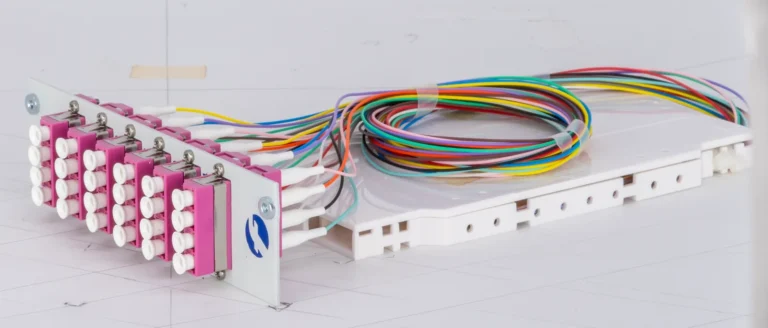
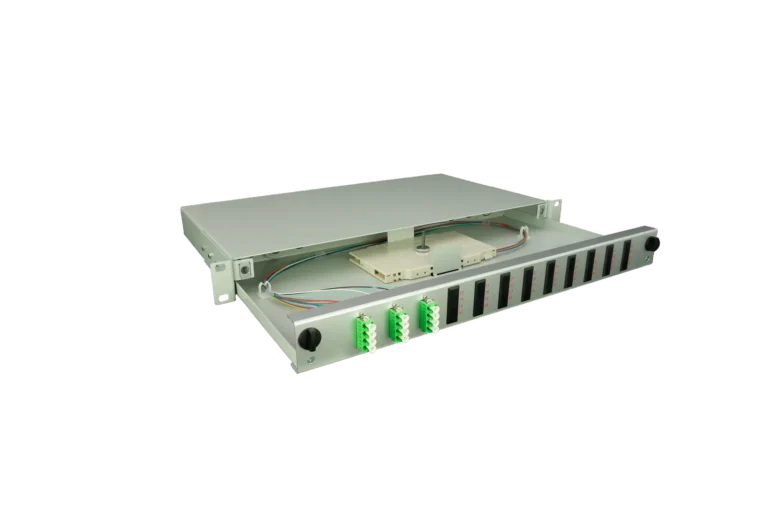
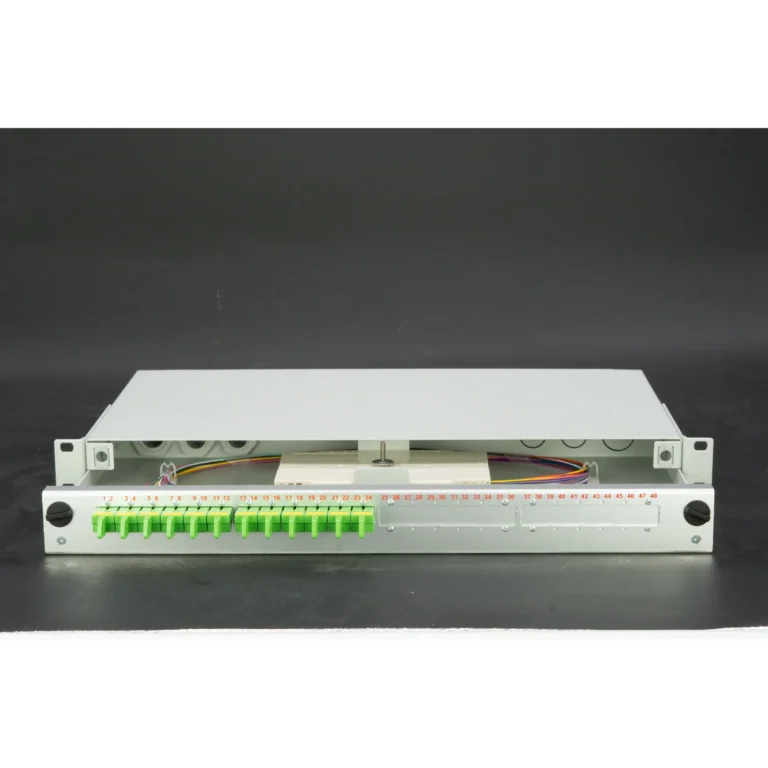
Modern tunnel infrastructure requires maximum fibre capacity in minimal space. With modular 1RU systems, up to 96 fibres can be accommodated in a single rack unit – double the density of conventional solutions.
- SlimConnect 1RU: Up to 96 fibres, fully modular and expandable
- VarioConnect 3RU: Up to 288 fibres for main distribution
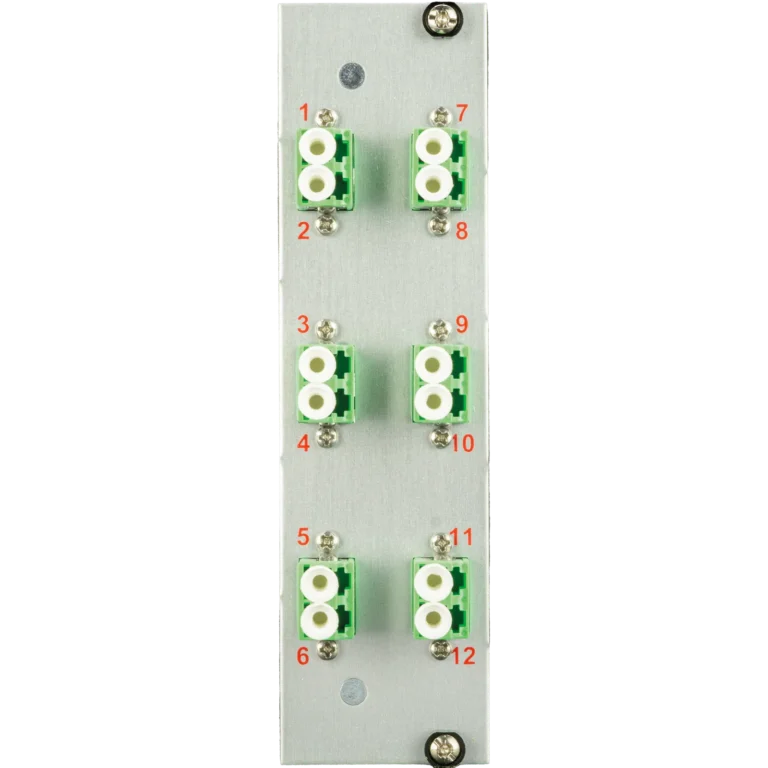
- Front modules: Tool-free exchange of LC, SC, E2000, MPO
- Splice cassettes: Pre-configured for rapid installation
Tunnel Network Security: Redundancy and Monitoring
Safety-critical systems in tunnels – from ventilation controls through fire detection systems to emergency call boxes – require highly available networks. Ring cabling with bidirectional singlemode fibres enables automatic switchover upon cable break in less than 50 milliseconds.
For fibre quality monitoring, integrated OTDR modules (Optical Time Domain Reflectometer) are suitable. These detect increases in attenuation due to bends or microcracks early and localise faults with ±1 metre precision.
Standards Compliance for Fibre Optic Tunnel Installations
Installation of fibre optic tunnels is subject to strict standards. Beyond the fundamental EN 50173-1 for structured cabling, specific requirements apply to transport infrastructure.
| Standard | Scope | Key Requirement |
|---|---|---|
| EN 50173-6 | Distributed building services | Redundant cabling |
| EN 50174-2 | Indoor installation | Bend radius min. 30mm |
| IEC 61300-3-35 | Connectors | Insertion loss <0.5 dB |
| EN 45545-2 | Rail fire safety | Hazard Level HL3 |
Practical Implementation: Fibre Installation in Rail Tunnels
Installation begins with laying armoured breakout cables on cable trays along the tunnel wall. Minimum clearance from high-voltage lines is 30 centimetres. At strategic points every 500 to 1,000 metres, weather-resistant distribution cabinets with modular splice systems are positioned.
- Cable entry: From below via cable glands M25
- Splice reserve: Plan minimum 2 metres per fibre
- Colour coding: Per DIN VDE 0888 for unambiguous identification
- Documentation: Digital measurement records for each section
- Acceptance test: OTDR measurement at 1310nm and 1550nm
Maintenance and Service of Tunnel Fibre Networks
Regular inspection of fibre infrastructure prevents outages. Modern monitoring systems continuously track attenuation values and report deviations via SNMP traps. Preventive cleaning of connectors every 12 months with specialised cleaning pens keeps attenuation below the critical value of 0.35 dB.
Maintenance in rail tunnels is subject to special safety regulations. Work may only be performed during blocking windows or under rail earthing. The modular design enables rapid replacement of failed components without operational interruption.
Future-Proof Planning for Tunnel Network Security
With the expansion of digital infrastructure, bandwidth requirements grow exponentially. Video surveillance in 4K resolution already requires 25 Mbit/s per camera. At 50 cameras per tunnel kilometre, demand quickly accumulates to multiple gigabits.
- 5G connectivity: Fronthaul links with 25 Gbit/s per sector
- IoT sensors: Thousands of measurement points for structural monitoring
- AI video analytics: Real-time processing on-site rather than transmission
- Quantum communication: Preparation for tap-proof transmission
Cost Optimisation through Modular Fibre Systems
Investment in high-quality modular systems pays for itself through reduced operating costs. Consider this: conventional splice boxes require complete recabling for expansions. Modular systems like SlimConnect grow on demand – new modules are simply inserted.
The 5 years warranty on Fiber Products systems reduces investment risk. Through European manufacturing, spare parts are available at short notice – a decisive advantage for critical infrastructure.
Integration into Existing Tunnel Infrastructure
Retrofitting existing tunnels with fibre optics requires careful planning. Often cable ducts for copper lines already exist and can be repurposed for fibre. The smaller cable diameter of fibre optics – typically 8-12mm for 48 fibres – permits installation in existing conduits.
| Tunnel Type | Characteristic | Recommended Solution |
|---|---|---|
| Road tunnel | High exhaust exposure | IP65 enclosure, LSZH cable |
| Rail tunnel | Strong vibrations | E2000 connectors, vibration dampers |
| Underground (metro) | Confined spaces | 1RU modules, 96 fibres |
| Service tunnel | Multi-purpose | Hybrid cable with copper/fibre |
Frequently Asked Questions on Fibre Optics in Tunnel Construction
What protection rating do fibre optic components need in tunnels?
Minimum IP65 is required to provide protection against dust and water spray. In areas with elevated humidity or condensation formation, IP67 is recommended.
How are vibrations in rail tunnels compensated?
Specialised vibration dampers and vibration-resistant connectors such as E2000 with screw locking prevent micromotion. Cables are additionally secured every 50 centimetres with elastic clamps.
What fibre capacity should be planned for future-proofing?
Plan for at least 50 per cent reserve capacity. With currently 48 fibres in use, 72 or preferably 96 fibres should be installed. The additional cost at initial installation is marginal compared to later upgrades.
How long does installation per tunnel kilometre take?
With pre-configured modular systems, a team of four technicians requires approximately 3-5 working days per kilometre including laying, splicing and measurement records.
What maintenance intervals are prescribed?
VDV 824 recommends annual visual inspections and metrological checks every two years. For critical sections, intervals shorten to six months.
Can existing copper cables continue operating in parallel?
Yes, parallel installation is unproblematic. Galvanic isolation of the fibre prevents interference. Often copper lines are retained for emergency power supply to remotely powered equipment.
Conclusion: Robust Fibre Solutions for Critical Tunnel Infrastructure
Fibre optic tunnels, tunnel fibre installations and tunnel network security require specialised components that withstand extreme environmental conditions. The combination of vibration-resistant E2000 connectors, modular splice systems with high fibre density and well-designed redundancy creates future-proof networks.
As a manufacturer of modular fibre optic systems, Fiber Products supports tunnel builders and infrastructure operators with tailored solutions. The 5 years warranty on all systems and the availability of components from European manufacturing minimise outage risks. For demanding industrial applications we provide the complete system solution from a single source – from planning through to commissioning.
Request a Quote
Have questions about our fibre optic solutions? Our expert team is happy to advise you – free and without obligation.