Fibre Optic Civil Works Capacity Bavaria 2026: Companies and Resources
Fibre Optic Civil Works Capacity Bavaria 2026: Companies and Resources
Bavaria faces the highest demand for fibre optic civil works capacity across Germany in 2026: with over 42,000 km of planned network expansion and an investment volume of €8.7 billion through 2030, network operators urgently seek qualified civil works partners.
Current deployment status and capacity bottlenecks in Bavarian fibre optic civil works
Fibre optic civil works in Bavaria achieved FTTH coverage of 35.9% by mid-2025 against a target of 50% by year end. Gigabit-capable connections stand at 72.9%, significantly higher but falling short of the 100% goal. This gap highlights the challenge: whilst coaxial and copper networks offer partial gigabit capability, future-proof FTTH requires extensive civil works.
The Bavarian Gigabit Directive funding details has already invested over €2.6 billion in expansion and supported 107,000 kilometres of fibre optic routes. Yet civil works capacity remains the limiting factor. Construction companies report average lead times of 6–9 months for new projects.
- Telekom plans at least 2.5 million new connections nationwide in 2026
- M-net is deploying FTTH to 9,000 GEWOBAU residential units in Erlangen
- municipal utilities FTTH strategy of up to 90% co-financing
- Parallel civil works underway for power grids and charging infrastructure
- Weather-related construction delays from November through March
Leading civil works contractors for optical fibre infrastructure in Bavaria
Bavarian fibre optic civil works are dominated by established general contractors and specialised mid-market firms. For major projects of 10,000 households or more, network operators typically award contracts to national enterprises with in-house crews and equipment fleets.
| Company | Headquarters | Employees | Specialisation | 2026 Capacity |
|---|---|---|---|---|
| Leonhard Weiss | Göppingen/Bavaria | 6,500 | FTTH complete solutions | Fully utilised |
| Max Bögl | Neumarkt | 7,000 | Infrastructure GC | Partial capacity |
| Bauer AG | Schrobenhausen | 11,000 | Specialist civil works | Project-dependent |
| Josef Rädlinger | Cham | 2,200 | Cable/optical fibre installation | Limited availability |
| Swietelsky | Linz/Bavaria | 10,500 | Utilities installation | Fully utilised |
Regional mid-market firms with 50–500 employees increasingly handle partial contracts and municipal projects. These companies benefit from flexibility and local presence but struggle with skilled labour shortages and equipment constraints.
Resource planning and technical requirements for fibre optic civil works
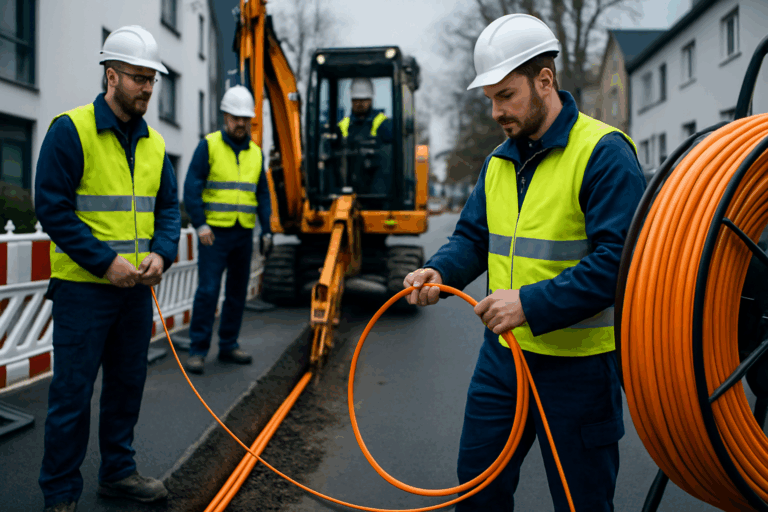
Optical fibre civil works capacity requires resources beyond conventional utilities installation. Modern fibre projects rely on trenchless installation using horizontal directional drilling (HDD) and plough-laying to shorten construction schedules and minimise surface disruption.
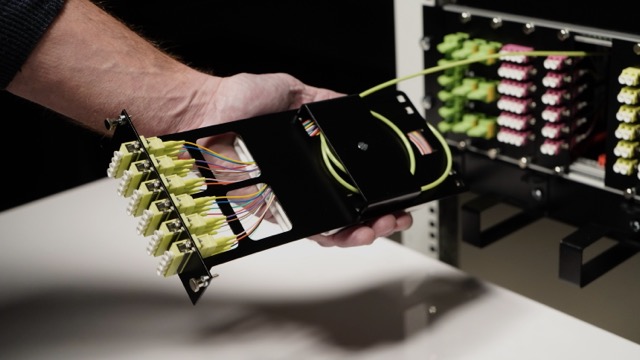
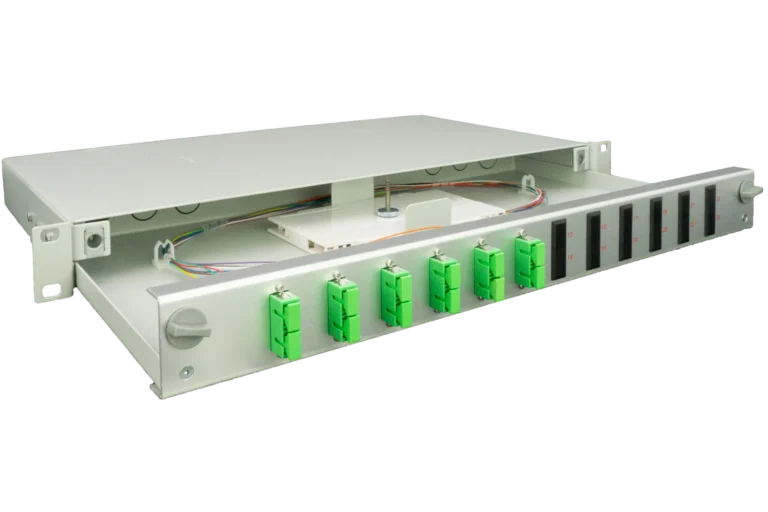
Technical infrastructure demands precisely coordinated components. Modular splice systems such as SlimConnect 1HE splice boxes accommodate up to 96 fibres in a single height unit. These systems deliver double the packing density of standard solutions and significantly reduce floor space requirements in distribution cabinets.
- Mini-excavators with GPS control for precise route alignment
- Cable pulling equipment with controlled tension up to 5 kN
- Blowing units for microducts with compressed air up to 15 bar
- Splicing equipment with loss under 0.02 dB
- OTDR test equipment for quality assurance per IEC 61280-4
Subsidy conditions and tender procedures in Bavaria 2026
The Bavarian Gigabit Directive targets grey spots with bandwidth below 100 Mbit/s in 2026. Municipalities receive subsidies up to 90% of eligible costs, with local contributions further reduced through federal funding. A total of €120.76 million is available for Upper Bavaria alone.
Fiber Products Quality Commitment: As an official Diamond Partner and manufacturer, we produce modular splice systems in Europe. Benefit from Swiss precision and in-house manufacturing.
Tenders increasingly use the Free State’s procurement platform with standardised bills of quantities. Municipal utilities and public network operators increasingly rely on framework agreements with 3–5 year terms to ensure planning certainty. Technical requirements mandatorily include compliance with DIN EN 50173 for structured cabling and IEC 61754 for connectors.
Regional deployment clusters in Bavarian fibre expansion
Fibre optic civil works in Bavaria focuses on multiple expansion clusters in 2026. Upper Bavaria leads with 2.03 million future gigabit-capable households, followed by Middle Franconia and Swabia. Telekom concentrates its 480 municipalities on previously underserved districts, whilst M-net prioritises urban growth corridors.
| Administrative district | FTTH coverage 2025 | Target 2026 | Investment volume | Focus areas |
|---|---|---|---|---|
| Upper Bavaria | 42% | 55% | €450m | Munich periphery |
| Middle Franconia | 38% | 50% | €320m | Nuremberg–Fürth |
| Swabia | 35% | 48% | €280m | Augsburg region |
| Lower Bavaria | 31% | 45% | €240m | Rural areas |
| Upper Palatinate | 29% | 42% | €210m | Regensburg |
Particularly dynamic are Bavaria’s 270 Gigabit Regions, where municipalities coordinate joint deployment projects. These partnerships unlock economies of scale in civil works and reduce per-connection costs by up to 30%.
Technical standards and quality requirements in optical fibre civil works
Fibre optic civil works in Bavaria must comply with strict technical specifications. Installation follows DIN 18220 for cable protection ducts and DVGW GW 125 for trenchless methods. Microduct bundles of 7×10 mm or 12×10 mm individual ducts are standard for FTTH deployments.
Passive infrastructure uses high-grade components. The VarioConnect series accommodates up to 288 fibres in 3HE configuration and offers the scalability required for expanding networks. Modular design permits subsequent upgrades without service interruption.
- Minimum cover 60 cm under pavements, 80 cm under roads
- Microduct bend radius minimum 20 times duct diameter
- Cable tensile strength minimum 1000 N per IEC 60794
- Singlemode fibre loss maximum 0.35 dB/km at 1310 nm
- Connector loss for APC connections under 0.25 dB
Challenges from parallel infrastructure projects
Optical fibre civil works capacity faces additional strain in 2026 from charging infrastructure and power grid expansion. Bavaria plans 50,000 new charging points through 2027, also requiring civil works. This multiple demand creates coordination challenges and extended timescales.
Municipal utilities address this through integrated deployment projects. Co-installing fibre optic, power and water lines reduces civil works costs by up to 40%. Success requires precisely coordinated components such as DIN-rail enclosures with IP65 protection for industrial environments.
Co-ordinating multiple trades demands well-conceived solutions. Modular fibre optic systems for municipal utilities deliver key advantages through flexibility and ease of maintenance. With 5 years warranty on all systems, manufacturers such as Fiber Products ensure long-term investment security.
Market development forecast through 2027
Bavarian fibre optic civil works will continue rapid growth through 2027. Experts forecast annual capacity demand of 3.5 million route metres for FTTH projects alone. Available civil works capacity must grow by at least 25% to meet deployment targets.
- Investment volume Bavaria 2026–2027: €4.2 billion
- Additional skilled civil works staff needed: 8,000 employees
- Planned FTTH connections by 2027: 2.8 million
- Average installation cost per metre: €80–120
- Share of trenchless methods: rising to 45%
Innovative installation techniques such as nano-trenching and milling gain importance. These methods reduce construction time and minimise traffic disruption. Demand simultaneously grows for pre-terminated systems with factory quality control.
Optimising construction workflows through modern splicing technology
Efficient splicing techniques substantially shorten assembly time and boost productivity in Bavarian fibre optic civil works. Modern splicing equipment with automatic fibre alignment achieves cycle times below 7 seconds per splice and losses under 0.02 dB.
Choice of splice components significantly impacts overall efficiency. Diamond-certified E2000 connectors deliver optimal performance in harsh site conditions through their bayonet coupling and integrated protective cap. Vibration resistance per IEC 61300-2-1 ensures lasting connection integrity.
| Connector type | Insertion loss | Return loss | Assembly time | Application |
|---|---|---|---|---|
| LC-APC | < 0.2 dB | > 60 dB | 30 sec | FTTH standard |
| SC-APC | < 0.25 dB | > 60 dB | 25 sec | Distribution |
| E2000-APC | < 0.15 dB | > 65 dB | 20 sec | Industrial/outdoor |
| MPO/MTP | < 0.35 dB | > 35 dB | 10 sec | High density |
Quality assurance and documentation in fibre optic civil works
Optical fibre civil works require comprehensive quality documentation. OTDR measurements per IEC 61280-4 record every route section with loss values and reflection events. Digital documentation systems capture route GPS coordinates with sub-metre accuracy.
Network operators increasingly demand BIM-compliant documentation (Building Information Modelling) for all passive infrastructure. These digital twins enable precise maintenance planning and cut downtime by up to 70%.
- Tier-1 test: loss and length per ISO/IEC 14763-3
- Tier-2 test: plus OTDR characterisation
- Endoscopic inspection of all connectors per IEC 61300-3-35
- Polarity check for MPO connections
- 24-hour full-load stress test
Sustainability and environmental compliance
Fibre optic civil works in Bavaria must comply with strict environmental rules. The Bavarian Compensation Ordinance requires remedial measures for soil disturbance exceeding 500 square metres. Trenchless installation reduces land use by up to 85% and avoids compensation obligations.
Recyclable materials gain relevance. Modern microduct bundles contain HDPE with 30% recycled content and meet DIN EN 61386-24 for cable protection duct systems. CO2 footprint improves further through regional production and short transport distances.
Frequently asked questions on fibre optic civil works in Bavaria
What civil works capacity is available in Bavaria in 2026?
Available capacity concentrates among approximately 150 specialist firms with a total of 12,000 skilled civil works staff in fibre optics. Large enterprises are already 95% utilised, while regional mid-market firms retain partial capacity. Average lead times are 6–9 months.
How can municipal utilities optimise subsidy access?
Municipal utilities should leverage the Bavarian Gigabit Directive’s 90% subsidy rate and create synergies through multi-utility projects. Combining federal funding can reduce local contribution to below 5%. Early application—at least 12 months before construction start—is essential.
Request a quote
Have questions about our fibre optic solutions? Our expert team offers free, no-obligation advice.