Campus Network Universities – Fibre Optic Systems for Research and Teaching
Campus Network Universities – Fibre Optic Systems for Research and Teaching
A campus fibre optic network forms the backbone of modern university optical fibre infrastructure and enables high-speed connections at 10 Gbit/s to 100 Gbit/s for research and teaching. German universities are deploying modular splice modules with up to 96 fibres in 1U height to meet growing demands for data transmission, video conferencing, and cloud-based research platforms. With the current FTTH rollout expansion, 21.3 million households in Germany already have fibre optic access – a development universities are leveraging for campus modernisation.
Why Fibre Optics Are Essential for University Campus Networks
Digital transformation in higher education requires robust network infrastructure. While traditional copper cabling reaches its limits at 1 Gbit/s, optical fibre enables transmission rates of 100 Gbit/s and beyond. The German Research Network (DFN) is already testing DWDM systems with 88 wavelengths at 100 Gbit/s for scientific applications.
Modern research projects such as the MAVERIC programme at Augsburg University, funded with €1.8 million from the BMWK, demonstrate the convergence of fibre and 5G technologies. These hybrid solutions require robust backbone infrastructure with high port density and modular expansion capabilities.
- Unlimited bandwidth scalability for future requirements
- Latency below 1 millisecond for real-time applications
- Energy savings compared to VDSL technology
- Interference-free transmission even in EMC-critical laboratory environments
- Future-proof operation for at least 25 years of service life
Technical Requirements for Campus Fibre Optic Networks in Universities
Planning a university campus fibre optic network requires precise fibre capacity dimensioning. Data centres typically require 48 to 96 fibres per building, while faculty connections need 24 to 48 fibres. Critical factors are attenuation values: single-mode fibres to ITU-T G.652.D achieve < 0.35 dB/km at 1310 nm.
| Building Type | Fibre Count | Bandwidth | Connector Type |
|---|---|---|---|
| Data Centre | 48–96 fibres | 40–100 Gbit/s | MPO/MTP |
| Faculty Building | 24–48 fibres | 10–40 Gbit/s | LC-duplex |
| Lecture Hall Centre | 12–24 fibres | 1–10 Gbit/s | SC or E2000 |
| Student Housing | 12 fibres | 1 Gbit/s | SC-APC |
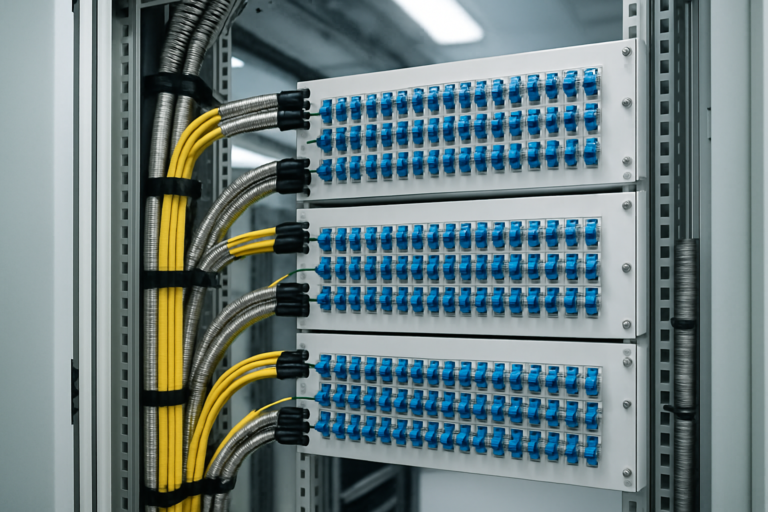
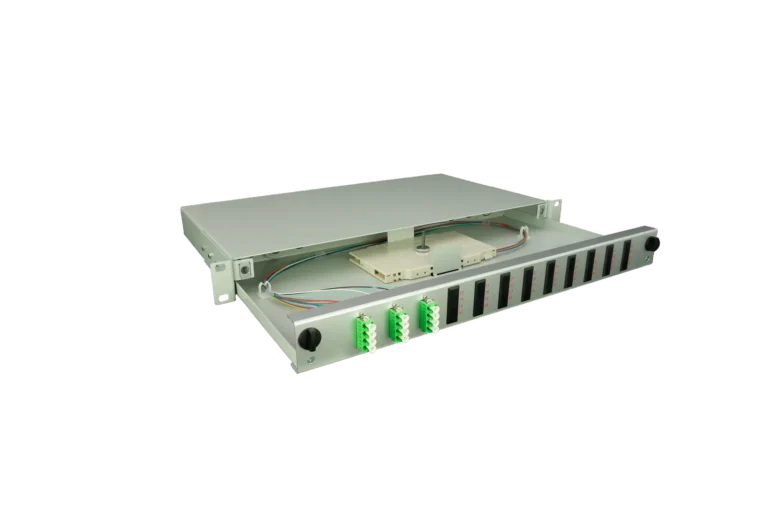
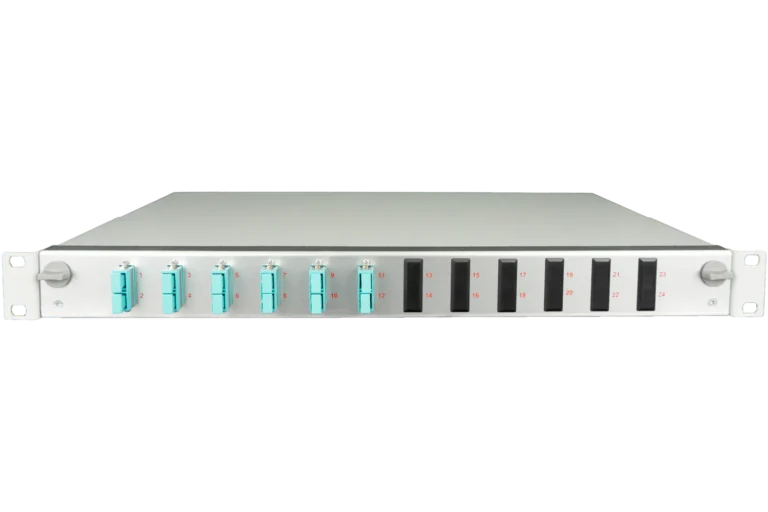
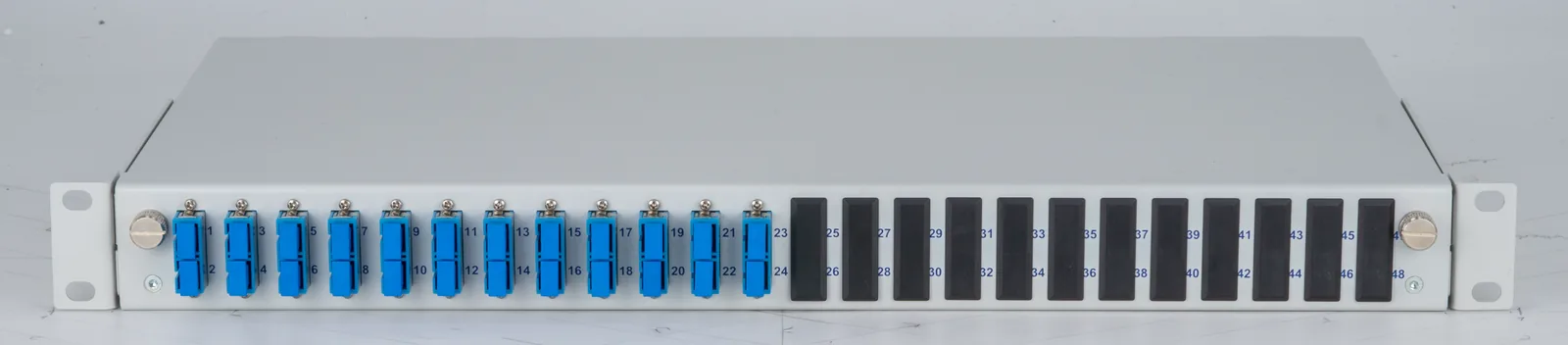
Modular splice modules such as SlimConnect with 1U height enable accommodation of up to 96 fibres in minimal space – ideal for cramped server rooms in older university buildings.
Splice Modules and Distribution Systems for University Optical Networks
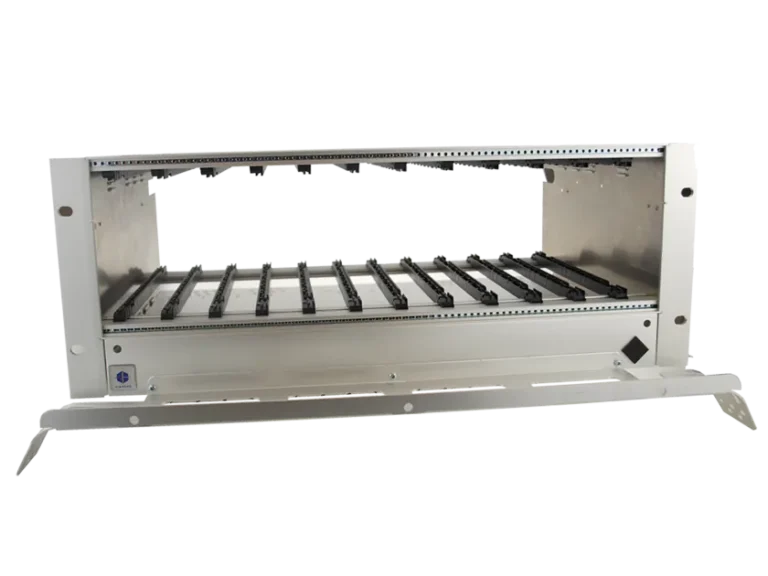
Selection of the right splice system determines maintainability and expandability of the campus network. Universities benefit from modular systems with tool-free assembly and flexible configuration. The VarioConnect series in 3U height offers space for up to 288 fibres and is ideal for central distribution points.
- Pre-configured splice cassettes reduce installation time
- Colour-coded fibre routing to DIN EN 50173-1 prevents mix-ups
- Integrated attenuation margin of 3 dB for future expansion
- Dust protection shutters to IP54 protect unused ports
- Labelling fields for structured documentation per ISO/IEC 14763-2
Fiber Products Quality Promise: As an official Diamond Partner and European manufacturer, we produce modular splice systems to the highest precision standards. Benefit from German engineering and in-house manufacturing.
Connector Types and Connectors for University Networks
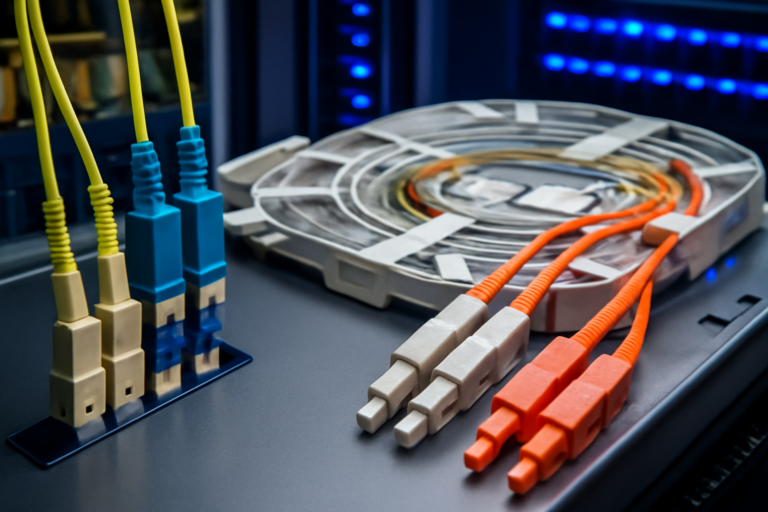
Connector selection significantly impacts transmission quality in campus fibre optic networks. While data centres typically use MPO connectors with 12 or 24 fibres, laboratory environments benefit from vibration-resistant E2000 connectors with integrated dust caps.
Return loss varies significantly by polish type: PC connectors achieve > 40 dB, while APC connectors with > 60 dB are essential for critical measurement applications. University laboratories with sensitive optical test equipment should exclusively use APC connectors.
| Connector Type | Insertion Loss | Return Loss | Application Area |
|---|---|---|---|
| LC-APC | < 0.25 dB | > 60 dB | Labs, measurement equipment |
| SC-PC | < 0.30 dB | > 40 dB | Standard data networks |
| E2000-APC | < 0.20 dB | > 65 dB | Research facilities |
| MPO/MTP | < 0.35 dB | > 35 dB | High-density backbone |
Integration of 5G Campus Networks with Fibre Optic Backbone
The convergence of fibre and 5G technology opens new possibilities for mobile research applications. A high-performance university fibre optic network forms the foundation for private 5G campus networks in the frequency band 3.7–3.8 GHz. Each 5G base station requires at least 10 Gbit/s backhaul via single-mode fibres.
- Fronthaul connections with < 100 microseconds latency
- CPRI protocol requires 24.3 Gbit/s for 20 MHz channel bandwidth
- Redundant fibre routing per ITU-T G.8032 for fault protection
- Time synchronisation over fibre per IEEE 1588v2
- Edge computing nodes directly at fibre distribution hub
Practical Implementation: From Planning to Installation
Implementing a campus fibre optic network requires systematic planning. The first step is an inventory of existing ducts and cable routes. Universities often have historically grown infrastructure with inner diameters of 50–100 mm, suitable for modern micro cables.
Fibre count is determined by a 20-year forecast plus 30% reserve. With average annual data growth of 15%, backbone links should provide at least 48 fibres. Modular splice systems allow for subsequent expansion without operational downtime.
Precision splice joints with < 0.05 dB attenuation are critical for quality. Modern fusion splicers with active core alignment reliably achieve these values. Documentation follows DIN EN 50346 with OTDR measurement protocols at 1310 nm and 1550 nm.
Cost–Benefit Analysis for University Optical Fibre Infrastructure
Investment in a modern university campus fibre optic network pays for itself through reduced operating costs and expanded research capabilities. While initial installation runs €150–200 per fibre metre, energy costs drop compared to copper networks.
- Space savings with compact 1U systems
- Maintenance intervals extend to 5 years
- Bandwidth upgrades possible without cable replacement
- Government subsidy rates up to 90%
- TCO reduction over 10-year service life
Standards and Regulations for Campus Fibre Optic Networks
Compliance with international standards ensures interoperability and future-proofing. For universities, the primary standards are ISO/IEC 11801-1 for structured cabling and DIN EN 50173-1 for information technology cabling systems. Fibre types follow ITU-T G.652 through G.657.
Special attention must be given to campus backbone cabling per ISO/IEC 11801-6, which defines transmission distances up to 10 km. For building cabling, the 500-metre limit applies to multimode and 3000 metres for single-mode fibres.
Maintenance and Operation of University Networks
Professional network management ensures availability of campus fibre optic systems. Regular OTDR measurements identify gradual degradation before failures occur. The attenuation margin of 3 dB compensates for ageing effects throughout the service life.
- Quarterly connector cleaning reduces attenuation
- Documentation of all splice joints in digital management systems
- Thermal imaging inspection of distribution cabinets prevents overheating
- Redundant fibre routing raises availability to 99.999%
- Preventive fibre replacement after 20 years of operation
Future Perspectives for University Optical Fibre Networks
Development of university fibre optic network technology advances rapidly. Coherent transmission technology already enables 400 Gbit/s per wavelength. With wavelength multiplex, modern systems achieve 38.4 Tbit/s over a single fibre – sufficient bandwidth for entire university campuses.
Quantum communication over fibre is approaching reality. The DFN is already testing QKD systems for tamper-proof connections between research institutions. Integration requires dedicated dark fibre with < 0.2 dB/km attenuation and minimal polarisation mode dispersion.
FAQ: Common Questions About Campus Fibre Optic Networks
How many fibres does an average university campus require?
A medium-sized campus with 15,000 students typically needs 200–300 fibres in the backbone. Plan for 24–48 fibres per building, with data centres requiring at least 96 fibres. Modular design enables demand-driven expansion.
How do single-mode and multimode fibres differ for university applications?
Single-mode fibres (OS2) suit campus backbones with distances over 500 metres and bandwidths from 10 Gbit/s. Multimode fibres (OM4/OM5) suffice for in-building connections up to 400 metres at 10 Gbit/s.
What funding is available for fibre rollout at universities?
The BMBF provides funding for digital university infrastructure up to 90% of investment costs. State programmes and EU funding can be combined. The 5-year warranty on modular systems reduces follow-on costs.
How do you integrate existing copper networks into new fibre infrastructure?
Media converters transform electrical into optical signals with < 1 millisecond latency. Parallel copper and fibre operation enables gradual migration without downtime.
What bandwidth do modern research applications require?
AI clusters and simulation computers need 100 Gbit/s per node. 4K video conferencing requires 25 Mbit/s per stream. Cloud backup of large research datasets benefits from 10–40 Gbit/s connections.
How is fault tolerance ensured in campus networks?
Redundant ring topologies per ITU-T G.8032 switch within 50 milliseconds. Diverse route engineering and dual core components raise availability to 99.999% – maximum 5.26 minutes downtime per year.
”
Request a Quote
Have questions about our fibre optic solutions? Our expert team is here to help – free and without obligation.