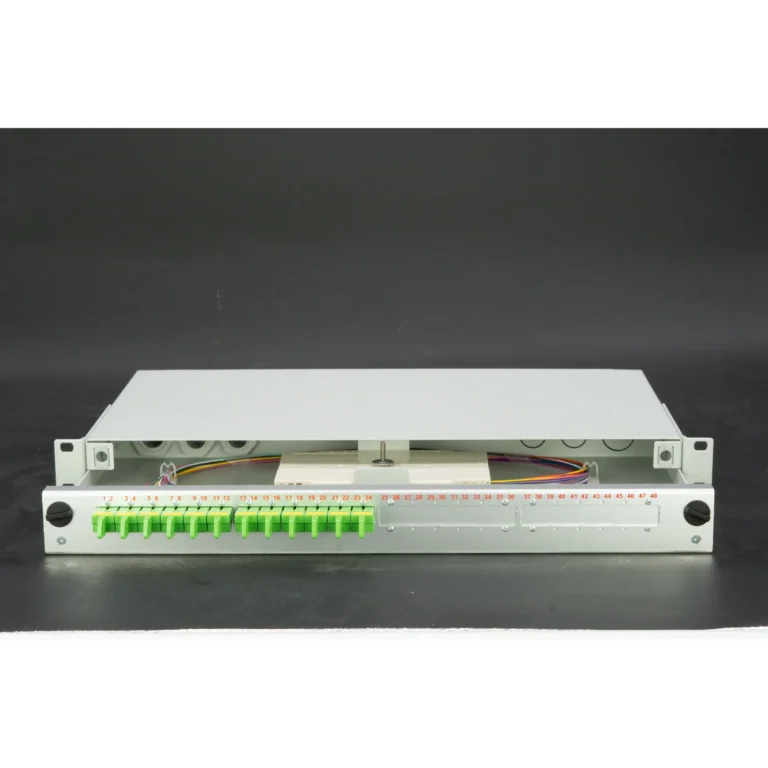
Fibre Optic Logistics Centre – Networking for Automated Warehouses
Fibre Optic Logistics Centre – Efficient Networking for Automated Warehouses
Fibre optic logistics centre infrastructure, warehouse automation via optical fibre, and modern warehouse network systems form the backbone of efficient distribution centres in the Industry 4.0 era. The integration of high-density fibre optic solutions with up to 96 fibres per 1RU enables low-latency communication between automated storage systems, conveyor equipment, and warehouse management software. Particularly in modern e-commerce centres, optical fibre technology ensures seamless networking of robotics systems, scanners, and surveillance installations while future-proofing against rising bandwidth demands.
The German fibre market is forecast to reach record levels in 2026 with 120,000 new connections per month, with industrial and logistics parks prioritised for expansion. For automated warehouses, this means improved connectivity to regional fibre networks and scalable internal networking solutions through modular splice systems.
Why Fibre Optics Are Essential for Modern Logistics Centres
The transformation to a fully automated warehouse requires gigabit transmission rates with minimal latency. While conventional copper cabling reaches its limits beyond 100 metres, fibre optics easily spans several kilometres without signal loss.
- Real-time data transmission for WMS systems (Warehouse Management)
- Interference-free communication despite electromagnetic effects from conveyor systems
- Bandwidth reserves for future AI-based warehouse optimisation
- Reduced downtime through redundant fibre routes
- Energy efficiency via lower power consumption compared to active copper components
Particularly in large-scale distribution centres with over 50,000 m² of warehouse space, the superiority of fibre optic technology becomes apparent. High-bay storage, picking zones, and dispatch areas are networked via central distribution points using modular splice modules.
Technical Requirements for Warehouse Network Infrastructure
Automated logistics centres impose specific requirements on their fibre optic infrastructure. The network must support both horizontal and vertical data streams between different automation levels.
| Network Level | Bandwidth Requirement | Recommended Fibre Type | Typical Connector Types |
|---|---|---|---|
| Backbone (Data Centre) | 10–100 Gbit/s | OS2 Single-mode | LC-APC, MPO |
| Warehouse Automation | 1–10 Gbit/s | OM4 Multimode | LC-PC, SC |
| Sensors/Scanners | 100 Mbit/s–1 Gbit/s | OM3 Multimode | ST, FC |
| Surveillance Cameras | 10–100 Mbit/s | OM2 Multimode | SC, E2000 |
The selection of appropriate fibre optic components depends on specific environmental conditions. In areas with high vibration from conveyor systems, E2000 connectors to IEC 61754-15 with robust locking mechanisms are recommended.
Integrating Warehouse Automation Fibre Optics into Existing Systems
Modernising existing logistics centres with fibre optics typically occurs in stages. Existing copper networks must often run in parallel during the transition phase. Modular splice systems enable this hybrid network architecture through flexible configuration.
- Media converters for copper-to-fibre transitions
- Pre-terminated patch cables shorten installation time
- DIN rail mounting for industrial control cabinets to DIN EN 60715
- Colour coding to DIN VDE 0888 for unambiguous fibre assignment
Fiber Products Quality Promise: As an official Diamond Partner and manufacturer, we produce modular splice systems in Europe. Benefit from Swiss precision and in-house manufacturing.
Scalable Network Architecture for Growing Logistics Centres
Modern distribution centres must respond flexibly to market demands. Fibre optic infrastructure should therefore be designed for expandability from the outset. Logistics centre fibre optic installations benefit from modular systems that enable capacity expansion later without complete replacement.
When planning, reserve fibres of at least 30% should be accounted for. These enable future expansions for additional warehouse automation or integration of new technologies such as autonomous transport vehicles.
- SlimConnect modules with 96 fibres per 1RU for maximum port density
- VarioConnect systems for up to 288 fibres in larger installations
- Tool-free installation via snap locks
- Backward compatibility with existing fibre optic systems
Robust Fibre Optic Solutions for Harsh Warehouse Environments
Logistics centres impose special demands on the durability of network components. Temperature fluctuations, dust, and mechanical stress require specially hardened fibre optic installations.
| Environmental Factor | Technical Solution | Protection Class |
|---|---|---|
| Deep-freeze storage (−30°C) | Specialist fibres with extended temperature range | IP65 |
| Dust exposure | Screwed E2000 connectors | IP67 |
| Vibration (conveyor systems) | Spring-loaded ferrule | IK08 |
| EMC interference | Fully dielectric cable | Class E |
For industrial applications, DIN rail-mounted boxes are ideal, integrating directly into existing control cabinets. These guarantee IP65 protection class and are rated for ambient temperatures of −40°C to +85°C.
Warehouse Network Redundancy and Fault Tolerance
Availability of the fibre network is critical for uninterrupted warehouse operations. Even brief outages can cause significant delays in order processing. Redundant fibre routing and mirrored network paths minimise this risk.
- Ring architecture with automatic switchover on fibre break
- Physically separated route planning for primary and backup lines
- OTDR measurements for preventive fault diagnosis
- Documentation of all fibre routes per EN 50173-1
- Keep emergency patch cables in defined lengths on hand
Implementation of a well-conceived redundancy concept increases system availability to over 99.9%. Critical connections between warehouse management system and warehouse automation should routinely be duplicated.
Cost-Efficiency Through Optimised Fibre Planning
Investment in future-proof fibre optic infrastructure in modern logistics centres typically pays for itself within 3 to 5 years. Forward-looking planning of warehouse automation fibre systems is critical to economic viability.
Modular systems not only reduce initial installation costs but also simplify later maintenance work. The ability to replace individual modules without operational interruption minimises downtime and associated costs.
- Reduced assembly time through pre-terminated components
- Lower energy costs compared to active copper cabling
- Extended service life of over 25 years with fibre optics
- Avoidance of costly retrofits through adequate capacity reserves
Future Trends: 5G and Fibre Optics in the Logistics Centre
The convergence of fibre optics and 5G technology opens new possibilities for warehouse automation. Private 5G networks combined with fibre optic backhaul enable flexible connectivity of mobile robot systems and autonomous transport vehicles.
Logistics centre fibre optic infrastructure forms the backbone for campus networks per 3GPP Release 16. Integration occurs via small cells connected by fibre optic, delivering data rates of up to 20 Gbit/s.
Practical Implementation: From Planning to Installation
Successful implementation of fibre optic infrastructure in a logistics centre follows a structured process. From requirements analysis through route planning to final commissioning, various project phases must be completed.
| Project Phase | Duration | Core Activities |
|---|---|---|
| Requirements Analysis | 2–3 weeks | Bandwidth assessment, site survey |
| Network Design | 3–4 weeks | Topology, redundancy, component selection |
| Installation | 4–8 weeks | Cable routing, splicing, module installation |
| Commissioning | 1–2 weeks | OTDR measurements, documentation, training |
For medium-sized logistics centres with 20,000 to 50,000 m² of area, typical project duration is approximately three months. Parallel installation during ongoing operations requires precise coordination with operational workflows.
Maintenance and Operation of Warehouse Network Systems
After successful installation, the operational phase begins, where regular maintenance ensures long-term performance. Fibre optic systems are fundamentally low-maintenance, though periodic inspections are recommended.
- Six-monthly visual inspection of all accessible components
- Annual OTDR reference measurements for early detection of degradation
- Connector cleaning when needed with specialist cleaning tools
- Update network documentation when changes are made
- Train maintenance staff in fibre optic handling
Collaboration with specialised industrial partners ensures professional support for maintenance and any future expansions. With a 5-year warranty on modular systems, logistics operators have comprehensive protection.
FAQ: Common Questions on Fibre Optics in Logistics Centres
What advantages does fibre optic offer over copper in automated warehouses?
Fibre optics enables interference-free transmission over large distances without signal boosters, is immune to electromagnetic interference from conveyor equipment, and provides virtually unlimited bandwidth reserves for future automation enhancements.
How many fibres should be planned for a medium-sized logistics centre?
For a 30,000 m² logistics centre, at least 144 fibres in the backbone area plus 30% reserve are recommended. The modular design allows future expansion without replacing the base installation.
Can existing copper networks continue to run alongside fibre optics?
Yes, through media converters and hybrid distribution systems, parallel operation is straightforward. This enables gradual migration without operational interruption.
What protection class do fibre optic components need in refrigerated warehouses?
For deep-freeze storage with temperatures down to −30°C, components with IP65 protection class and extended temperature range are required. Specialist low-temperature fibres prevent micro-bending in cold conditions.
How long does installation of complete fibre optic infrastructure take?
For an average distribution centre, pure installation time is 4 to 8 weeks. With planning and commissioning, allow approximately three months for overall project duration.
What maintenance intervals are recommended for fibre optic systems?
Fibre optic systems require minimal maintenance. An annual OTDR measurement for documentation plus six-monthly visual inspections are sufficient. Connectors should be cleaned when required.
Request a Quote
Have questions about our fibre optic solutions? Our expert team is happy to advise you – free and without obligation.