AI Data Centres Germany 2026: GPU Infrastructure and Fibre Optic Demand
AI Data Centres Germany 2026: GPU Infrastructure and Fibre Optic Demand
AI data centre Germany, GPU cluster fibre optics and AI infrastructure face fundamental change: with Germany’s first AI factory in Munich coming online, featuring 10,000 Blackwell GPUs and computing power of 0.5 ExaFLOPS, entirely new fibre optic cabling requirements are emerging. Exponentially growing GPU clusters need high-density data center cabling with up to 96 fibres per 1U, while transmission speeds of 1.6 to 3.2 terabits per second become the new standard.
The Paradigm Shift: From Conventional Data Centres to AI-Driven GPU Clusters
Germany’s data centre landscape is experiencing unprecedented transformation. By 2030, AI data centre capacity will quadruple from the current 530 megawatts to 2,020 megawatts. This expansion concentrates mainly on the Frankfurt-Rhine-Main region with over 1,100 megawatts of installed capacity and Berlin-Brandenburg as the second major AI hub.
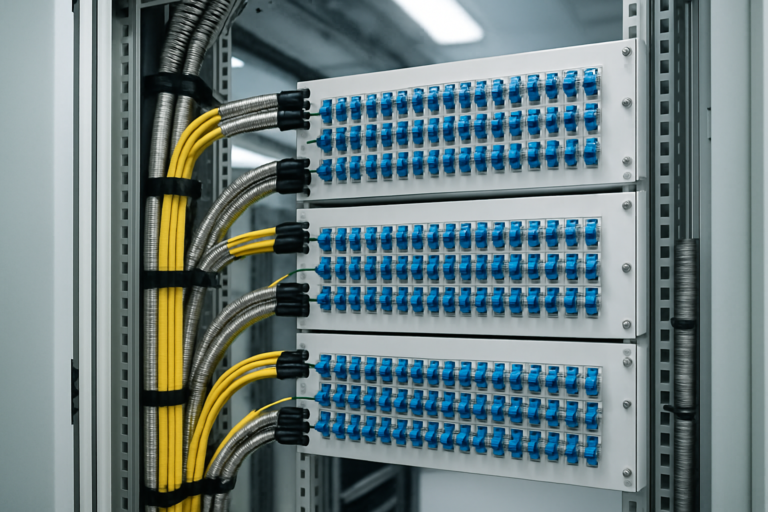
The technical challenges of this development are enormous. A single NVIDIA HGX B200 server with eight Blackwell GPUs requires up to 16 fibre connections for the network fabric alone. In clusters with thousands of compute nodes, hundreds of thousands to millions of connections must fit within compact rack spaces.
- Latency requirements of under 1 microsecond between GPU clusters
- Bandwidth of 260 terabytes per second in a single NVL72 system
- Complete redundancy for 99.999% availability
- Scalability for future 3.2 terabit connections
GPU Cluster Architecture: New Dimensions of Fibre Optic Networking
Communication within modern GPU clusters occurs across multiple hierarchical levels with different technical requirements. At the intra-node level, NVLink 5.0 enables 1.8 terabytes per second bidirectional bandwidth between adjacent GPUs – 14 times faster than PCIe Gen 6.
| Connection Level | Technology | Bandwidth | Latency |
|---|---|---|---|
| Intra-Node (GPU to GPU) | NVLink 5.0 | 1.8 TB/s bidirectional | < 200 nanoseconds |
| Inter-Node (Server to Server) | 400G and 800G Ethernet | 800 Gbit/s – 1.6 Tbit/s | < 1 microsecond |
| Cluster Backbone | MPO/MTP Systems | 3.2 Tbit/s (planned) | < 5 microseconds |
These extreme requirements drive development of new fibre optic solutions. PAM4 modulation enables doubling the data rate per optical channel without increasing transmission speed. Simultaneously, new transceiver standards with 100 Gbit/s per channel at 120 GBaud modulation rates are being deployed.
High-Density Splice Modules: The Answer to Exponentially Growing Fibre Counts
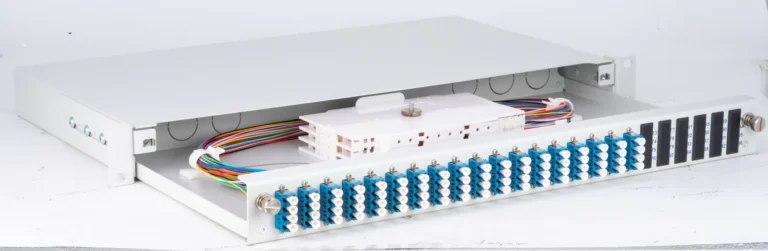
Physical realisation of these bandwidth densities requires revolutionary approaches to fibre optic infrastructure. Modern modular splice systems today achieve up to 96 fibres per rack unit (1U) – a an increase compared to conventional systems with 48–72 fibres.
Fiber Products Quality Promise: As an official Diamond Partner and manufacturer, we produce modular splice systems in Europe. Benefit from Swiss precision and in-house manufacturing.
When terminating 10,000 fibres, this means concretely: instead of 105 rack units with conventional 48-port systems, only 55 rack units with high-density 96-port systems are required. The saved 50 rack units represent more than one complete rack with significant savings on floor space, cooling and power supply.
- Pre-configured modules with factory-mounted couplings
- Integrated splice cassettes for faster installation
- Interchangeable front modules for LC, SC, E2000 and MPO/MTP
- Flexible configuration from minimum to maximum 288 fibres per system
Ribbon Splicing Technology: Efficiency Gains for AI Data Centre Germany
With growing GPU cluster fibre optic requirements, ribbon splicing technology is experiencing a renaissance. This technology enables simultaneous splicing of 12 fibres in the time conventionally needed for a single fibre – a twelve-fold speed increase.
Modern ribbon splice machines guarantee consistently high quality with insertion loss under 0.1 dB. For data centre connections between specialised GPU clusters, this enables massive time and cost savings while achieving higher packing density.
MPO/MTP Connectors: The Standard for AI Infrastructure
Choosing the correct connector type is critical for modern AI data centre performance. MPO (Multi-fiber Push-On) and MTP (Mechanical Transfer Pull-On) connectors dominate high-density GPU cluster installations.
| Connector Type | Fibre Count | Application | Transmission Rate |
|---|---|---|---|
| MPO-12 | 12 fibres | 40G/100G Backbone | up to 100 Gbit/s |
| MPO-24 | 24 fibres | 400G/800G Cluster | up to 800 Gbit/s |
| MTP-16 | 16 fibres | 1.6T GPU Networking | up to 1.6 Tbit/s |
A single 800G switch port can flexibly be split into two 400G GPU connections, while 1.6T and 3.2T ports enable even more complex breakout configurations. This flexibility optimises total cost of ownership and allows future-proof upgrades.
Liquid Cooling and Fibre Optic Routing: New Challenges
The enormous power densities of modern GPU clusters with up to 120 kW per rack require liquid cooling. This presents special requirements for fibre optic routing, as cables and cooling lines must coexist in the same space.
- Temperature-resistant cables for ambient temperatures up to 70°C
- Waterproof feedthroughs with IP65 protection rating
- Separate cable routes for signal and cooling lines
- Flexible cable management for cooling system maintenance access
Modular fibre optic solutions for data centres must consider these special requirements from the start. Pre-configured systems with thoughtful cable management reduce installation errors and accelerate commissioning.
Power Supply and Fibre Optic Infrastructure: The Critical Link
AI data centre Germany sites require not only massive computing power but also corresponding power supply. The planned 2,020 megawatts by 2030 demand new approaches to energy distribution and associated control and monitoring systems.
Fibre optic cables play a dual role here: they transmit not only data between GPU clusters but also connect intelligent power distribution systems. The electromagnetic immunity of fibre optics is a decisive advantage near high-voltage installations and transformers.
Future-Proof Design Through Modular Systems
The rapid evolution of AI infrastructure demands maximum flexibility. The VarioConnect 3U system offers 144 to 288 fibres per unit, providing the necessary scalability for growing requirements.
Consistently modular architecture enables staged expansion without operational interruption. Interchangeable front modules allow migration from older connector types to modern MPO/MTP systems while preserving the core infrastructure.
- Investment protection through 5 years’ manufacturer warranty
- Compatibility between different product generations
- Preparation for 3.2 terabit transmission rates
- Support for all common connector types (LC, SC, E2000, MPO)
Standards Compliance and Certification for GPU Cluster Fibre Optics
Compliance with international standards is essential for AI data centres. All components must meet standards IEC 61754 for connectors and IEC 61753 for passive components.
| Standard | Scope | Requirement |
|---|---|---|
| IEC 61754-15 | MPO Connectors | Mechanical Interface |
| IEC 61753-1 | Passive Components | Environmental Resistance |
| IEC 61300-3-35 | Loss Measurement | < 0.25 dB Insertion Loss |
| DIN EN 50173-1 | Cabling Structure | Data Centre Standard |
Certification to these standards ensures interoperability between different manufacturers and long-term operational safety. As a Diamond Partner and manufacturer, Fiber Products guarantees full standards compliance of all systems.
Practical Implementation: From Planning to Installation
Successful implementation of GPU cluster fibre optic infrastructure requires systematic planning. From needs analysis through system selection to final installation, all steps must be precisely coordinated.
Capacity planning begins based on current and projected GPU numbers. In a typical deployment of 1,000 GPUs, approximately 16,000 fibre connections are created, which must be structured and terminated. The choice between central and distributed termination depends on data centre architecture.
Installation itself benefits from pre-configured systems with factory-tested components. Modern splice modules reduce installation time through thoughtful cable management and tool-free assembly.
Frequently Asked Questions About AI Data Centre Germany and GPU Cluster Fibre Optics
What fibre density does a modern AI data centre require?
Modern AI data centres require at least 96 fibres per rack unit for efficient GPU cluster networking. Approximately 16,000 fibre connections are created per 1,000 GPUs, which must be terminated in minimal space.
How do MPO and LC connectors differ for AI infrastructure?
MPO connectors provide 12 to 24 fibres per connector and suit high-density GPU connections at 400G to 1.6T. LC duplex connectors with 2 fibres are used for individual server connections or management networks.
What transmission speeds are standard in 2026?
The standard is evolving from 800 Gbit/s to 1.6 Tbit/s per connection. First installations with 3.2 Tbit/s are already in pilot phase at major cloud providers.
How does liquid cooling affect fibre optic installation?
Liquid cooling requires temperature-resistant cables up to 70°C and waterproof feedthroughs to IP65 rating. Cable routing must be separated from cooling lines and allow maintenance access.
What standards apply to data centre cabling?
Key standards are IEC 61754 for connector interfaces, IEC 61753 for passive component performance and DIN EN 50173-1 for generic cabling structure, with DIN EN 50173-5 covering data centre spaces. IEC 61753-1 sets no single loss limit but defines grades: for singlemode, Grade B means a mean insertion loss of 0.12 dB or less and 0.25 dB or less for at least 97% of connections; Grade C means 0.25 dB mean and 0.50 dB. For multimode, Grade Bm allows 0.3 dB mean and 0.6 dB.
How long does installation of a 288-fibre system take?
With pre-configured modular systems and ribbon splicing technology, a 288-fibre system can be fully installed and tested in a short time – a time saving compared to conventional methods.
Conclusion: The Future of AI Infrastructure in Germany
AI data centre Germany, GPU cluster fibre optics and AI infrastructure face enormous growth rates. Quadrupling capacity by 2030 requires innovative fibre optic solutions with maximum density and flexibility. Modular splice systems with up to 288 fibres and support for 3.2 terabit transmission rates form the backbone of this development.
The success of German AI data centres depends critically on the right fibre optic infrastructure. With well-designed modular systems, professional planning and future-proof technology, the challenges of exponentially growing GPU clusters can be mastered. As a manufacturer and Diamond Partner, Fiber Products provides the complete system solution for these demanding requirements – from the splice box to the E2000 connector in proven Swiss precision quality.
Order directly from our shop: fiber-products.de
Request a Quote
Free consultation – personalised quote within 24 hours