Civil Works Capacity for Fibre Deployment in Eastern Germany 2026: Saxony, Thuringia, Brandenburg
Civil Works Capacity for Fibre Deployment in Eastern Germany 2026: Saxony, Thuringia, Brandenburg
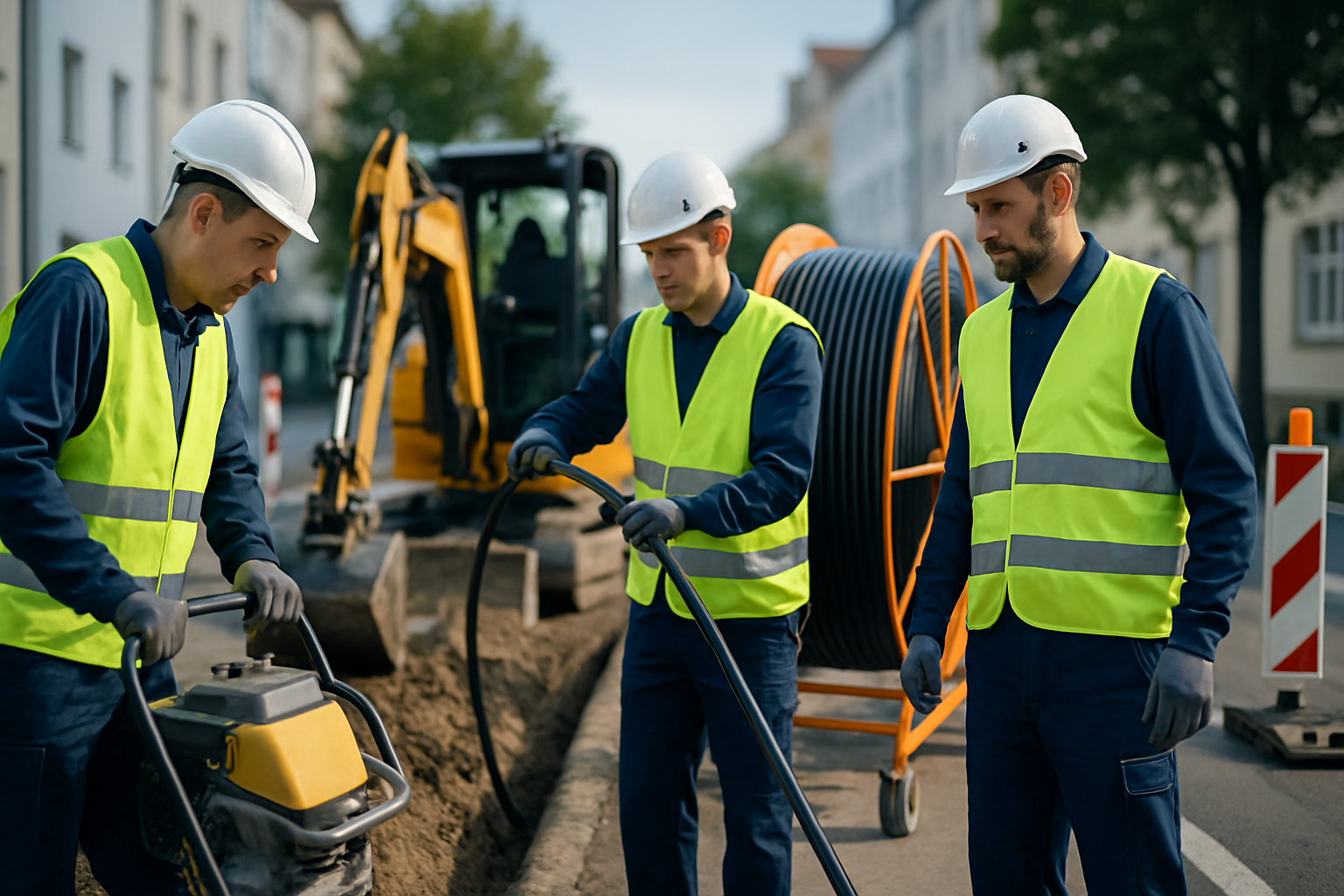
The new federal states are experiencing a historic phase of fibre rollout in 2026: Saxony, Thuringia and Brandenburg are investing heavily in FTTH infrastructure, but face significant capacity constraints among qualified civil works contractors.
For civil works companies and municipalities in Eastern Germany, this means concretely: without strategic optimisation of fibre infrastructure, the ambitious expansion targets by 2030 cannot be achieved. The solution lies in the intelligent combination of efficient civil works methods and modular splice modules with high port density.
Current Civil Works Capacity in Eastern Germany: Figures and Facts for 2026
The German Institute for Economic Research forecasts a real growth in civil works construction volume of 1.7 percent for 2026, driven primarily by fibre and energy transition projects. In the new federal states, however, the picture is mixed:
- Saxony: Over 45 active FTTH construction sites, average project duration 18-24 months
- Thuringia: 32 municipal fibre projects with total volume of €380 million
- Brandenburg: Largest area with expansion needs – over 2,100 municipalities below 50 Mbit/s
- Capacity bottleneck: Only 12 specialised fibre civil works firms per federal state
- Skills gap: 3,500 qualified civil works technicians missing in Eastern Germany
The order books of civil works companies are full until mid-2027. New projects must plan for waiting times of 6-9 months before construction can even begin.
Challenges in Fibre Civil Works Eastern Germany, FTTH Trenching New Federal States
The structural challenges in the eastern federal states differ significantly from western German metropolitan areas. Municipalities and civil works companies struggle with specific problems:
| Challenge | Impact | Affected Regions |
|---|---|---|
| Lengthy permit procedures | Average 4-6 months delay | Rural municipalities Brandenburg |
| Missing civil works capacity | 70% utilisation, no available crews | Entire region |
| Complex soil conditions | 30% higher construction costs | Lausitz, Erzgebirge |
| Landowner permissions | Up to 40% refusal rate | Small towns Thuringia |
| Microduct systems | Missing standard knowledge | All three federal states |
The German Commission for Electrical Engineering emphasises that missing knowledge of standards when laying cable in microducts without damage particularly delays rollout. Here DIN EN 60794 and IEC 61754-15 are the relevant standards for professional fibre installations.
Optimisation Potential through Modular Splice Modules in Eastern Germany FTTH Deployment
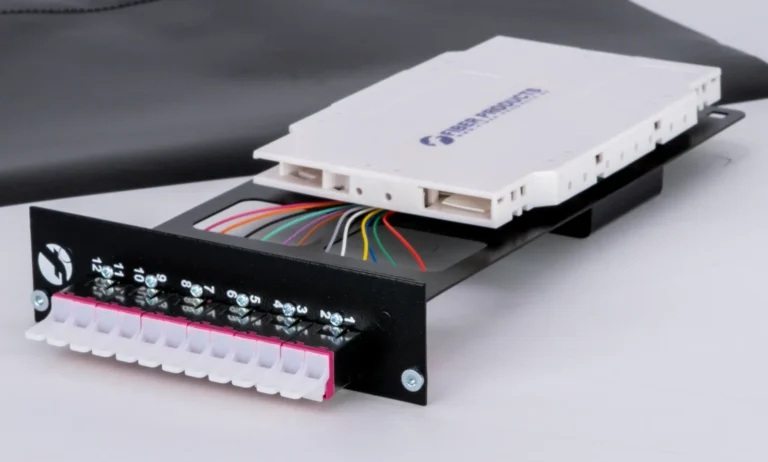
Modern splice technology can significantly improve efficiency in fibre civil works Eastern Germany, FTTH trenching new federal states. The key lies in pre-fabrication and modular design, which reduces installation times.
Fiber Products Quality Promise: As an official Diamond Partner and manufacturer, we produce modular splice modules in Europe. Benefit from Swiss precision and in-house manufacturing.
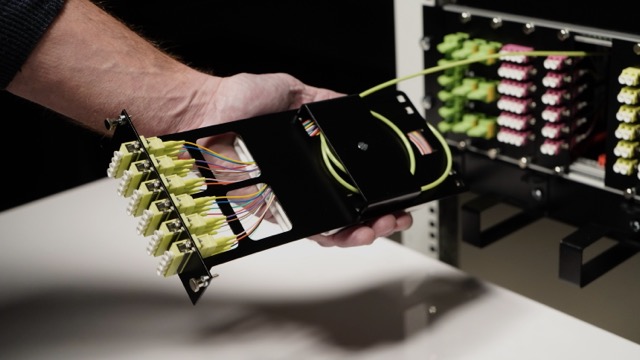
The advantages of modular systems are particularly evident in municipal projects in Saxony, where an average of 96 fibres per location must be spliced. With high-density 1HE splice boxes, the same fibre count can be accommodated in a quarter of the usual space requirement.
Technical Requirements for Civil Works Companies: Standards and Regulations
For successful FTTH projects in Eastern Germany, civil works companies must meet specific technical standards. The most important standards for fibre rollout are:
- DIN VDE 0888-1000: Base standard for optical fibre outdoor cable
- IEC 61300-3-35: Attenuation measurement on connectors (max. 0.25 dB)
- EN 50173-1: Application-neutral communication cable systems
- ZTV TKNetz 40: Additional technical contract terms for civil works
- OTDR measurements: Per ITU-T G.650.3 for quality assurance
Compliance with bend radius per IEC 60794-1-21 is particularly critical. Improper installation creates microbends, leading to attenuation losses exceeding 2 dB/km.
Funding and Municipal Strategies for Fibre Rollout 2026
The funding landscape for fibre civil works Eastern Germany, FTTH trenching new federal states has improved significantly in 2026. Municipalities can benefit from various programmes:
| Funding Programme | Grant Amount | Availability Eastern Germany |
|---|---|---|
| Federal Gigabit Funding | Up to €1,900 per connection | All three federal states |
| Digital Pact Saxony | 75% of civil works costs | Saxony only |
| Broadband Invest Brandenburg | 90% in structurally weak areas | Brandenburg |
| Thuringia Development Bank | Up to €50 million per project | Thuringia |
Municipalities like municipal utilities increasingly pursue self-funded rollout combined with grants. The advantage: full control over network quality and deployment speed.
Splice Technology Innovation: Time Savings through Pre-Fabrication
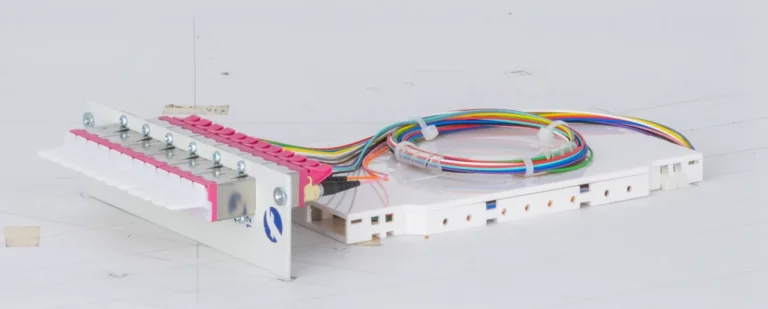
The largest time saving in Eastern Germany FTTH civil works comes from pre-fabricated splice modules. Instead of splicing on-site, finished modules with LC, SC or E2000 connectors are deployed.
- Time saving: significant for each 24-fibre module
- Error reduction: Factory-tested attenuation values below 0.15 dB
- Weather independence: No splice work in rain or frost
- Documentation: Factory protocol for every single fibre
- Replaceability: Defective modules replaced quickly
Modular design enables a complete multi-family building with 48 residential units to be connected in under three hours – provided civil works are completed.
Comparison: Conventional vs. Modular Fibre Deployment in Eastern Germany
Direct comparison shows efficiency advantages of modular systems in fibre civil works Eastern Germany, FTTH trenching new federal states:
| Criterion | Conventional Splice Box | Modular System (e.g. SlimConnect) |
|---|---|---|
| Installation time 96 fibres | High | Low |
| Space requirement | 4 RU | 1 RU |
| Flexibility | Permanently spliced | Interchangeable modules |
| Documentation effort | Manual on-site | Factory protocols supplied |
| Maintenance | Complete replacement needed | Individual modules replaceable |
| Investment protection | 10 years | 20+ years through modularity |
Practical Examples of Successful FTTH Projects in Saxony, Thuringia and Brandenburg
Real projects show how fibre civil works Eastern Germany, FTTH trenching new federal states progresses despite capacity constraints. In Lausitz, the use of modular splice systems reduced project duration.
A mid-sized civil works firm from Erfurt reports significant efficiency gains from switching to pre-fabricated systems. Assembly times fell from an average of 12 to 7 working hours per distribution point. Factory pre-fabrication pays off especially in winter conditions.
In Brandenburg, a municipal network operator uses high-density E2000 connectors per Diamond Standard. Vibration-resistant connections with IP65 protection are optimal for harsh outdoor conditions.
Quality Assurance in Civil Works: Measurement Methods and Documentation
Quality control during fibre deployment requires precise measurement methods. Civil works companies must document the following parameters:
- Attenuation measurement: Maximum 0.35 dB/km at 1310 nm wavelength
- OTDR protocols: Complete documentation of all splice points
- Connector attenuation: Below 0.25 dB per connection
- Return loss: Minimum 45 dB for PC connectors, 60 dB for APC
- Polarisation mode dispersion: PMD value below 0.2 ps/√km
Modern measurement equipment stores all values digitally and creates automated acceptance protocols per DIN EN 61280-4-2. This significantly reduces documentation effort.
Future Outlook: Fibre Deployment in Eastern Germany to 2030
Forecasts for fibre civil works Eastern Germany, FTTH trenching new federal states show: without massive capacity expansion, targets are unrealistic. The DIW forecasts another 3.4 percent growth in civil works volume for 2027.
Solution approaches for the coming years include increased vocational training, simplified permit procedures and consistent use of time-saving technologies. Modular splice systems with up to 288 fibres on 3RU will become standard for larger distribution points.
Integration of MPO/MTP connectors for mass connections reduces installation times further. A 144-fibre backbone can be connected in a very short time – work that conventionally takes a full day.
Action Recommendations for Civil Works Companies and Municipalities
Based on current challenges, concrete recommendations emerge for successful FTTH projects:
- Early planning: Allow minimum 12 months lead time for civil works capacity
- Modular systems: Invest in interchangeable splice modules for future-proofing
- Standards training: Regular further education on DIN VDE 0888 and microduct technology
- Quality partners: Work with certified manufacturers (e.g. Diamond Partners)
- Funding: Full utilisation of available programmes
- Documentation: Digital capture of all measured values for future expansions
Frequently Asked Questions on Fibre Civil Works Eastern Germany
How long does fibre deployment take for a 5,000-resident municipality in Saxony?
With optimal planning and available civil works capacity, expect 18-24 months construction time. Preparation (planning, permits) takes an additional 6-9 months. With modular splice systems, pure installation time can be reduced.
What port density is optimal for municipal FTTH projects in Eastern Germany?
For typical distribution points in residential areas, 96 fibres on 1RU is recommended. This covers 40-50 households and allows reserves for commercial customers. Larger hubs benefit from 288 fibres on 3RU with modular design.
When is it worthwhile to use E2000 connectors instead of LC connections?
E2000 connectors with IP65 protection and automatic shutter are especially suitable for outdoor distribution cabinets and industrial environments. The higher investment above LC pays back through longer lifespan and lower failure rates within 3-5 years.
How do modular splice systems reduce installation time in civil works?
Pre-fabricated modules eliminate time-consuming on-site splicing. A 24-fibre module is installed quickly, while manual splicing takes considerably longer. In bad weather, waiting time is also eliminated.
Which standards must civil works companies observe during fibre deployment in Brandenburg?
The requirements come in layers rather than from one standard. The old national outdoor-cable standard DIN VDE 0888-3 was withdrawn in 1999; current optical cable requirements sit in the European standards adopted into the VDE 0888 classification. The civil works and the reinstatement of the surface follow the road authority’s rules and the construction specifications named in the contract, and acceptance follows the measurement procedures the tender specifies. Take the exact designations from the current tender documents.
What is realistic FTTH deployment speed in Thuringia?
With current capacity, specialised civil works firms achieve 50-80 household connections per week. With parallel work by multiple crews and modular technology, up to 150 connections are possible. The bottleneck remains the limited number of qualified civil works firms.
Conclusion: Strategic Decisions for Successful Fibre Deployment
The fibre civil works in Eastern Germany demands strategic foresight. Success depends on three factors: qualified personnel, modern technology and forward planning. Municipalities that invest early in modular infrastructure and work with certified partners will reach their 2030 targets on schedule and within budget.
Request a Quote
Do you have questions about our fibre solutions? Our expert team will be happy to advise you – free and without obligation.