AI Data Centres 2026: Fibre Optic Requirements for GPU Clusters and AI
AI Data Centres 2026: Fibre Optic Requirements for GPU Clusters and AI
AI data centres face fundamentally new demands on fibre optic infrastructure in 2026: 1.6-Terabit connections are becoming the standard, while GPU clusters require high-density optical fibre systems with over 9,000 fibres per rack.
The transition from AI training to industrial inference in hyperscale data centres creates entirely new requirements for fibre optic infrastructure. Modular systems with up to 96 fibres on 1RU and latencies under 1 millisecond become a fundamental prerequisite for high-performance GPU clusters.
Technical Fundamentals: Why AI Data Centres Need Different Fibre Optic Architectures
AI workloads differ fundamentally from traditional data centre applications. GPU clusters for machine learning generate massive parallel data streams with extreme bandwidth requirements. A single GPU server today can already require 8 x 200G connections – and the trend is upwards.
The key lies in communication structure: whilst traditional applications primarily generate north-south traffic, AI clusters are dominated by east-west traffic between GPUs. This leads to exponential growth in the required fibre connections within the data centre.
- Traditional architecture: 48 fibres per rack sufficient
- AI GPU clusters 2024: up to 3,000 fibres per rack
- AI hyperscalers 2026: over 9,000 fibres per rack required
- Latency requirements: < 1 microsecond between GPUs in the same cluster
- Loss budget: maximum 0.25 dB per connection for error-free transmission
Current Market Development in DACH for AI Infrastructure
Deutsche Telekom invests billions annually in expanding AI-capable fibre optic infrastructure. Frankfurt in particular is emerging as the central hub for AI data centres in Europe, with direct connections to Amsterdam and London via new subsea cables.
| Location | AI Capacity 2024 | Planned Expansion 2026 | Fibre Density |
|---|---|---|---|
| Frankfurt | 450 MW | 850 MW | up to 12,000 fibres/rack |
| Munich | 180 MW | 380 MW | up to 8,000 fibres/rack |
| Hamburg | 120 MW | 320 MW | up to 6,000 fibres/rack |
| Berlin | 200 MW | 450 MW | up to 9,000 fibres/rack |
The Federal Government’s National Data Centre Strategy specifically promotes investment in AI-capable infrastructure. Eurofiber is simultaneously expanding latency-optimised routes between major data centre locations, essential for distributed AI training across the DACH region.
Fibre Types and Connector Systems for GPU Cluster Networks
Selecting the right fibre optic type and connector systems is crucial for the performance of AI data centre fibre optic installations. Singlemode fibres per ITU-T G.652.D remain the standard, whilst for shorter distances within the cluster, OM5 multimode is increasingly deployed.
- OS2 Singlemode: Unlimited bandwidth, ideal for spine-leaf architectures
- OM5 Multimode: Cost-effective for connections up to 100 metres
- Hollow-core fibres: 30% lower latency, entering first production systems from 2026
- Bend-insensitive fibres per G.657.A2: Essential for high-density cabling
MPO/MTP connectors dominate for rapid scaling. For critical single connections, leading data centres rely on E2000 connectors with their superior return loss of >85 dB.
Fiber Products Quality Promise: As an official Diamond Partner and manufacturer, we produce modular splice systems in Europe. Benefit from Swiss precision and in-house manufacturing.
High-Density Splice Systems: The Key to Scalability
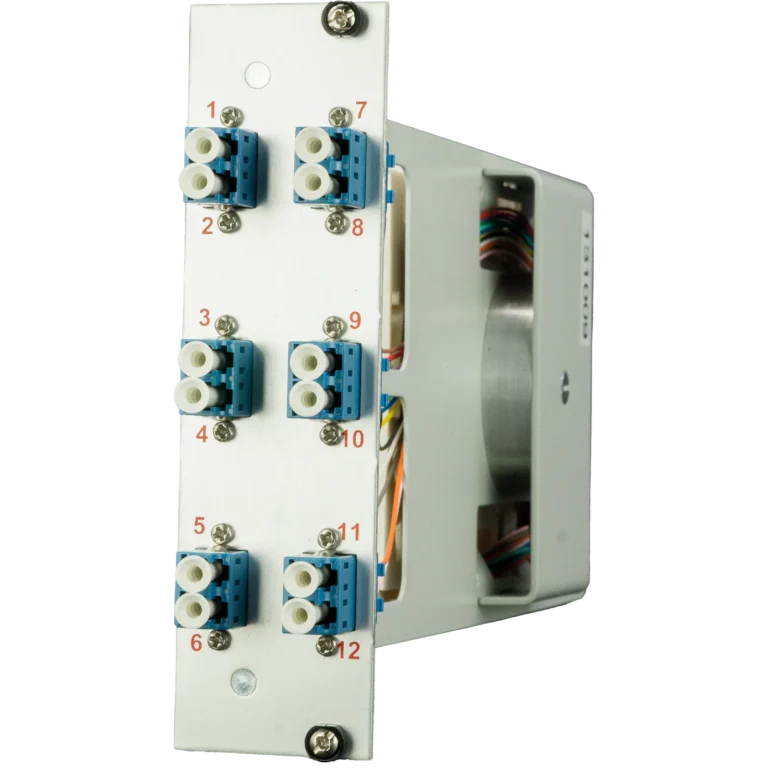
Modular splice systems form the backbone of any AI data centre fibre optic infrastructure. Demands on packing density and flexibility reach new dimensions in 2026: up to 288 fibres on 3RU become the minimum standard.
The challenge lies not only in raw fibre count, but in simultaneously ensuring accessibility and maintainability. Modern systems such as VarioConnect enable individual fibre access without affecting neighbouring connections – critical during live GPU cluster operation.
| System Type | Rack Units | Max. Fibres | Fibres per RU | Suitability for AI |
|---|---|---|---|---|
| SlimConnect | 1RU | 96 | 96 | Edge AI systems |
| VarioConnect | 3RU | 288 | 96 | GPU clusters |
| DIAMOND subrack | 4RU | 144 | 36 | Cable-management-intensive sites |
Thermal Management and Cabling for 300 kW Racks
AI racks with over 300 kW power consumption create entirely new demands on cabling management. The fibre optic infrastructure must coexist with liquid cooling systems without impeding airflow or complicating maintenance.
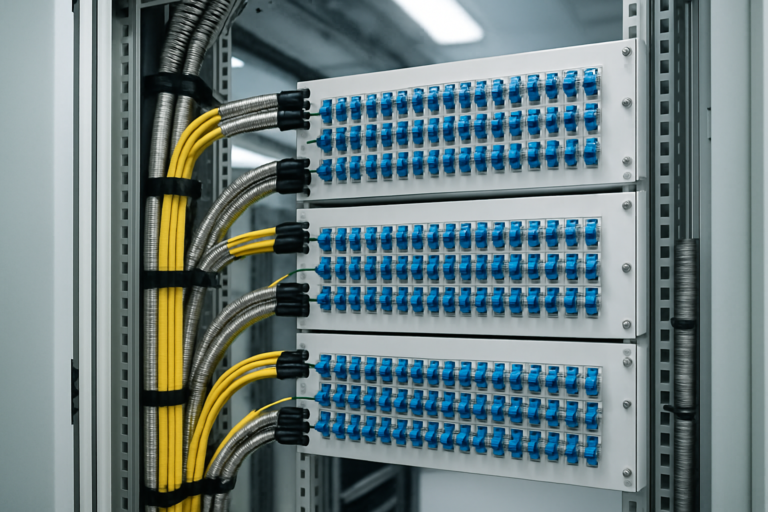
Pre-terminated high-density assemblies reduce cable volume by up to 70 per cent compared to individual fibre installations. This creates necessary space for cooling lines and simultaneously improves clarity.
- Use of micro-cables with 2 mm diameter for maximum space utilisation
- Separation of fibre and power routing for EMC optimisation
- Redundant fibre routing via separate pathways for maximum availability
- Colour coding per TIA-606-C for rapid fault identification
- Documentation of every fibre in digital twins
CPO Preparation: Co-Packaged Optics as Next Evolution
Co-Packaged Optics (CPO) integrate optical transceivers directly into GPU and switch chips. This technology promises 80 per cent energy saving in signal transmission and will reach first production environments from 2026.
Preparing the fibre optic infrastructure for CPO requires strategic decisions today. Data centres must design their cabling to enable later transition without complete overhaul.
Modular systems with interchangeable faceplate modules offer decisive advantages here. The ability to upgrade from MPO to new VSFF connectors without renewing the entire infrastructure saves millions during migration.
Standards and Norms for AI Fibre Optic Infrastructure 2026
Standardisation lags behind technical development. Whilst IEEE 802.3 still works on 1.6T standards, leading hyperscalers already implement proprietary 3.2T solutions. For planners, this means increased diligence in system selection.
- IEC 61754-15: New requirements for E2000 connectors in AI environments
- TIA-942-C: Revised data centre standards with AI focus
- ISO/IEC 11801-6: Cabling for distributed building automation
- EN 50173-6: European standard for data centre cabling
- ANSI/TIA-568.3-E: Optical transmission paths for high bandwidths
Particularly critical is observance of attenuation budgets. At 400G and 800G Ethernet 1.5 dB total loss – every additional connection must be carefully planned.
Practical Implementation: From Design to Installation
Planning AI data centre fibre optic infrastructure begins with precise demand analysis. GPU clusters require not only high bandwidth but also deterministic latency and minimal packet loss.
A typical design for an 8-GPU server cluster requires at least 64 singlemode fibres for interconnects plus additional connections for management and redundancy. The Diamond splice boxes offer maximum flexibility here with their modular design.
| Planning Step | Time Required | Critical Factors | Tools |
|---|---|---|---|
| Demand analysis | 2–3 weeks | GPU count, topology | Network simulation |
| System design | 3–4 weeks | Scalability, redundancy | CAD planning |
| Installation | 4–6 weeks | Precision, testing | OTDR, power metre |
| Commissioning | 1–2 weeks | Documentation | Certification |
Test Equipment and Quality Assurance for GPU Cluster Networks
Quality assurance for AI data centre optical fibre installations requires high-precision test equipment. Every connection must be individually certified – with 9,000 fibres per rack, a significant challenge.
Modern OTDR devices with automatic evaluation reduce test time per fibre to under 30 seconds. Documentation occurs digitally with direct transfer to management systems.
- Attenuation measurement at 1310 nm and 1550 nm for singlemode
- Return loss minimum 50 dB for standard applications
- Chromatic dispersion testing for connections over 10 km
- Polarisation mode dispersion (PMD) for 100G and above
- End-face inspection at 400x magnification
Maintenance and Lifecycle Management in AI Environments
AI data centres operate with availability requirements of 99.999 per cent. Maintenance windows are virtually non-existent, which is why the fibre optic infrastructure must deliver maximum reliability.
Preventive maintenance includes regular connector cleaning, bend radius verification and attenuation value monitoring. Modern systems integrate optical monitoring directly into the infrastructure.
Expected lifespan of fibre optic installations exceeds 25 years. However, rising bandwidth requirements necessitate active component upgrades every 3–5 years. Modular systems with 5 years’ warranty provide investment security.
Future Outlook: AI Infrastructure 2028 and Beyond
Development of AI data centre fibre optic technology is accelerating. Experts forecast first commercial implementations of 6.4T connections and fibre densities exceeding 20,000 per rack by 2028.
- Quantum computer integration requires specialised singlemode fibres
- Photonic processors eliminate electro-optical conversion
- AI-driven real-time network optimisation
- Self-healing fibre optic networks through redundant paths
- Integration of sensing into every fibre for precise monitoring
The DACH market is optimally positioned by its central European location and strong industrial base. Investment in fibre optic infrastructure creates the foundation for Europe’s digital sovereignty in the AI age.
FAQ: Common Technical Questions on AI Fibre Optic Infrastructure
What fibre count does a typical 8-GPU server require?
An 8-GPU server with current architecture requires at least 64 singlemode fibres for GPU interconnects, plus 16 fibres for uplinks and 8 fibres for management – total 88 fibres. With redundancy, we recommend 96 fibres, which exactly matches the capacity of one SlimConnect 1RU module.
How do APC and PC connectors differ in AI applications?
APC connectors (angled physical contact) meet return loss grade 1 to IEC 61755-1/-2-2, defined as ≥60 dB; non-angled PC connectors fall under grades 2 to 4 (≥45, ≥35, ≥26 dB). DIAMOND specifies ≥70 dB return loss for the E-2000 APC versus ≥50 dB for the PC version. No standard mandates APC, but its lower back-reflection makes it the preferred choice in dense AI fabrics.
What role do splice modules play in CPO migration?
Modular splice systems enable gradual transition to CPO without complete replacement. Through interchangeable faceplate modules, existing MPO connections can be upgraded to new VSFF standards. Investment in high-quality splice modules with 5 years’ warranty secures future capability.
How critical is observance of bend radius for high-speed connections?
At 400G and above, falling below the minimum bend radius of 30 mm (G.657.A2) causes measurable packet loss. Modern bend-insensitive fibres tolerate 15 mm, offering decisive advantages in high-density environments.
What test equipment is required for GPU cluster cabling acceptance?
Minimum requirements: OTDR with 1 m resolution, power metre for 1310/1550 nm, microscope at 400x magnification for end-face inspection, and chromatic dispersion analyser for spans over 2 km. Total investment ranges from €25,000 to €35,000.
How can downtime during maintenance be minimised?
Through consistent A/B path redundancy and use of modular systems like VarioConnect. The ability to swap individual cassettes during operation reduces maintenance windows considerably.
Conclusion: Strategic Direction for AI-Capable Fibre Optic Networks
The transformation to AI data centre fibre optic, GPU cluster network and AI data centre optical fibre infrastructure requires more than just higher bandwidths. It represents a fundamental reorientation of optical network architecture with focus on ultra-low latency, maximum packing density and absolute reliability.
Successful implementations rely on modular, scalable systems with proven quality. Choice of manufacturers with European manufacturing, long-term support and robust warranties proves decisive.
Request a Quote
Have questions about our fibre optic solutions? Our expert team is happy to advise you – free and without obligation.