Government Procurement of Fibre Optics – Tenders and Awards Procedures Done Right
Government fibre optic tenders, public optical fibre procurement, and VOB fibre specifications are subject to simplified award procedures with new value thresholds from 2025, which will significantly ease the burden on municipal contracting authorities when procuring modular fibre-optic systems. Direct awards up to €100,000 and restricted tenders up to €150,000 enable faster procurement processes for splice boxes, distribution modules, and fibre-optic infrastructure in the public sector.
The Gigabit Directive 2.0 fundamentally shapes the current tender landscape for fibre-optic projects in German public authorities. In parallel, federal states such as North Rhine-Westphalia are abolishing state-level value thresholds and introducing nationwide standards.
New Procurement Guidelines 2025/2026 for Public Fibre-Optic Projects
Government procurement of fibre-optic components is experiencing significant simplifications through the VOB/A reform. From January 2025, uniform thresholds for construction services apply, which are particularly relevant when procuring splice modules and distribution systems:
| Award Type | Previous Threshold | New Threshold from 2025 | Fibre-Optic Application |
|---|---|---|---|
| Direct Award | €10,000 | €50,000 | Splice boxes, patch cables |
| Direct Procurement | €10,000 | €100,000 | Complete 1U systems |
| Restricted Tender | €10,000 | €150,000 | Multiple distribution sites |
This increase in value thresholds enables public administrations to procure high-quality fibre-optic systems directly without costly Europe-wide tenders. Authorities particularly benefit from faster procurement procedures when modernising existing distribution infrastructure.
Technical Requirements for Public Procurement of Optical Fibre Systems
Fibre-optic infrastructure tenders require technical requirements for public contracts. When procuring modular splice systems, public authorities must observe the following standards:
- Conformity with IEC 61754 for connectors
- Compliance with DIN EN 50173 for structured cabling
- Attenuation values per IEC 61300-3-4
- Return loss per IEC 61300-3-6
- 19-inch compatibility per DIN 41494
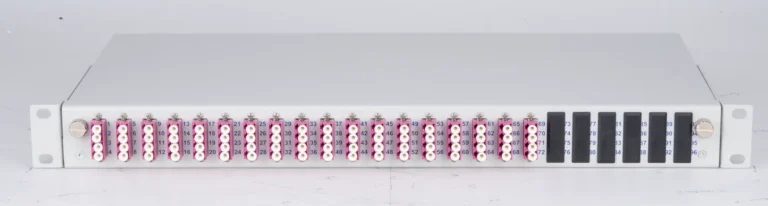
Modern splice modules must support at least 48 fibres per 1U, while high-density systems already enable up to 96 fibres. This port density is crucial for the cost-effectiveness of public fibre-optic projects.
VOB Fibre Procurement – Special Procurement Law Considerations
The VOB/A distinguishes between pure supply services and construction services with installation for fibre-optic projects. For public authorities, this means different award procedures depending on project scope.
For pure procurement of splice boxes and distribution systems without installation, the Unterschwellenvergabeordnung (UVgO) – the regulations for contracts below EU thresholds – applies. Direct awards can be made up to €25,000 net without further requirements.
Once installation and assembly work is added, VOB/A applies with its new value thresholds. Direct procurement up to €100,000 then enables rapid commissioning of complete system solutions including installation.
Fiber Products Quality Promise: As an official Diamond Partner and manufacturer, we produce modular splice systems in Europe. Benefit from Swiss precision engineering and in-house manufacturing.
Defining Award Criteria for Modular Fibre-Optic Systems
When tendering for government fibre-optic systems, technical minimum requirements must be formulated in a product-neutral manner. Key criteria for modular splice systems include:
| Criterion | Minimum Requirement | Weighting |
|---|---|---|
| Fibre Density | 48 fibres/1U | 25% |
| Connector Types | LC, SC, E2000 | 20% |
| Warranty Period | 3 years | 15% |
| Delivery Time | Max. 6 weeks | 20% |
| Price | Value for money | 20% |
The weighting of award criteria must be documented transparently. Quality aspects such as extended warranties of 5 years or European manufacturing can be included as additional evaluation criteria.
Gigabit Directive 2.0 – Meeting Subsidy Requirements
Public procurement of optical fibre infrastructure under the Gigabit Directive 2.0 is subject to special requirements. Funded projects must consider the broadband cost reduction model and ensure open network access.
When conducting funded tenders, public authorities must ensure that procured fibre-optic systems are technology-neutral and future-proof. In concrete terms, this means:
- Support for singlemode OS2 fibres for future-capable transmission rates
- Compatibility with GPON, XGS-PON and future standards
- Modular expandability for later capacity increases
- Documentation of all splices and connections
- Open interfaces for various network operators
Service Descriptions for Splice Modules and Distribution Systems
Legally compliant VOB fibre procurement requires detailed service descriptions. Public authorities should structure technical specifications for splice modules as follows:
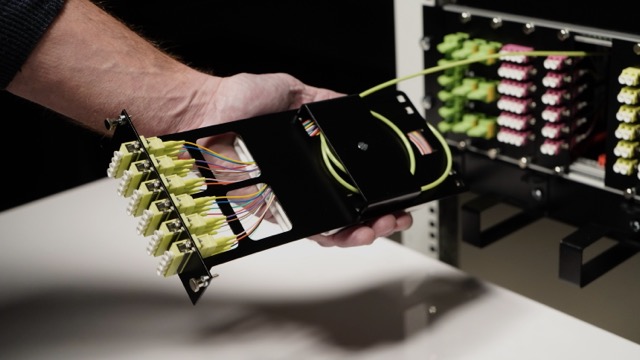
Mechanical Requirements: Systems must be integrable into 19-inch racks and have a height of 1U to maximum 4U. Front panels should be tool-free removable for rapid configuration changes.
Optical Parameters: Insertion loss maximum 0.25 dB for LC connectors, return loss at least 50 dB for APC polishes. Splice cassettes must accommodate 24 individual fibre splices or 12 ribbon cable splices.
Flexibility and Modularity: Interchangeable front modules for different connector types (LC, SC, E2000, ST, FC) without system modification. Modules should be hot-swappable during operation.
Tender Documentation and Value-for-Money Assessment
When conducting government fibre-optic tenders, contracting authorities must demonstrate the value for money of their decision. This applies particularly when using increased thresholds for direct procurement.
- Document market research with at least 3 comparable quotations
- Prove technical suitability of products through datasheets and certificates
- Calculate lifecycle costs including maintenance and spare parts availability
- Check and document compatibility with existing infrastructure
- Evaluate manufacturer warranties and service agreements
The tender file must present all decision-making bases transparently. Particularly for high-quality systems with 5 years’ manufacturer warranty, higher initial investment can be justified by lower total operating costs.
Quality Assurance in Public Procurement of Optical Fibre Components
Public contracting authorities must define and verify quality standards when procuring fibre-optic systems. Extended warranty services and certificates of origin are becoming increasingly important.
Certification Requirements: Manufacturers should be ISO 9001 certified and have their products tested according to IEC standards. For security-critical applications in government networks, these certifications are essential.
Manufacturing Location as a Criterion: Manufacturing in Europe or Germany can be factored in as a quality feature in the evaluation. Made in Germany as procurement standard or Swiss precision engineering stand for short supply chains and high manufacturing standards.
Framework Agreements for Continuous Fibre-Optic Procurement
For public authorities with regular fibre-optic component requirements, framework agreements are advisable. These enable flexible ordering without repeated tenders.
| Contract Type | Term | Benefits | Suitable For |
|---|---|---|---|
| Framework agreement with individual call-offs | 2–4 years | Flexible quantities, fixed prices | Municipal utilities, large administrations |
| Framework agreement with mini-competition | 3–4 years | Competition at each call-off | Federal authorities |
| Successive delivery contract | 1–2 years | Predictable deliveries | Continuous rollout |
For framework agreements covering modular splice systems, price escalation clauses and technical enhancements should be considered. The product range must remain available over the contract term.
Integrating Sustainability into VOB Fibre Procurement
Environmental aspects are increasingly important in public tenders. Government fibre-optic tenders can define sustainability criteria as award criteria:
- Recyclability of housing materials and packaging
- Demonstrate production energy efficiency
- Minimise carbon footprint through regional manufacturing
- Ensure longevity through high-quality materials and extended warranties
- Guarantee repairability through modular design
Modular systems with interchangeable components meet these requirements optimally. The ability to replace individual front modules or splice cassettes substantially extends the service life of the overall installation.
Practical Implementation – From Needs Assessment to Award
Successful public procurement of optical fibre infrastructure follows a structured process. Public authorities should involve technical departments and procurement offices early on.
Phase 1 – Needs Assessment: Determine required fibre count, connector types, and expansion stages. Plan for future growth with at least 30% capacity headroom.
Phase 2 – Market Research: Review available systems and manufacturers. Check reference projects from comparable public authorities. Obtain benchmark quotes for cost estimation.
Phase 3 – Tender Procedure: Select the appropriate procedure based on contract value and complexity. For standard products under €100,000, direct procurement is possible.
Frequently Asked Questions on Government Fibre-Optic System Procurement
Which connector types should public authorities consider when tendering for splice modules?
Government networks should support at least LC duplex for high port density and E2000 for security-critical applications. SC connectors remain relevant for legacy compatibility. Modules should accommodate different connector types without system modification.
How do I calculate the required fibre density for government fibre-optic projects?
Plan with 2 fibres per workstation plus 50% reserve for redundancy and expansion. For 100 workstations, this means 300 fibres, which modern 96-fibre systems in 1U can efficiently deliver.
What warranty periods are standard in VOB fibre procurement?
Standard coverage is 2–3 years’ manufacturer warranty. Premium manufacturers offer up to 5 years’ warranty on modular splice systems, significantly reducing total operating costs.
Must public authorities always select the lowest-cost bidder in fibre-optic tenders?
No, the most economically advantageous tender receives the award. This can be a more expensive offer if justified by better technology, longer warranty, or lower operating costs. Award criteria must be defined transparently in advance.
How do I document value for money in direct procurement up to €100,000?
Obtain at least 3 comparable quotations and document technical suitability. Justify your selection decision based on objective criteria such as port density, warranty duration, and compatibility.
Can framework agreements for fibre-optic components be extended retrospectively?
Framework agreements can be extended by maximum 50% of the original contract value if this was provided for in the tender. The term is limited to 4 years, or exceptionally 6 years.
Conclusion: Legally Compliant Fibre-Optic Procurement for Public Authorities
Government fibre-optic tenders are significantly simplified by new procurement thresholds. With direct procurement up to €100,000, public contracting authorities can rapidly and unbureaucratically procure high-quality splice systems. What remains crucial is precise technical specification and transparent documentation.
Modular fibre-optic systems with high port density, flexible connector options, and long warranty periods optimally meet the requirements of modern government networks. Investment in high-quality systems with 5 years’ warranty and European manufacturing pays off through lower operating costs and higher availability.
As a manufacturer of modular fibre-optic solutions and official Diamond Partner, Fiber Products supports public authorities in specifying and implementing their fibre-optic projects – with proven Swiss precision engineering quality and comprehensive warranty services.
Request a Quote
Have questions about our fibre-optic solutions? Our expert team will be happy to advise you – free of charge and without obligation.