Fibre Rollout Hamburg 2026: Hamburg Netz and Modular Splice Solutions
The fibre rollout Hamburg reaches a critical milestone in 2026 as Hamburg Netz FTTH projects undergo massive expansion with state-of-the-art splice modules Hamburg enabling efficient network connectivity. With an availability rate exceeding 65 per cent of Hamburg households, the Hanseatic city positions itself as a pioneer in German fibre optic deployment. Parallel rollout activities by Hamburg Netz, Telekom, and alternative network operators in Wandsbek, Harburg and Altona require modular splice systems with up to 96 fibres in 1U, meeting rising demands for packing density and scalability.
Hamburg Netz FTTH: Current Deployment Figures and Project Progress 2026
Fibre optic infrastructure in Hamburg is developing at impressive speed. Hamburg Netz, as the municipal network operator, has already connected 420,000 households with fibre-based infrastructure by January 2026. The rollout pace averages 8,500 new connections per month, with districts Wandsbek and Harburg particularly in focus.
In parallel, alternative network operators are driving competition forward. Wilhelm.tel already serves 180,000 households in the greater Hamburg area and continues to expand into outer districts. Deutsche Glasfaser concentrates on previously underserved districts, utilising modern laying techniques per DIN 18220.
- Hamburg Netz: 420,000 households connected (as of January 2026)
- Telekom Hamburg: 380,000 FTTH connections available
- Wilhelm.tel: 180,000 households in greater Hamburg
- Deutsche Glasfaser: 95,000 households under rollout or in planning
- Total Hamburg availability: 65% of all households with fibre optic connection
Technical Requirements for Splice Modules in Hamburg Netz FTTH Rollout
The massive fibre rollout Hamburg imposes special demands on splice technology employed. In dense urban areas, distribution points must terminate a maximum number of fibres in minimal space. Modern splice modules with 96 fibres in just 1U enable twice the packing density of conventional systems.
| Splice Module Type | Fibre Density | Rack Height | Hamburg Application |
|---|---|---|---|
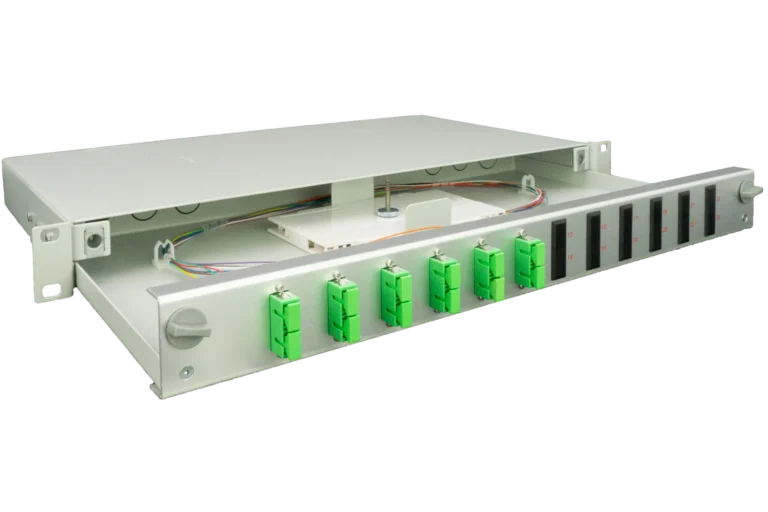
| SlimConnect | 96 Fibres | 1U | Street distributor city centre |
| VarioConnect 3U | 288 Fibres | 3U | District main distributor |
| Standard Modules | 48 Fibres | 1U | Legacy system expansion |
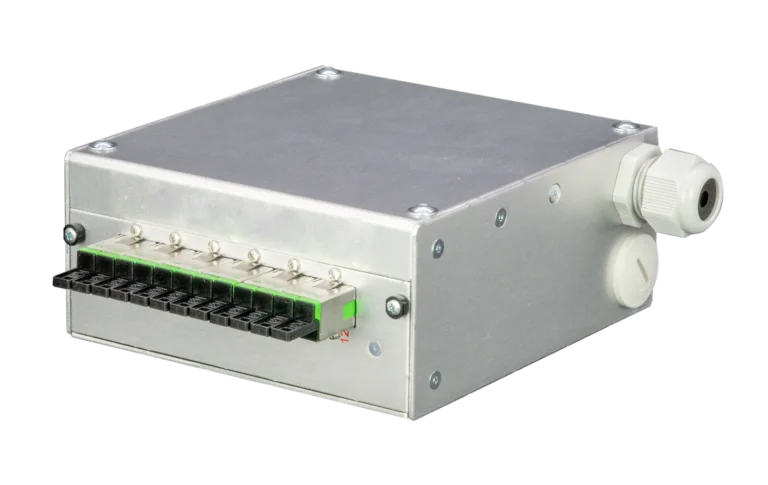
| DIN Rail Box | 24 Fibres | DIN Rail | Port area industrial zones |
Selection of the correct splice system directly influences rollout economics. For a typical street distributor in Hamburg-Wandsbek with 384 households to connect, conventional 48-fibre modules require eight rack units, whilst modular 96-fibre systems need only four rack units.
Regulatory Framework: EU Gigabit Regulation and Local Requirements
Since November 2025, the EU Gigabit Infrastructure Regulation is binding for Hamburg Netz FTTH projects. The regulation mandates that all new buildings and comprehensively renovated buildings be equipped with fibre-ready infrastructure. For Hamburg, this concretely means approximately 12,000 residential units annually must be equipped with preconfigured splice modules.
The Hamburg Building Authority has issued additional guidelines exceeding EU requirements. Splice modules in public buildings must provide at least 30 per cent spare capacity and be modularly expandable. This requirement favours systems with exchangeable cassettes and front panels.
Fiber Products Quality Promise: As an official Diamond Partner and manufacturer, we produce modular splice systems in Europe. Benefit from Swiss precision and in-house manufacturing for fibre rollout Hamburg.
Splice Module Hamburg: Installation Efficiency and Time Savings in Practice
Installation speed is a critical success factor in fibre rollout Hamburg. Preconfigured splice modules Hamburg reduce installation time per distribution point by up to 35 per cent. Compared with the average installation time of a conventional 48-fibre module, this represents a noticeable time saving per unit.
- Preconfigured couplers: No on-site assembly required
- Colour-coded cassettes per IEC 61754-15
- Tool-free front panel assembly
- Integrated strain relief for cables up to 24mm diameter
- Label fields per DIN EN 50173-1
An installation team in Hamburg-Harburg reports installing twelve distribution points per day with modular systems, compared to eight points with conventional technology. This efficiency improvement enables Hamburg Netz to achieve ambitious rollout targets.
Connector Variety and Standards Compliance for Hamburg Netz FTTH Networks
Heterogeneity of Hamburg’s fibre optic infrastructure requires splice modules Hamburg with flexible connector options. Whilst new construction projects predominantly employ LC connectors with APC polish, legacy networks often still use SC or E2000 connections.
| Connector Type | Attenuation | Hamburg Application | Standard |
|---|---|---|---|
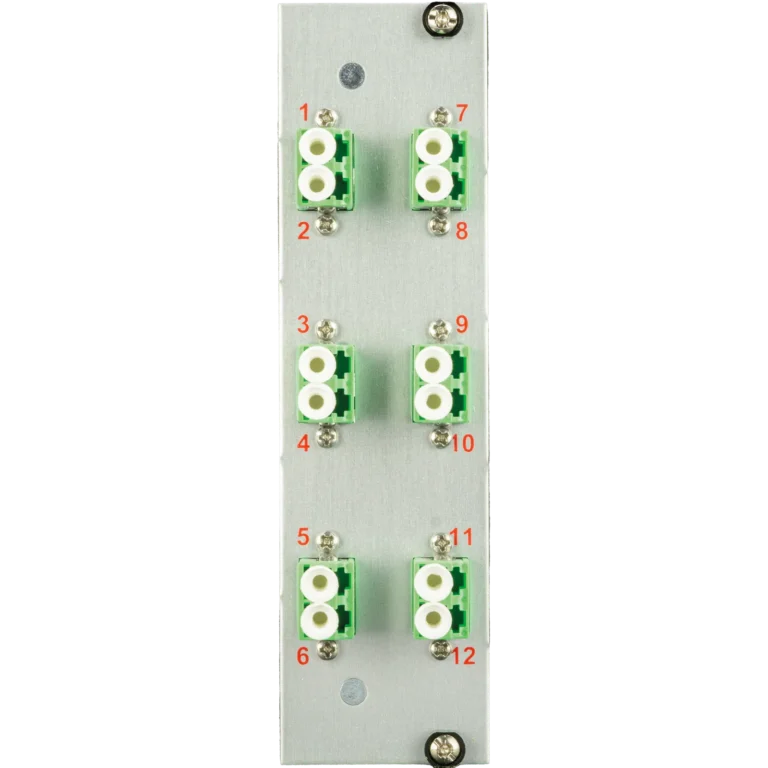
| LC/APC | < 0.25 dB | FTTH new buildings | IEC 61754-20 |
| SC/APC | < 0.30 dB | Legacy networks | IEC 61754-4 |
| E2000/APC | < 0.20 dB | Industrial connections | IEC 61754-15 |
| MPO/MTP | < 0.35 dB | Data centres | IEC 61754-7 |
The ability to combine different connector types in a single splice module is particularly important for transition phases. A modular system allows gradual replacement of SC with LC couplers without complete infrastructure redesign.
Density Strategies: Maximum Fibre Count in Minimal Space
Limited space in Hamburg street distributors and equipment rooms makes density strategies essential. Modern splice modules Hamburg employ various space optimisation techniques. Staggered arrangement of splice cassettes enables 96 fibres in 1U with full accessibility to all connections.
Using slim cassettes at just 3mm height instead of conventional 5mm cassettes creates space for additional fibre levels. Combined with angled couplers and optimised cable routing, modern systems achieve 100 per cent higher packing density than solutions from a decade ago.
- Slim cassettes: 3mm height per industry standard
- Angled LC couplers: space saving
- Overlapping cable routing: bend radius >30mm maintained
- Removable cassettes for maintenance work
- Colour coding per TIA-598-C for quick identification
Quality Assurance in Fibre Rollout Hamburg: Measurement Procedures and Documentation
Hamburg Netz requires comprehensive quality records for all FTTH installations. Each splice operation must be documented with an OTDR measurement report demonstrating attenuation values below 0.25 dB at 1310nm and 0.30 dB at 1550nm. Employed splice modules must guarantee these values even after repeated connections.
Return loss must be at least 60 dB for APC connectors. Modular systems with factory-assembled and tested pigtails ensure consistent achievement of these values. Continuous serial number tracking enables complete documentation from manufacturer to installed distribution point.
Hamburg Netz acceptance criteria are stringent. Beyond optical parameters, mechanical execution is also inspected: strain reliefs must withstand 100 Newtons, connector interfaces must survive at least 500 connection cycles without degradation.
Future-Proofing: Migration to Higher Transmission Rates
The fibre rollout Hamburg must meet not only current but also future requirements. Whilst GPON at 2.5 Gbit/s downstream is predominantly deployed today, Hamburg Netz FTTH already plans migration to XGS-PON with 10 Gbit/s symmetrical.
Splice modules Hamburg must support this evolution without complete passive infrastructure replacement. Modular systems with exchangeable splitter cassettes enable transition from 1:32 to 1:64 splitting ratios. Singlemode fibres per ITU-T G.652.D are already designed for wavelengths to 1625nm.
- Current GPON technology: 2.5 Gbit/s down / 1.25 Gbit/s up
- XGS-PON from 2027: 10 Gbit/s symmetrical
- Future 25G-PON: 25 Gbit/s for business customers
- Wavelength multiplexing: parallel operation of different technologies
- Backward compatibility ensured through modular architecture
Cost Efficiency Through Modular Splice Systems: Economic Analysis
Economics of fibre rollout Hamburg depend substantially on system costs. Modular splice systems reduce total operating costs through multiple factors. Higher packing density saves floor space – a relevant factor at €25 per square metre rental costs in Hamburg equipment rooms.
Preconfiguration reduces installation times and therefore labour costs. At €65 per hour for qualified installers and 16-minute time savings per module, savings amount to approximately €17 per installation. Across 1,000 distribution points in Hamburg, this totals €17,000 cost advantage.
The 5-year warranty on high-quality splice modules minimises failure risk and unplanned maintenance costs. Modular systems also enable staged investment – initially only required ports are populated, expansions follow as needed. This optimises capital deployment and avoids overinvestment.
FAQ: Frequently Asked Questions on Splice Modules in Hamburg Netz FTTH Rollout
What fibre density is optimal for Hamburg Netz FTTH projects?
For urban distribution points in Hamburg, 96-fibre modules in 1U are recommended. These offer the best balance of packing density and handling. Main distributors employ 288-fibre systems in 3U.
Must splice modules for Hamburg have special certifications?
Yes, Hamburg Netz requires CE marking, compliance with IEC 61300-3-35 for optical properties and DIN EN 50173-1 for structured cabling. Additional RoHS compliance documentation is also required.
How is migration from copper to fibre accomplished in existing buildings?
Existing buildings often employ hybrid splice modules accommodating both legacy SC connections and new LC ports. Modular design enables gradual replacement without service interruption.
What advantages do preconfigured modules offer versus on-site spliced modules?
Preconfigured modules are terminated and measured under controlled factory conditions, so each fibre is delivered with a documented insertion loss value from a repeatable process. This removes much of the workmanship variation of on-site termination and shortens the work required in the field. The applicable loss limits depend on the connector performance grade specified for the product.
How is documentation of splice points for Hamburg Netz accomplished?
Each splice module receives a unique serial number recorded in central network documentation. OTDR measurement reports are digitally archived. QR codes on modules enable mobile access to installation data.
Are modular systems compatible with planned 25G-PON technology?
Yes, high-quality modular splice systems with singlemode fibres per ITU-T G.652.D support wavelengths to 1625nm and are thus 25G-PON ready. Only active components require replacement.
Recommendations for Successful FTTH Rollout
The fibre rollout Hamburg requires strategic decisions in system selection. Municipal utilities and network operators should choose modular splice systems combining flexibility with economy. Investment in high-quality systems with 5-year warranty delivers returns through reduced operating costs.
For detailed advice on modular splice solutions and their optimal deployment in Hamburg’s FTTH network, Fiber Products experts are available. Fiber Products for municipal utilities serves as Diamond Partner and European manufacturer, offering complete system solutions from planning through installation. Further information on high-density splice modules with up to 96 fibres is available in the technical product catalogue.
Interested in modular fibre optic solutions?
Fiber Products GmbH – official DIAMOND SA Partner. Made in EU, 5 years warranty.