XGS-PON vs. GPON: XGS-PON migration to 10 Gbit/s symmetrical – when is the switch worthwhile?

The technological leap from GPON to XGS-PON is revolutionizing the fibre optic industry and requires strategic decisions from network operators worldwide. With symmetrical 10 Gbit/s connections, a professional XGS-PON migration opens up new dimensions for broadband providers, municipal utilities and telecommunications companies. But when does the technology migration justify the considerable investment?
This comprehensive guide analyzes the technical differences, economics and strategic considerations for migrating to the next generation of PON. A systematic XGS-PON migration requires careful planning, but the benefits of symmetrical fiber optic transmission justify the effort for forward-looking network operators.
Modern telecommunications networks face the challenge of coping with exponentially growing bandwidth requirements. A well thought-out migration offers the solution to this challenge through revolutionary performance increases and future-proof infrastructures for fiber optic solutions for telecommunications providers.
GPON vs. XGS-PON: The fundamental technical differences
A successful migration starts with understanding the technological evolutionary steps. XGS-PON is an updated standard for Passive Optical Networks (PON) that supports higher symmetrical data transmission at 10 Gbit/s and belongs to the gigabit-capable PON family of standards. The “X” stands for “10”, the letter “S” for “symmetrical” – XGS-PON therefore means “10 Gigabit Symmetrical PON”.
The evolution of PON technology shows clear leaps in performance: GPON (Gigabit-PON) offers 2.5 Gbit/s downstream and 1.25 Gbit/s upstream, XG-PON achieves 10 Gbit/s downstream with 2.5 Gbit/s upstream (asymmetrical), while XGS-PON enables symmetrical 10 Gbit/s downstream and upstream. This symmetry makes the decisive difference for modern applications.
A direct comparison of technical performance parameters illustrates the advantages of an XGS-PON migration: while GPON offers asymmetric rates of just 2.5 Gbit/s downstream and 1.25 Gbit/s upstream, XGS-PON enables symmetric 10 Gbit/s in both directions. This symmetrical transmission is particularly relevant for modern applications that require high upload speeds.
Range and splitting ratios
XGS-PON considerably extends the technical possibilities compared to GPON systems. While GPON has a maximum physical transmission distance of 60 km and a maximum split ratio of 1:128, a modern XGS-PON migration enables transmission distances of up to 100 km with maximum split ratios of 1:256.
Wavelength management is a critical difference. XGS-PON utilizes the wavelength of 1577 nm downstream and 1270 nm upstream. The main reason is the coexistence capability: multiple PON services can coexist on the same PON and allow seamless upgrades during XGS-PON migration.
The infrastructure compatibility simplifies migration projects considerably. Since XGS-PON wavelengths differ from other standards such as G-PON and NG-PON2, the PON transmission window from 1260 nm to 1650 nm supports the simultaneous transmission of different standards over the same fiber optic network.
Coexistence capabilities and parallel standards
Parallel operation of different standards during migration minimizes migration risks and service interruptions. The different wavelengths enable network operators to run GPON and XGS-PON services in parallel during the transition period.
Combo transceivers for seamless migration revolutionize the implementation of new PON standards. Thanks to XGS/GPON Combo SFP+ and SFP-DD transceivers, service providers can offer both XGS-PON and GPON services over the same network. This greatly simplifies XGS-PON migration and makes it easier for network operators to update their services as needed.
Basically, combo optics have a wavelength combiner in the transceiver that enables OLT devices to communicate with two PONs simultaneously. This technology is crucial for a successful XGS-PON migration in fiber optic solutions for network operators.
Technical requirements for migration
Infrastructure assessment forms the basis of every XGS-PON migration. Existing fiber optic infrastructures must be checked for XGS-PON compatibility. The positive news: Although the fiber optics and data formatting for XGS-PON technology are identical to the original G-PON standard, only the wavelengths have been shifted.
Quality assurance during migration requires specialized measurement technology. A TruePON tester is a wavelength-selective level meter for passive optical networks that can also evaluate the TruePON PON ID. The wavelength selectivity ensures that individual downstream wavelengths are measured precisely to avoid borderline installations during the XGS-PON migration.
When does the XGS-PON migration pay off economically?
Application scenarios with a clear ROI justify immediate migration decisions. Enterprise and business customers with high bandwidth requirements benefit directly from an XGS-PON migration. Cloud computing, video conferencing in 4K/8K quality and data-intensive applications justify investments in symmetrical 10 Gbit/s connections.
Content creators and media production have special requirements: 4K streaming already requires approx. 25 Mbit/s, while the targeted 8K streaming would require approx. 50 Mbit/s. With XGS-PON, a bandwidth of 1.56 Gbit/s per customer is possible. Graphic designers, video producers and other content creators require high upload speeds for cloud-based workflows.
Smart City and IoT applications open up new markets for strategic XGS-PON migration. Municipal network operators and fiber optic solutions for public utilities can use XGS-PON as a backbone for smart city infrastructures. Sensor networks, intelligent traffic systems and IoT devices require reliable, high-performance connections.
5G backhaul and future applications
5G backhaul benefits optimally from XGS-PON technology. Optical fiber with XGS-PON is ideal for 5G connectivity thanks to its high performance and low latency. Thanks to the passive infrastructure, 5G sites can be connected to existing local structures for end customers, making the migration economically attractive.
In fact, 10G PON plays an important role in 5G expansion. Base stations must be connected to high-performance backhaul networks. Using XGS-PON, a provider can connect several 5G hotspots (e.g. via streetlights) without having to lay new cables for each base station.
Economic factors increasingly favor a timely XGS-PON migration. Falling equipment costs combined with performance benefits, new revenue growth opportunities and government investment programs for rural connectivity are motivating service providers to invest in technology.
Migration strategy: systematic step-by-step approach
Phase 1 of the XGS-PON migration begins with the coexistence setup. Technical preparation includes installation of combo transceivers that support both GPON and XGS-PON. This dual-standard capability minimizes migration risks and enables gradual transition without service disruptions.
Comprehensive Network Assessment prior to XGS-PON migration should carry out a comprehensive analysis of the current situation. Existing GPON infrastructures, customer distribution and bandwidth requirements determine the optimal migration strategy. Systematic planning prevents costly errors and delays.
Phase 2 focuses on selective customer migration with strategic prioritization. Premium customers should be prioritized for XGS-PON migration: Business customers, content creators and power users justify investments in XGS-PON equipment through immediate value-added usage.
Service level differentiation
Service level differentiation during the XGS-PON migration enables flexible business models. Different service providers can use the same PON or offer different service levels (e.g. for private users vs. business customers). This enables flexible pricing models and upselling opportunities.
Phase 3 of the XGS-PON migration includes a complete system changeover with professional time slot management. When switching technology from P2P to XGS-PON, service providers are given a choice of defined switching time windows. These usually extend over half a day and describe time windows for field work.
Customer device migration requires careful compatibility testing. End devices must be tested and approved before they can connect to XGS-PON networks. As XGS-PON is a shared medium, this check ensures that no customers are disturbed by non-approved devices.
Splicing technology and infrastructure requirements
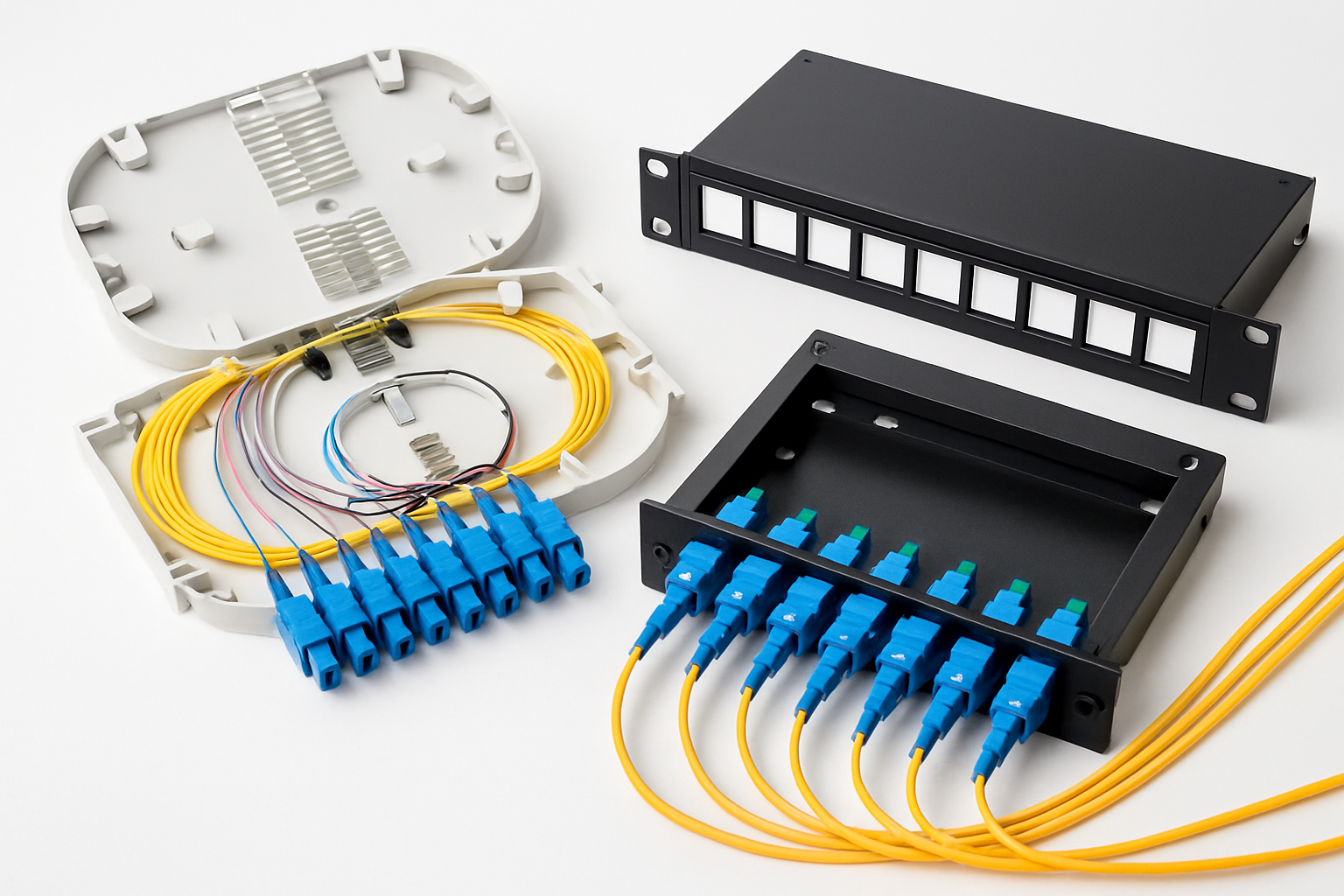
Adaptations to passive components are crucial for successful XGS-PON migration. Splice boxes and distributors must meet higher requirements for fiber optic connection quality. Professional splice cassettes must support extended wavelength ranges and guarantee the lowest attenuation values.
Splitter technology for XGS-PON requires precise optical components. The higher splitting ratios of XGS-PON (up to 1:256) require precise optical splitters and high-quality splices. Any additional attenuation reduces available reach and number of customers per PON port during migration.
Infrastructure compatibility simplifies migration considerably. The advantage of point-to-multipoint with XGS-PON is that active technology can be completely relocated from the network to the exchange without affecting the customer’s bandwidth.
Microducts and cable management
Microducts and optimized cable management reduce infrastructure complexity. Distributed splitters in the network infrastructure reduce the number of fibers and thus the microduct size in the distribution network, eliminating the need for power supply at distribution points and significantly reducing the size and power requirements at the exchange.
Existing fibre optic usage optimizes investments in the XGS-PON migration. This reduces investment costs (less material, less space required), accelerates network expansion and lowers operating costs. Point-to-multipoint networks not only make economic sense, they are also sustainable solutions.
Quality Assurance in modular 1U systems ensures optimum performance. The ability to measure individual PON wavelengths simultaneously is essential if upgrade plans provide for multiple services to be present in the same PON (“coexistence”).
Practical examples from the German fiber optic industry
Deutsche Telekom conducts pilot projects and develops rollout strategies for nationwide XGS-PON migration. Deutsche Telekom offers XG-PON networks in selected expansion areas, including Berlin and Darmstadt. Tariffs with 2 GBit can be booked there. Nationwide systems should be available by 2030.
Technical implementation at Telekom shows potential: “In future, we will have the 10-gigabit XGS-PON system. We will then be able to offer 10 gigabits downstream and 10 gigabits upstream in the same network structure.” For the first time, the upload will be just as fast as the download.
Regional providers and municipal utility projects demonstrate successful XGS-PON migration. M-Net and other providers are already operating their first XG-PON connections. M-net offers up to 5 GBit/s. These regional implementations show the potential for fiber optic solutions for system houses and municipal network operators.
German fiber optic expansion
Deutsche Glasfaser announced the launch of 10 Gbps services in cooperation with market-leading providers from April 2024. This signals the start of the commercial XGS-PON era in Germany and demonstrates the market readiness of the technology for full build-out projects.
Market dynamics and competitive pressure are accelerating the XGS-PON migration. In recent years, P2MP technology has become established, which has led to large international network equipment suppliers investing primarily in this technology. This leads to greater innovative strength and lower unit prices for the corresponding equipment.
Future proofing of investments shows clear market trends: XGS-PON will account for 55% of the total PON market by 2026, compared to only 15% in 2021. This market development underlines the strategic importance of timely technology migration.
Challenges and risks of XGS-PON migration
Technical challenges require careful planning and risk management. Compatibility problems can delay migration projects: The FRITZ!Box 5690 XGS should still be available specifically for the standard in 2025. Otherwise, there are currently only a few devices that are sold directly by providers.
Network performance challenges in the XGS-PON migration: Even with 1G connections, a small town could utilize DE-CIX to capacity. Higher bandwidths require corresponding backbone capacities and can expose bottlenecks in downstream network segments.
Economic risks must be carefully evaluated during the XGS-PON migration. Investment security through the use of existing network equipment eliminates the need for large capital investments in overarching network changes during the migration. However, OLT upgrades and new ONTs require significant investment.
Market acceptance and marketing
Market acceptance is a key challenge of the XGS-PON migration. For years, Internet connections have no longer been about continuous load due to the simultaneous use of services. Any 100 Mbps connection can handle the basic load, including video conferencing and streaming, without any problems. The challenge lies in marketing the actual added value.
Customer loyalty through symmetrical 10 Gbit/s connections creates strong differentiation. Switching to competitors with lower bandwidths becomes unattractive for customers who have experienced XGS-PON performance. This justifies premium pricing and improves customer lifetime value.
Technology leadership through early XGS-PON migration positions providers as innovation leaders. Early adopters can position themselves as technology leaders and win premium customers. Differentiation through speed and service quality justifies higher prices and creates competitive advantages.
Future developments: What comes after XGS-PON?
NG-PON2 and 25G-PON define the next evolutionary stage after the successful XGS-PON migration. There are already the first NG-PON2 network architectures that enable up to 40 GBit/s. These networks are still relatively expensive and complex and are primarily used for data centers and by wholesale providers such as Amazon.
25GS-PON tests show future possibilities: At the beginning of 2025, the Broadcast Forum in the USA carried out tests with 25GS-PON. As the name suggests, this should make 25 Gbit/s possible in the home in the future. It will probably be many years before PON2 is available for private customers.
Integration with 5G and edge computing significantly expands application scenarios. Network convergence through XGS-PON optimally supports 5G expansion. Edge computing requirements benefit from low latency and high bandwidth for local data processing with minimal delays.
Strategic decision criteria
Market positioning and competitive advantages through timely XGS-PON migration create sustainable differentiation. Technology leadership, customer loyalty and premium positioning justify investments even with initially limited customer use.
Investment planning and ROI analysis for XGS-PON migration require a lifecycle perspective. Step-by-step implementation through coexistence capability enables risk-minimized, gradual migration. Network operators can start with lucrative customer segments and expand gradually.
The lifecycle costs of XGS-PON migration show long-term benefits: investment costs are reduced (less material, less space required), network expansion is accelerated and operating costs are lowered. Point-to-multipoint networks are economical and sustainable.
Best practices for successful XGS-PON migration
Planning and project management are the foundation of successful technology migration. Comprehensive Network Assessment prior to XGS-PON migration should carry out a comprehensive analysis of the current situation. Existing GPON infrastructures, customer distribution and bandwidth requirements determine the migration strategy.
Phased rollout strategy minimizes risks and optimizes use of resources: pilot phase with test implementation in selected areas, business customer migration of commercial customers with high bandwidth requirements, premium residential upgrade of power users and early adopters, mass market with nationwide switchover.
Technical implementation of the XGS-PON migration requires a systematic approach. Combo transceiver deployment enables seamless coexistence during the transition phase. This minimizes service interruptions and significantly reduces migration risks.
Quality assurance and performance tests
Quality assurance through systematic OTDR measurements and performance tests ensures optimal network performance. Specialized measurement technology for XGS-PON migration is essential if upgrade plans require multiple services to be present in the same PON.
Vendor evaluation for XGS-PON migration should prioritize equipment suppliers with combo transceiver solutions. Long-term partnerships with technology leaders ensure access to the latest innovations and support for customized fiber projects.
Pilot Project Planning develops controlled test rollouts in selected areas. Lessons learned from pilot implementations optimize the full XGS-PON migration and reduce implementation risks for full-scale projects.
Recommendations for network operators
Immediate measures for strategic XGS-PON migration include technology assessment to evaluate existing GPON infrastructure for XGS-PON compatibility. Market Analysis to identify customers with high bandwidth requirements and ROI potential for early migration.
Medium-term strategy development expands service portfolios. Development of new services that take advantage of symmetrical 10 Gbit/s connections creates additional revenue streams. Cloud services, managed backup and B2B connectivity for the XGS-PON migration can be refinanced through additional wholesale revenues.
Partnership development with content providers, cloud providers and 5G operators allows XGS-PON Migration to refinance investments through additional wholesale revenues. Collaborations create win-win situations and accelerate ROI realization for technology upgrades.
Long-term positioning uses XGS-PON migration as a springboard for further PON evolution stages. Investments in modern optical infrastructure create the basis for 25G-PON and NG-PON2. Future Technology Readiness ensures that infrastructure investments are future-proof.
Ecosystem integration and smart city
Ecosystem integration of XGS-PON migration in comprehensive smart city and IoT strategies opens up new business models. High bandwidth and low latency support innovative applications in fiber optic solutions for educational institutions and municipal projects.
Service portfolio expansion through XGS-PON migration enables premium services: Managed cloud connectivity, dedicated business lines, IoT backbone services and 5G backhaul wholesale create new revenue streams beyond traditional broadband services.
ROI optimization of the XGS-PON migration requires systematic monetization of new capabilities. Symmetrical 10 Gbit/s enable services that were technically impossible with GPON. Content delivery, cloud storage integration and real-time applications justify premium pricing.
Technical implementation details
Combo transceiver technology revolutionizes XGS-PON migration with simultaneous standard support. XGS/GPON Combo SFP+ and SFP-DD transceivers enable seamless coexistence during migration phases. Wavelength combiners in the transceiver enable OLT devices to communicate with both PON standards simultaneously.
Network Architecture Optimization in the XGS-PON migration makes optimal use of passive infrastructure. Point-to-multipoint topology reduces active components in the field and concentrates intelligence in central offices. This reduces maintenance costs and significantly improves system reliability.
Wavelength management for coexistent systems requires precise planning. XGS-PON uses 1577 nm downstream and 1270 nm upstream, while GPON uses other wavelengths. This separation enables parallel operation without interference during XGS-PON migration.
Performance Optimization
Signal quality management for XGS-PON migration requires maximum precision. 10 Gbit/s signals are more sensitive to optical losses and reflections. Professional splice modules ensure optimum connection quality for maximum system performance.
Power budget calculations for XGS-PON take into account higher splitting ratios and extended ranges. Up to 1:256 splits require precise attenuation budget planning. Each splice and connector must have minimal loss for optimal XGS-PON migration results.
Quality assurance through specialized test equipment ensures network performance. TruePON testers with wavelength-selective measurement are essential for XGS-PON migration projects. Simultaneous measurement of different PON wavelengths enables coexistence validation.
Economic success models
Business case development for XGS-PON migration is based on several revenue pillars. Premium residential services, business connectivity, 5G backhaul and smart city applications diversify revenue streams and reduce dependency on traditional broadband services.
Market Segmentation Strategy optimizes XGS-PON Migration ROI through targeted customer approach. Early adopters, technology enthusiasts, business power users and content creators pay premium prices for symmetrical 10 Gbit/s performance.
Competitive differentiation through XGS-PON migration creates a sustainable competitive advantage. Asymmetric GPON competitors cannot adequately support upload-intensive applications. Symmetrical performance becomes the decisive differentiating feature.
Revenue Optimization
Premium pricing models justify XGS-PON migration investments through value-based pricing. Symmetrical 10 Gbit/s enable 3-5x higher ARPU compared to standard GPON services. Business customers accept premium pricing for guaranteed performance.
Upselling opportunities through XGS-PON migration extend customer lifetime value. Existing GPON customers can be migrated to XGS-PON services with significant ARPU increases. Managed services and value-added services further increase profitability.
Wholesale revenue through 5G backhaul and B2B services diversifies revenue streams. Mobile network operators need high-performance backhaul connectivity. XGS-PON migration enables attractive wholesale pricing for symmetrical multi-Gbit services.
Regulatory aspects and standards
Compliance requirements for XGS-PON migration take into account national and international standards. ITU-T G.9807.1 defines XGS-PON specifications, while regional certification requirements must be met. Interoperability between different vendor equipment requires strict standard conformance.
Spectrum management and wavelength coordination ensure trouble-free operation of various PON standards. Regulatory bodies define wavelength allocations for different services. XGS-PON Migration must take these specifications into account for legally compliant implementation.
Data protection and security compliance remain critical for XGS-PON migration. GDPR, BSI requirements and industry-specific security standards must be met. Higher bandwidths require adapted security architectures and monitoring capabilities.
International Standards
European standards for fiber optic infrastructures influence XGS-PON migration strategies. ETSI standards, EN standards and CE conformity are mandatory for European deployments. Harmonized standards facilitate cross-border technology implementation.
Industry best practices from international XGS-PON migration projects provide valuable experience. Broadband Forum, FTTH Council and vendor-specific best practice guides support implementation. Lessons learned from other markets optimize German rollout strategies.
Future Standards Development considers post-XGS-PON technologies. 25G-PON, 50G-PON and NG-PON2 evolution influence long-term architecture decisions. XGS-PON migration should consider migration paths to future standards.
Practical guide for successful implementation
Project Management Framework for XGS-PON Migration structures complex technology projects. Agile methodologies, stage-gate processes and risk management ensure on-time, on-budget implementation. Cross-functional teams coordinate technical, commercial and operational aspects.
Change management for XGS-PON migration addresses organizational challenges. Employee training, process adaptation and customer communication require a systematic approach. Technology change affects all areas of the company, from engineering to customer service.
Vendor Management Strategy optimizes XGS-PON migration through strategic partnerships. Multi-vendor strategies reduce dependencies, while preferred partners for critical components ensure stability. Equipment roadmaps and support agreements ensure long-term technology evolution.
Training and skills development
Technical training for XGS-PON migration develops the necessary skills. Field technicians, network engineers and operations teams need XGS-PON-specific know-how. Vendor training, certification programs and hands-on workshops ensure competence building.
Customer support training prepares service teams for XGS-PON migration. Symmetrical 10 Gbit/s services require customized troubleshooting procedures and performance monitoring. Customer-facing teams must be able to articulate the value proposition.
Continuous Learning Programs ensure technological competence. PON evolution is evolving rapidly. Ongoing training, conference participation and vendor relationship management keep teams up to date with XGS-PON migration best practices.
Successful XGS-PON migration: conclusion and outlook
The XGS-PON migration is not just a technical upgrade, but a strategic step into the future of broadband communication. With symmetrical 10 Gbit/s connections, extended ranges and flexible coexistence options, XGS-PON provides the technical basis for the next generation of digital services.
The core benefits of systematic XGS-PON migration include 4x higher download speeds and 8x higher upload speeds compared to GPON, symmetrical bandwidth for upload and download for the first time, scalability up to 256 customers per PON port, future-proofing as the basis for 5G backhaul and smart city applications, as well as ROI through falling device costs and new revenue opportunities.
The optimal time to migrate depends on customer demand for higher bandwidths, the competitive situation in the local market, the availability of compatible equipment solutions and the investment budget with ROI requirements. Early adopters position themselves as technology leaders and create the infrastructure foundation for digital transformation.
Future prospects
Network operators that begin systematic XGS-PON migration now position themselves as technology leaders and create the infrastructure foundation for the digital transformation of their regions. Coexistence capability minimizes migration risks and enables gradual, risk-minimized transition from legacy systems.
The future of fiber optic communication is symmetrical, high-performance and XGS-PON-based. Companies that anticipate this technology evolution in good time and implement it systematically will be the winners of the next broadband decade.
Technology roadmaps show clear evolution: XGS-PON as a stepping stone to 25G-PON and NG-PON2. Investments in XGS-PON migration create the basis for further technological leaps and ensure long-term competitiveness.
Professional XGS-PON migration with Fiber Products
At Fiber Products, we develop future-proof fiber optic infrastructures for the highest quality requirements and systematic technology migration. Our modular 3U/4U ODF system VarioConnect solutions support XGS-PON migration through optimized splice cassettes and fiber routing for minimal attenuation losses.
Systematic XGS-PON migration requires professional passive components that support extended wavelength ranges and ensure the lowest optical losses. Our fiber optic components are specifically designed for next-generation PON standards and enable future-proof infrastructure investments.
With a 5-year warranty and European manufacturing to German quality standards, we offer optimum value for money for professional telecommunications infrastructures. Discover our complete product range on Fiber Products or visit our online store for XGS-PON compatible components.
Talk to us – together we will develop the optimal solution for your XGS-PON migration. Contact us for an individual consultation or find out more about other specialist topics on PON technology evolution in our fiber optic knowledge blog.